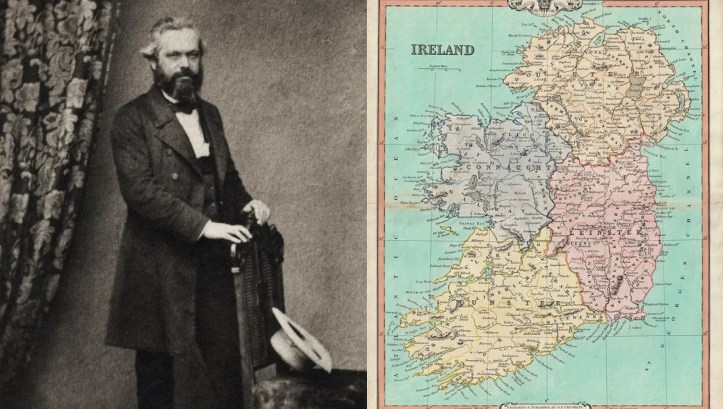
By no means all of Marx and Engels writing and correspondence on Ireland, the dozen letters below from 1936’s ‘Selected Correspondence’ do contain some of the most important. Largely centered on Britain’s role in Ireland’s economy and the First International’s response to the Fenian movement of the late 1860s, the letters stand as some of Marx and Engels’ most insightful tracts on the impact of colonialism on both the colonized and the colonizer. Lenin would make great use of these profound writings in his own elaboration of the self-determination of nations.
‘Letters on Ireland’ by Karl Marx and Frederick Engels from Selected Correspondence, 1846-1895. International Publishers, New York. 1936.
Engels to Marx. Manchester, 23 May, 1856.
In our tour in Ireland we came from Dublin to Galway on the west coast, then twenty miles north inland, then to Limerick, down the Shannon to Tarbert, Tralee, Killarney and back to Dublin. A total of about four to five hundred English miles in the country itself, so that we have seen about two-thirds of the whole country. With the exception of Dublin, which bears the same relation to London as Dusseldorf does to Berlin and has quite the character of a small one-time capital, all English built too, the whole country, and especially the towns, has exactly the appearance of France or Northern Italy, Gendarmes, priests, lawyers, bureaucrats, squires in pleasing profusion and a total absence of any and every industry, so that it would be difficult to understand what all these parasitic growths found to live on if the misery of the peasants did not supply the other half of the picture. “Strong measures” are visible in every corner of the country, the government meddles with everything, of so-called self-government there is not a trace. Ireland may be regarded as the first English colony and as one which because of its proximity is still governed exactly in the old way, and here one can already observe that the so-called liberty of English citizens is based on the oppression of the colonies. I have never seen so many gendarmes in any country, and the drink-sodden expression of the Prussian gendarme is developed to its highest perfection here among the constabulary, who are armed with carbines, bayonets and handcuffs.
Characteristic of this country are its ruins, the oldest from the fifth and sixth centuries, the latest from the nineteenth—with every intervening period. The most ancient are all churches; after 1100, churches and castles; after 1800 the houses of peasants. The whole of the west, but especially in the neighborhood of Galway, is covered with these ruined peasant houses, most of which have only been deserted since 1846. I never thought that famine could have such tangible reality. Whole villages are devastated, and there among them lie the splendid parks of the lesser landlords, who are almost the only people still living there, mostly lawyers. Famine, emigration and clearances together have accomplished this. There are not even cattle to be seen in the fields. The land is an utter desert which nobody wants. In County Clare, south of Galway, it is rather better, here there are at least some cattle, and the hills toward Limerick are excellently cultivated, mostly by Scottish farmers, the ruins have been cleared away and the country has a bourgeois appearance. In the southwest there are a lot of mountains and bogs but also wonderfully rich forest growth, beyond that again fine pastures, especially in Tipperary, and towards Dublin land which is, one can see, gradually coming into the hands of big farmers.
The country has been completely ruined by the English wars of conquest from 1100 to 1850 (for in reality both the wars and the state of siege lasted as long as that). It is a fact that most of the ruins were produced by destruction during the wars. The people itself has got its peculiar character from this, and despite all their Irish nationalist fanaticism the fellows feel that they are no longer at home in their own country. Ireland for the Saxon! That is now being realised. The Irishman knows he cannot compete with the Englishman, who comes with means in every respect superior; emigration will go on until the predominantly, indeed almost exclusively, Celtic character of the population is all to hell. How often have the Irish started to try and achieve something, and every time they have been crashed, politically and industrially! By consistent oppression they have been artificially converted into an utterly demoralised nation and now fulfil the notorious function of supplying England, America, Australia, etc., with prostitutes, casual laborers, pimps, thieves, swindlers, beggars and other rabble. This demoralised character persists in the aristocracy too. The landowners, who everywhere else have taken on bourgeois qualities, are here completely demoralised. Their country seats are surrounded by enormous, wonderfully beautiful parks, but all around is waste land, and where the money is supposed to come from it is impossible to see. These fellows ought to be shot. Of mixed blood, mostly tall, strong, handsome chaps, they all wear enormous moustaches under colossal Roman noses, give themselves the sham military airs of retired colonels, travel around the country after all sorts of pleasures, and if one makes an inquiry, they haven’t a penny, are laden with debts, and live in dread of the Encumbered Estates Court.
Marx to Engels. London. November 2, 1867.
I used to think the separation of Ireland from England impossible. I now think it inevitable, although after the separation there may come federation. The way the English are going on is shown by the agricultural statistics for this year, published a few days ago. Then too the form of the evictions. The Irish Viceroy, Lord Abicorn (this is roughly the name) has “cleared” his estate of thousands within recent weeks by forcible executions. Among the evicted are well-to-do farmers whose improvements and capital investments are confiscated in this fashion! There is no other European country in which foreign rule takes this direct form of native expropriation. The Russians only confiscate for political reasons; the Prussians in West Prussia buy out.
Marx to Engels. London, November 30, 1867.
What the English do not yet know is that since 1846 the economic content and therefore also the political aim of English domination in Ireland have entered into an entirely new phase, and that, precisely because of this, Fenianism is characterised by a socialistic tendency (in a negative sense, directed against the appropriation of the soil) and by the fact that it is a lower orders movement. What can be more ridiculous than to confuse the barbarities of Elizabeth or Cromwell,–who wanted to supplant the Irish by English colonists (in the Roman sense),–with the present system, which wants to supplant them by sheep, oxen and pigs! The system of 1801-46, with its rackrents and middlemen, collapsed in 1846. (During this period evictions were exceptional, occurring mainly in Leinster where the land is specially good for cattle raising.) The repeal of the Corn Laws, partly the result of or at any rate hastened by the Irish famine, deprived Ireland of its monopoly of England’s corn supply in normal times. Wool and meat became the slogan, hence conversion of tillage into pasture. Hence from then onwards systematic consolidation of farms. The Encumbered Estates Act,1 which turned a mass of previously enriched middlemen into landlords, hastened the process. The clearing of the estate of Ireland! is now the one idea of English rule in Ireland. The stupid English government in London itself knows nothing, of course, of this immense change since 1846. But the Irish know it. From Meagher’s Proclamation (1848) down to the election manifesto of Hennessy (Tory and Urquhartite) (1866), the Irish have expressed their consciousness of it in the clearest and most forcible manner.
The next question is, what shall we advise the English workers? In my opinion they must make the repeal of the Union (in short the affair of 1783, only democratised and adapted to the conditions of the time) into an article of their pronunziamento. This is the only legal and therefore only possible form of Irish emancipation which can be admitted in the programme of an English party. Experience must show later whether a purely personal union can continue to subsist between the two countries. I half think it can if it takes place in time.
What the Irish need is:
(1) Self-government and independence from England.
(2) An agrarian revolution. With the best will in the world. the English cannot accomplish this for them, but they can give them the legal means of accomplishing it for themselves.
(3) Protective tariffs against England. Between 1783 and 1801 every branch of Irish industry began to flourish. The Union, which overthrew the protective tariffs established by the Irish Parliament, destroyed all industrial life in Ireland. The little bit of linen industry is in no way a substitute. The Union of 1801 had just the same effect on Irish industry as the measures for the suppression of the Irish woollen industry, etc., taken by the English Parliament under Anne, George II, etc. Once the Irish are independent, necessity will turn them into protectionists, as it did Canada, Australia, etc. Before I bring my views before the General Council (next Tuesday, this time fortunately without the presence of reporters), I should be glad if you would send me a few lines with your opinion.
Marx to Engels. London, October 10, 1868.
When you were here last you saw the Blue Book on the land situation in Ireland 1844-45. By accident I have found in a small second-hand shop the Report and Evidence on Irish Tenant Right, 1867 (House of Lords). This was a real find. While Messrs. the Economists treat the question whether ground rent is payment for natural differences in the land, or merely interest on the capital invested in the land, as a pure conflict of dogmas, we have here an actual life and death struggle between farmer and landlord on the question of how far the rent should also include, in addition to payment for the difference in the land, interest on the capital invested in it–not by the landlord but by the tenant. It is only by substituting for conflicting dogmas the conflicting facts and real contradictions which form their hidden background that we can transform political economy into a positive science.
Engels to Marx, Manchester, October 24, 1869.
Irish history shows one how disastrous it is for a nation when it has subjugated another nation. All the abominations of the English have their origin in the Irish Pale. I have still to work through the Cromwellian period, but this much seems certain to me, that things would have taken another turn in England but for the necessity for military rule in Ireland land the creation of a new aristocracy there.
Marx to Engels London, November 18, 1869.
Last Tuesday I opened the discussion on Point No. 1, the attitude of the British Ministry to the Irish Amnesty question. Made a speech of about three-quarters of an hour, much cheered, and then proposed the following resolutions on Point No. 1:
Resolved:
that in his reply to the Irish demands for the release of the imprisoned Irish patriots–a reply contained in his letter to Mr. O’Shea, etc., etc.–Mr. Gladstone deliberately insults the Irish nation;
that he clogs political amnesty with conditions alike degrading to the victims of misgovernment and the people they belong to;
that having, in the teeth of his responsible position, publicly and enthusiastically cheered on the American slaveholders’ rebellion, he now steps in to preach to the Irish people the doctrine of passive obedience;
that his whole proceedings with reference to the Irish Amnesty question are the true and genuine offspring of that “policy of conquest,” by the fiery denunciation of which Mr. Gladstone ousted his Tory rivals from office;
that the General Council of the “International Workingmen’s Association” express their admiration of the spirited, firm and high-souled manner in which the Irish people carry on their Amnesty movement;
that these resolutions be communicated to all branches of, and workingmen’s bodies connected with, the “International Workingmen’s Association” in Europe and America.
Engels to Marx. Manchester, November 29, 1869.
The election in Tipperary [The election of O’Donovan Rossa, one of the Fenian prisoners Ed. Eng. ed.] is an event. It forces the Fenians out of empty conspiracy and the fabrication of small coups into a path of action which, even if legal in appearance, is still far more revolutionary than what they have been doing since the failure of their insurrection. In fact, they are adopting the methods of the French workers and that is an enormous advance. If only the thing is carried on as intended. The terror which this new turn has produced among the philistines, and which is now being screeched throughout the whole Liberal press, is the best proof that this time the nail has been hit on the head. Typical is the Solicitors’ Journal, which remarks with horror that the election of a political prisoner is without precedent in the realm of Britain! So much the worse– where is there a country except England in which such a case is not a common event! The worthy Gladstone must be horribly annoyed.
But you really ought to look at the Times now. Three leaders in eight days in which either it is demanded of the Government or the Government itself demands that an end be put to the excesses of the Irish Nationalist press.
I am very eager to hear about your debate to-morrow evening and its result, about which there can be no doubt. It would be very fine to get Odger into a hole. I hope Bradlaugh will stand for Southwark as well as he, and it would be much better if Bradlaugh were elected. For the rest, if the English workers cannot take an example from the peasants of Tipperary they are in a bad way…
Last week I waded through the tracts by old Sir John Davies (Attorney-General for Ireland under James). I do not know if you have read them, they are the main source; at any rate you have seen them quoted a hundred times. It is a real shame that one cannot have the original sources for everything; one can see infinitely more from them than from the second-hand versions which reduce everything that is clear and simple in the original to confusion and complexity.
From these tracts it is clear that communal property in land still existed in full force in Ireland in the year 1600, and this was brought forward by Mr. Davies in the pleas regarding the confiscation of the alienated lands in Ulster, as a proof that the land did not belong to the individual owners (peasants) and therefore either belonged to the lord, who had forfeited it, or from the beginning to the Crown. I have never read anything finer than this plea. The division took place afresh every two to three years. In another pamphlet he gives an exact description of the income, etc., of the chief of the clan. These things I have never seen quoted and if you can use them I will send them you in detail. At the same time I have nicely caught Monsieur Goldwin Smith. This person has never read Davies and so puts up the most absurd assertions in extenuation of the English. But I shall get the fellow…
Marx to Kugelmann. London, November 29, 1869.
You will probably have seen in the Volksstaat the resolution against Gladstone which I proposed on the question of the Irish amnesty. I have now attacked Gladstone-and it has attracted attention here just as I formerly attacked Palmerston. The demagogic refugees here love to fall upon the Continental despots from a safe distance. That sort of thing only attracts me, when it happens vultu instantis tyranni [before the face of the tyrant].
Nevertheless both my coming out on this Irish Amnesty question and my further proposal to the General Council to discuss the relation of the English working class to Ireland and to pass resolutions on it, have of course other objects besides that of speaking out loudly and decidedly for the oppressed Irish against their oppressors.
I have become more and more convinced–and the only question is to bring this conviction home to the English working class–that it can never do anything decisive here in England until it separates its policy with regard to Ireland in the most definite way from the policy of the ruling classes, until it not only makes common cause with the Irish, but actually takes the initiative in dissolving the Union established in 1801 and replacing it by a free federal relationship. And, indeed, this must be done, not as a matter of sympathy with Ireland, but as a demand made in the interests of the English proletariat. If not, the English people will remain tied to the leading-strings of the ruling classes, because it must join with them in a common front against Ireland. Every one of its movements in England itself is crippled by the disunion with the Irish, who form a very important section of the working class in England. The primary condition of emancipation here–the overthrow of the English landed oligarchy–remains impossible because its position here cannot be stormed so long as it maintains its strongly entrenched outposts in Ireland. But there, once affairs are in the hands of the Irish people itself, once it is made its own legislator and ruler, once it becomes autonomous, the abolition of the landed aristocracy (to a large extent the same persons as the English landlords) will be infinitely easier than here, because in Ireland it is not merely a simple economic question, but at the same time a national question, since the landlords there are not like those in England, the traditional dignitaries and representatives, but are the mortally hated oppressors of a nation. And not only does England’s internal social development remain crippled by her present relation with Ireland; her foreign policy, and particularly her policy with regard to Russia and America, suffers the same fate.
But since the English working class undoubtedly throws the decisive weight into the scale of social emancipation generally, the lever has to be applied here. As a matter of fact, the English republic under Cromwell met shipwreck in–Ireland. Non bis in idem! [Not twice for the same thing]. The Irish have played a capital joke on the English government by electing the “convict felon ” O’Donovan Rossa to Parliament. The government papers are already threatening a renewed suspension of the Habeas Corpus Act, a “renewed system of terror.” In fact, England never has and never can–so long as the present relation lasts-rule Ireland otherwise than by the most abominable reign of terror and the most reprehensible corruption.
Engels to Marx. Manchester, December 9, 1869.
…Ireland still remains the Holy Isle whose aspirations must on no account be mixed with the profane class-struggles of the rest of the sinful world. This is no doubt partly honest madness on the part of the people, but it is equally certain that it is also partly a calculation on the side of the leaders in order to maintain their domination over the peasant. Added to this, a nation of peasants always has to take its literary representatives from the bourgeoisie of the towns and their intelligentsia, and in this respect Dublin (I mean Catholic Dublin) is to Ireland much what Copenhagen is to Denmark. But to these gentry the whole labour movement is pure heresy and the Irish peasant must not on any account know that the Socialist workers are his sole allies in Europe.
Marx to Engels. London, December 10, 1869.
As to the Irish question…The way I shall put forward the matter next Tuesday is this: that quite apart from all phrases about “international” and “humane ” justice for Ireland–which are to be taken for granted in the International Council–it is in the direct and absolute interest of the English working class to get rid of their present connection with Ireland. And this is my most complete conviction, and for reasons which in part I cannot tell the English workers themselves. For a long time I believed that it would be possible to overthrow the Irish regime by English working class ascendancy. I always expressed this point of view in the New York Tribune. Deeper study has now convinced me of the opposite. The English working class will never accomplish anything before it has got rid of Ireland. The lever must be applied in Ireland. That is why the Irish question is so important for the social movement in general.
I have read a lot of Davies in extracts. The book itself I had only glanced through superficially in the Museum. So you would do me a service if you would copy out the passages relating to common property. You must get Curran’s Speeches edited by Davies, (London, James Duffy, 22 Paternoster Row.) I meant to have given it you when you were in London. It is now circulating among the English members of the Central Council and God knows when I shall see it again. For the period 1779-80 (Union) it is of decisive importance, not only because of Curran’s speeches (especially the legal ones; I consider Curran the only great advocate–people’s advocate–of the eighteenth century and the noblest nature, while Grattan was a parliamentary rogue) but because you will find quoted there all the sources for the United Irishmen. This period is of the highest interest, scientifically and dramatically. Firstly, the foul doings of the English in 1588-89 repeated (and perhaps even intensified) in 1788-89. Secondly, it can be easily proved that there was a class movement in the Irish movement itself. Thirdly, the infamous policy of Pitt. Fourthly, which will annoy the English gentlemen very much, the proof that Ireland came to grief because, in fact, from a revolutionary standpoint, the Irish were too far advanced for the English Church and King mob, while on the other hand the English reaction in England had its roots (as in Cromwell’s time) in the subjugation of Ireland. This period must be described in at least one chapter. John Bull in the pillory!… As to the present Irish movement, there are three important factors: (1) opposition to lawyers and trading politicians and blarney; (2) opposition to the dictates of the priests, who (the superior ones) are traitors, as in O’Connell’s time, from 1789-1800; (3) the agricultural labouring class beginning to come out against the farming class at the last meetings. (A similar phenomenon in 1795-1800.)
The rise of the Irishman was only due to the suppression of the Fenian press. For a long time it had been in opposition to Fenianism. Luby, etc., of the Irish People, etc., were educated men who treated religion as a bagatelle. The government put them in prison and then came the Pigotts and Co. The Irishman will only be anything until those people come out of prison again. It is aware of this although it is making political capital now by declaiming for the “felon-convicts.”
Marx to Meyer and Vogt. London, April 9, 1870.
After occupying myself with the Irish question for many years I have come to the conclusion that the decisive blow against the English ruling classes (and it will be decisive for the workers’ movement all over the world) cannot be delivered in England but only in Ireland. On December 1, 1869, the General Council issued a confidential circular drawn up by me in French (for the reaction upon England only the French, not the German, papers, are important), on the relation of the Irish national struggle to the emancipation of the working class, and therefore on the attitude which the International Workingmen’s Association should take towards the Irish question.
I will here only give you quite shortly the decisive points. Ireland is the bulwark of the English landed aristocracy. The exploitation of this country is not only one of the main sources of their material wealth, it is their greatest moral strength. They, in fact, represent the domination of England over Ireland. Ireland is therefore the great means by which the English aristocracy maintains its domination in England itself.
If, on the other hand, the English army and police were withdrawn to-morrow, you would at once have an agrarian revolution in Ireland. But the overthrow of the English aristocracy in Ireland involves and has as a necessary consequence its overthrow in England. And this would fulfil the prerequisite for the proletarian revolution in England. The destruction of the English landed aristocracy in Ireland is an infinitely easier operation than in England itself, because the land question has hitherto been the exclusive form of the social question in Ireland, because it is a question of existence, of life and death, for the immense majority of the Irish people and because it is at the same time inseparable from the national question. Quite apart from the passionate character of the Irish and the fact that they are more revolutionary than the English.
As for the English bourgeoisie, they have in the first place a common interest with the aristocracy in transforming Ireland into a mere pasture land which provides the English market with meat and wool at the cheapest possible prices. Hence they are interested in reducing, by expropriation and forcible emigration, the Irish population to such a small number that English capital, invested in land leased for farming, can function with “security.” They have the same interest in clearing the estate of Ireland as they had in clearing the agricultural districts of England and Scotland. The £6000-£8000 absentee and other Irish revenues which at present flow annually to London have likewise to be taken into account.
But the English bourgeoisie has also much more important interests in the present Irish regime. Owing to the constantly increasing concentration of farming, Ireland supplies its own surplus to the English labour market and thus forces down wages and lowers the moral and material position of the English working class. And most important of all: every industrial and commercial centre in England now possesses a working-class population divided into two hostile camps, English proletarians and Irish proletarians. The ordinary English worker hates the Irish worker as a competitor who lowers his standard of life. In relation to the Irish worker he feels himself a member of the ruling nation and so turns himself into a tool of the aristocrats and capitalists against Ireland thus strengthening their domination over himself. He cherishes religious, social and national prejudices against the Irish worker. His attitude towards him is much the same as that of the “poor whites” to the “n***rs” in the former slave states of the U.S.A. The Irishman pays him back with interest in his own coin. He regards the English worker as both sharing in the guilt for the English domination in Ireland and at the same time serving as its stupid tool.
This antagonism is artificially kept alive and intensified by the press, the pulpit, the comic papers, in short by all the means at the disposal of the ruling classes. It is the secret of the impotence of the English working class, despite their organisation. It is the secret by which the capitalist class maintains its power. And of this that class is well aware.
But the evil does not stop here. It continues across the ocean. The antagonism between English and Irish is the hidden basis of the conflict between the United States and England. It makes any honest and serious co-operation between the working classes of the two countries impossible. It enables the governments of both countries, whenever they think fit, to break the edge of the social conflict by their mutual threats and if need be by war with one another.
England, as the metropolis of capital, as the power which has hitherto ruled the world market, is for the time being the most important country for the workers’ revolution, and moreover the only country in which the material conditions for this revolution have developed up to a certain point of maturity. Therefore to hasten the social revolution in England is the most important object of the International Workingmen’s Association. The sole means of hastening it is to make Ireland independent.
Hence the task of the “International” is everywhere to put the conflict between England and Ireland in the foreground, and everywhere to side openly with Ireland. The special task of the Central Council in London is to awaken a consciousness in the English workers that for them the national emancipation of Ireland is no question of abstract justice or human sympathy but the first condition of their own emancipation.
International Publishers was formed in 1923 for the purpose of translating and disseminating international Marxist texts and headed by Alexander Trachtenberg. It quickly outgrew that mission to be the main book publisher, while Workers Library continued to be the pamphlet publisher of the Communist Party.
PDF of later edition of book: https://archive.org/download/in.ernet.dli.2015.227457/2015.227457.Selected-Correspondence.pdf
 Revolution's Newsstand