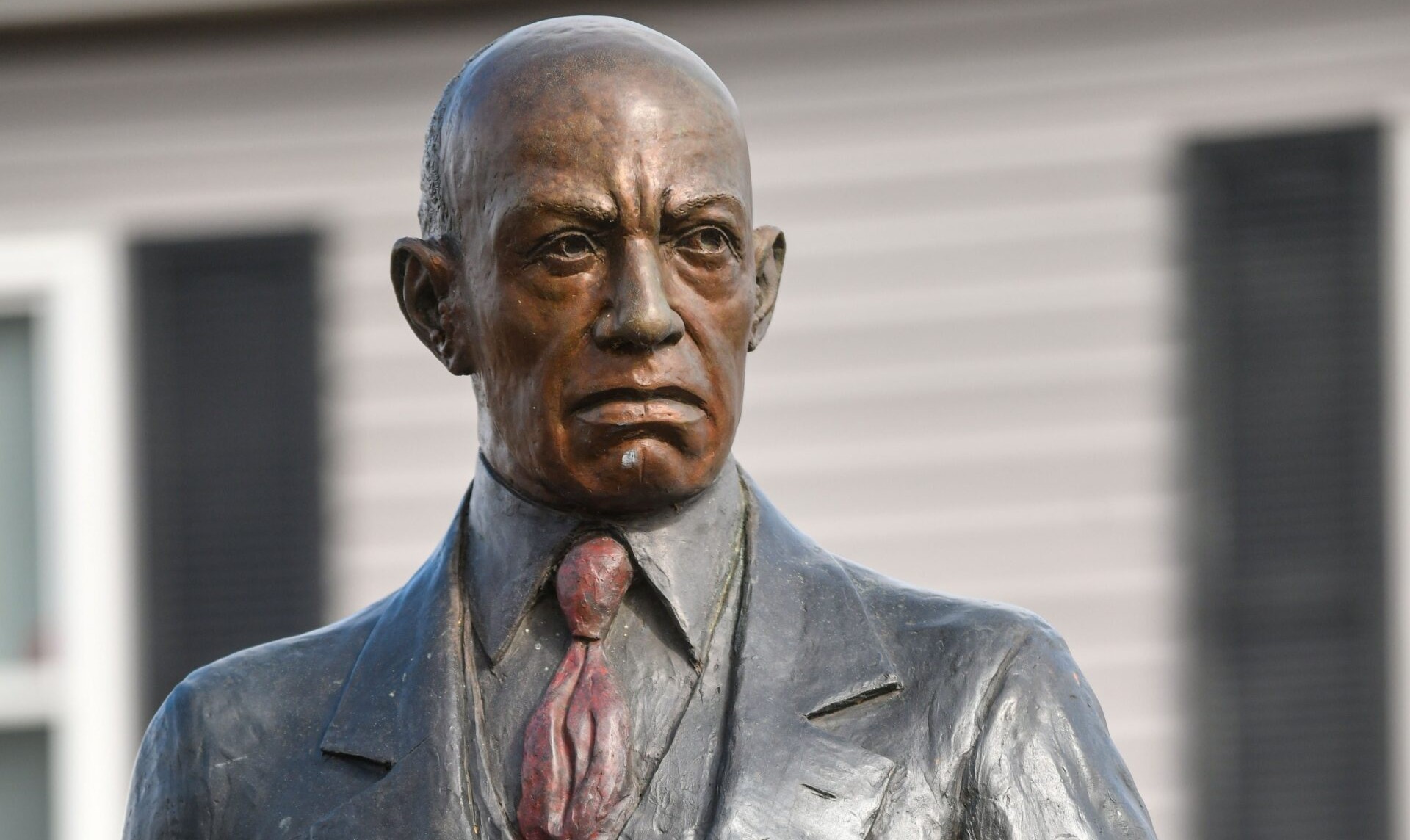
A famous essay by the preeminent Black historian of his generation, Carter G. Woodson. The son of formerly enslaved parents who received his Doctorate in History from Harvard in 1912, Woodson founded the Association for the Study of African American Life and History in 1915 which would publish the venerable ‘Journal of Negro History.’ Woodson created what is now ‘Black History Month,’ and taught for many years at Howard University as well as being an author of a number of classic works of history.
‘The Miseducation of the Negro’ by Carter G. Woodson from The Crisis. Vol. 38 No. 8. August, 1932.
The author of this article has recently unsheathed his sword and leapt into the arena of the Negro press and splashed about so vigorously and relentlessly at almost everything in sight that, the black world has been gasping each week. We have asked him, therefore, to sum up for the Education Number of THE CRISIS his critique of Negro education. Dr. Woodson was born in Virginia in 1875, educated at Berea and the University of Chicago and is a Ph.D. of Harvard in History. He is founder and editor of the Journal of Negro History, and our foremost historical scholar.
IN their own as well as in mixed schools Negroes are taught to admire the Hebrew, the Greek, the Latin and the Teuton and to despise the African. The thought of the inferiority of the Negro is drilled into him in almost every class he enters. If he happens to leave school after he has mastered the fundamentals, before he has finished high school or reached college, he will naturally escape from some of this bias and may recover in time to be of service to his people.
Practically all of the successful Negroes in this country are those who never learned this prejudice “scientifically” because they entered upon their life’s work without formal education.
The large majority of the Negroes who have put on the finishing touches of our best colleges, however, are all but worthless in the uplift of their people. If, after leaving school, they have the opportunity to give out to Negroes what traducers of the race have taught them, such persons may earn a living by teaching or preaching to Negroes what someone would like to have them know, but they never become a constructive force in the elevation of those far down. They become estranged from the masses and the gap between them widens as the years go by.
The explanation of this is a simple problem. The schools and colleges of this country are so conducted as to produce this result. For example, an officer of a Negro university, thinking that an additional course on the Negro should be given there, called upon a Negro Doctor of Philosophy of the faculty to offer such work. He promptly informed the officer that he knew nothing about the Negro. He did not go to school to waste his time that way. He went to be educated.
Last year at one of the Negro summer schools, a white instructor gave a course on the Negro, using for his text a work of Jerome Dowd, who teaches that whites are superior to blacks. When asked by one of the students why he used such a textbook, the instructor replied that he wanted them to get Dowd’s point of view. If schools for Negroes are places where they must be convinced of their inferiority, they cannot escape from their tormentors and rise to recognition and usefulness.
As another has well said, to handicap a student for life by teaching him that his black face is a curse and that his struggle to change his condition is hopeless is the worst kind of lynching. It kills one’s aspirations and dooms him to vagabondage and crime.
In most cases, moreover, when the teachers of Negroes are persons of good intentions, the result is the same. the school of business administration, for example, Negroes are trained exclusively in the economics and psychology of Wall Street, and are thereby made to despise the opportunities to conduct laundries, repair shoes, run ice wagons, push banana carts, and sell peanuts among their own people. Foreigners, who have not studied economics and psychology but have studied Negroes, take up this business and grow rich while the “highly educated” Negroes are complaining because the native American whites do not permit the blacks to share what others have developed.
In schools of journalism Negroes are being taught how to edit such metropolitan dailies as the Chicago Tribune and the New York Times, which would hardly hire a Negro as a janitor; and when such graduates come to the Negro weeklies for employment they are not prepared to function in such establishments, which to be successful must be built upon accurate knowledge of the psychology and philosophy of the Negro.
In the schools of religion Negro ministers devote their time to dead languages and dead issues, to the dogma of other races, the schism produced by unnecessary disputes, and the conflicts by which fanatics have moistened the soil of Asia and Europe with the blood of unoffending people. These “highly educated” Negro ministers, then, know practically nothing of the religious background of their parishioners, do not appreciate their philosophy of life, and do not understand their spiritual development as influenced by African survivals in America and the peculiar development of the Negro church. The result, therefore, is that while the illiterate minister who has given attention to these things preaches to the masses, the “highly educated” Negro minister talks to benches.
The Negroes who have been trained the most serve the least. Our physicians and lawyers who have undergone training in the leading universities of the land often have difficulty in making a living. Teachers of “ripe scholarship” influence the youth less than those of limited training. Such mal-adjusted workers complain that, since Negroes are ignorant, they prefer ignorant leaders; but the trouble is not that the people are ignorant, but that these misfits are ignorant of the people.
Unfortunately these conditions have continued because schools for Negroes have always been established in mushroom fashion, without giving sufficient thought to the needs of the people to be thus served, and most of those now promoting Negro education are proceeding in the same way. Talking the other day with one of the men now giving millions to establish four Negro universities in the South, I find that he is of the opinion that you can go almost anywhere and build a three million dollar plant, place in charge a man to do what you want accomplished, and in a short while he can secure or have trained to order the men necessary to make a university.
Such a thing cannot be done because there are not sufficient Negroes or whites in this country qualified to conduct for Negroes such a university as they need. Most of the whites who are now serving Negroes as educators come to them as persons bearing gifts from a foreign shore, and the Negroes gather around them in childlike fashion, gazing with astonishment and excitement to find out what these things mean.
All things being equal, however, there should be no different method of approach or appeal to Negro students that cannot be made just as well by a white teacher to Negro students or a Negro teacher to white students, if such teachers are properly informed and have the human attitude; but tradition, race hate, and terrorism have made such a thing impossible. However, I am not an advocate of segregation. I do not believe in separate schools. I am merely emphasizing the necessity for common-sense schools and teachers who understand and continue in sympathy with those whom they instruct.
Those who take the position to the contrary have the idea that education is merely a process of imparting information. One who can give out these things or devise an easy plan for so doing, then, is an educator. In a sense this is true, this machine method accounts for most of the troubles of the Negro. For me, education means to inspire people to live more abundantly, to learn to begin with life as they find it and make it better.
The instruction so far given in Negro Colleges and universities has worked to the contrary. In most cases such graduates have merely increased the number of malcontents who offer no program for changing the undesirable conditions about which they complain. The seat of the trouble is in what Negroes are now being taught. Their education does not bring their minds into harmony with life as they must face it. When a Negro student works his way through college by shining shoes he does not think of making a special study of the science underlying the production and distribution of leather and its products, that he may some day figure in this sphere. The Negro boy sent to college by a mechanic seldom dreams of learning mechanical engineering to build upon the foundation his father has laid, that in years to come he may figure as a contractor or a consulting engineer. The Negro girl who goes to college hardly wants to return to her mother if she is a washerwoman, but this girl should come back with sufficient knowledge of physics and chemistry and business administration to use her mother’s work as a nucleus for a modern steam laundry.
A white professor of a Southern university recently resigned his position to get rich by running a laundry for Negroes. A Negro college instructor would have considered such a suggestion an insult. The so-called education of Negro college graduates leads them to throw away opportunities which they have and go in quest of those which they do not find. A school system which thus handicaps people for life by setting them adrift is not worthy of public support.
In the case of the white youth in this country, they can choose their courses more at random and still succeed because of numerous opportunities offered by their people, but even they show so much more wisdom than do Negroes. For example, a year or two after I left Harvard I found out West a schoolmate who was studying wool. “How did you happen to get into this sort of thing,” I enquired. His people, he replied, had some experience in wool and in college he prepared himself for this work by studying its economic foundation. When I was at Harvard I studied Aristotle, Plato, Marsiglio of Padua, and Pascasius Rathbertus. My friend who studied wool, however, is now independently rich and has sufficient leisure to enjoy the cultural side of life which his knowledge of the science underlying his business developed, but I have to make my living by begging for a struggling cause.
From this indictment of our schools, then, one may conclude that it would serve the public better to keep Negroes away from them. Such an unwise course, however, is not herein suggested. The thing needed is reform. Negro institutions of learning and those of whites, too, especially those white institutions which are training teachers who have to deal with large numbers of Negroes, should reconstruct their curricula. These institutions should abandon a large portion of the traditional courses which have been retained throughout the years because they are supposedly cultural, and they should offer instead training in things which are also cultural and at the same time have a bearing on the life of the people thus taught. Certainly the Negro should learn something about the history and culture of the white man with whom he has to deal daily, and the white man should likewise learn the same about the Negro; but if the education of either is made a one-sided effort neither one will understand or appreciate the other, and interracial cooperation will be impossible.
Looking over the recent catalogues of the leading Negro colleges, I find their courses drawn up without much thought about the Negro. Invariably these institutions give courses in ancient, mediaeval, and modern Europe, but they do not offer courses in ancient, mediaeval, and modern Africa. Yet Africa, according to recent discoveries, has contributed about as much to the progress of mankind as Europe has, and the early civilization of the Mediterranean world was decidedly influenced by the so-called Dark Continent.
Negro colleges offer courses bearing on the European colonists prior to their coming to America, their settlement on these shores, and their development here toward independence. Why not be equally as generous with the Negroes in treating their status in Africa prior to enslavement, their first transplantation to the West Indies, the Latinization of certain Negroes in contradistinction to the development of others under the influence of the Teuton, and the effort of the race toward self expression in America?
A further examination of the curricula of Negro colleges shows, too, that as a rule they offer courses in Greek philosophy and in modern European thought, but direct no attention to the philosophy of the Negro. Negroes have and always have had their own ideas about purpose, chance, time, and space, about appearance and reality, and about freedom and necessity. The effort of the Negro to interpret man’s relation to the universe shows just as much intelligence as we find in the philosophy of the Greeks. There were many Socrates. Africans who were just as wise.
Again I find in some of these catalogues numerous courses in art, but no well defined course in Negro or African art. The art of Africa, however, influenced the art of the Greeks to the extent that thinkers are now saying that the most ancient culture of the Mediterranean was chiefly African. Most of these colleges, too, do not even direct special attention to Negro music in which the race has made an outstanding contribution in America.
The unreasonable attitude is that because the whites do not have these things in their schools the Negroes must not have them in theirs. The Catholics and Jews, therefore, are wrong in establishing special schools to teach the principles of their religion, and the Germans in the United States are unwise in having their children taught their mother tongue.
The higher education of the Negro, then, has been largely meaningless imitation. When the Negro finishes his course in one of our schools, he knows what others have done, but he has not been inspired to do much for himself. If he makes a success in life it comes largely by accident.
The Crisis A Record of the Darker Races was founded by W. E. B. Du Bois in 1910 as the magazine of the newly formed National Association for the Advancement of Colored People. By the end of the decade circulation had reached 100,000. The Crisis’s hosted writers such as William Stanley Braithwaite, Charles Chesnutt, Countee Cullen, Alice Dunbar-Nelson, Angelina W. Grimke, Langston Hughes, Georgia Douglas Johnson, James Weldon Johnson, Alain Locke, Arthur Schomburg, Jean Toomer, and Walter White.
PDF of full issue: https://archive.org/download/sim_crisis_1931-08_38_8/sim_crisis_1931-08_38_8.pdf
 Revolution's Newsstand