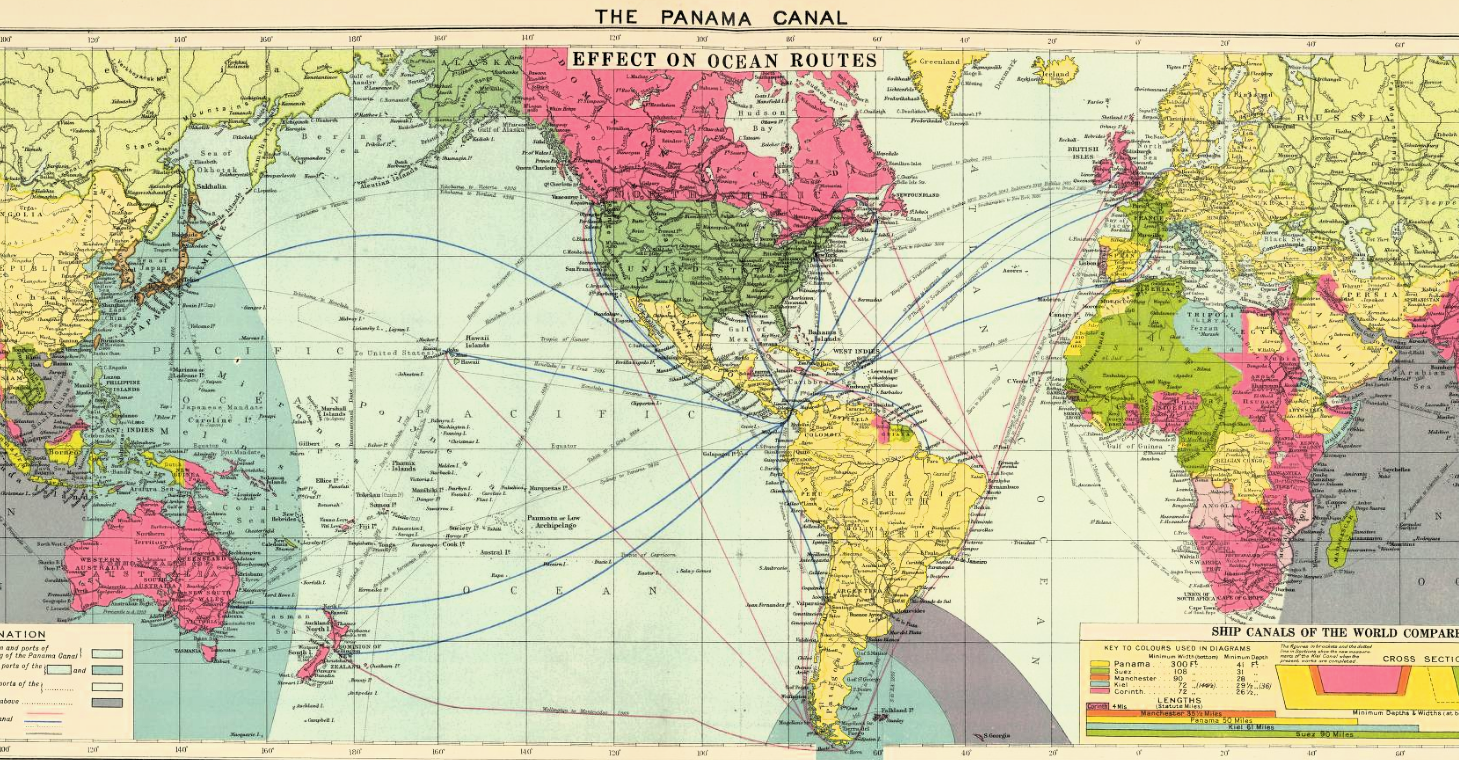
The opening of the Panama Canal had innumerable consequences, Tom Barker looks at the impact on the world’s marine transport workers. Barker was a self-educated, working-class Marxist, a leading figure in the New Zealand and Australian I.W.W., deported to Latin America for his anti-war and union activities, where he worked the Buenos Aires docks and became a leader of the international marine workers organizing and delegate to the Red International of Labor Unions.
‘Panama and Marine Transport Workers’ by Tom Barker from Industrial Pioneer. Vol. 1 No. 6. November, 1921.
JOHN Benjamin King, the greatest I.W.W. exponent that ever popularized the industrial unionist ideas in Australasia, used to say that the two greatest things in the modem world in compelling the workers to organize internationally and industrially were the Panama Canal and the Diesel motor. Time is proving that, even though J.B. has served seven years in an Australian jail for having two I.W.W. stickers in his possession, since making use of the above statement, he has been a true prophet.
In the marine transport industry these effects are already noticeable, as these two outstanding features are transforming every phase of shipping, and also revolutionizing the ideas and the lives of the men who work on ships and in ports. In my book “The Story of the Sea” I deal particularly with both matters, and point out all the labor that they will displace. In regard to Panama I say: “The recent opening of the Panama Canal was another great event in the shipping world and also had its effect upon the men who man ships. It shortened the sea distance between San Francisco and New York by more than one half. Instead of the long trip around the South American continent, it is now possible to travel through the locks in Central America. This gigantic enterprise cost millions of dollars, and hundreds of lives—working class lives. It also shortened the distance between Europe and Chile, Australia and New Zealand, and thus abolished the risks incurred by sailing in the low latitudes off Cape Horn. It has made a large difference in the sea distance between the Northern Pacific coast ports and those of the River Plate, and also between the Atlantic Coast ports and the nitrate ports of Chile. It strengthened enormously the position of the United States economically and politically. It has transferred the carrying of cargo from the U.S. railroads to the ships, for it is now cheaper to send a ton of cargo from Seattle to Philadelphia via Panama than to send it by freight train. Panama has strengthened the octopus of shipping, the autocracy of merchant shipping.”
At the end of the fiscal year for 1920 the Panama canal authorities have issued their report. In their report they have proven that this immense canal is going to displace thousands of our class in the marine transport industry. During the past fiscal year 11,599,214 tons of cargo passed through the Panama, without mentioning a minor item of 453,769 tons of government cargo that did not pay dues. This represents an increase of 23% over the previous year. Of this, United States ships carried 45%, British ships 32% and Japanese ships 7%. During the year 2,892 ships passed through the canal, including 1,212 U. S. ships, 970 British, 140 Norwegian and 136 Japanese. The total income was $11,276,890, an increase over the income of the previous year of 32%.
At a conservative estimate deep-water, long distance freights are costing about $2.50 to $3.50 per 1,000 miles. Calculating at $3.00 per 1,000 miles we find that the income at Panama is equivalent to the saving of over 3,500,000,000 cargo miles, or 1,000,000 miles for a ship with 3,500 ton cargo capacity. Reckoned at the most reasonable figure, Panama is equivalent to 300 voyages. But in considering that an average amount of $1.00 per ton cargo represents compared with pre-canal days a saving to the ship-owner of anything from $1.00 up to $10.00 a ton, it will be easily seen that Panama must dispense with the need for thousands of ships, particularly when the readjustment of war disorganization is completed. We cannot compute with any degree of exactness the number of ships that will be permanently put out of business, nor the number of our fellow workers who will be scrapped. But the fact is as J.B. King prophesied that nothing can meet the needs of the marine transport industry today, except the immediate creation of ONE union on the sea, capable of developing the power to take charge of the industry, and running it for the working class. Again, we must remember that the ships that are scrapped are the more costly, old fashioned ships, which usually carried big crews, particularly in the engineers’ department. The oilburning ships with their small crews will carry the greatest part of the cargo in the future. Panama, like Suez, is saving millions of ship miles, as its annual report proves, and what is more important it is displacing thousands of mates, skippers, firemen, sailors, cooks, stewards, oilers, galley boys, etc. It has almost as great effect in Great Britain as in the United States.
Now we come to the crux of the question, you sons of the ocean. What can Andy Furuseth and his yellow outfit do under these circumstances! What did the International (!) Seamen’s Union ever do, except leave its chiefs hanging around Washington, pushing along by intrigue and softsoap, that old Seamen’s Act that doesn’t mean anything to anybody? Did all the lobbying stop the cutting of Panama, or will it alter one of the effects of Panama! It is a question whether Andy and his crowd have yet heard that Panama has been opened. It is up to someone to tell them that Queen Anne is dead, and send them to Baffin Land to chloroform the walruses with nice talk.
If you think you can get the best of the U.S. Shipping Board, the Chamber of Shipping of the United Kingdom, Panama Canal and Diesel motor with sentiment, sweet reasonableness, the Seamen’s Act, and an obsolete agreement signed in war time, you have another think coming.
The M.T.W. is the only way to get out of things as they are. Every class-conscious man on a ship if he is sick of capitalism, poverty, prison cells, loggings, hard work and nothing to show for it, must join up with the I.W.W. in the ranks of the Marine Transport Workers Industrial Union No. 510. Unionism of the right kind, with everyone from the bridge to the firehole in the ONE union regardless of the workers’ nationality or the flag of the ship, or the port in which you happen to be. Andy Furuseth and dear old senile Havelock Wilson have got to go. They are wooden ship men, with iron heads. They learn nothing, know nothing, and the world has gone past them. Mustard plasters are no good for our modern complaints. Panama is good. It drives us to organize, and to organize right. We must have class organization, and develop sense enough to run ships for ourselves. Say, fellow worker, they are getting wise overseas. In Australia they are doing this thing. Why? Well, just because the I.W.W. showed them the need some years ago. In all the ports of South America they are coming into line, and in Germany, England and Scandinavia. Join the M.T.W., read the literature and fit yourself for running the industry. Do it now!
The Industrial Pioneer was published monthly by Industrial Workers of the World’s General Executive Board in Chicago from 1921 to 1926 taking over from One Big Union Monthly when its editor, John Sandgren, was replaced for his anti-Communism, alienating the non-Communist majority of IWW. The Industrial Pioneer declined after the 1924 split in the IWW, in part over centralization and adherence to the Red International of Labour Unions (RILU) and ceased in 1926.
PDF of full issue: https://www.marxists.org/history/usa/pubs/industrial-pioneer/Industrial%20Pioneer%20(November%201921)_0.pdf
 Revolution's Newsstand