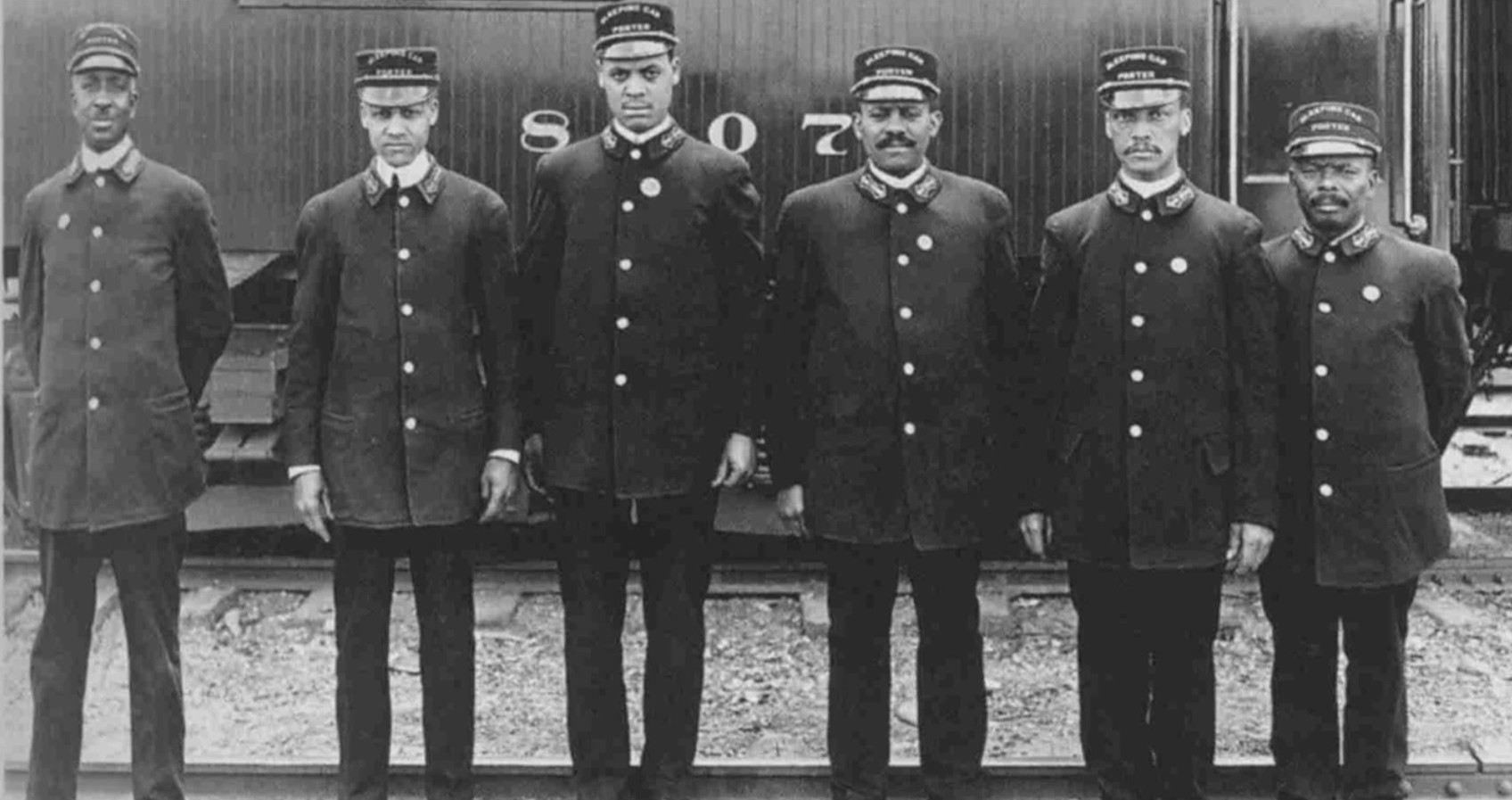
A fine piece by Dunn on what organizers faced in trying to bring a real union to sleeping car porters.
‘Pullman “Company Union” Slavery’ by Robert W. Dunn from Labor Age. Vol. 15 No. 3. March, 1926.
LAST month we set forth some of the hypocrisies of company unionism on the Pennsylvania Railroad System. This month we shall examine a near relative of the P.R.R., the company that makes and operates sleeping and chair cars—the infamous Pullman Company. Its financial guardians are Morgan, Vanderbilt, Marshall Field and several banks that also take the exploiter’s toll from the Pennsylvania lines.
The Pullman Company has never been in love with labor unions. For evidence on this point look up the records of the Industrial Relations Commission of 1916; examine the story of the great Pullman strike of 1894; consult the officials of the carmen or the sleeping car conductors who have had to deal with this company during the last few years. And finally, take into consideration the present merciless manoeuvres of this rich corporation in fighting off the unionizing efforts of its 12,000 train porters. It is with these porters and their union, the Brotherhood of Sleeping Car Porters, and the relation of that union to the “company union” that this article is chiefly concerned.
First let us examine this “plan of employee representation,” which so closely resembles the anti-union schemes adopted by other American companies within the last six years. It is “offered to our employees,” says President E.F. Carey of the Pullman Company, “for the purpose of handling expeditiously and settling promptly and fairly all questions which arise as to wages, working conditions, and such other matters as may be important to the welfare of the employees.” It is a joint committee type of plan as on the Pennsylvania, with “representatives” speaking for the management, and others supposedly elected freely by the workers. Unlike some other plans, however, the Pullman plan explicitly reserves the right to have the last “say” every dispute that cannot be settled in the joint councils. All ‘such matters are referred to the Bureau of Industrial Relations “and the decision of the bureau shall be final.” This bureau is simply the company’s labor or personnel department.
The plan, as is customary, promises no discrimination to any worker by reason of his membership in any union or fraternal order, but “the right to hire and discharge shall be invested exclusively in the company.” To be sure the workers’ representatives may bring up a discharge as a grievance—but remember the Bureau of Industrial Relations has the final voice. In other words the company can dispose of any worker who may prove troublesome to its plan, and its pursuit of profits.
Totten and Lancaster
In actual operation the plan has proved a fraud and a crooked, hypocritical device to hypnotize the workers and destroy their solidarity. The evidence under this head is overwhelming. Men have been fired out offhand not only for displaying an interest in the trade union, but merely for carrying out their duties as “representatives” in an effort to squeeze what justice they could out of the company scheme.
A.L. Totten was one of those who tried to make the plan work in the interest of the porters. As a properly elected representative he attempted to stand up for the men who had elected him. For handling one or two of their grievances in a manner that showed the company he had courage and backbone, he was handed his discharge papers and dismissed for “insubordination and unsatisfactory service.”

Another well-known and highly respected porter, Roy Lancaster, was elected under the plan to represent the men. He tried to get them together for a wage conference last year—the company, it should be noted, has no regular date for calling conferences under its plan—and sent out a letter to other representatives asking them to formulate their demands. As soon as this letter came to the attention of the company he was set down as a “trouble maker” and discharged from the service.
Others like S.E. Grain have been removed without any stated reason for their discharge, but to all who have watched the Pullman Company in the last few months it is obvious that activity in the union has been the sole reason.
Still another porter, with a clean twenty-year service record happened to be in St. Paul on a run and attended an organizing meeting of the new union of which he was not even a member. He was called to the Pullman office the next morning and placed on the “extra list”—a man who had been on the same regular run for fourteen ‘years straight! The order for his virtual discharge came, it was explained, from the general office. The local officials could do nothing to help him. They would not tell him what he had done, why he was being let off…He is still trying to get back on his run.
Other reprisals have been visited on the porters who have had the courage merely to attend meetings of the new union. One man in St. Paul—also a 20year man—was laid off his run on January 20th. He is still off, although not definitely discharged from the service of the company.
There is nothing unusual about this practice. It is the first weapon of any anti-labor corporation in countering an effort to organize its workers. It is merely interesting to observe the no-discrimination—pretentions of the company union plan in contrast with its actual workings.
“Elections?”
The eighteen delegates who attended the company union conference in Chicago in January were handpicked by the Pullman Company. Of course the usual pretense of “free elections” was made. But the results showed that no delegate who had not been virtually pledged in advance against the porters’ union had a chance of getting to Chicago. In the first place many of the organized porters refused to participate in the elections in spite of all the threats and coercion of the company. Of the 1,100 eligible voting porters in the New York Central Terminal district (New York City), less than 500 voted and less than 400 of these votes went to a certain T.E. Griffin. He was sent to Chicago as a delegate although it requires, under the plan constitution, a majority of the votes of the porters of the whole country to elect a delegate to the conference. On the other hand the same number of eligible voters— some 1,100—at the Pennsylvania Terminal cast 978 votes for a certain porter who was favorable to the labor union. He was not sent to Chicago. Then we have Grand Rapids, Michigan, where some five porters voted. Their nominee, Pearson, was elected to the Chicago conference! And a certain Keene who secured the nominating votes of only 15 porters in the Columbus, Ohio agency was also elected. When one remembers that the Pennsylvania Terminal with 1,100 voters had not one delegate at the conference and that none represented the Washington and other large terminals, one begins to appreciate the magnitude of the election frauds put over by the company in the name of “employee representation.” Responsible officials of the porters’ union estimate that of the 18 delegates at the conference only 3 secured the necessary majority required by the constitution to elect them!
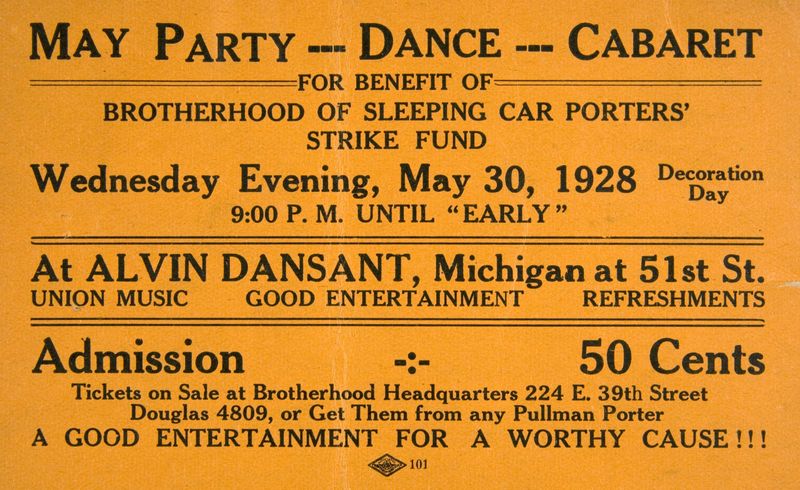
The elections in 1924 were equally farcical. Sample ballots were mailed out to the various districts with the names of the company men marked with an “x.” A porter would be going out to make up his car when he would be stopped by a company official. “Hey George! Did you vote yet? No? Can’t go out on your run till you vote. What’s your name and address? All right.” The porter would hurry on to his car. The official would pull a marked ballot out of his side coat pocket and vote for “George.”
Contemptible Tactics
In its campaign to smash the porters’ union and maintain the dictatorship of the company union there is no underhand work to which the Pullman management has not stooped. Intimidation of every sort has been the daily practice of the company. One porter in Jacksonville who had expressed mild sympathy for the new union was told that he would either repudiate this endorsement or get off the cars. He was forced to write an open letter to all porters attacking the porters’ union. In fact it is estimated that 75 per cent. of the delegates to the company union conference in Chicago had proved their loyalty to the company by writing similar letters extolling the plan and slurring the real labor union and its leaders. Moreover the most popular, independent and competent men were “defeated” in the elections to the conference, indicating clearly that it was a steam-rollered affair solely in the interest of the company.
The company has been clever in its use of propaganda. All the plaudits of the company plan have seemed on the surface to originate spontaneously with persons and papers far removed from company influence. On investigation, however, it has been found that the praise of the company has come from negro papers all over the country in which advertising has been carefully purchased in return for a “correct” editorial policy. The “brass check” has never been so well illustrated as in this systematic pollution of the negro press with company-inspired messages. Then when the newspapers have printed their dirtiest slanders against the porters’ union and run scare heads on the leaders “Escaping with Union Funds,” the company has stepped in and purchased thousands of these papers and distributed them among the porters. It has tacked the items and editorials of the papers on the bulletin boards and walls of waiting rooms, and done everything possible to tell the porter that the world is against him if he bucks the company. In the official house organ of the company nothing has been written about the porters’ union. The company has deliberately sown its seed on the outside where the editorial utterance would appear to come from impartial sources!
“Uncle Tom” Stuff
The advertisements running in these papers have often been in the form of a letter from some “loyal’’ Uncle Tom, “me-too-boss” porter playing up the glories of the company union or the company benefit association. Samples from these messages bought and paid for by Pullman agents will illustrate the general tone of the anti-labor propaganda:
“Let us not turn over our money to those who will put ropes around our necks and lead us into the corral where we will be put under the yoke and forced into submission to the will of the American Federation of Labor…Let us view with suspicion the baits that are set to trap us into an ignominious position…We do not need the uninvited interference of radical outsiders…Let us remain true to the traditions of our race…Let us maintain the proud record of fidelity that we have built up…Let us stand shoulder to shoulder for our co-operative Employee Representation Plan.”
Every passion, prejudice and fear is thus played upon by the copy writer of the Pullman Company. Another half page spread in several papers raises the spectre of unemployment against those workers who dare to join a union and says frankly:
“You can earn an honest living up here (in the North) as long as the great manufacturers see fit to employ you.”
Following this threat with the advice:
“The voice of the labor union is the voice of danger, betrayal and destruction. Do not heed it.”
So powerful is the whip held over the negro press that out of five such papers in Chicago none dares openly espouse the cause of the porters’ union against the intimidation and terrorism of the company union. Indeed, so effective is the choke the Pullman Company can put on the press in general that even the white press, with some exceptions, has been afraid to carry the news of the Pullman porters’ battle for trade unionism. Take as an example the debate at which A. Philip Randolph, General Organizer of the Sleeping Car Porters, trimmed Perry W. Howard, a Pullman legal agent. This debate attracted 1,700 people on a Sunday afternoon in Chicago. Invitations and releases were sent to all the Chicago reporters, and they came and “covered” it with care. But not one “stick” of news on this debate appeared in any of the capitalist sheets the following day.
The Case of Perry Howard
This Perry Howard, incidentally, illustrates the Pullman propaganda tactics. Howard is a Republican politician from Mississippi. Although on the payroll of the U.S. Department of Justice as a special assistant to Attorney-General Sargent, he has been released to work for the Pullman Company in. heading off union organization and scattering lies about the “red”? character of the union. The contribution of this colored Judas to the issues involved in this controversy are summed up in the following expression: “The economic salvation of the race lies in the good-will of the capitalists. Attempts to create ill-will between the colored people and the capitalists are for the purpose of exploitation.” He follows this up with the threat that the company will import Filipino workers to man the sleeping cars if the negroes rebel against their wages of $67.50 per month. And adds that to pay the porters a living wage would bankrupt the Pullman Company—which in its last annual report shows the largest gross revenue in the history of the corporation, amounting to $84,000,000 with a net income of nearly $16,000,000 equivalent to nearly $12 a share on its capital stock.

In addition to the “representation plan,” one of the most effective company devices for enslaving the porters is the Pullman Porters’ Benefit Association, (organized in 1920), which some of the Pullman advertisements have dealt with in recent months. None of the seven members of the board of this association are porters. Instead they hold attractive jobs as “welfare workers” and their wages are more than double those of a porter. The chief job of the welfare workers seems to be to spy on workers to determine their “loyalty” to the company. The company will inform you solemnly that it has nothing whatsoever to do with the Benefit Association. And yet the chairman of the association is a company agent and not one penny can be paid out of the treasury of the association without the O.K. of A.A. Cummings, Treasurer of the Pullman Company! The money cannot be used for any purpose without the consent of the company management. And stenographers who work for the benefit associations do not even dare to attend meetings of the Sleeping Car Porters’ Unions for fear of being fired! The “benefit” of this association all goes to the company. To be sure it writes an insurance policy for the workers at a rate no less than that charged by ordinary insurance companies and much higher than that obtaining in labor union insurance societies. If the porter leaves the service of the company the premium is doubled.
The Cards Are Stacked
To return to the “plan” itself, it is clear that it is owned body and soul by the Pullman management. All the cards are stacked against the porters. The same local management that recommends the discharge of a porter sits on the local committee as prosecutor, judge and juror in the case. And if the local committee should happen to recommend that the porter be put back on his job the decision is not carried out. The higher, or “zone committees,” have no more power. All their decisions are simply referred up to the management in Chicago which decides according to its own whim the fate of a porter. And no matter what the decision in any of the committees, the management is always sustained as a matter of form. Moreover, the committees are not permitted to have persons charged with offenses appear before them to hear the charges. The defendant is never allowed to face the evidence or to be in the room when the charges are made, often by some prejudiced “welfare worker” serving as a company stool-pigeon. In many instances, also, the plan has served as a literal graveyard for grievances, the company dupes stalling and delaying and refusing to take up the case of a worker bringing an appeal. The worker remains on the street while he slowly awakens to the realization that the plan is a farce and a joke.
Labor Age was a left-labor monthly magazine with origins in Socialist Review, journal of the Intercollegiate Socialist Society. Published by the Labor Publication Society from 1921-1933 aligned with the League for Industrial Democracy of left-wing trade unionists across industries. During 1929-33 the magazine was affiliated with the Conference for Progressive Labor Action (CPLA) led by A. J. Muste. James Maurer, Harry W. Laidler, and Louis Budenz were also writers. The orientation of the magazine was industrial unionism, planning, nationalization, and was illustrated with photos and cartoons. With its stress on worker education, social unionism and rank and file activism, it is one of the essential journals of the radical US labor socialist movement of its time.
PDF of full issue: https://www.marxists.org/history/usa/pubs/laborage/v15n03-mar-1926-LA.pdf
 Revolution's Newsstand