
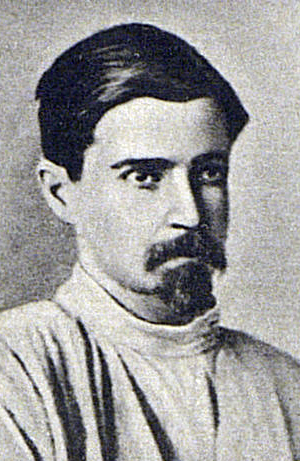
Bukharin debates Yuri Larin (I could not find his speech) on the ‘kulak’ at the 14th Congress of the Communist Party in 1925. Larin was not a Left Oppositionist, but demanded action against rich peasants during the N.E.P.
‘The New Economic Policy in the Village’ by Nikolai Bukharin from International Press Correspondence. Vol. 5 No. 36. May 30, 1925.
I am of the opinion, comrades, that in the agrarian question the Party is at present being misled by two great aberrations; two false attitudes. I shall first deal with the first of these. Some comrades consider it to be perfectly right to promote the revival of our whole economics by means of affording possibilities of development to the upper strata of the peasantry and even by means of removing all restrictions on the economics of the kulak (that is, by giving these the possibility of development), to say nothing of the economics of the well-to-do peasant, the small holder, etc.
One step leads to another. If we release the uppermost stratum of the agricultural bourgeoisie from their restrictions, we give at the same time so say these comrades, the possibility of development to the lower social and economic strata. The error contained in this aberration lies in the fact that these comrades disregard the other half of the task: the purpose for which all this is done.
The correct viewpoint at least in my opinion is that we must enable these economics to develop, to the end that the sum total of our national income, the collective proceeds of our agriculture, may be increased, and consequently our goods traffic, the income of our state industry, and the income of our state treasury, may be increased at the same time. In other words, the object in view is the increase of the sum total in the hands of the state power of the working class, enabling greater expenditure, in accordance with our agrarian policy, in the form of agricultural credits, etc. for the economic support of the main mass of the agricultural population, that is, preeminently for the economic support of the poor peasantry and the small holders, their co-operatives and collective organisations.
I believe that the matter is sufficiently correctly formulated when we state that we can now proceed to develop the NEP in the villages, where it hitherto scarcely came in question, for our leadership is now based on fulcrums which we hitherto did not possess,
There are some comrades in the Party whose opinion is approximately as follows: “What is the use of your chattering about socialism here in the villages; the conditions which will develop will be purely capitalist, however disagreeable that may be.”
But is this true? I do not think so. Theoretically, this view is incorrect, and practically we may designate it as a “Kulak deviation”. These comrades do not grasp the significance of the proletarian dictatorship, they observe the development of capitalist conditions in themselves, as if there had never been a proletarian dictatorship in Russia, as if there were not still a proletarian dictatorship. As if we had no Supreme Economic Council in the hands of the proletarian power, as if the banking system, the agricultural credit traffic, were not under our control,
In the bourgeois countries capitalist conditions developed with great rapidity after the agrarian revolution. But in Russia we have the proletarian dictatorship, and this is not only a state power, but a very powerful economic one. The proletarian dictatorship introduces “slight” corrections into economic development, and thus considerably alters the whole course of this development.
Of what do these alterations consist? Comrade Lenin has already deal with the subject. When we finance co-operative organisation, we finance socialist construction at the same time. And when we now conclude that it is incumbent on us to aid the development of the economics of the Kulak and small holders, we have at the same time at our disposal a large number of measures enabling us to set limits to the attendant tendencies towards exploitation.
And yet we permit the Kulak to live and to accumulate. Why? For the purpose of obtaining a larger fund for financing the upbuilding of the co-operative organisations, above all the co-operatives of the middle class of peasantry, whom we can organise in co-operatives by means of suitable grants of state credits.
It is obvious that care must be taken not to confuse this piece of economic strategy with a “course directed towards the Kulak”. Why? Because a “course directed towards the Kulak”, or even a “course directed towards the well-to-do peasantry, would simply signify releasing the economics of the Kulak from all fetters, but nothing more. But what is now being proposed, and what I am endeavouring to substantiate, is the utilisation of this “unfettering process”, for the support and financing of the (objectively) anti-capitalist elements among the peasantry. Our actual course is directed towards these anti-capitalist elements. Thus, if we are asked whither our agrarian course is directed at the present time, we must reply:
Towards the growth of the elements of socialist economics.
We have more distinctly and concretely defined our course as being towards the co-operatives. Not merely for the sake of shouting: “Co-operatives, co-operatives, and again co-operatives”, but for the purpose of furthering this central form of our economic life. And to do this we must free our goods traffic from its fetters. Here we may observe a certain analogy. We have permitted the introduction of private capital. Thanks to our economic fulcrums, we recently found ourselves in a position to limit private capital to such an extent that in a certain sense we attained a greater effect than we desired. We can hold private capital fast in our hands, we can give it greater freedom of movement, and we can restrict it again. Can it be said of us that we are directing our “course” towards the bourgeoisie because we grant it a certain liberty of movement in a certain stage of our economic development? Not in my opinion. We grant this certain amount of freedom of action, and then observe whether it has the effect of increasing the national income and economic power of our state. This is not “directing our course towards the new bourgeoisie”.
It is from this point of view that we must approach the new stage of developments in agrarian conditions. Our new course is not towards the Kulak, but towards the liquidation of that same system which we had in the cities at one time, the system obtaining at the stage when we had all the shops in our own hands, and every shop bore on its sign: “Workers of the world, unite!”, but there was nothing for sale in the shops, and we had nothing to eat. We then “unfettered” the private merchant. We obtained something from him directly, but still more indirectly, by means of the strengthening of our goods traffic, and we utilised the increase of values for traffic, and we utilised the increase of values for securing our own position. Those comrades who only see one half of the problem, the unfettering of the capitalist forms of economics, the letting loose of the NEP in the villages, and who fail to see the other half, the aid lent to all strata of our supporters, these comrades are representatives of a “Kulak deviation”.
Comrade Larin, who has also spoken here, represents another deviation, one taking a contrary direction. The representatives of the first deviation speak of the “unfettering” of the rich farmer, and of nothing more, and comrade Larin is guilty of the opposite exaggeration. How does the matter appear to him? For him the small holder simply does not exist. If it were a picture of “puzzle find the small holder” the small holder could not have vanished more completely. For comrade Lenin the small holder was the central figure. And is he not still the central figure? Indeed he is. But where is he in comrade Larin’s estimation. He has disappeared altogether. Comrade Larin speaks of “capitalist conditions”. On the one side we have the agricultural labourers, on the other the agricultural bourgeoisie. This is very good; it is an elementary fact. But is it the whole truth? No, for comrade Larin forgets the “central figure”. He takes the two opposing poles, and says that they are all. But in reality they are not all, and it is entirely wrong to see the two poles only, and to ignore the main mass of the peasantry. How many kulaks and well-to-do peasants have we? Not more than about 3 to 4 per cent. And yet it is maintained that the farmers are gaining the upper hand. This is of course an exaggeration. It is true that in the immediate future the farmers will play a greater role in Russia, but when determining on our policy we must not lose sight of the actual proportions. We must regard the whole of the strata of the rural population in their real relations.
For comrade Larin the small-holder has disappeared. According to his conception, the small-holder has to be sought for with a lantern, even in broad daylight. This is the origin of comrade Larin’s strange deviation, which represents the continuation of a non-Bolshevist policy towards the peasantry, Comrade Larin’s idea is that the small-holder remains in the background. There is only the kulak on the one side and the proletarian on the other, and we as “orthodox Marxists” have the task to aggravate the class struggle, and this aggravated class struggle will lead us to a “second revolution”, that is, to a point where the one class overthrows and expropriates the other. The whole attitude of comrade Larin shows this to be his conclusion.
Yesterday he made an attempt to turn the matter off with a joke, and observed that the Soviet power will be strong enough by that time to accomplish this revolution by means of a “decree”. But surely it is unallowable to speak in this manner. We shall not become “suddenly” so powerful that we can annihilate by a decree this “powerful stratum”, which according to comrade Larin’s idea is waiting for the opportunity to seize our power. His conception is as follows: The kulak is becoming frightfully powerful. He will become a tremendous power here it must be remembered that the small-holder does not appear in the scene and therefore we must expropriate him, that is the inevitable conclusion to be drawn from these premises. But in comrade Larin’s speech this expropriation is carried out in a somewhat comic opera style. First we are frightened by the discovery of a mighty enemy, then we simply sweep him away by a decree. It is obvious that there is a flaw somewhere.
Were we in a position compelling us to carry out such an expropriation as comrade Larin imagines, this would mean the necessity of a “second revolution”. But in this case we should not have to hide ourselves behind a decree, we should have to state openly: “We are obliged to submit to a fresh series of purely capitalist conditions in the villages. In the cities everything will be proletarian, or almost proletarian. But in the villages everything will be conducted as if under a capitalist regime. In the cities everything will go on as it does today, but in the villages there will be capitalist conditions, with exploiters and exploited, until we finally proceed to the “expropriation of the expropriators”. Not until then will our two component parts, town and country, form a consistent whole.”
Where is the main error here? Comrade Larin’s main error lies in the fact that he does not see that we have not merely an “unfettering of capitalist conditions” in the villages, but that we have at the same time a dictatorship of the proletariat, and one which is not merely a political power, but simultaneously a powerful economic force. Tell me if you can, where there is room in comrade Larin’s plan in which we see solely the “kulak” and “collective economics”, but no small holder where there is room for the co-operative in the sphere of the process of circulation, that is, in the processes of selling of acquiring, of credit operations, etc.? Comrade Larin leaves scarcely any room for these at all in his “plan”.
Such “Larinist” views exist among us in the Party. There are comrades who maintain the “collective economics” to be the real co-operative, and who consider sales, acquisition, and credit as of secondary importance. This viewpoint arises from the absence of the small-holder, and from the general theoretical conceptions of the comrades. The small holder having vanished, his cooperative has naturally vanished with him, and in consequence the whole Leninist plan of building up Socialism as cooperative Socialism vanishes too.
This is not our standpoint. We cannot share this conception, and thus we cannot agree with comrade Larin’s views.
It seems to me that in his speech, yesterday, comrade Larin fell into a slight confusion of ideas. Instead of proclaiming the slogan of the “aggravation of class warfare in the villages” as such, he spoke of the aggravation of political class warfare in the villages, and imagined this aggravation in the innocent form of the struggle for influence in the “revival of the Soviets”. It is perfectly true that if we are intent upon the revival of the Soviets, we much fight for our candidates, etc., with much greater determination. But this is very far from the necessity of an aggravated class struggle slogan in the light of a prospective second revolution, the inevitable conclusion of comrade Larin’s attitude,
If we regard the prospective developments as they really are, what will be the course of events in the villages? Will the capitalist conditions increase? Yes, they will. Will there be capitalist elements in the co-operatives, or will the Mensheviki and the SR, as comrade Lenin once put it, be “expelled by a chemical process”? To be sure there will be capitalist elements. Will the cooperative not the co-operative of the kulak. but the cooperative of the small holder type gain ground if we lend it the increased aid which our developed goods traffic will enable us to give? Yes. And will the co-operatives of the poorer peasantry grow also, in the form of collective organisations? Yes, these will grow also. What will then be the elements in the villages? The cooperative of the poor peasantry, that is, the collective organisation and the cooperative of the small-holders in the sphere of sales, acquisition, credit, etc. Here and there will be kulak cooperatives, probably supported by the credit societies. This whole graduation of co-operatives will grow into the entire system of our economic institutions. And what will be the general result? The general result will be that when the kulak grows into the whole system, he will become an element of state capitalism; and when the pour peasantry and the small-holder have done the same, then we shall have that socialist co-operative of which Lenin spoke. We will present a variegated picture.
And what of the class struggle under these circumstances? Will it become more acute? In all probability it will at first become more acute. But can we maintain that our general line of action, our Bolshevist line, the line to be pursued by our policy, is bound to consist for a period in forcing the class struggle? It is just this which I do not believe.
Our class war will be carried on to a great extent in entirely different forms, and we must adopt the line of strengthening these forms at the expense of the earlier methods of class warfare. Why? For the simple reason that even the agricultural labourer, exploited as he is by the kulak, is, in his capacity as a member of the ruling class, to a certain extent above the kulak, and is enabled by our legislation to force his class will upon his “lord” in a large number of peculiar forms. We have at our disposal our agreements, our trade unions, labour legislation, taxation, and finally our credit policy. How shall we conduct and organise the class struggle? In the first place by fighting for our political candidates, at the election. This is beyond doubt.
There are however other forms of class warfare, which we must not forget, and which form the essential factors of the struggle during a whole historical period. If we tax the kulak more heavily than the other strata and finance the small-holder, what do we accomplish? In a certain sense we direct our course towards a levelling of the peasantry, for by raising the economics of the middle and poor peasantry we lift these out of their poverty. Are we to regard the poor peasant as condemned to everlasting poverty? To be sure not. We raise him a step upward, and on the other we place a heavier burden on the kulak. This is one form of the class struggle. Here the preponderant weight is removed from the earlier form of class war (the mechanical “using our teeth”) to these new forms, possible only under the conditions given by the dictatorship of the proletariat. It is here that the characteristic peculiarity of our period and of our whole policy lies.
And if this is so, can we then maintain that we are moving consciously along the line of “aggravated class war”? Not in the least. We transfer preponderant importance to other forms of the struggle. Does this however signify that we are secure against attempts at mechanical collisions? No. It is possible enough that we shall encounter the misfortune of a war, and we shall be obliged to direct our course towards the committees of the poor peasantry; and if the kulak incites a rebellion against us, we shall be compelled to combat him by terrorist measures. But our general line must consist of transference from these forms of class warfare to other forms: this is an essential element of a rational policy. We must pass to the heavier taxation of the richer strata, to the lending of aid to the other strata in the form of agricultural credits, and (in time) by the improvement of our technical basis, that is, by electrification, etc. Our conception of our prospective development is thus very different from comrade Larin’s.
The whole fault lies in the fact that in comrade Larin’s eyes the small-holder has disappeared. If the question of “unfettering” is regarded as I regard it, the interests of the small-holder, the interests of this “central figure” still exist. Comrade Larin knows nothing of this.
With regard to the co-operatives I see the selling, procuring, and credit co-operatives, and besides these the collective organisations. Comrade Larin knows practically only the collective organisations. Collective economics are a mighty force, but they are not the main road to Socialism.
I attach much more importance to the new forms of class warfare, but comrade Larin holds substantially to the form of “using our teeth”.
We look to a prospective inclusion of the farmer into our total system of socialist upbuilding, but he looks to a “second revolution”.
You will see that these are two entirely different theoretical conceptions, two entirely different ideas as to the course to be taken by our revolution in the villages and by the development of our socialist upbuilding.
I maintain that everything which can be said at the present time shows us that we have no reason whatever to renounce the position now before us. This does not however mean that we are to fold our hands and sit still till things come of themselves. Let us remember comrade Lenin’s attitude towards the cooperative question. He said: There are comrades who, for one reason or another, believe that the New Economic Policy renders the co-operative superfluous. But I say to you (these are comrade Lenin’s words). “It is precisely our adoption of the New Economic Policy which renders the co-operative of the greatest importance”.
We are now passing in general to the adoption of the New Economic Policy in the villages, and in a much more decisive form. We are adopting methods enabling the traffic in goods to be widely extended, and we are working at the revival of the Soviets, which is synonomous with the development of the political “self-activity of the peasantry”. But it is precisely because we are doing this that a firmer closing of the ranks of our Party, and the strengthening of our core, become of even greater importance than before. We underwent a Party crisis at the time of our transition to the New Economic Policy, and our present transition means a Party crisis in the villages, caused by the lack of organisation hitherto shown in our village nuclei. The work of enlightenment with regard to our policy is therefore the more important.
We have not yet solved every problem. We are taking our first steps, and we must proceed cautiously. But I repeat once more: with such ideas as comrade Larin’s we shall not go far, for we should then forget the small-holder, that “central figure” towards whom comrade Lenin “directed his course” in his pamphlet on taxation in kind, and in his subsequent tactical articles. At the present time we have no reason to renounce this policy, and I am confident that the resolution here moved by comrade Rykov represents this Leninist line, and not comrade Larin’s line. Comrade Larin’s conceptions are based upon entirely different premises, and are bound to lead to other political results, harmful to our Party. (Prolonged applause.)
International Press Correspondence, widely known as”Inprecorr” was published by the Executive Committee of the Communist International (ECCI) regularly in German and English, occasionally in many other languages, beginning in 1921 and lasting in English until 1938. Inprecorr’s role was to supply translated articles to the English-speaking press of the International from the Comintern’s different sections, as well as news and statements from the ECCI. Many ‘Daily Worker’ and ‘Communist’ articles originated in Inprecorr, and it also published articles by American comrades for use in other countries. It was published at least weekly, and often thrice weekly.
PDF of full issue: https://www.marxists.org/history/international/comintern/inprecor/1925/v05n46-may-30-1925-Inprecor.pdf
 Revolution's Newsstand