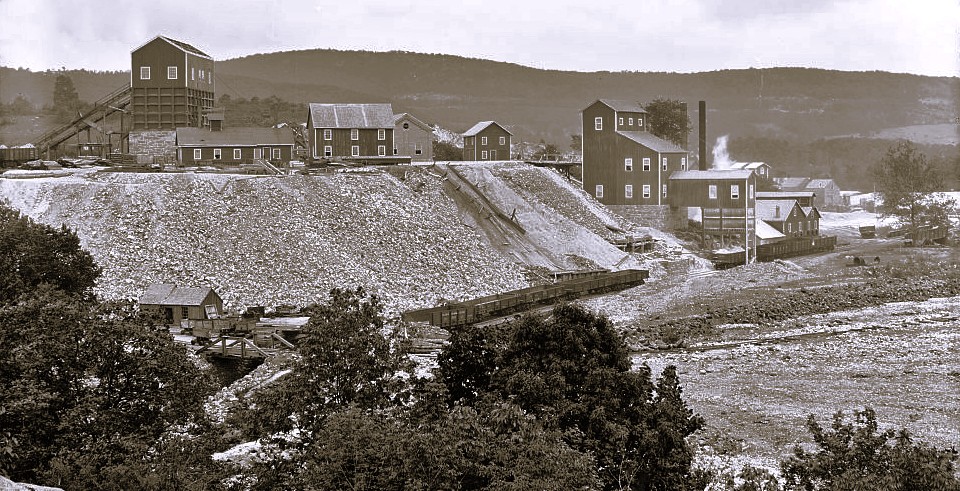
The past lesson with a lesson, and a warning. Solidarity is broken by U.S.-born zinc miners, and the Iron Heel comes down on the foreign-born strikers of Franklin Furnace, New Jersey.
‘Vigilantes War on Zinc Strikers in New Jersey’ from The New York Call. Vol. 4 No. 350. December 16, 1911.
Franklin Furnace Citizens Still Menace Workers Who Formed Union.
The warfare that opened at Franklin Furnace, N.J., several weeks ago, when the New Jersey Zine Company. through systematic persecution and oppression of its employes, forced them to rebel and lay down their tools as a protest against the methods employed by the company, is still being waged, according to Joseph Tylkoff, organizer of the American Federation of Labor, who returned from the New Jersey town yesterday.
Tylkoff told a Call reporter of his experience in the iron ore trust town and stated that the lives of the workers, who are still loyal to the union, are absolutely unsafe there. Tylkoff said he had arranged with the president of the union to meet him at the train, and when he arrived he found there about forty men waiting for him. He thought a slugging committee of the company was awaiting him.
Later, however, the president of the union came over to the train and told Tylkoff he had purposely brought the forty men to the train to protect Tylkoff and see that he did not meet the fate of Organizers Schossler and Phillips of the Western Federation of Miners, who were met at the train and run out of town. At present the city is in an awful state of affairs, the thugs and “good citizens” of the city terrorizing everyone who dares to talk about the union.
The trouble started when eighteen men were discharged on September 17 without apparent reason. Guy Miller of the Western Federation of Miners was then busy organizing a local, which is now known as Franklin Furnace M. & S. Union, Local 266. W.F. of M. The Americans who were in the union stirred up the other workers to strike and demanded the reinstatement of the eighteen men, which resulted in the strike being called on September 17.
Stopped Injury Indemnity.
Shortly before that the company promised to pay the injured workers one-half of their wages while unable to work in the mine. When the Workmen’s Compensation Act was passed in New Jersey, the company told the workers that it would have to discontinue to pay the injured workers and this was also one of the points that caused the strike. On September 18 the Americans were called to the office of the company and without giving any reason to their fellow strikers they betrayed them and returned to work.
The next day thirty armed “citizens,” who said they were a vigilance committee to see that “law and order” prevailed in the city, routed the foreign workers from their beds and ordered them to go to work. Several of them went to work for fear of being beaten by the “good citizens,” while the others refused to be bullied by the “vigilantes.”
Several days later thirty of the strikers, who refused to work, were roused from their houses and driven to the train, where they were put on and sent to Jersey City under a guard of citizens and there they were let go without a cent in their pockets or any means of livelihood.
Among those kidnapped and run out of town were John Pisarewitz, Mike Krook, Sam Damajuk, Georze Durko, Vasyl Zilit, Mitro Homka, Prochar Sarza, Sam Swirepa, Tony Anton, and Aspanazi Vorobey. Previous to the running out of the city of these workers, John Pisarewitz, Alex Szurkala, Joe Mahol and John Hlavka were arrested and kept handcuffed for twenty-four hours and let go without a trial.
On September 2, at the instigation of the Vigilance Committee, which was composed of saloon keepers and other politicians, Mike Duboza, Mike Prokurat, Stephen Piericz, John Sciezlea, John Kozloff, Mike Yazko, and Anton Szuzmak were arrested, and without being given a chance to defend themselves were railroaded to the Newtown Jail for three months each.
Foreigners Locked Up at Random.
Since the trouble started, the “citizens” have shown their loyalty to the company and whenever they see the foreign workers on the streets in groups of three or more, the latter are immediately arrested and railroaded to jail. The Vigilance Committee are all armed with rifles and shotguns, and they are parading the streets “keeping order.” The work is very dangerous and there are men injured in the mine every day. When a man is crippled and disabled the company does not give him any money, but he is provided with tickets, and under a guard placed on a steamer and sent off to Europe. During last year there were five men killed in the mine, and all the company gave their families was funeral expenses for the slain workers.
There is great strife among the workers now and there are many walking the streets with their families, starving. The company owns all the houses and stores in the city and the strikers can get no credit. The active union men, fifty-five in number, were dispossessed from the company’s houses and there are many homeless workers.
The families of the strikers were taken in by the toilers working in other plants. Twenty or more people are crowded together in little dingy holes, and disease threatens. The company blacklisted all the strikers and many of them who went to Hamburg, a nearby city, near Franklin Furnace, were denied work.
The authorities are also against the strikers, and when they are arraigned before them they are called anarchists and bitterly denounced. False witnesses are always handy to testify against the workers, but witnesses for the strikers are not permitted to testify. Governor Wilson, who is now seeking the Presidential nomination, has been appealed to by the strikers, but thus far he has failed to do anything for them. A commission was appointed to investigate the charges of the strikers, but a report has never been made. The strikers charge that one of the commission is a judge said to be “controlled and owned by the company.” Tylkoff said he was followed by spotters and was not permitted to leave the hall by the proprietors who warned him he would get a beating or would be run out of town. The halls are denied to strikers and they have been unable to hold a meeting for the past few weeks. Since the September strike, which wound up in short order after the strikers were driven back to work, the company discharged several of the strikers and on November 24 there was another walkout.
The Hungarians who are now working in the mine promised the Russian and Polish workers to join them in the strike, but they remained at work. Tylkoff said the Hungarians have to pay bribes to the foremen in order to get a job, and there are many “good citizens” who helped the company break the strike now making big money for having the privilege to hand out jobs and take the bribes.
It is said that the men are constantly discharged in order to make room for new workers, so that the foremen and the “good citizens” can get the bribes. The Western Federation of Miners and the American Federation of Labor are going to look into the case and force the authorities to make an investigation. Governor Wilson of New Jersey came in for bitter criticism by union officials yesterday for his failure to look into the case and force the company to remedy conditions prevailing in its mines, where workers are daily injured and disabled.
The New York Call was the first English-language Socialist daily paper in New York City and the second in the US after the Chicago Daily Socialist. The paper was the center-right of the Socialist Party and under the influence of Morris Hillquit. The paper is an invaluable resource for information on the city’s workers movement and history, it is one of the most important socialist papers in US history. The Call ran from 1908 until 1923, when the Socialist Party’s membership was in deep decline and the Communist movement became predominate.
PDF of issue: https://www.marxists.org/history/usa/pubs/the-new-york-call/1911/111216-newyorkcall-v04n350.pdf
 Revolution's Newsstand