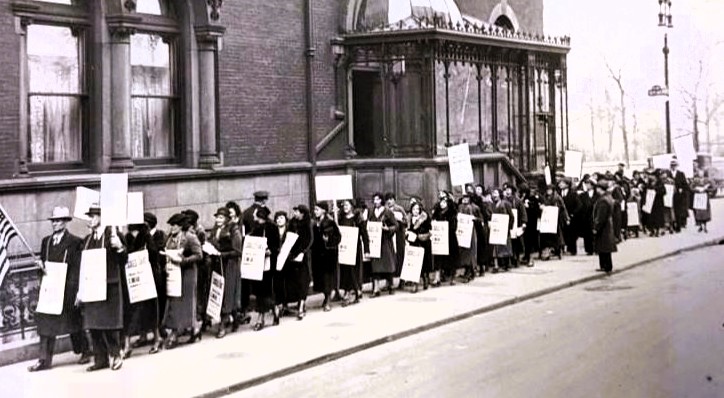
Slogan of workers striking the National Biscuit Company (Nabisco), trolling the company’s “Uneeda Biscuit” brand. In January, 1935 three thousand members of Bakery Workers Federal Union No. 19595, half of them women, struck for equal pay for equal work in a conflict that lasted months, and was ultimately a failure, in large part due to its bureaucratic A.F.L. leadership.
“U-Don’t-Need-A-Biscuit” by Ann Barton from Working Woman. Vol. 6 No. 5. May, 1935.
THE strike of 6,000 National Biscuit Company workers is entering its fourth month. In New York City 1,500 of the 3,000 strikers are women.
The majority of these women have worked for the National Biscuit Company from ten to twenty years. The younger women tell you. “I haven’t worked there long–only five years!” Some of the older women have worked in the plant for forty years, even before 1898 when the National Biscuit Company was incorporated.
A survey of the Board of Directors reveals the name of Ogden Mills, of the National Committee of the Republican Party; Jackson Eli Reynolds, President also of the First National Bank, (Morgan controlled); and Franklin D’Olier, director of the Chase National Bank (Rockefeller controlled).
It is these interests that have made a furious attack upon the continued existence of the union, arresting strikers, beating them, men and women alike, and, lately, obtaining an injunction, prohibiting strikers from picketing within four blocks of the plant!
The strike was called January 8th, when the company refused to live up to its agreement with the union, the Inside Bakery Workers Federal Union No. 19595. The union’s demand was for “equalization” of wages, or more familiarly, “equal pay for equal work”. It was in the Philadelphia plant that the company first began to contest the strength of the union. In answer 6,000 workers in plants in New York, Philadelphia, Newark, and York, Pennsylvania, and Atlanta, Georgia, came out on strike.
The women speak of the speed-up. In the icing department and the zwieback department, they relate, the speed-up was so intense that the skin of the girls was torn off as they worked madly at the conveyor that took the cakes or the cartons past them almost more quickly than they could get at them. They spoke of unventilated rooms, of the girls whose job it was to turn the cakes. For speed-up purposes the company installed a platform fifteen feet off the floor. Windows and doors were shut. Near the ceiling it was hot and breathless. One day a girl fell, injuring her back.
They spoke of “short” time.–“We never knew when they would send us home. Sometimes our week’s time would come to no more than three days a week!”
In May, 1934, all the workers in the New York plant stopped work at their machines for twenty minutes. Not all of the girls knew what was happening. But they found out that the stoppage had convinced the plant that the union represented the majority of the workers.
The girls began almost immediately to feel the difference between a non-union, and a union shop. Electric fans were put in unventilated rooms, the killing speed-up was slackened, and the company began paying equal pay for equal work.
“Why do you think the newspapers keep quiet about us?” asked the young woman. “Because,” she answered, “Ogden Mills owns half of our company. He’s bought out the police and the newspapers. Why do you think one of our pickets was nearly killed by a cop, and the police protect the scabs?”
Before the injunction was served and before the president of the union, William Galvin was persuaded by the strikers and the strike committee that the union must call for mass picketing of strikers and sympathizers, the women were demanding more militant action.
“Maybe they don’t want mass picketing because that’s supposed to be Red,” said one girl doubtfully, as a group of them talked together about mass picketing.
“What if it is,” said another striker strongly, “it helped the Ohrbach people to win their strike.”
“Those Ohrbach strikers put up a fight! We’ve got to have a mass picket line like they did!” said a matronly looking stout woman.
“Sure we picket in the rain,” said one girl as she walked up and down during a veritable blast of rain, “we are strikers! We’re not sugar”! Young and old alike during the bitter weather of January, during rain and snow, they’ve held their picket lines.
Wide support has been given this strike by workers all over the country. The slogan “U-Don’t Need-A-Biscuit!” improvised by the strikers themselves, has been carried all over the country. The Communist Party has issued leaflets to the strikers practically every day calling on them to strengthen their strike, and now, to smash the vicious injunction.
Now all sympathizers to the strike have been invited by the union to help them with picketing, with the boycott campaign of the National Biscuit Company products, with relief. The Communist Party, Women’s Councils, workers’ groups are mobilizing their forces to help the strike. Already Communists and Socialists have responded. They, together with the strikers have been herded into police wagons from the picket lines. But the fight is a strong one. The offer of the company to take back 50 per cent of the strikers was met with a voluminous “NO” at the meeting where the proposals was brought to the strikers. “All or none” and “Back only with the Union” are slogans that every striker holds. The strike of the National Biscuit Company strikers shows the unswerving determination of the workers to build their unions and defend them. It shows also the increasing militancy of working-class women. The strikers need all possible support. They need pickets to swell their ranks. They need help in the way of food, relief. Such assistance to the strike can be given in New York through the New York office of the union at 245 West 14th Street. Women should reach the local office of the union and offer their help and throughout the country make the slogan “U-Don’t-Need-A-Biscuit” a powerful one.
The Working Woman, ‘A Paper for Working Women, Farm Women, and Working-Class Housewives,’ was first published monthly by the Communist Party USA Central Committee Women’s Department from 1929 to 1935, continuing until 1937. It was the first official English-language paper of a Socialist or Communist Party specifically for women (there had been many independent such papers). At first a newspaper and very much an exponent of ‘Third Period’ politics, it played particular attention to Black women, long invisible in the left press. In addition, the magazine covered home-life, women’s health and women’s history, trade union and unemployment struggles, Party activities, as well poems and short stories. The newspaper became a magazine in 1933, and in late 1935 it was folded into The Woman Today which sought to compete with bourgeois women’s magazines in the Popular Front era. The Woman today published until 1937. During its run editors included Isobel Walker Soule, Elinor Curtis, and Margaret Cowl among others.
PDF of full issue: https://www.marxists.org/history/usa/pubs/wt/v6n05-may-1935-Working-Women-R7524-R1-neg.pdf
 Revolution's Newsstand