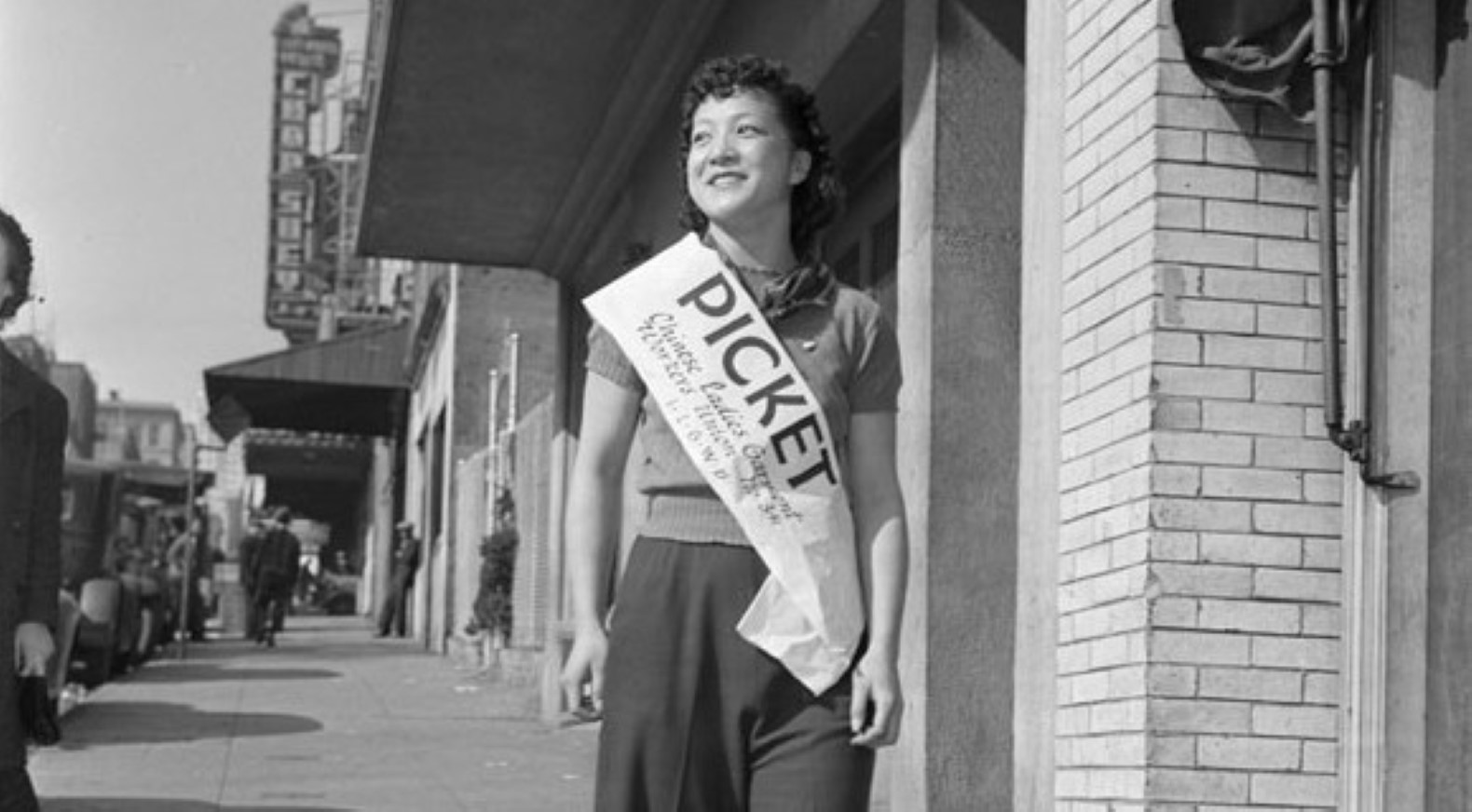
A report on an important early struggle among Chinese workers in the U.S. to unionize. Here, International Ladies Garment Workers Union Local 341, 125 Chinese women, strike against Chinese-owned sweatshops in San Fransisco.
‘New Era Dawns in Chinatown as Women Picket Garment Shops’ by William Morgan from Peoples Daily World. Vol. 1 No. 52. March 2, 1938.
Unionism at Stake in Strike Outcome
SAN FRANCISCO, March 1. One of the brightest mile-posts in Chinatown’s colorful history was being firmly rooted as the first strike ever held there- a strike to obtain an “American standard of living,” went into its third day.
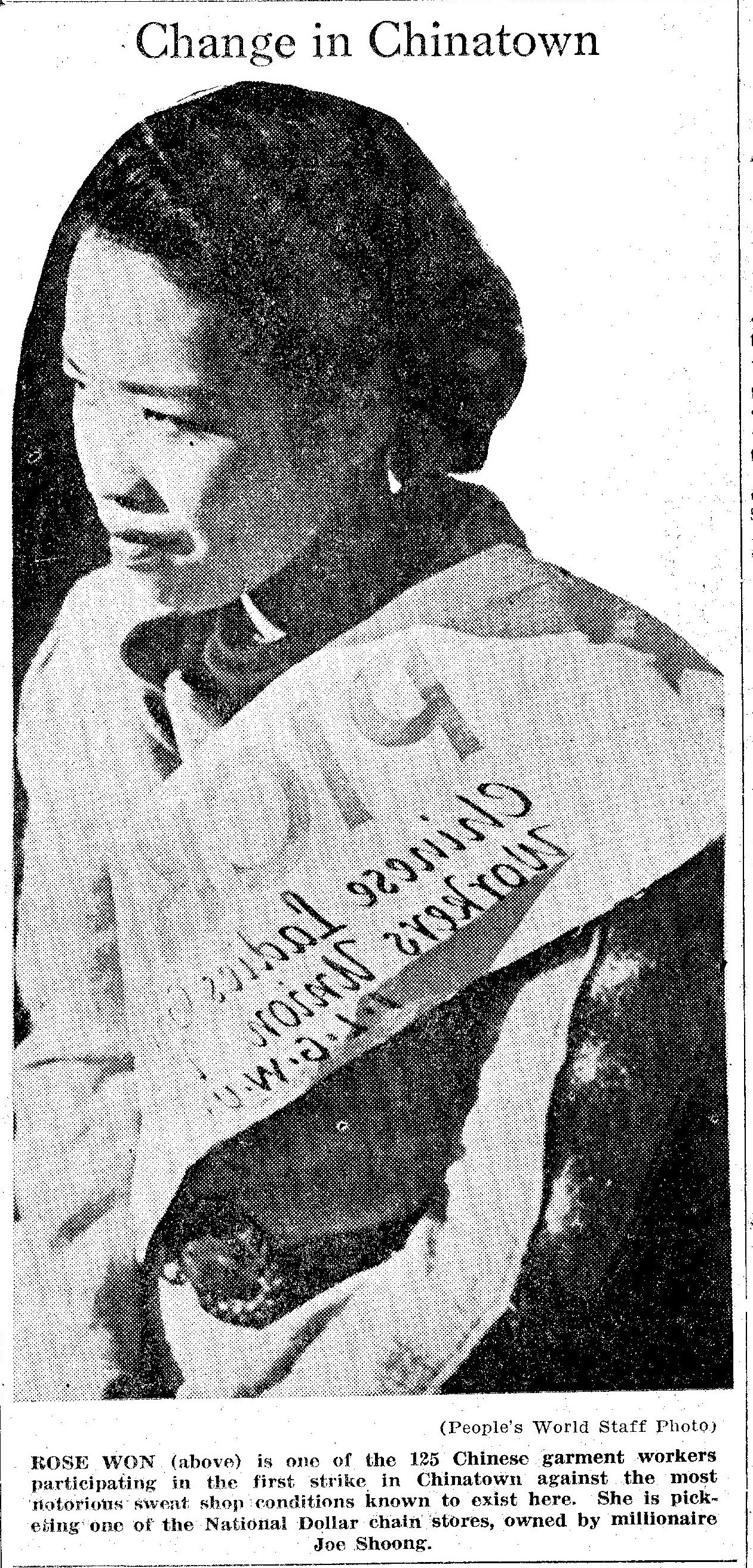
The 125 strikers, makers of low-priced dresses and cloaks sold in the National Dollar Stores, are seeking $20 per 35-hour week and recognition of their union, the, Chinese Ladies Garment Workers Union, Local 341 of the CIO union, ILGWU.
Their employer, Joe Shoong, millionaire Chinese chain store owner and manufacturer, has been paying them $13.33 per 40-hour week.
Shong, a pillar of Chinese-American society, is a shining example of the immigrant boy who “made good.” His 38 red-front stores are placed in all of the western states, the farthest one east being in Kansas City, Mo.
Shoong Tricks Employes
Despite his good reputation, however, he attempted a fast play on his workers that resulted in the strike.
Organized in November, the workers won an agreement from Shoong on January 25 after a decision by the San Francisco Regional Labor Board had named their union as the collective bargaining agency.
No sooner was the agreement signed, establishing $20 per 35-hour week and the closed shop, than Shoong asked for a postponement. This the workers granted, thus giving Shoong time to “sell” his factory.
The union claims the sale was a fake. Two of the new “owners,” they say, were employes in Shoong’s enterprises.
The sale, however legal it may look on paper, has shocked China- town. No one there doubts that the former “shining example,” Shoong, has used a shoddy trick to break a promise to his workers.
Stores Picketed
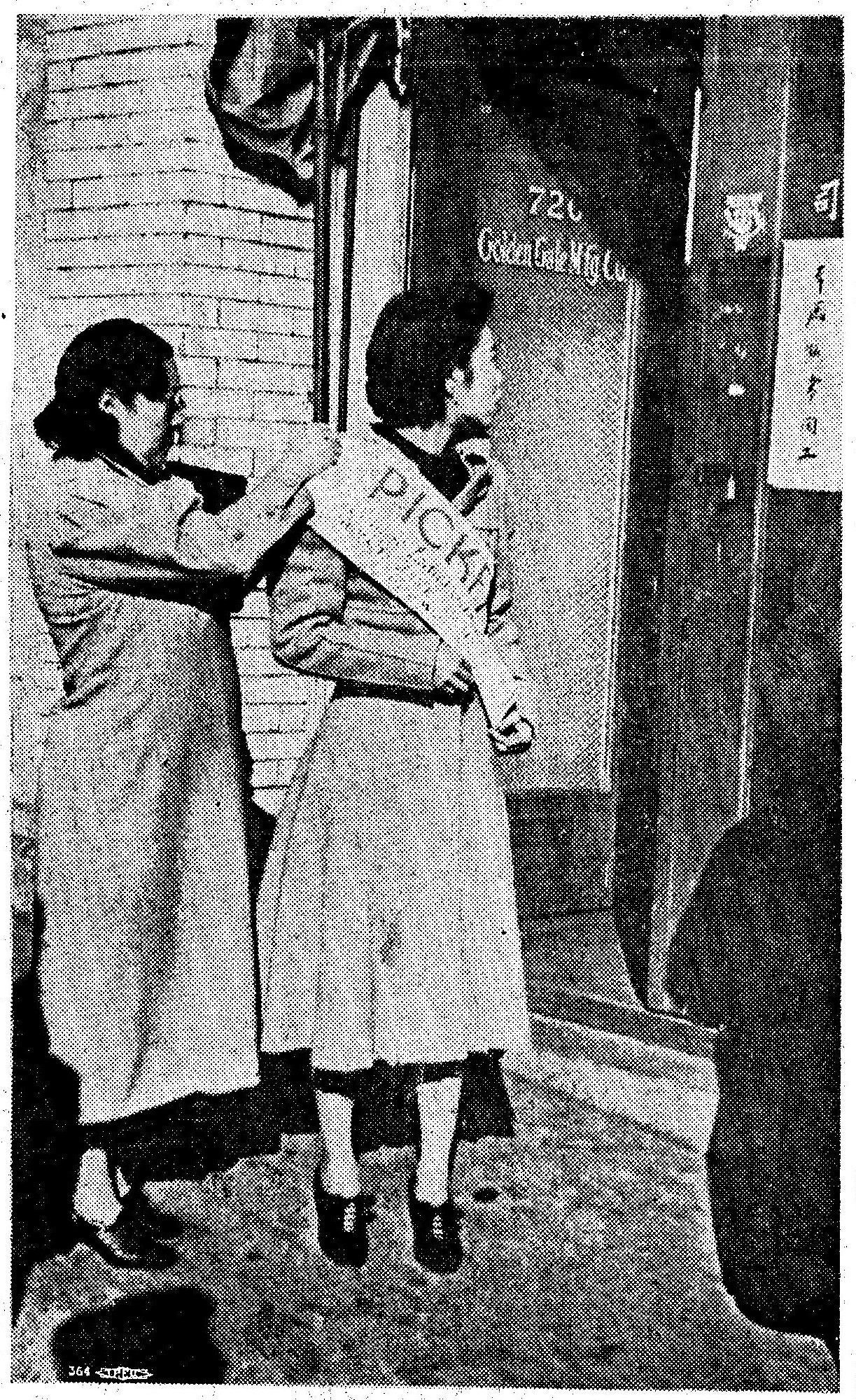
The strike was called last Saturday after repeated attempts to make Shoong live up to his agreement. Picket lines were thrown across entrances to the San Francisco Dollar Stores as a means of notifying the public of scab conditions in the factory.
At that point another splendid instance of rank and file labor unity occurred. The sales girls in the Dollar Stores, members of the AFL retail clerks’ union, refused to cross the picket lines!
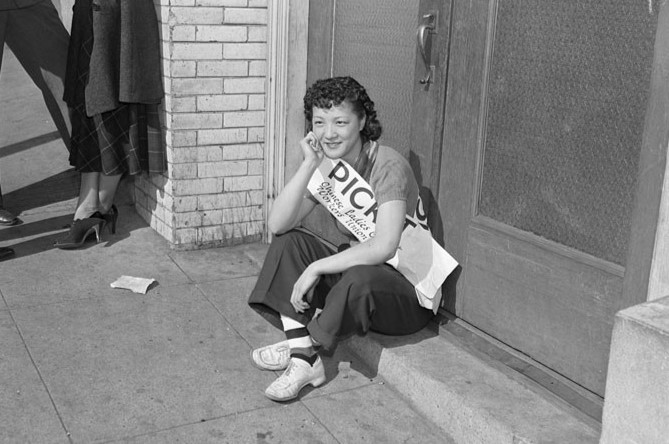
To see the pretty girl pickets, some in native Chinese costumes, laughing gayly as they munch on American doughnuts, one would never guess the broad significance of their strike to San Francisco labor in general and Chinese labor in particular.
Answer Old Question
It is rather on the traditionally blank faces of old Chinese who now stop to stare in stunned amazement at the pickets, that the epochal nature of the strike is most clearly revealed.
The first important question of whether or not Chinese workers can be integrated into the Ameri- can labor movement has been answered.
Jennie Matyas, local organizer of the International Ladies Garment Workers, a battle-scarred veteran of scores of strikes, cannot praise the Chinese highly enough:
“They are wonderful! Such wonderful people,” she says, after having observed them for the past few days. “They have overcome their traditional shyness to fight for their rights.”
Unionism at Stake
An important issue at stake is the eventual unionization of the several thousand workers in Chinatown.
In addition to thrills for tourists, the narrow, dimly lighted alleys in Chinatown are known to shelter small shops and factories where conditions of human exploitation range from the blackest of out-and-out slavery upward to “coolie wages,” with hours ranging from 10 to 14.
The obscurity of things Chinese have long given the Grant Avenue section a peculiar charm for those in search of art objects and exotic cooking. But this same obscurity has operated to baffle labor groups who have attempted to establish good conditions in certain lines.
In the past numerous cases have come to light of unscrupulous employers paying $1000 for workers who have been smuggled into America. Since the practice is of course illegal, the employer has been able to do as he will with his alien help.
Cousins Baffle NRA
Immigration authorities have confided that this practice still goes on, though obtaining evidence is practically impossible.
During the NRA period, the government attempted to bring about. an improvement of conditions in Chinatown, but with practically no success. Investigators were baffled by quick-witted Chinese with their inscrutable “no savvy,”
The insistence of an employer that his shop full of workers were his cousins (and all of the “cossins” would agree to this-had the NRA licked, for cousins could work any hours they chose on the theory they were part owners.
The question of what to do is known to have been forwarded to Washington. General Johnson, who at that time seemed to know all of the answers, gave up when asked, “When is a San Francisco Chinese cousin not a cousin?”
The strike of the Chinese garment workers has won the support and sympathy of San Francisco labor, and victory is expected. Such a victory will doubtless inspire other Chinese workers to shake off the poverty which has characterized them in the past.
The People’s Weekly/Daily World continued Western Worker, Western Worker was the publication of the Communist Party in the western United States, focused on the Pacific Coast, from 1933 until 1937. Originally published twice monthly in San Francisco, it grew to a weekly, then a twice-weekly and then merged with the Party’s Daily Worker on the West Coast to form the People’s Daily World which published until 1957. Its issues contain a wealth of information on Communist activity and cultural events in the west of those years.
PDF of full issue: https://www.marxists.org/history/usa/pubs/peoples-world/v1n52-mar-02-1938-PDW.pdf
 Revolution's Newsstand