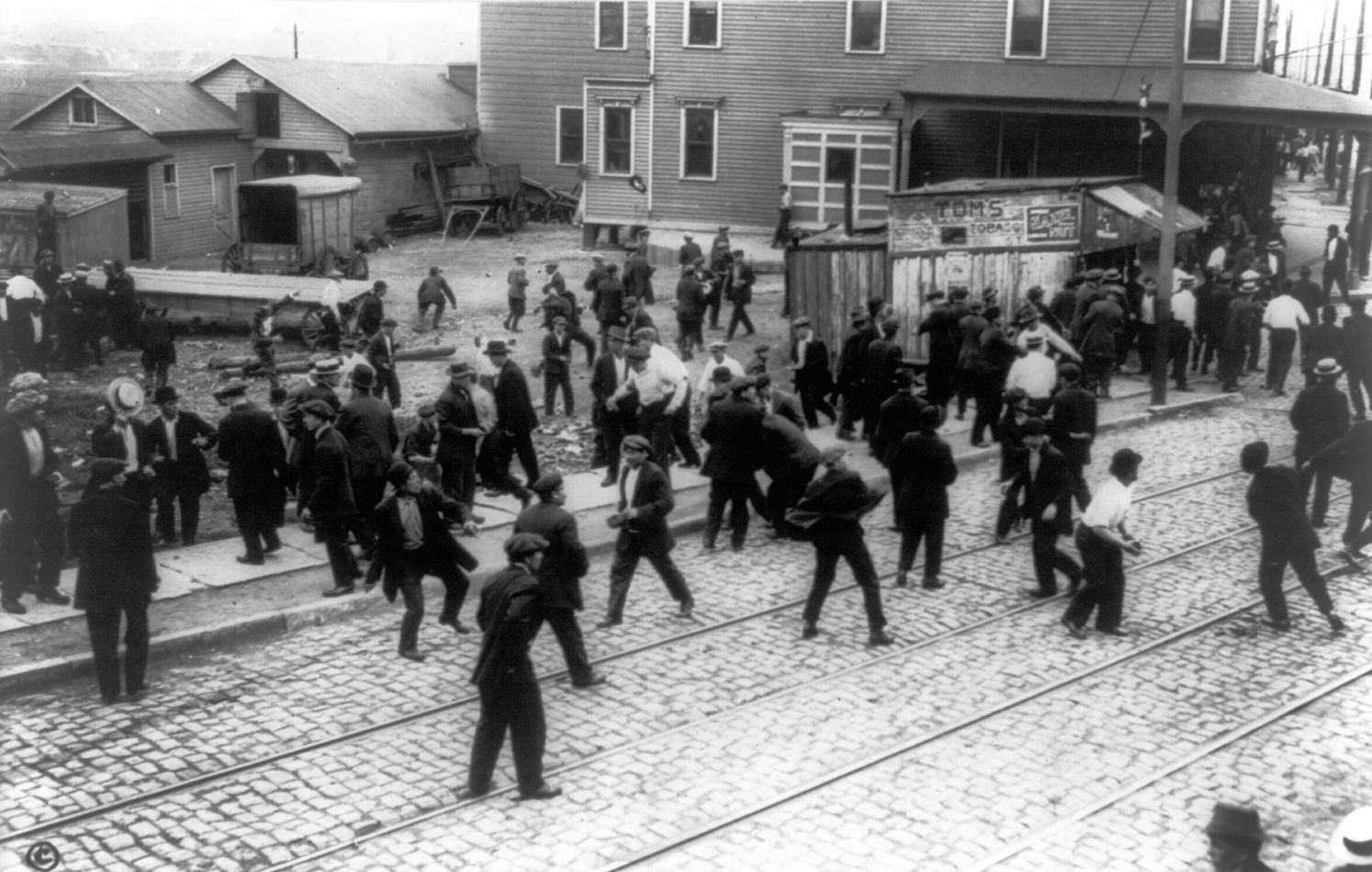
The story of getting Socialist papers into the strike zone at Bayonne, New Jersey in July, 1915. Thousands of largely Polish workers, doing 6-day, 84-hour weeks for $2.50 a day, and without a union, struck John D. Rockefeller’s Standard Oil and Tidewater Petroleum. Intense violence between local police, security guards, ‘deputies’ and strikers with their supporters lasted 8 days, with several refineries burnt to the ground. Eight-six workers wounded, and five killed. The strike ended with the Governor ordering mass arrests of strikers and security guards, while refusing to call out the National Guard. The workers won an 8-hour day and a small increase in pay. The following October, the strike was on again and for two weeks riots raged, with four workers dead and hundreds injured. This time, with no concessions.
‘Bare Fists at Bayonne Cannot Overcome Power of State’ by Chester M. Wright from The American Socialist. Vol. 2 No. 5. August 14, 1915.
Sheriff Kinkead Broke Strike At Bayonne for Standard Oil–Eight Thousand Poorly Paid Men and Boys Face Rockefeller’s Hired Gunmen with Bare Fists But Cannot Overcome Power of State.
The strike at Bayonne, N.J., is over, but the class struggle has just begun in something of a conscious manner.
In the neighborhood of 8,000 poorly paid men and boys threw down their tools and walked out of the Rockefeller plant in Bayonne. They had no organization; most of them didn’t know anything about revolution, almost none of them knew anything about philosophies of any kind. They merely knew that they were battered. and beaten and starved to the point where they could stand it no longer.
It was the savage turning of the primitive, driven to the limit.
But it was a turning that brought with it such an example of sublime courage as we seldom see. These men shook their bare fists in front of loaded guns. And had they developed a leader big enough they probably would be on strike today.
Jeremiah Baly, a mere lad, slight and almost frail, went over from Elizabeth to see what was going on, intending to write something about the strike for the Elizabeth Issue, the Elizabeth Socialist weekly.
Baly is a clean young chap, member of the Y.P.S.L. and liked by his comrades. Sheriff Kinkead, the czar of the strike, was making a speech when Baly arrived at Bayonne. Kinkead was hammering the doctrine of capitalism into the strikers. Baly asked some questions of the sheriff. And the strikers admired his pluck so much that they elected him a member of the strike committee.
Later the committee elected him chairman.
WANTED TO BE OF SERVICE.
And here is a peculiar thing. The strikers thought, evidently, that Baly was a striker.
The sheriff says he thought so. And Baly thought that as long as he could be of service, that was the main thing, so he said nothing about not being a striker. His big idea was to be of service.
Kinkead then began to explode. Never has the east seen a man so erratic, so bereft of all sense, so literally a bull in an industrial china shop. He commandeered all the police of the county and even the firemen. He gathered up an army of a thousand men.
He gathered the strikers into a hall, posted police at all doors, would allow no one to speak without giving name and address. He called for an American flag, which he draped behind him. Then pointing to it, he told the audience in melodramatic fashion that the flag stood for the greatest nation on earth and that all of the great power of that nation was back of him. Then he said: “I no longer ask you; I COMMAND YOU to go back to work.”
Before this meeting he had pounced on Jerry Baly, beaten him up and thrown him into a cell. With their leader gone Kinkead ran things with a high hand. But even so, at this afternoon meeting where the flag was waved for Standard Oil and Profit, the men voted not to go back to work. It was later in the day, when they realized to the full the hopelessness of their position, that the men decided to return on the promise that Rockefeller would consider and adjust their grievances within ten days. KINKEAD BROKE THE STRIKE FOR STANDARD OIL!
During the first stage of the strike Standard Oil and its subsidiary, the Tidewater company, herded the gunmen from New York into their barricaded plants. Almost a thousand armed guards were placed in these two plants. They were well fed and well housed. Also they were paid $3 a day in addition to food, lodging and ammunition.
These guards killed four men. The fourth victim died on the day the men went back to work.
BRICKS AND BARE FISTS.
Against the reckless firing of the guards the strikers fought back with bricks and bare fists. So reckless was the firing of the Rockefeller assassins that their bullets pierced walls of houses all around the plant. They knew no law but the law of the jungle. And so their guns barked out savage but well paid defiance to the strikers and to everything that stood for decency.
Between this terrible gunfire and Kinkead’s equally brutal and lawless conduct the strikers gave in. But Kinkead was the chief factor. He broke the strike. The strikers would have stood against the guns of the Rockefeller pirates, but they knew they couldn’t hold out against the great powers of the state.
In the midst of all this The Call came in for a share of Rockefeller’s displeasure. At the first shot The Call jumped in to help the strikers. It sent one of its best men to the scene and kept him there. He was J. Charles Laue, one of the best men on the Socialist press in America. He was under fire with the strikers. So was Robert Minor. Minor went to the scene so that he could picture it more powerfully. Both these men saw strikers shot and beaten. Their stories make the blood run hot in rebellion at such atrocities. But their pictures of the courage of the strikers make one glad that there is such courage.
The Call’s news reports were so complete and its whole tone so vigorous, Minor’s cartoons were SO powerful and inspiring, and the workers of Bayonne read the paper so eagerly, that Rockefeller couldn’t stand the pressure and The Call was suppressed in Bayonne.
For a week no news dealer dared display The Call for sale. Wild Kinkead probably would have beaten up any man who had displayed it. Certainly he would have arrested any so bold. The ban was absolute and effective. The Call was completely shut out of the regular channels of business. It was too hot for John.
But The Call wasn’t beaten. It shipped papers into Bayonne by the thousand while Kinkead ran rings around himself trying to find out how it was done. Let’s tell Kinkead now.
It was all so simple that Kinkead must have been very stupid on this point at least. The papers were bundled in 500-bundles. They were shipped to various points near to Bayonne and from there taken into Bayonne by varying routes and distributed through the strikers.
HOW THE CALL WON.
One day the papers were shipped to Newark, on two days they went to Elizabeth, once to Elizabethport and once to a little siding just beyond Bayonne. Fred W. Harwood was in charge of the work of sleuthing the papers into Bayonne. He was a fox too foxy for Kaiser Kinkead.
One day Harwood spent a half day in Bayonne taking papers to the strikers while two detectives tried their best to get him. But they never got near enough to arrest him. The worst part of going into Bayonne was not the simple matter of being arrested; it was the chance of being beaten up and sent to jail with broken bones. And a man who is in jail with broken bones is of little immediate use in a strike. That is the story of Bayonne. The men have gone back to work and as this is written one plant, the Tidewater, has granted the 15 per cent increase that the men struck for. A foreman that they objected to has been discharged.
And as a final dash of Kinkead’s kidding, almost the entire batch of 99 gunmen that he arrested AFTER THE STRIKE WAS OFF, were released and told to go on their murderous way.
This has been a defeat for Rockefeller emphatically so. He has been backed up against the wall. But the chief lesson in it all is that the workers must control the great FORCE of the state. For it is force that wins in strikes. Nothing else wins. There is no use glossing anything over. PURE FORCE IS WHAT WINS, however you interpret it. And so long as capital can control the force represented in the state it can beat down the men who strike. Labor must get the political control that carries with it the force of the Kinkeads of the country. Bayonne has been a dramatic example. And it has been a great lesson.
The American Socialist, edited by J. Louis Engdahl, was the official Party newspaper of the Socialist Party of America in the years before World War One. Published in Chicago starting in 1914, the Appeal continued the semi-internal Socialist Party Official Bulletin founded in 1904 which became Party Builder in1913. The American Socialist closely followed the SP’s electoral challenges, Engdahl was often an SP candidate in Chicago as he edited the paper, and took an early and prominent anti-war position. With a circulation of around 60,000 the paper was one of the leading anti-war voices in the run up to US entry into World War One. The paper was suppressed by Federal authorities, along with much of the anti-war left, in 1917.
PDF of full issue: https://www.marxists.org/history/usa/pubs/american-socialist/v2n05-aug-14-1915-TAS.pdf
 Revolution's Newsstand