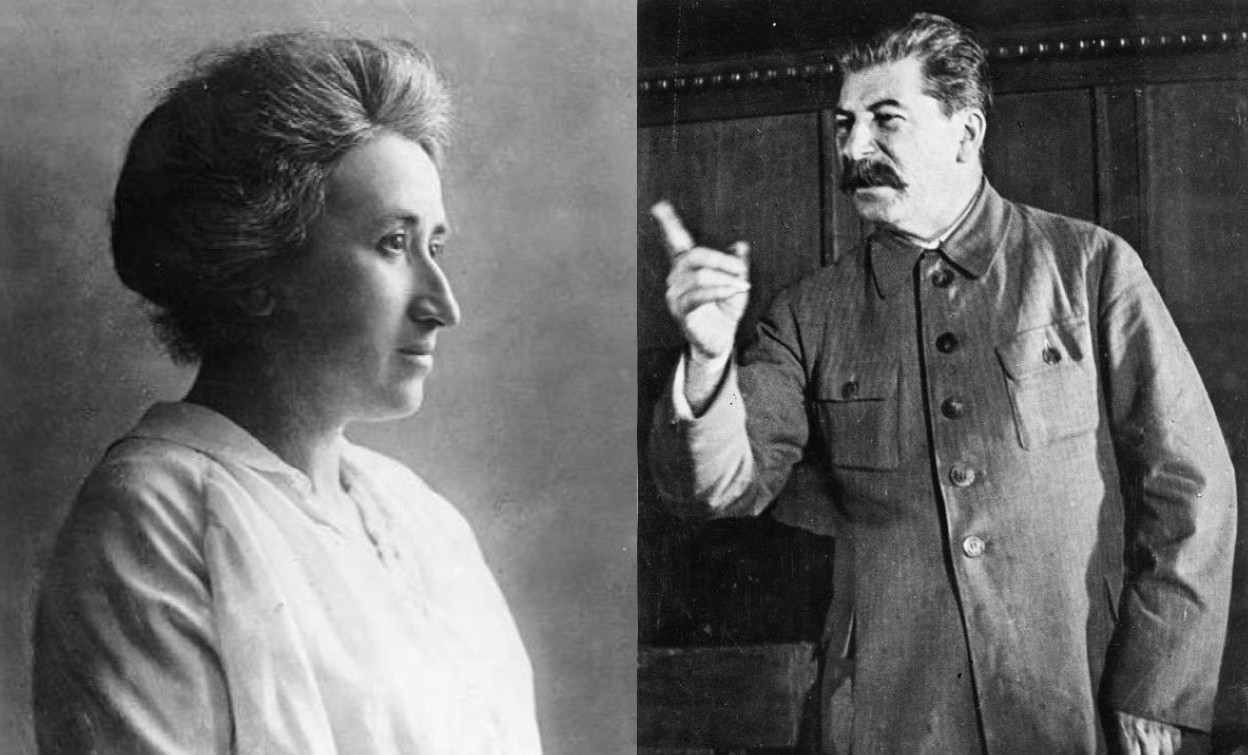
In November, 1931 Stalin began a campaign against “Luxemburgism” in the Comintern and its German section as a supposed Menshevist deviation with an article titled “Some Questions Concerning the History of Bolshevism”, quickly responded to in the German Party with a December, 1931 decision to ‘liquidate Luxemburgism’. In refutation Luxemburg’s old comrade August Thalheimer makes the obvious historical observation that Rosa Luxemburg was with Lenin, and many others, a founder of the Third International. Indeed, by definition everybody outside of Russia who founded the Comintern was not a ‘Bolshevik” at the time. Also included is an editorial Arbeiterpolitik, daily paper of the Communist Party of Germany (Opposition) defending Luxemburg.
‘Rosa Luxemburg and the Comintern’ by Arbeiterpolitik from Workers Age. Vol. 1 No. 1. January 23, 1932.
Stalin as Historian.
Not the least of the profound errors contained in the “historical letter” (as the Comintern press calls it!) of Stalin to the editorial board of the Proletarskaya Revoluzye, is the attempt to misrepresent the historical role of the German Left Radicals, the group that developed around Rosa Luxemburg. It is only necessary to recall Lenin’s words in his pamphlet on “Leftism”: “History by the way, has now, on a large, universal scale, confirmed the opinion always advocated by us, that the revolutionary German Social-democracy…was the nearest approximation to that party which is necessary to the revolutionary proletariat to enable it to attain victory. Now, in 1920, after the ignominious failures, bankruptcy and crises during the war and the first! years after, it can plainly be seen that of all the Western parties, it was the German revolutionary Social-democracy which gave the best leaders, restored itself, healed its wounds and gained new strength before all the others. This may be seen in the example of both the party of the Spartacans and the left, proletarian wing of the Independent Social-democratic party of Germany, which carry on an incessant fight with the opportunism and characterlessness of the Kautskys, Hilferdings, Ledebours and Crispiens.”
The following article is from the Arbeiterpolitik, daily paper of the German Communist Opposition.
Stalin’s letter to the editorial board of Proletarskaya Revoluzya shows that he understands mighty little about the development of and disputes within the German Social-democracy before the war. He writes, for example, that the “lefts in the German Social democracy” allowed themselves “to be heard from for the first time” in 1903-1904. But at that time, at the time of the Dresden Congress, there belonged to the “left”, that is, to those against the revisionism of Bernstein and his supporters, not only the later Left Radicals (Franz Mehring, Rosa Luxem- burg, Clara Zetkin) but also the later Centrists around Kautsky. The independent public appearance of the Left Radicals against the Kautskyites, against centrism, began only in 1910 with the debate on the mass strike.
Lenin’s Position
What was Lenin’s position at the time that the Left Radicals, under the leadership of Rosa Luxemburg, made their first public appearance against Kautsky and therewith, for the first time in Germany, took up the struggle against centrism?
Stalin (and his example is followed by the entire C.P.S.U. and Comintern press) argues as follows: 1. It is self-evident that Lenin fought against Kautsky from the very beginning. 2. Insofar as he didn’t do this, it was because the German Left Radicals around Rosa Luxemburg were miserable wretches politically. “It is not clear,” says Stalin, “that the Bolsheviki could not support the lefts in Germany without serious reservations?”
Stalin does not notice that by presenting matters in this way he is making a caricature of Lenin. In truth, things were in this position: at the very beginning, Lenin saw in the struggle of the Left Radicals an internal fight within the German revolutionary Marxist circles. But this by far did not make Lenin a centrist and he certainly did not make the least concessions to centrism, as his position in the discussions in the Russian labor movement of those days shows. For, with all his faults, Kautsky had hitherto represented a Marxist course. In 1906, in estimating the driving forces of the Russian revolution, he supported the Bolshevist standpoint against the Menshevik. In 1909, in his book “The Road to lower”, he declared that the world revolution, leading to the dictatorship of the proletariat, had emerged historically on the order of business. It is therefore quite conceivable that Lenin should have refrained from taking a position as long as his judgment had not been finally formed, when he did make up his mind it was quite different from Stalin’s viewpoint according to which the Left Radicals were really a type of Mensheviki.
In his article “the Collapse of the II International” (1915) Lenin writes of the work of Rosa Luxemburg, Karl Liebknecht and their supporters:
“In fact, there grows, becomes stronger and organizes itself a new party, a real workers party, a real revolutionary Social-democratic party.” (In those days the Bolsheviks called themselves revolutionary Social-democrats–Editor).
Here the historical role of the Left Radicals and of Rosa Luxemburg is presented quite clearly. They were the creators of the Communist Party in Germany.
The Role of the Left Radicals The decisive question in the estimation of the Left Radicals: Were they champions of a deviation from revolutionary Marxism, champions of a line leading away from revolutionary Marxism or were they the pioneers of Communism in Germany? Stalin secs in them merely the representatives of semi-Menshevism. This viewpoint stands in direct opposition to the facts as well as to the opinion of Lenin on the historical role of Rosa Luxemburg and the Left Radicals.
It has now become the fashion to represent the work of Rosa Luxemburg as a prize collection of political errors. The final touch has now been given by Karl Radek in a letter to the Pravda in which he attributes his having become a Trotskyite to the influence of the ideas of Rosa Luxemburg on him! According to the way history is written in the Communist International today, either the Communist Party of Germany arose as a consequence of long continued and obstinately defended mistakes or else, before the triumph of the ultra-left course, there was no Communist Party at all in Germany but rather a “semi-Menshevist” organization led by the “Brandlerites” as the defenders of the revolutionary services of Rosa Luxemburg. And indeed this latter conception is not at all unusual in the circles of the Party bureaucracy!
The Role of Rosa Luxemburg
In order to judge properly the life-work of Rosa Luxemburg it is not enough to declare that she differed from Lenin on many questions of the Russian labor movement, on the national question, etc. It is above all necessary to examine the viewpoint of Rosa Luxemburg on the decisive questions of the German labor movement at the great turning-points in its history. If we undertake such an examination we find that the Left Radicals were the most advanced section of the German labor movement, that at every historical turn, they took a decisive step forward in the interests of the proletarian revolution. Take Rosa Luxemburg for example. A straight line leads from her criticism of Bernstein thru her criticism of Kautsky up to her position after August 4 and finally to the formation of the Communist Party, to the Spartacus program, the program of the champions of the Soviet dictatorship on the model of the Russian October revolution.
The Bolsheviki were the first to form an independent revolutionary party. They were the first to work out the decisive question of the revolution, the concrete question of the proletarian dictatorship. The work of Rosa Luxemburg, the foundation of the C.P.G., was based on the absorption of the lessons of the Russian revolution. In the last stages of her activity she moreover dropped her original disagreement with the Bolsheviki on all questions.
The Rote Fahne speaks of the “underestimation of the role of the Party” on the part of Rosa Luxemburg. But she founded the Communist Party in Germany while the present leadership of the C.P.G has succeeded only in showing that it is incapable of learning from the rich experiences of Lenin and the Bolsheviki how to realize the role of the party!
‘The New Drive Against ‘Luxemburgism’ and the Historical Basis of the Comintern’ by August Thalheimer from Workers Age. Vol. 1 No. 6. February 27, 1932.
We publish below an article by August Thalheimer, leading Marxist theoretician of Germany, on a very important question of the history of the world Communist movement. The article is of great current significance since the distortion of the history of the Comintern, heralded to the world under the slogan of: “Down with Luxemburgism!” in the “historical letter” of Comrade Stalin, aims not only to provide an ideological cover for the present ultra-left course but also to justify the absence of a real international collective system of leadership in the Comintern (the monopoly of leadership of the C.P. S.U.), which lies at the roots of the present crisis in the C.I.
The “Luxemburgism” against which the leadership of the Communist International and the Communist Party of Germany are today conducting a drive, never had a real existence as a separate tendency in the Communist International. This “Luxemburgism” was the deliberate contrivance of Ruth Fischer and Maslow as a means of discrediting the opposition to their ultra-left course at a time when their policies were already obviously bankrupt. The present campaign against “Luxemburgism” plays the same role, with only this big difference. At that time the leadership of the C.I. took no active part in this campaign, at most it only tolerated it, and later on even criticized it in its exaggerated forms: today the Comintern is taking the lead in this drive. The anti-“Luxemburgism” is today the more intense and the more vicious precisely because the ultra-left course to defend which is the purpose of the whole campaign is more deep-rooted and widespread.
The basis of the offensive lies in the declaration that that tendency in Germany out of which the Spartakusbund and the Communist Party developed was a semi-Menshevist, semi-centrist tendency which contributed nothing towards the crystallization of the Communist International, that this crystallization was the result of the sole effort of the Bolsheviks, and that only the Bolsheviks carried on a struggle against the Kautskyan “center,” in the course of which they always had to fight the “Luxemburgians” also!
The Communist Opposition is certainly the last group in the world to deny that the contribution of the Bolsheviki in the formation of the Comintern was most decisive and most significant, that, under the leadership of Lenin, they brought to Communism more than any other tendency, and that the development of the Marxist Left would be absolutely inconceivable without the great lessons of the three Russian Revolutions of 1905 and 1917. But it must be equally emphatically asserted that it is false and dangerous to maintain that roots of Communism are to be found exclusively in Russia. And fortunately there are evidences as to the real role of the Marxist Left and later of the Spartakusbund which cannot be touched by the “historical letter” of Stalin or the scribblings of official Party historians.
For lack of space it is impossible to quote all the various remarks of Lenin during the war; we limit ourselves to one single piece of evidence, namely the material provided by the foundation congress of the Communist International (March 2-6, 1919).
The “Letter of Invitation to the Communist Party of Germany (Spartakusbund) for the First Congress of the Communist International” declares:
“13. The basis of the Third International is provided by the fact that in various parts of Europe there have already been formed groups and organizations, standing upon a common platform and applying the same tactical methods. These are in the first place the Spartakus-people in Germany and the Communist Parties in many other countries.”
And, in the” Resolution on the Attitude Towards the Socialist Tendencies and the Berne Conference,” it is declared:
“Already in the Second International there were manifested three tendencies. In the course of the war up to the beginnings of the proletarian revolutions in Europe, the outlines of these three groups appeared with the greatest clarity: (1) The Socialist-chauvinist tendency (the tendency of the ‘majority’)…; (2) The ‘center tendency’ (Socialist-pacifists, Kautskyans, Independents) (3) The Communists. In the Second International, where this tendency defended the Marxist-Communist views on war and the tasks of the proletariat (Stuttgart, 1907, the Blum-Luxemburg resolution), it remained in a minority. The ‘Left Radical group (the later Spartkusbund in Germany, the party of the Bolsheviks in Russia, the “Tribunists’ in Holland, the group of the Youth in Sweden, the left wing of the Youth International) formed the first nucleus of the new International.
“True to the interests of the working class this tendency raised, from the very beginning of the war, the slogan: Transformation of the imperialist war into a civil war. This tendency has now constituted itself as the Third International.”
Two things are clear here and not in occasional articles or “letters” but in the official documents of the foundation congress of the Third International:
1. that the Communist International was formed not only out of the Bolsheviks but also out of Communist groups in other countries, the chief of which was the Spartakusbund in Germany.
2. that the tendency out of which the Communist International was formed in 1919 arose already within the Second International, long before the war, and that in this process the Marxist Left in Germany played its historical role.
Workers Age was the continuation of Revolutionary Age, begun in 1929 and published in New York City by the Communist Party U.S.A. Majority Group, lead by Jay Lovestone and Ben Gitlow and aligned with Bukharin in the Soviet Union and the International Communist (Right) Opposition in the Communist International. Workers Age was a weekly published between 1932 and 1941. Writers and or editors for Workers Age included Lovestone, Gitlow, Will Herberg, Lyman Fraser, Geogre F. Miles, Bertram D. Wolfe, Charles S. Zimmerman, Lewis Corey (Louis Fraina), Albert Bell, William Kruse, Jack Rubenstein, Harry Winitsky, Jack MacDonald, Bert Miller, and Ben Davidson. During the run of Workers Age, the ‘Lovestonites’ name changed from Communist Party (Majority Group) (November 1929-September 1932) to the Communist Party of the USA (Opposition) (September 1932-May 1937) to the Independent Communist Labor League (May 1937-July 1938) to the Independent Labor League of America (July 1938-January 1941), and often referred to simply as ‘CPO’ (Communist Party Opposition). While those interested in the history of Lovestone and the ‘Right Opposition’ will find the paper essential, students of the labor movement of the 1930s will find a wealth of information in its pages as well. Though small in size, the CPO plaid a leading role in a number of important unions, particularly in industry dominated by Jewish and Yiddish-speaking labor, particularly with the International Ladies’ Garment Workers’ Union Local 22, the International Fur & Leather Workers Union, the Doll and Toy Workers Union, and the United Shoe and Leather Workers Union, as well as having influence in the New York Teachers, United Autoworkers, and others.
For a PDF of the full issue: https://www.marxists.org/history/usa/pubs/workers-age/1932/v1n01-jan-23-1932-WA.pdf
PDF of issue 2: https://www.marxists.org/history/usa/pubs/workers-age/1932/v1n06-feb-27-1932-WA.pdf
 Revolution's Newsstand