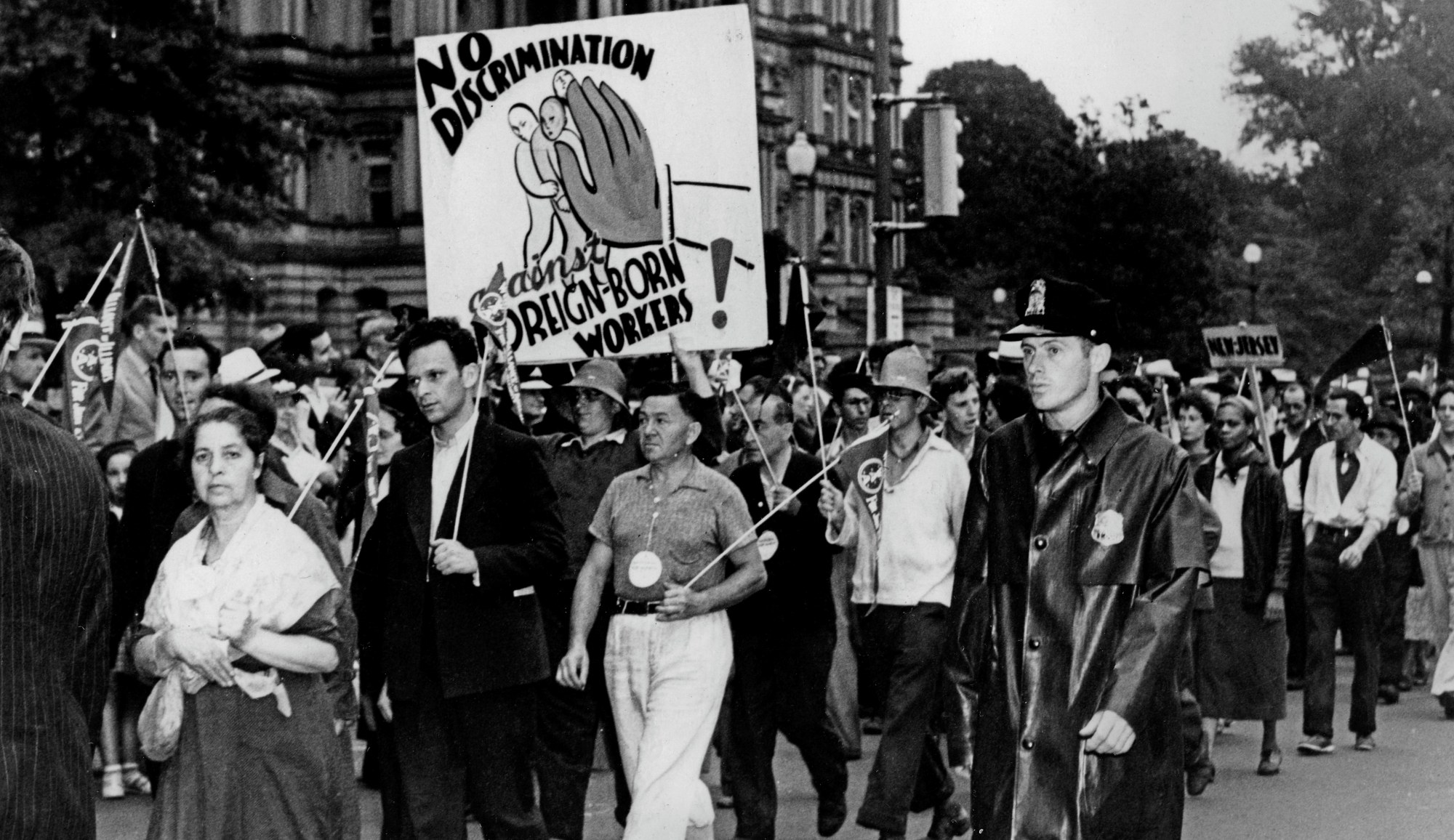
A look at both Communist Party organizing among ‘foreign-born’ workers in a period of anti-immigrant reaction, and the effect on the Party of having language and national divisions.
‘Tasks Among the Foreign-Born Workers’ by F. Brown from The Communist. Vol. 12 No. 8. August, 1933.
Comrades: At this plenum we are not going to submit a special resolution on the work in the language organizations. The resolution will have to be worked out in line with the Open Letter, in line with the discussion at this plenum and a deep analysis of our language work made by all the language buros and the district committees of the Party subsequent to this plenum on the basis of a draft resolution on language work submitted to the Central Committee as material. The material submitted to us points out in its introduction following:
“The split up condition of the American working class into various languages which the bourgeoisie has always skillfully exploited to keep the workers divided, is one of the main sources of the strength of the American bourgeoisie. With the sharpening of the crisis and the radicalization of the workers, the unity of the working class is growing but at the same time the bourgeoisie is increasing its efforts to keep the workers divided and deepen the already existing division. It is of the greatest importance for the Party and revolutionary organizations, in the interests of the unity and solidarity of the working class, that more systematic attention be given to the foreign-born work, side by side with the Negro work, and the penetration into the ranks of the native-born American proletariat. Subtle propaganda against the foreign-born workers is carried on among the native-born workers. Mass deportations are supporting this propaganda and at the same time aiming at the terrorization and intimidation of the foreign-born workers.
“Aside from these methods, the bourgeoisie is also trying to keep the foreign-born workers under the influence of its ideology. Numerous foreign language organizations, still under the leadership and influence of the social-fascist and fascist leaders among the various nationalities, are consistently carrying out these efforts of the American bourgeoisie by maintaining nationalist, religious and other reactionary ideas to prevent these workers from uniting with the American-born workers and to defend their interests. At the same time, the foreign-born workers in the United States are subjected to the most severe exploitation. They are being discriminated against in the distribution of relief, while unemployed. These conditions contribute to their radicalization and bring them to class-consciousness and closer to the struggle of the whole working class.
“Because of this, our work in the foreign language sections is of overwhelming importance. This importance is even increased by the fact that in basic industries such as coal, mining and steel, there is a predominance of foreign-born workers.”
Is this analysis correct? We have to answer yes. It is the line that the Party has been endeavoring to carry out in its language work to a great extent embodied in the resolution of the Sixteenth Plenum. However, as in other phases of the Party work, also in the language field we must state that there is a discrepancy between our correct analysis and the carrying through of the tasks.
What is the situation of the foreign-born masses of workers today? Millions of them are unemployed. Those remaining in the shops have received vicious cuts in wages, even more so than the American workers, with the exception of the Negroes, because of the fact that the largest number of them are unskilled workers. The foreign unemployed workers are discriminated against by the various welfare organizations when it comes to relief, they are discriminated and terrorized in the factories, in thousands they are losing their life savings which they have invested in small homes. The best fighters of them are under constant danger of deportation, are persecuted, arrested and deported by the thousands,
We know that millions of foreign-born workers are organized in all kinds of organizations which are instruments of their own and the American bourgeoisie because of the reactionary leadership of those organizations. The American bourgeoisie in cooperation with the ruling class of the original countries of the foreign-born skillfully carry out a policy of dividing these workers by developing nationalistic and chauvinistic tendencies and at the same time stirring up American patriotism among them. Here we have a revival of the old Maternich policy of divide and rule in the period of the “new deal.”
It is very interesting to note that while the best militants among the foreigners are persecuted, driven out from the country, where they have given their sweat and blood for years to the capitalists, the agents of the fascist countries are receiving from the American bourgeoisie all kinds of assistance, are touring the country in the interests of their fascist governments and the American ruling class. Bulgarian fascist agents, Polish fascist agents, Italians are complimented by the American authorities and made heroes in the eyes of the foreign born. Especially in the last few years can be noticed the strenuous effort by the bourgeoisie to prevent the penetration of our influence among the wide masses of foreign born workers. The following will illustrate how this policy is carried out in practice. Archbishop A. Taragoras came to this country from Greece for one particular purpose, to reorganize the Greek mass organizations, falling to pieces, making the church a basis of unity for all of them. He certainly did not come here without the knowledge of the American ruling class and its government, without a previous elaborated plan. Balbo’s flight has also a significance for the winning over of the Italian masses to fascism and Roosevelt’s support.
In spite of the reaction and the terror, we can state today that the radicalization of the foreign-born is growing. Together with this grows the Americanization process among them. This process is based on the growing class struggle of the American working class, of which they become more and more conscious of being an integral part. There is no doubt that the influence of the Party through our mass organizations is a big factor in this process. The daily struggle shows more and more foreign-born workers participating. Here it is not necessary to quote examples. Also today the capitalist press brings the news of the strike against forced labor in Rochester where thousands of the foreign-born workers, the majority of them Italians, are involved.
If we consider that the foreign born in this country, on the basis of government statistics, are 14 million—that 60 percent of the workers in the basic industries are foreign born, then we have to realize more and more the correctness of the analysis that the language work of our Party is still one of the most important tasks before us. The material submitted to us states:
“Our work in the foreign language sections is of overwhelming importance. This importance is even increased by the fact that in basic industries such as coal, mining and steel, there is a predominance of foreign-born workers.”
Looking at the strength of the mass organizations under the influence of our Party in comparison with the big masses still under the influence of the reactionaries, we must say that we are still far from being a predominant factor in the life of this section of the American working class. It is true that in the last period we can register certain achievements. Where we were able to take advantage of the growing dissatisfaction of the masses in many of the mass organizations against the fascist and social-fascist leadership—we became a factor in developing struggles. There we have to register some results. These results must be studied by us in order to be able to utilize them in all our further work in the language field. The anti-fascist movement among the Jewish masses, the movement for social insurance among the Hungarians, the strengthening of the left wing in the Ukrainian opponent organizations, the strengthening of the Macedonian anti-fascist League are an example of the smaller foreign-born sections. In general, the fact that in the last year we have to register an increase from 15 to 20 thousand members in the mass organizations under our influence, that the language press increased its readers from 10 to 12 thousand, that the mass organizations in the last six months for the first time started to seriously build youth sections that already embrace over three thousand members (American youth), show the big possibility before us if we will improve our activities in this field.
What are the main obstacles in the development of our work? The material submitted to us clearly points this out. It states as follows:
“Our work in the foreign language mass organizations suffers from a number of serious defects.
“a, A general underestimation of its importance. There is not only no regular check-up on the activities of the Party members in these organizations, but work in these organizations is not considered Party work, and is not accepted as important mass work.
“b, Lack of systematic fraction work. Because of the underestimation of the importance of this work, the organization and the direction of fractions in them are either neglected or slighted.
“c, Non-political approach. Organizations of that character under our leadership are treated not as political bodies, but as unimportant appendices that are of value only from the financial point of view.
“d. Mechanical control. Because of the financial approach to these organizations, Party leadership manifests itself in orders and in manipulations instead of political guidance. Such a method of leadership can destroy, but not build.
“e. Lack of inner democracy. The control method used by the Party, commanding, neglect of convincing, disregarding the nature of mass organizations, is still preventing the proper and rapid development of inner democracy in these organizations. Actions are generally entered upon quite mechanically without any political preparations, without winning the membership, etc.”
The comrades of the leading fractions in the mass organizations, the comrades of the language buros of the C.C., the district and section leadership know very well that this analysis is based on the wrong practices of our Party. It is for the purpose of correcting these weaknesses that these are pointed out in order that we shall be able to make the turn in this field of work. The fact that up till now very few districts have real functioning language commissions, the fact that very little effort is made to establish functioning fractions in the mass organizations, to check up on their activities, show the gross underestimation on the part of the Party with regards to this work.
In the mutual field, the International Workers Order must become instrumental for the penetration of our campaign for unemployment and social insurance among the millions of foreign born, American and Negro workers organized in the mutual aid societies, in establishing a real broad united front on these issues. In this respect the I.W.O. Convention held recently in Chicago has made a start but now it is necessary to develop with all energy such a campaign that shall arouse and reach hundreds of thousands of workers and win them over for the struggle. The experience of the United Front convention, initiated by the Hungarian section of the I.W.O. has to be studied and applied in all the sections and by the I.W.O. as a whole, and by the left wing oppositions in all the mutual aid organizations under reactionary leadership, especially in the Croatian Fraternal Union, in the large Slovenian Mutual Aid Society, in the old Lithuanian Alliance, etc. What were the demands adopted unanimously by the representatives of the various Hungarian organizations at the Chic ago Convention among which there were Catholic, Socialist workers and others: (a) struggle for social insurance; (b) government guarantee of the funds of mutual aid societies; (c) Reconstruction Finance Corporation loan for mutual aid societies; (d) release of all deposits of the societies from closed banks. This to apply to members also to enable them to pay their dues; (e) to demand a moratorium on small homeowners, that are members of the society and to endorse the demands of the other small homeowners; (f) the establishment of an unemployed fund to be able to prevent the dropping of members; (g) to organize unemployed committees to demand relief for the members and also financial aid to pay their dues, etc.
The conference also decided to establish a protective federation of the Hungarian Mutual Aid Society. This shows the possibility for the building of a broad loose movement in the form of a federation of mutual aid organizations, built on the program advanced by the I.W.O., which in practice will be a real united front of the broad masses of the mutual aid organizations, as part of the much wider united front that has to be established on this issue—under the leadership of the Unemployed Council and the Red Trade Unions.
Another fundamental problem that has to be tackled seriously is the building of a whole net of workers’ clubs, and cultural organizations, which by their character, by their program shall become real workers’ centers and schools for developing the class consciousness of the workers and draw them into the daily struggles. This is especially a fundamental problem among the Italian, Polish, German, Spanish speaking workers, Greeks, where we are at the beginning of building a mass movement, at the beginning of also enlarging the basis for the language papers of the language groups. It is through the mutual aid organizations led by our forces through the federation of workers’ clubs, that we shall be able to penetrate the broad masses of the foreign-born workers that still cannot be reached at this time directly by the Party, or the Trade Union Unity League. It is through the building of a powerful movement in the mutual aid field, in organizing workers’ clubs, in the building of the left wing oppositions which must develop struggles on the basis of their own program, that we are establishing levers, which if correctly used by our Party, will mobilize around the Party big masses out of which thousands and thousands of the best elements will be drawn into the Party and revolutionary trade unions and will help us also in strengthening the opposition in the A.F. of L. unions,
At this point we have again and again to emphasize the necessity of orientating the mass organizations under our influence towards the workers in the factories. When we consider the composition of the mass organizations under our influence, with the 100,000 members and the more thousands in the left wing oppositions, the 150,000 readers of the language press, then we immediately realize that we have already thousands upon thousands of potential forces inside of hundreds of factories in this country, among the millions of unemployed—forces that have to be utilized, made conscious of their task in the factories, and become a source of strength for the Party and the Trade Union Unity League in its factory work.
Of course, the mass organizations cannot substitute the Party in this work. But under our guidance they must become one of the factors which will help the Party in solving its fundamental tasks, rooting itself among the employed in the factories. We will succeed in solving this problem through a consistent planned work of education and not through a mechanical approach as was the tendency of simply registering the members of these organizations to make them ultimately members of the unions.
I want to point out how it is possible for the Party, for the trade unions to utilize these forces in establishing factory shop committees and shop nuclei. Let us take a steel town, as Youngstown, Ohio, or any other small industrial town. There we see that the national composition of the foreign-born workers in the mills, factories, etc., reflects to a great extent the composition of the mass organizations of the foreign workers. In the factory they are united. Their national organizations divided them. On the basis of our experiences we know also the difficulties that we encounter in our concentration work in the factories because of the rationalization, spy system, speed-up system, that prevent the workers from exchanging their views while at work, because of departmentalization, etc. This does not mean that these difficulties should prevent us from reaching the workers in the factories, to spread our agitation there, to establish our groups there, by working inside, improving on the basis of the experience our methods of work.
What I want to bring forward at this point is that the Party can find a big help for its concentration in the factories, also approaching the workers in the neighborhood of the factories. And through a correct orientation of the mass organization towards the factories, giving practically to the Party thousands upon thousands of potential connections in the industries. It is the task of the fraction to bring the mass organizations to realize that in connection with their struggle against the discrimination of the foreign born, against deportation, the struggle for relief, with the struggle for unemployment and social insurance, they have to connect also this struggle with the struggle against the stagger system, in general with the struggle against the Roosevelt “New Deal,” the Industrial Recovery Act that Comrade Browder correctly points out to be a slavery act, that the members of the mass organizations shall bring this struggle inside the factories.
In line with the Open Letter to the Party, in line with Comrade Browder’s report, the language mass organizations under the influence of our fractions will have also to work out their own plan of concentration in the concentration districts. Which means that in these five districts it is imperative to establish functioning language commissions for the coordination of the whole language work, that the district language commissions be in close connection with the language fractions and must work out the plan of concentration. For example, the Lithuanians in Chicago will have to orientate themselves towards the stockyards, for winning over the Lithuanian workers in the stockyards; all language buros of the C.C., all leading fractions in the mass organizations, will have to study the program of how to concentrate in these five districts, by sending organizers, by using the respective language press as one of the major instruments of this work. I mean that the language press has to take up the problems of the foreign-born workers in these districts, not only of the mass organizations but of the conditions of the respective communities, of the language groups in the industries, which practically means the building of a whole net of worker-correspondents that will write not only from the mass organizations but more from the shops. If this task is obligatory for all language groups, it is imperative especially for the work among the Polish, Italian and Jugoslavian masses concentrated in the basic industries of Pennsylvania, Ohio, Michigan and Illinois. The development of this work will depend a great deal on the ability of our comrades in the mass organizations to develop new cadres which has to be done by establishing schools, through bringing into leadership new elements. It is true, in the past, many comrades were taken out from the language field and put into some other Party work, which weakened the Party in the language mass organizations. Our weakness consisted at that time in not having taken all the necessary steps to replace these comrades with new elements. In my opinion in the language mass organizations under the influence of the Party, there is plenty of splendid material to be developed. The I.W.O. Convention in Chicago was in this respect a splendid example of what forces there are in the masses that can be developed. For this reason I am firmly convinced that there will be no harm to the language mass organizations, but on the contrary, a big help if in line with the turn, through the work of our fractions, we will draw in the next period into the Party, thousands of those elements that are ripe for the Party, that are following the Party line. This will not only strengthen the position of our fractions but will give elbow room for the development of new energies in the Party and among the non-Party workers.
It is necessary to bring forward more problems which are vital. As, for example, the mass organizations in relation to the program for the protection of the foreign-born, the anti-fascist struggle, the struggle against white chauvinism, the struggle against war, etc. But many of these problems are included in the Open Letter to the Party and in the material submitted to us which will have to be discussed and embodied in the final resolution.
But it is necessary to take up at least one more point, the problem of the youth. In the last three or four months, with little effort, the language mass organizations were able to build youth sections with thousands of members, which proves that this work must be developed and that the language mass organizations can be a splendid instrument for mobilizing at least part of the American youth.
I am confident that if the whole Party will realize the importance of this work and will succeed in establishing the correct relation between the mass organizations and the Party it will strengthen our fraction inside the language mass organizations so that at the next convention we will be able to speak about the experiences that made the mass organizations under our influence levers in the hands of the Party by which we reach broad masses, which will help the Party to root itself in the factories.
There are a number of journals with this name in the history of the movement. This ‘Communist’ was the main theoretical journal of the Communist Party from 1927 until 1944. Its origins lie with the folding of The Liberator, Soviet Russia Pictorial, and Labor Herald together into Workers Monthly as the new unified Communist Party’s official cultural and discussion magazine in November, 1924. Workers Monthly became The Communist in March ,1927 and was also published monthly. The Communist contains the most thorough archive of the Communist Party’s positions and thinking during its run. The New Masses became the main cultural vehicle for the CP and the Communist, though it began with with more vibrancy and discussion, became increasingly an organ of Comintern and CP program. Over its run the tagline went from “A Theoretical Magazine for the Discussion of Revolutionary Problems” to “A Magazine of the Theory and Practice of Marxism-Leninism” to “A Marxist Magazine Devoted to Advancement of Democratic Thought and Action.” The aesthetic of the journal also changed dramatically over its years. Editors included Earl Browder, Alex Bittelman, Max Bedacht, and Bertram D. Wolfe.
PDF of full issue: https://www.marxists.org/history/usa/pubs/communist/v12n08-aug-1933-communist.pdf
 Revolution's Newsstand