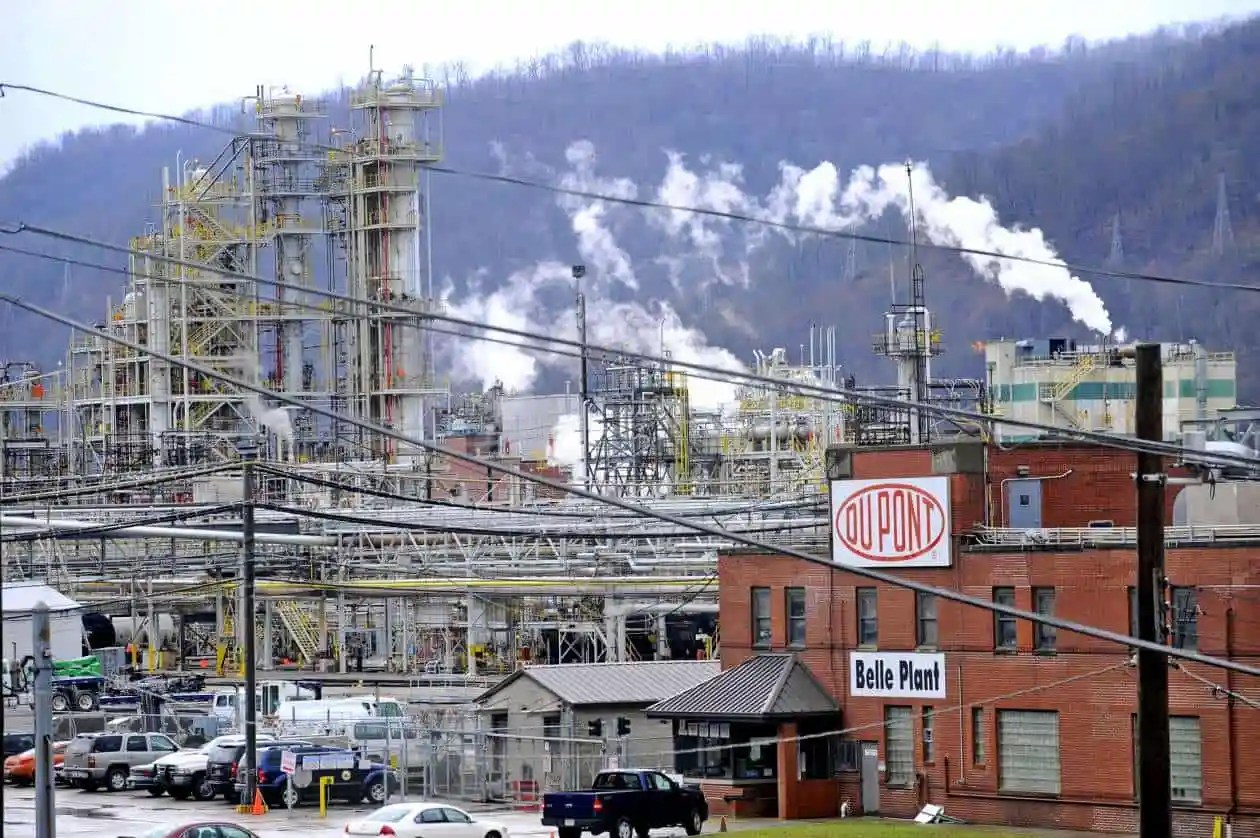
Despite regulations, testing, and oversight the du Pont corporation gets the O.K. to produce poisons on an industrial scale. John Spivak with an investigative report. Du Pont continues to be a lead poisoner of people and defiler of the planet.
‘Methanol–A Hazard in Sixty Trades’ by John L. Spivak from Health and Hygiene. Vol. 4 No. 6. December, 1936.
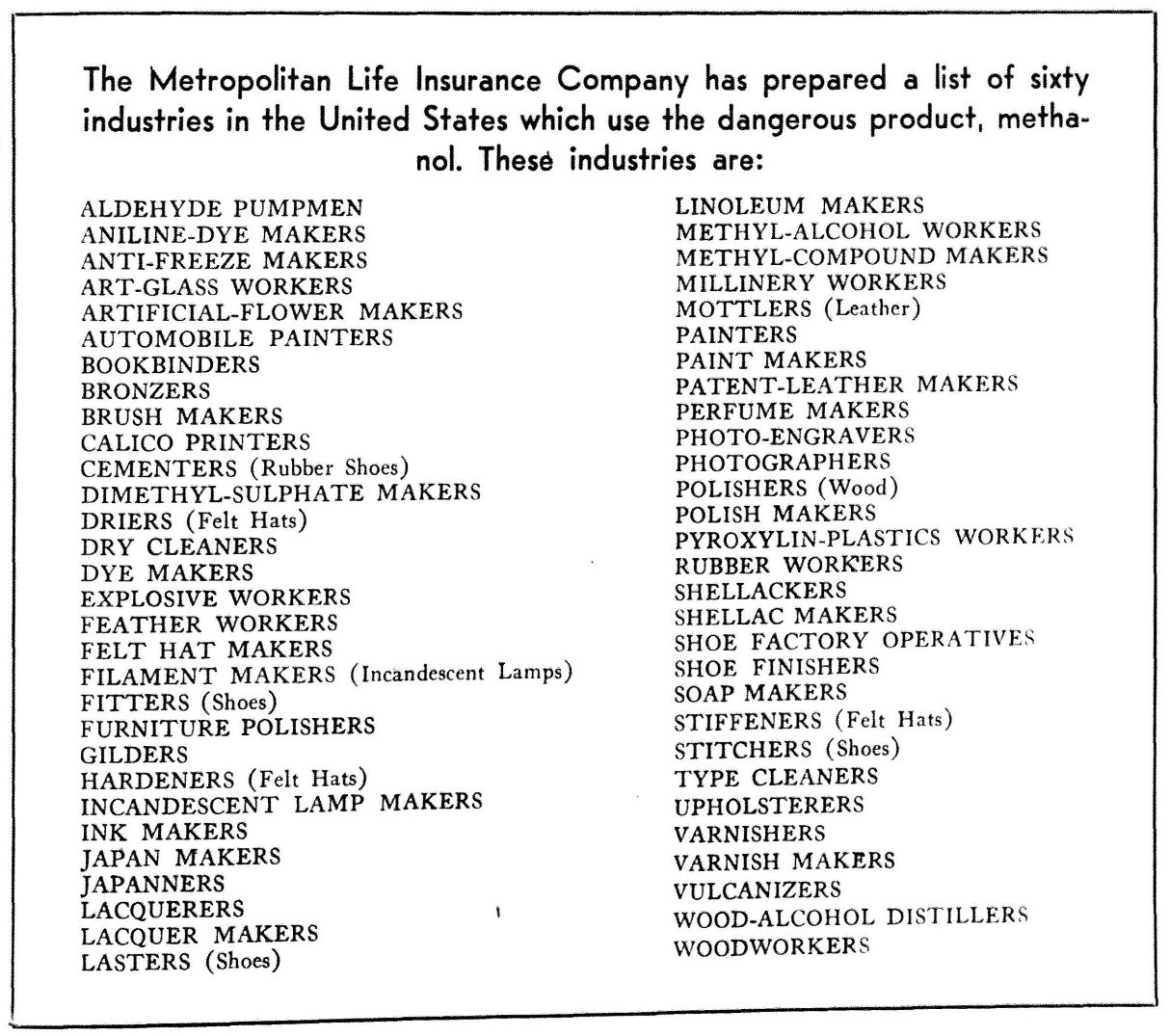
MORE than 2,000,000 workers in sixty American industries are daily endangering their health and their lives by working with a chemical product manufactured by the largest chemical companies in the United States. This product, methanol (wood alcohol), manufactured by the du Ponts under the trade name of Zerone, and by others under different names, has been denounced as a dangerous industrial hazard by the ablest medical authorities.
In putting this dangerous product on the market, the du Ponts, the Mellon controlled Carbon and Carbide Chemical Co., and the Morgan-Rockefeller controlled Commercial Solvents Corporation had the assistance of the United States Public Health Service during the Hoover administration. At the time the approval of the Public Health Service was sought and received for this hazardous product, Andrew Mellon, it will be remembered, was Secretary of the Treasury. The United States. Public Health Service is under the jurisdiction the Treasury Department.
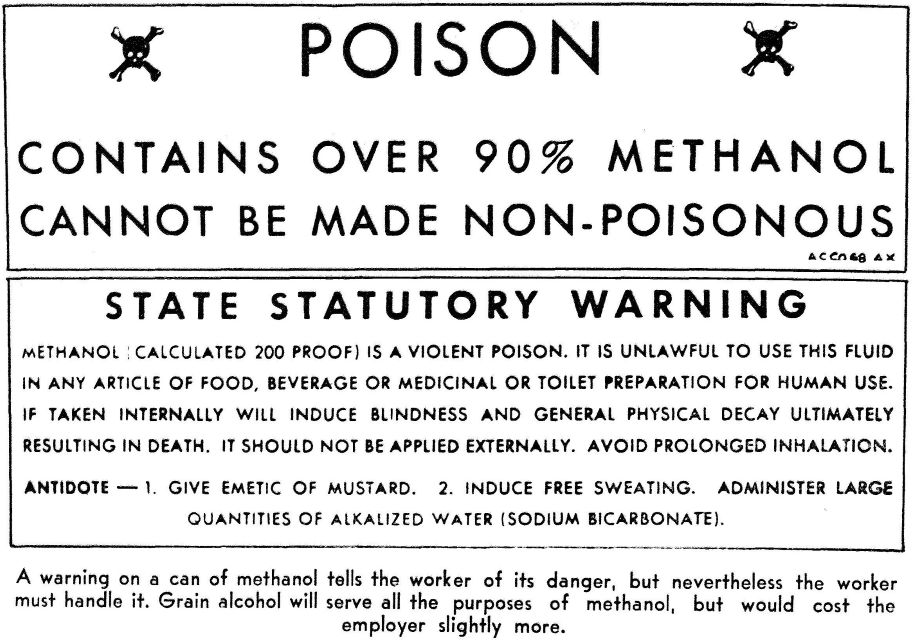
Warnings of the dangers of using synthetic wood alcohol (methanol) in industry have been made by leading scientists the world over. The New York State Department of Labor, the Metropolitan Life Insurance Co., the American Medical Association, and specialists in industrial hygiene have held that it is dangerous. None of this, however, has served to remove the pall of silence that surrounds the deal made between the leaders of the chemical industry and the United States Public Health Service which is supposed to guard the health of the American people.
As far back as 1928, the du Ponts, seeking to manufacture Zerone, for use as an anti-freeze in automobile radiators, had their own scientists carry on experiments to determine the hazard to life and health of those who would work with and handle it. The du Pont scientists reported that methanol was capable of producing degeneration of the kidneys and liver, blindness, and death when its fumes were inhaled or when it came in contact with the skin.
Despite this report, the du Ponts sought to get the government’s approval of the product, and, in cooperation with the Mellon and the Morgan-Rockefeller companies, gave the United States Bureau of Mines $10,000 to make an investigation to determine whether or not methanol was an industrial hazard. It was agreed that the du Pont and Mellon companies were to see the report before it was published and that they were also to have the privilege of making “suggestions.”
Because winter was coming on and the du Ponts were ready to put Zerone on the marker they were anxious for the government to rush through a preliminary report which could be used to persuade garage men and gas station attendants that it was not dangerous to handle methanol. As Mr. J.G. Davidson, manager of the Chemical Sales Division of Mellon’s Carbon and Carbide Corporation, expressed it in a letter to the United States Department of Commerce on March 14, 1930:
“As you know it (the industrial use of methanol) is becoming a very important matter. Methanol has decreased in price to such a point that considerable saving would ensue if it were used in place of ethyl (grain) alcohol. Before this can be done it is necessary to ascertain the minimum concentration of methanol in air that is apt to cause difficulty from the standpoint of inducing paralysis of the optic nerve.
“The problem, you will realize, is one that has an interest far beyond our own cooperation, for very determined efforts are being made to introduce methanol industrially by at least three very large corporations. We are interested in being able to tell our prospective customers that no difficulty will ensue providing that ventilation is installed so that the maximum concentration of methanol is not more than a given quantity.”
In compliance with the wishes of the chemical companies, a Bureau of Mines chemist was put to work, under the direction of the United States Public Health Service, to prepare the report. In order to rush matters to a conclusion as quickly as possible, Dr. H. Wade Rinehart of the du Pont Ammonia Corporation, on September 8, 1930, wrote the following to Dr. R.R. Sayres of the Public Health Service:
“In connection with the work on the toxicity of methanol the attached copy of an editorial from the August 30 issue of the Journal of the American Medical Association has come to our attention and we are attaching a copy of this editorial in the event that you have not already seen it. This is, of course, very damaging to our case and we would like to have your opinion as to whether it would be advisable or possible to do anything about it at this time.
“I understand from Mr. Reid that a meeting of the committee would probably be called the latter part of September. Needless to say we are very anxious to have as early as possible anything in the way of a preliminary report which can be used in support of the use of methanol in automobile radiators.”
THE experiments were rushed through as quickly as possible because the du Ponts were in a hurry to get their anti-freeze mixture on the market for their winter trade. On November 17, 1930, Dr. Sayres forwarded the desired “preliminary” report to Dr. Rinehart. “I shall appreciate it if you will review this, sending me such suggestions or comments as you desire…” said the government official to the official of the company whose product was being tested.
The du Ponts were not shy about expressing their desires. Two days later, Rinehart, on du Pont Ammonia Corporation stationery, wrote to Dr. Sayres:
“We certainly feel that this is a splendid report and that you are to be complimented on your manner of presenting the subject. On the whole we subscribe heartily to the report as it now stands but there are, as you might guess, a few points where slight changes or deletions would be desirable from our point of view.
“It would seem to us that the first two complete sentences on page 4; ‘The products which will be dispensed equivalent to that of one gallon of anti-freeze ethyl alcohol’ are not necessary as far as the report as a whole goes and it would be helpful to us if this were omitted. The fact of the matter is that the 76.5 per cent solution may not be continued indefinitely.
“We would also suggest that if it is in accord with your views of the report the first paragraph on page 5 could be omitted. We are a little fearful that this paragraph might be willfully misconstrued by some of our competitors. The most important sentence of this paragraph reading ‘there is no procedure or treatment whereby a layman or chemist can make methanol non-poisonous or even reduce its toxicity’ can very easily be included in the following paragraph as the closing sentence, if you feel it is desirable to have that sentence appear in the report.
Dr. Rinehart feared that the sentence in the report stating that the investigation was being continued “might be misconstrued to indicate that the report is being made before sufficient data have been accumulated to show that methanol can be used in automobile radiators without question of health hazard.” Strange, indeed, since Rinehart himself had asked for “anything in the way of a preliminary report”! However, since Rinehart did fear such a “misconstruction” he suggested a different wording and proposed that this part of the report close with the sentence: “Also, while there are no apparent reasons to believe danger to health, etc.”
In addition to these changes Rinehart wanted a number of others. “Our reason, he says, referring to one of these desired changes, “is that this reversal of the sentence places the favorable portion first and permits of no misrepresentation.
The closing paragraphs of Rinehart’s letter are quoted in full to show the extent of its hypocrisy:
“We would like to suggest that your recommendations Nos. 5 and 6 be entirely omitted from this preliminary report on the basis that the present report is preliminary and that a final report will no doubt be written which would most logically contain your recommendations on the matters of handling and exposure. You will appreciate that a great deal of our material has already been placed in the hands of the dealer, some of it uncolored because of the wide divergence of opinion regarding the need for, or advisability of, coloring. It would be difficult to say the least, not only for ourselves, but for some of our methanol competitors, to color material already in the hands of the dealers and since some dealers might have cleared material, a report advocating color, at this time, might embarrass them or lead them to misrepresent the material which, of course, we want to avoid.
“While we have been very free in our criticisms. and suggestions above, we want to repeat again that we feel you have done a fine piece of work on this subject and we are certainly much gratified by the report. We can only hope that the revised report will have an immediate release and that we can take it promptly to our distributors, jobbers and dealers in our first real effort to protect ourselves against propaganda which has been issued against anti-freeze methanol.”
The revised report was issued as requested, and du Pont and the others went ahead putting methanol on the market. Later, a complete report was prepared, but this was apparently unfavorable to the du Ponts’ case, for it was never published, and to this day officials of the Public Health Service profess a profound ignorance concerning it. In 1931, immediately following the issuance of the revised report, over 7,000,000 gallons, valued at $1,500,000, were manufactured. By 1935 production had increased to more than 23,000,000 gallons. The $10,000 contributed by the chemical industrialists for the investigation were well invested.
WHAT of the “propaganda” against the use of methanol which this $10,000 was spent to allay? From what sources did this ‘propaganda” issue? In the first place, at about the time that the Bureau of Mines investigation was under way state and local departments of health in a number of places throughout the country were receiving reports of methanol poisoning and issuing warnings against it. Furthermore, reputable medical journals, shocked by the callous attempts of industrialists to deny or minimize the effects of a dangerous poison, were publishing editorials condemning the use of the product. A list of the symptoms of methanol poisoning published by the United States Department of Labor, three years after the Bureau of Mines preliminary report was issued, indicates that from the point of view of the workers who were going to handle methanol, this “propaganda” was particularly important. These symptoms include headache, nausea and vomiting, vertigo, irritation of mucous membranes, severe colic, convulsions, paralysis, chilliness and cold sweats, cyanosis, loss of reflexes and sensation, irregular and intermittent heart action, rapid breathing followed by retardation, rapid and marked drop in temperature, affections of sight, including amblyopia, optic neuritis, conjunctivitis, mydriasis, nystagmus, visual hallucinations, and blindness.
Cases of workers who went blind or died as a result of using wood alcohol (methanol) in their daily work have been collected by Professor William D. MacNally, of the Department of Medicine of Rush Medical College in Chicago. Professor McNally, considered by scientists one of the country’s leading authorities on industrial hygiene, stated at the conclusion of his investigation:
“Wood alcohol can be absorbed through the skin or through the lungs, and gain entrance into the blood stream and cause the same train of symptoms as is caused by taking the alcohol internally as a beverage…With the one exception of carbon monoxide, wood alcohol is the most deadly poison used in our daily work.”
So much for the testimony of a nationally known medical scientist against the testimony of Dr. R.R. Sayres and one layman who conducted an investigation paid for by the du Ponts and other interests making enormous profits by selling methanol as Zerone and under other trade names.
The National Safety Council has published a warning to employers of what methanol means to workers in industry. It states that immediately wash the skin with plenty of fresh anyone coming in contact with methanol should clean water. If the fumes are inhaled, a physician should be called immediately. If the worker is in a room where the ventilation is faulty, he must wear a mask, and if he gets any of the dangerous product on his clothes he should change into dry garments at once. These extraordinary precautions which the National Safety Council tells employers they must take are sufficient evidence of the danger of the product.
It is true that all the dangers involved in the use of synthetic wood alcohol could be avoided if ethyl (grain) alcohol were used instead. But grain alcohol costs more than wood alcohol, and danger to workers means nothing to the du Ponts when dollars are concerned.
The United States Public Health Service, after rushing through a preliminary report on methanol in order that the du Ponts might sell it as an anti-freeze, has had six years to publish the text of the complete report. As yet this report has not appeared. Nor has the Public Health Service shown any intention of starting an impartial investigation of the use of methanol in industry—an investigation the report of which would not first be submitted to the du Ponts for approval. The 2,000,000 workers who come in daily contact with methanol are waiting for such an investigation.
Health was the precursor to Health and Hygiene and the creation of Dr. Paul Luttinger. Only three issues were published before Health and Hygiene was published monthly under the direction of the Communist Party USA’s ‘Daily Worker Medical Advisory Board Panel’ in New York City between 1934 and 1939. An invaluable resource for those interested in the history history of medicine, occupational health and safety, advertising, socialized health, etc.
PDF of full issue: https://www.marxists.org/history/usa/pubs/health/v4n6-dec-1936-health-hygiene-ocr-n.pdf
 Revolution's Newsstand