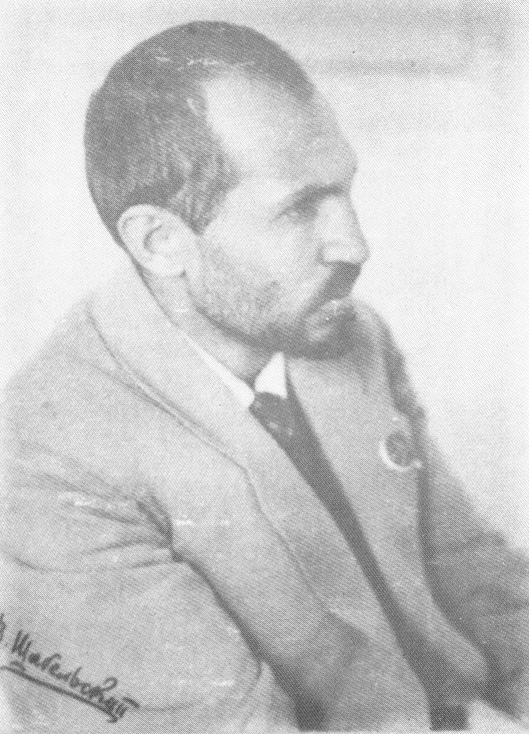
Avetis Sultan-Zade, founder of the Communist Party of Persia and member the Executive of the Comintern, speaks in the discussion on the ‘National and Colonial Question’ introduced by Lenin during 1920s’ Second Comintern Congress. In his intervention he stresses to conflicting interests in the national liberation movement and takes issue with some of M.N. Roy’s assertions. A Left Communist, Sultan-Zade was side-lined through much of the mid-20s for favoring land collectivization and hostility to the Comintern’s orientation to progressive nationalists. He returned to leadership as the Comintern moved to the ‘Third Period’, to be expelled in 1932 and later a victim of the purges, executed on June 18, 1938.
‘On The National and Colonial Question’ by Sultan Zade from Proceedings of the Second Congress of the Communist International, 1920.
SULTAN ZADE (Persia): The Second International discussed the colonial question at almost all its congresses, and adopted excellent resolutions which were never put into practice. These resolutions were for the most part discussed and adopted without the participation or representatives of backward countries. Moreover, when after the crushing of the first Persian Revolution by Russian and German executioners, the Social Democratic Party of England addressed itself to the European proletariat then represented in the Second International, in the expectation of getting support for Persia; it obtained nothing, not even a resolution. It is here, for the first time, at the Second Congress of the Third International that this question is undergoing discussion with the participation of almost all representatives of colonial and semi-colonial countries of the East and of America. The resolution adopted by our committee is fully in accord with the aspirations of the toiling masses of the oppressed peoples, especially that part of it which concerns the encouraging of the Soviet movement in those countries. At first sight, it may appear rather strange to speak of a Soviet movement in countries which are still feudal or semi-feudal. But a more careful study of the social structure of these countries will clear away all doubt in this regard.
Comrade Lenin has already spoken of the experiences of the Russian Communist Party in Turkestan, Bashkiria, and Kirghistan. If the Soviet system has brought good results in those countries, there is no doubt that in Persia and in India, that is to say, in the countries in which class differentiation has made gigantic strides, the Soviet movement is going to spread to a very wide extent.
As early as 1870 these countries had reached the climax of commercial capitalism. The situation has changed very little ever since. The colonial policy of the Great Powers, not allowing these countries to develop their own industries, has reduced them to mere markets and to sources of supply of raw materials for the Great European industrial centres. The influx of European manufactured products upon the colonial markets has brought ruination to the poor artisans and small traders, and has converted them into recruits of the ever-increasing army of paupers. In the European countries, the painful period of “primary accumulation” of capital had not lasted so long, and the rapid growth of capitalist industry has quickly converted the old artisans and mechanics into proletarians and imbued them with a new ideology. In the Orient, however, this has not been the case, and the resulting situation is that thousands upon thousands of these unfortunates have emigrated to Europe and America.
In these colonial and semi-colonial countries, there are also great masses of peasants living in frightful conditions. Feudal slavery prevails all over the Orient. A heavy burden of taxation and feudal duties weighs upon the shoulders of the suffering population. The peasants, being the sole producers, are compelled to maintain hosts of merchants, exploiters, and tyrannical officials. In consequence of the oppression they have had to live under, the masses of the Orient have not been able until to-day to create a powerful revolutionary organisation.
At the same time a great diversity of interests prevails among the ruling classes.
The interests of the landed proprietors demand the continuation of the colonial policy of the Great Powers, while the bourgeois elements are opposed to foreign interference; the clergy protests against the importation of products from the infidel countries, while the merchants find their profits in a competitive struggle. There is no concord of interests, and there can be none in a country in which one part of the ruling class depends on the market of the metropolis for the exploitation of their workers, while the other parties dream of national independence. All these conditions create a tense revolutionary atmosphere; and, in view of the weakness of the bourgeoisie, the next national upheaval may easily turn into a social revolution. Such is the situation, in a general way, prevailing in most colonial countries of Asia. This, of course, does not justify the conclusion that the triumph of Communism in the rest of the world depends upon the success of the Social Revolution in the Orient, as Comrade Roy asserts, and as a number of comrades in Turkestan believe. It is true that the exploitation of the colonies arouses a revolutionary spirit, but it is also true that it fosters a contrary spirit among the labour aristocracy of the metropolis. By yielding an infinitesimal part of its booty to a small fraction of aristocrats of labour, capitalism tries to retard the course of the Social Revolution. But even supposing that the Communist Revolution breaks out in India, will the workers of that country be in a position to sustain the onslaught of the world bourgeoisie without the support of a simultaneous revolutionary movement in England and in the rest of Europe? Certainly not. The defeat of the Persian and of the Chinese revolutions furnish sufficient evidence of this.
The fact that the Turkish and Persian Revolutions have thrown down the gauntlet to all-powerful England is not because they have become strong, but because the imperialist brigands have become powerless. The growth of the Revolution in the East has also strengthened the revolutionaries of Persia and of Turkey, for the epoch of World Revolution has begun.
The passage in the theses in which support is pledged for the bourgeois democratic movements of the backward countries appears to me to be applicable only to those countries where the movement has just begun. For in those countries where the movement has already been going on for ten years and more, or in those countries where, like in Persia, the power of government has already been attained, there it would mean leading the masses to counter-revolution. In such countries we must create a purely Communist movement in opposition to the bourgeois democratic movement. Any other attitude may lead to deplorable results.
Proceedings of the Second Congress of the Communist International. Publishing Office of the Communist International, America. 1921.
Contents: Editorial Note, Convention Call by G. Zinoviev and K. Radek, FIRST Session July 19, Zinoviev’s Opening Address, Theses on the International Situation and the Fundamental Tasks of the Communist International (Lenin), Greetings, SECOND Session July 23, Standing Orders and Agenda, Discussion on the role of the Communist Party in the proletarian revolution (Opened by Zinoviev), THIRD Session July 24, Procedural, Discussion on role of Communist Party continued (reply by Zinoviev), Theses on the Role of the Communist Party in the Proletarian Revolution, FOURTH Session July 25, Report on National and Colonial Question (Lenin), Supplementary Theses on the National and Colonial Question (Maring), Discussion America and the Negro question (John Reed), FIFTH Session July 28, Discussion on National and Colonial Question, Discussion, on the Jewish Question (Frumkina), Theses on the National and Colonial Question, SIXTH Session July 29, Conditions for entry into the Communist International (Zinoviev), Discussion on Conditions for Entry. 234 pages.
PDF of book: https://archive.org/download/2nd_congress_of_communist_international_proceedings/2nd_congress_of_communist_international_proceedings.pdf
 Revolution's Newsstand