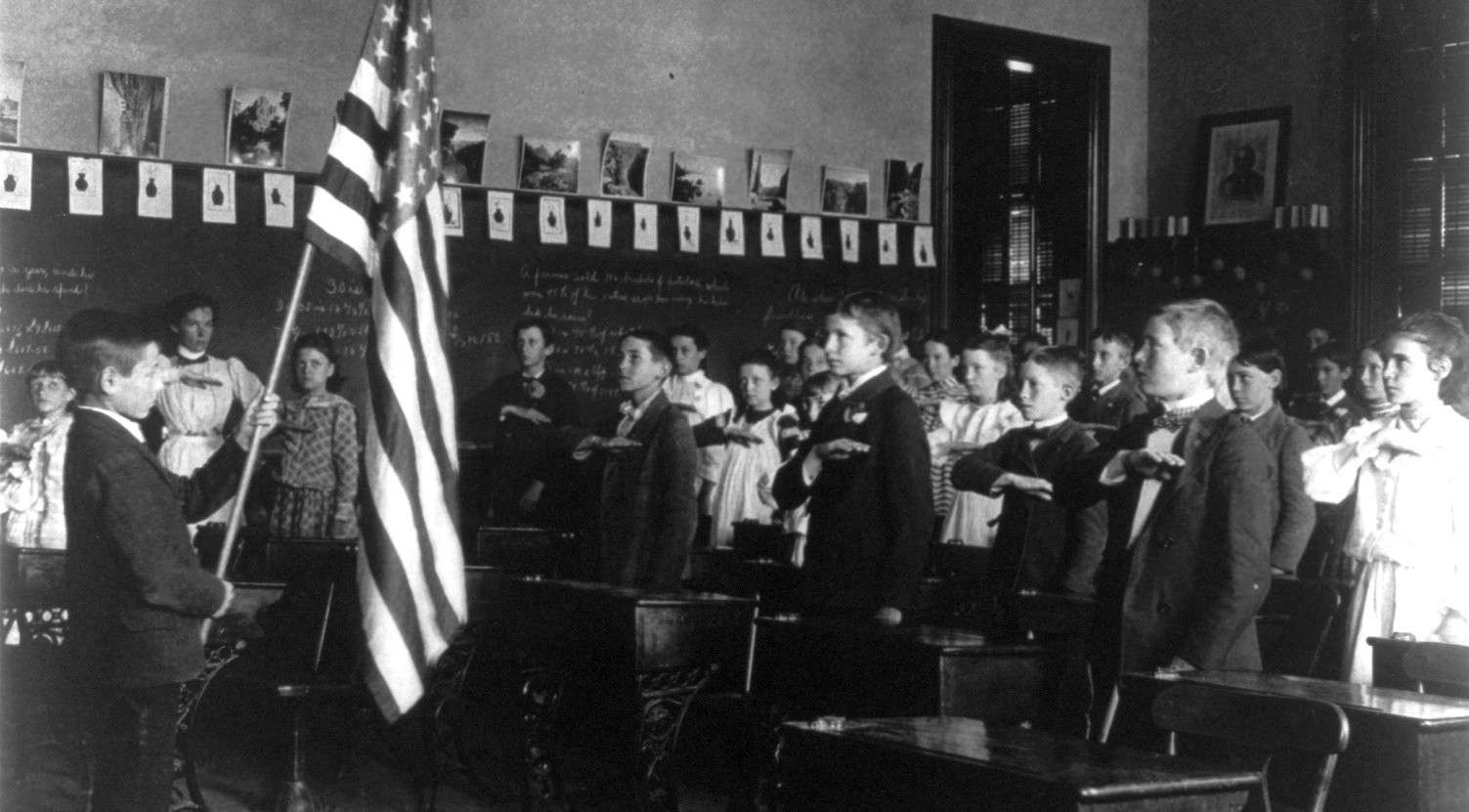
Public schools have always been a seat of intense ideological struggle.
‘Patrioteering in Our Public Schools’ by Samuel Schmalhausen from Workers Council. Vol. 1 No. 5. June 1, 1921.
Patriotism is the primitive emotion of self-glorification erected into a sham philosophy of nationalism.
The State (meaning a political clique temporarily in control of the machinery of governmental repression and coercion) is assumed to be a mystic power, in every way superior to the collectivity which it is presumed to represent.
By a process of loose believing and thinking, we come to look upon the State as “ours.” A madman’s delusion!
The State belongs to those who own the wealth and industries of the nation. Then representatives occupy the strategic positions of legislative, executive and judicial control. The plain people occupy no such positions, The State is in no honest sense theirs.
It is easy to understand why the plutocratic citizenry encourage State-worship. Their interests, economic and psychologic, are inseparable from the destiny of the State. In a very simple and literal sense, the patriotism of the plutocrats is the essence of real patriotism.
The plain people (the vast mass of the propertyless) have no “State.” Their duty it is to share the burdens, not the privileges and the strategic positions, of the State. The only group in modern society which honestly typifies the consciousness-of-kind of the plain people is The Class.
The only reason why the State (usually referred to as the Nation) is not simply alluded to as the property of the Upper Class is because so straightforward a reference would at a stroke reveal the sinister division in modern society—the existence of classes in irreconcilable opposition.
As at present constituted (judged by the laws of Profit and Prestige), the Nation is the property and plaything of a manipulating class. That class attempts to hide this truth from the common people by tabooing the specific and significant term, Class, and by popularizing the general and mystical designation, Nation (or State).
Our educational system, the plutocratic State in miniature, is charged with the duty of perpetuating the upper class mythology of nationalism. Nationalism is the pretense of unanimity and singleness of interest among the social classes. Nothing but pretense!
The most critical time for inculcating this sham conception of the State is, of course, during a period of war (or the preparation for war). The patriotism of the plutocratic State is then automatically instilled as the only loyalty of a law-abiding citizen.
Those who have a good eye for contradictions must be amused by the spectacle of an upper class and its hired employes straining every nerve to impart their brand of patriotism to a lower class that (for reasons never published by the upper class) is apparently in dire need of an allegiance that should be natural and spontaneous, but is somehow or other artificial and forced.
It is not difficult to explain why the intensest patriotism wells up naturally in the hearts of those who are especially privileged! Let us frankly acknowledge that the perfect patriot (in a society torn by class struggles) cannot be found among the proletariat.
The plutocracy as a whole yielded up its heart and soul (though not its income and control) to the patriotic requirements of the State. It never occurred to official spokesmen to inaugurate campaigns of patriotic enlightenment among those whose historic privilege it is to control the State. Campaigns of patriotic enlightenment seem to have been necessary only among that peculiarly detached section of society whose struggle for control has not yet brought the State within its grasp.
There is the perfect patriotism of the plutocrat (who controls the State and, therefore, enhances his class when he “fights” for the nation) and there is the perfect patriotism of the proletarian. This latter is a comparatively recent contribution to civilized values. In the course of the evolution of the State, it is destined to supplant the former. The patriotism which springs inevitably from the consciences of the plain people and attaches itself to ideals that promise a genuine amelioration of their hard lot is the kind of patriotism that will increasingly gain the attention of the mass of mankind. Every other kind of patriotism will be known for what it is: a species of self-destruction in behalf of irrelevant “ideals”.
Our school system distinguished itself during the period of America’s participation in the Great War by assassinating the patriotism of the proletariat and super-imposing the patriotism of the plutocracy. Unquestioning obedience to authority was the command of the ruling class. Those teachers whose intellectual attitude toward life did not permit so drastic a surrender to coercive patriotism were severely dealt with; persecution, suspension, dismissal, the spirit of the inquisition, a systematic reign of terror—these were the conventional methods and devices employed by an outraged plutocracy against the spokesmen of the new order.
The patrioteering in our public schools went so far as to jeopardize the whole historic underpinning of the constitutional guarantees of freedom of speech, freedom of press, freedom of religion, freedom peaceably to assemble and to petition for a redress of grievances. Teachers who held an “unpopular” point of view in relation to the war were dismissed. An attitude of mind, a theory of things, a hypothetical point of view in a hypothetical situation, a mere belief, any one of these was considered sufficient cause for dismissal.
Any teacher who, as part of his activities outside the class room, perpetrated the folly of writing in criticism of governmental authority or of educational authority was dismissed.
The patriotism of plutocracy thrives on the ignorance of its victims. It perverts the facts of history, because without such perversion its bloated myths would die of malnutrition. It caters to the most primitive instincts, because without such a prostitution of human nature its schemes of aggrandizement could not be realized. This is the brand of patriotism that is the arch foe of science and humane fellowship.
What is the plutocrats fear? Socialism! They haven’t the courage to express it in so many words, because they know that the philosophy of Socialism has captured the allegiance of the greater portion of civilized mankind. They screen their opposition to radicalism in general behind the bogey of Bolshevism. Nothing could serve their reactionary purposes more adequately than this newly discovered opportunity to launch their attacks upon the critical-minded by screaming, Bolshevik!
Teachers have been terrified into an unholy silence. Their hearts beat in tune with the marvelous procession of an awakened proletariat. Unorganized disorganized, timid and insecure, the radical teachers are in a desperate plight. The passionate truth locked within their souls cries out for liberation.
To whom shall the public schools belong? How much longer shall the younger generation be brought up on lies? How much longer before the common people appreciate the revolutionary function of education?
Verily, these are the momentous days that try one’s soul.
Which shall it be: the patriotism of the plutocracy or the patriotism of the proletariat? No question can be more profoundly significant.
The Worker’ Council purpose was to win the Socialist Party of America to the Third, Communist, International and later to win locals and individuals. Published (mostly) weekly by the International Education Association in New York City, Workers Council included important members of the SP, mainly from its Jewish Federation like. J. Louis Engdahl, Benjamin Glassberg, William Kruse, Moissaye J. Olgin, and J. B. Salutsky, editor of the radical Jewish weekly, Naye Welt. They constituted the Left Wing that remained in the Socialist Party after the splits of 1919 and were organized as The Committee for the Third International. Most would leave the SP after its1921 Convention, joining the Workers (Communist) Party after a short independent existence later that year.
PDF of full issue:
 Revolution's Newsstand
Wonderful ♥️
LikeLike