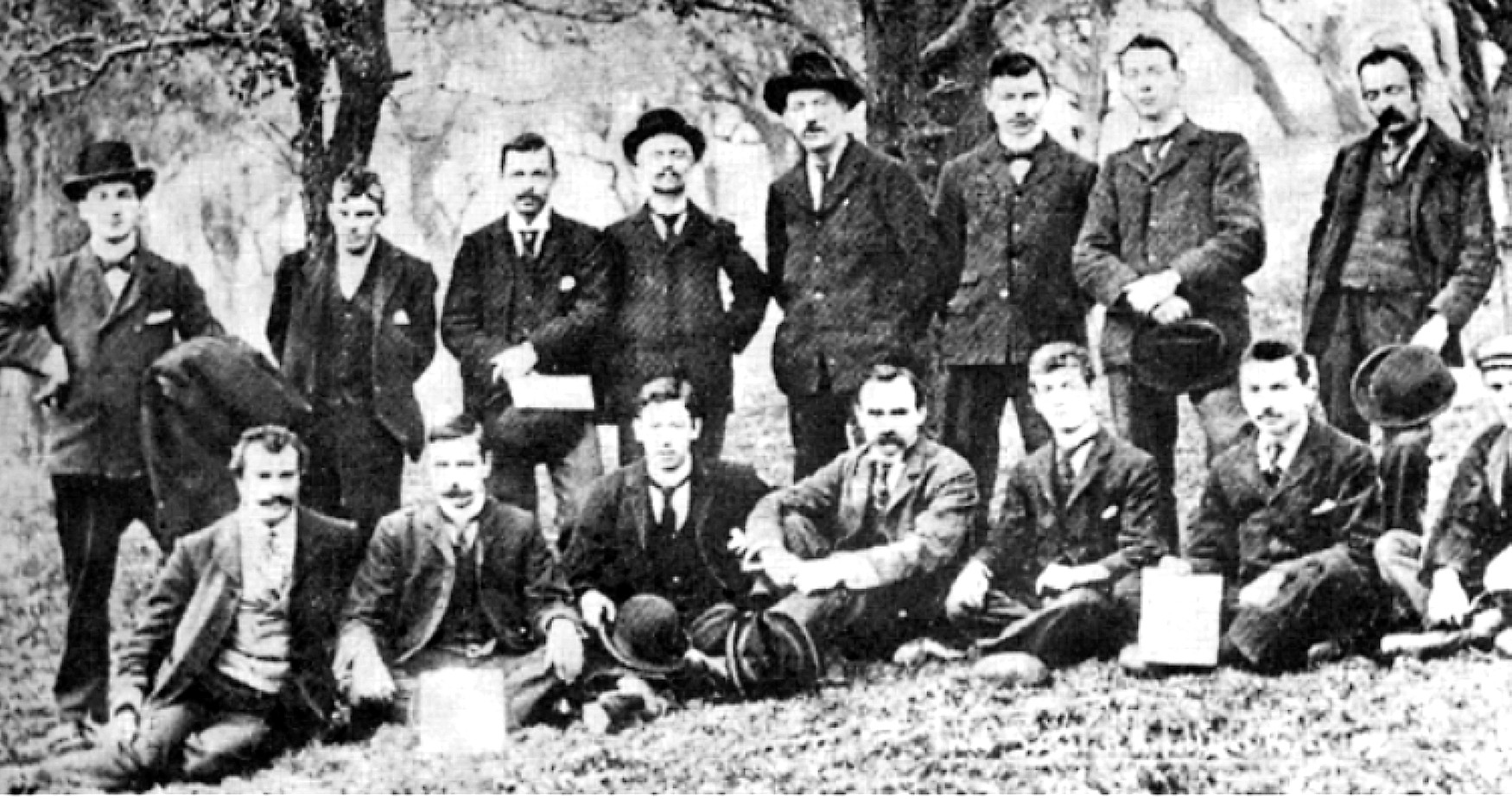
During the visit of the British Colonial Secretary to Dublin in December, 1899 James Connolly’s Irish Socialist Republican Party and others called a demonstration to “celebrate the British defeat at Stormberg” in the Boer War. Police raids, baton charges, and Connolly’s arrest follow. A full report from the I.R.S.P.’s W.J. Bradhsaw.
‘Account of The Recent “Riots” in Dublin’ by W.J. Bradshaw from The Weekly People. Vol. 9 No. 42. January 14, 1900.
Irish Socialists Hold a Mammoth Demonstration, Which Police Intervention Turns into a Mammoth Parade, to Denounce the Capitalist “Law and Order” British Government for its Assault on the Boers.
DUBLIN, Ireland, Dec. 30, 1899.-As the facts to be stated herein may be of interest to not only the Irish-American Comrades, but also to the American Comrades, I am instructed to forward to THE PEOPLE the following account of recent happenings here.
I shall begin with the following clippings from the Dublin, Ireland, “Daily Nation” of the 19th instant:
Police Raid in Abbey Street.
“After leaving Foster place a number of members of the Irish Socialist Republican Party. accompanied by a large crowd, proceeded to the rooms of the organization in Upper Abbey street. En route loud cheers were given for Kruger, and the success of the Boer arms, while the name of the Colonial Secretary was received with the greatest disfavor and booing. To the most casual observer it was quite plain to be seen from the enthusiasm and demonstrations made by the gathering that their sympathies to a man were entirely with the plucky Boers in their gallant fight for liberty. A posse of police intervened on the route and prevented the crowd from reaching its destination. Subsequently it became known that the Republican Party had determined on holding a meeting in their rooms. A large force. of police, under Inspector Dixon had previously assembled outside and in the immediate vicinity of the premises, 138 Upper Abbey street, while some men were also collected in Capel street, which is close by. Some flags which the authorities considered of a treasonable nature were displayed from the windows of the rooms. When he believed the meeting was about to be commenced it is stated that Inspector Dixon ordered the men under his command to force the door of the house and gain access to the building. The adoption of such a violent course of action, however, proved unnecessary, inasmuch as the door was not locked. Acting under the direction of their officers the police, to the number of 25, with drawn batons, rushed up stairs, and it is alleged acted in an aggressive manner. A member of the organization informed our representative that on entering the rooms at the top of the building, without the slightest reason, they proceeded to destroy a quantity of type used in connection with the Party’s publications, tear up pamphlets, and batter everything all round which came within their reach. Several of the members protested against what they termed the unwarrantable and Illegal procedure of the police. These, including a Mr. Lyng, are said to have been set upon, and the latter received very rough treatment. The inspector directed the police to seize the flags of the association under any circumstances. This order they immediately proceeded to carry luto execution, and before many minutes they were in possession of all the flags and banners in the house. The members naturally felt aggrieved at their property being taken from them by force, and in strong terms objected to the conduct of the police, but their protestations fell on deaf ears, and the flags were duly carried off by their triumphant captors. It is alleged that several, including a youngster of 11 years, were subjected to rough handling while the police were on the premises. Subsequently a meeting was held at which Mr. C.W. Stewart presided. He condemned in strong language the action of the M.P.’s who had promised to be present at the Beresford place meeting and declared that their absence was due to fear that danger might overtake them, as the gathering had been proclaimed. He also animadverted on the members of the Corporation who absented themselves from the City Hall when a resolution in favor of the Boer arms was announced to come up for adoption. He commented upon the conduct of the police in illegally entering their premises and assaulting some of their members. Mr. Quinn proposed that we, the citizens of Dublin in public meeting assembled, declare our opposition to the war of aggression in South Africa, rejoice at the crushing defeats which have overtaken the English forces, and hope that these defeats may prove the prelude of the complete overthrow of the Pirate Empire, and declare that the action of the Dublin Corporation does not represent the public opinion of the people of Dublin, and we hereby express our detestation and contempt of the brutal and wanton attack made upon the Irish Socialist Republican Party and the destruction of their property by the, force of police under Inspector Dixon. Mr. Lyng seconded the resolution, which was supported by Mr. Griffith, Mr. McManus, etc., and carried amid loud cheers. The police remained in the vicinity of the premises until after midnight.”
You will see that we are having a pretty hot time here, owing to the Anglo-Boer war. We are availing ourselves of every opportunity afforded by the incidents of it to demonstrate against and bring into contempt the institutions of capitalist” law and order.”
On the Sunday previous to the occurrence of the events described in the clippings, we helped to organize a meeting in Beresford place, Dublin. This meeting, however, was proclaimed by the very Government which is alleging as one of the reasons for invading the Transvaal Republics that freedom of speech is not allowed under them! Notwithstanding the proclamation, and the fact that, long before the time appointed for holding the meeting, about 500 police were stationed in and about the place where the meeting was proposed to be held, to enforce the proclamation, a waggonette, containing James Connolly, Editor of the “Workers’ Republic”; E. W. Stewart, manager of the paper; and W.J. Bradshaw, Honorary Secretary of the Party; Miss Maude Gonne, who is well known in America, and several other revolutionary spirits, was driven gaily and unconcernedly to the meeting place. Its appearance there was the signal for loud cheers for the “Socialist Republic” on the part of the immense crowd present, and for a fierce charge on the part of the police. The driver was ruthlessly pulled from his position on the box seat, and carried off to an adjacent police station, and the police made frantic efforts to stop the progress of the waggonette. But they “reckoned without their host,” for our gallant editor immediately seized the reins and drove the yoke right through the mass of infuriated police, amidst the enthusiastic cheers of an ever increasing crowd. Having evaded the police for the nonce, he attempted to address the monster gathering, but had only time to animadvert upon the cowardly action of the authorities, when these blessed props of a rotten system swooped down upon the waggonette again, and essayed to unyoke the horses. Failing in this, the order was given to drive the yoke and its occupants to the nearest station. When the object of the police became known to the gathering, cries of execration rent the air, and at one point a riot seemed imminent. The car, followed by nearly the whole populace of Dublin, was led to the station, but the police, probably having regard for the dangerous temper of the crowd, instead of arresting the occupants or taking the car, allowed it to pass down a street branching off from the station.
An historic procession then took place through the streets of Dublin. First came the waggonette, with the Socialists and other occupants already mentioned, surrounding it, and following it was probably the largest crowd that has paraded the streets of Dublin since the stormy times of ’67. Following the crowd was the whole available police force of Dublin along with a large number from outlying districts. As the procession triumphantly wended its way through the streets, loud and prolonged cheers were given for the “Irish Socialist Republic,” the “Social Revolution,” and the Boers, who won so bravely, breasting the powers of the most piratical empire under the sun. Cheers were also given for the terrible disasters sustained by the capitalist army, and for the “Downfall of the British Empire.” In Georges street, Comrade Connolly managed to address the crowd for a short time. He said that the fact of their meeting having been proclaimed that day ought to indelibly imprint on other minds the necessity of intelligently using the ballot and capturing the whole machinery of government in the interests of the working class. The Junkers who had originated this war prated a lot about the “outlander.” but what about the outlanders who were there that day, denied the right to express their opinions upon a question of great moment. (Loud cheers.) He moved that this monster meeting hereby declares its opposition to the criminal war now being waged by the capitalist government of England against the citizens of the Transvaal Republic; and that the action of our capitalist corporation in cowardly absenting themselves from the special meeting convened with a view to express sympathy with the Boers, in no way represents the opinion of the mass of the people. (Prolonged cheering.) The resolution, on being put to the meeting, was carried by waving of hats, cheering, and cries of “Down with the Robber Empire.” Just at this juncture the police interfered again, and attempted to stop the waggonette, but they were foiled in the attempt by the pluck of the crowd. The procession had proceeded as far as Capel street, when the clatter of hoofs was heard, and on looking back a large number of I mounted police were espied bearing wildly down upon the processionists. But the latter were nothing daunted, and stubbornly surrounded the waggonette, cheering the occupants the while. The object of the mounted hirelings was soon discovered. They wished in the first place to seize a revolutionary flag which was proudly floating from the waggonette; and, in the second place, they wished to cut the crowd off and compel the car to go in an opposite direction. This proved the crucial point of the proceedings. The officer made desperate attempts to capture the flag, but it was defended so vigorously by those in the car that for a long time he was unsuccessful until a large number of foot constables came to his assistance, and brute force prevailed.
While this was being enacted, the crowd were having a high time with the mounted constables, groaning the police and cheering the “Socialist Republic” alternately.
There is an end to everything, however, and this end of the historic demonstration came in a short time after. The crowd were manifesting in such a dangerous spirit that the police finally decided to take possession of the waggonette. Their first move in this direction was to attempt to seize the reins. Connolly would not let them go, how- ever, and he was brutally slung off the car. The rest of the occupants were treated in a somewhat similar fashion. The police had it not all their own way, however, some of them meeting the treatment which they intended for the occupants. After the capture of the car, police and people met in conflict, baton charges were frequent, and the greatest excitement prevailed until a late hour at night.
The one significant feature in connection with the whole display was the whole-hearted sympathy of the mass of the crowd–the working class–for the occupants of the car, and their intelligent recognition of the significant contest which was going on between two opposing forces, the representatives of the dominant class and the representatives of the Irish revolutionary proletariat. It thrilled one to hear the tumultuous cheering for the “Downfall of Capitalism” and the institution of the Socialist Republic. The new spirit is abroad in Ireland! Long live the Socialist Republic!
But time at last makes all things even
And if we do but watch the hour,
There never yet was human power
That could evade, if unforgiven,
The patient hate and vigil long
Of those who treasure up a wrong.
W.J. BRADSHAW, Hon. Secretary
New York Labor News Company was the publishing house of the Socialist Labor Party and their paper The People. The People was the official paper of the Socialist Labor Party of America (SLP), established in New York City in 1891 as a weekly. The New York SLP, and The People, were dominated Daniel De Leon and his supporters, the dominant ideological leader of the SLP from the 1890s until the time of his death. The People became a daily in 1900. It’s first editor was the French socialist Lucien Sanial who was quickly replaced by De Leon who held the position until his death in 1914. Morris Hillquit and Henry Slobodin, future leaders of the Socialist Party of America were writers before their split from the SLP in 1899. For a while there were two SLPs and two Peoples, requiring a legal case to determine ownership. Eventual the anti-De Leonist produced what would become the New York Call and became the Social Democratic, later Socialist, Party. The De Leonist The People continued publishing until 2008.
PDF of full issue: https://www.marxists.org/history/usa/pubs/the-people-slp/000114-thepeople-v09n42.pdf
 Revolution's Newsstand