
Karl Marx despised bourgeois hypocrisy. After Union armies liberated New Orleans in May, 1862 commanding General Benjamin “The Beast” Butler (one of the more interesting political figures of the late 19th century) issued General Order No. 28 against the propertied women of New Orleans for interfering with Northern troops. The British ruling class and its press were outraged at this violation of Southern womanhood, to which Marx replied with this blistering article for Die Presse on June 20, 1862.
‘English Humanity and America’ (1862) by Karl Marx from Civil War in America. International Publishers, New York. 1937.
Humanity in England, like liberty in France, has now become an export article for the traders in politics. We recollect the time when Tsar Nicholas had Polish ladies flogged by soldiers1 and when Lord Palmerston found the moral indignation of some parliamentarians over the event “impolitic”. We recollect that about a decade ago a revolt took place on the Ionian Islands2 which gave the English governor there occasion to have a fairly considerable number of Grecian women flogged. Probatum est,3 said Palmerston and his Whig colleagues who at that time were in office. Just a few years ago proof was furnished to Parliament from official documents that the tax collectors in India employed means of coercion against the wives of the ryots,4 the infamy of which forbids giving further details. Palmerston and his colleagues did not, it is true, dare to justify these atrocities, but what an outcry they would have raised, had a foreign government dared to publicly proclaim its indignation over these English infamies and distinctly indicate that it would step in if Palmerston and colleagues did not at once disavow the Indian tax officials. But Cato the Censor himself could not watch over the morals of the Roman citizens more anxiously than the English aristocrats and their ministers over the “humanity” of the war-waging Yankees!
The ladies of New Orleans, yellow beauties, tastelessly bedecked with jewels and comparable, perhaps, to the women of the old Mexicans, save that they do not devour their slaves in natura,5 are this time—previously it was the harbours of Charleston—the occasions for the British aristocrats’ display of humanity. The English women who are starving in Lancashire (they are, however, not ladies, nor do they possess any slaves), have inspired no parliamentary utterance hitherto; the cry of distress from the Irish women, who, with the progressive eviction of the small tenant farmers en masse in green Erin, are flung half naked on the street and driven from house and home quite as if the Tartars had descended upon them, has hitherto called forth only one echo from the Lords, the Commons, and Her Majesty’s government—homilies on the absolute rights of landed property.
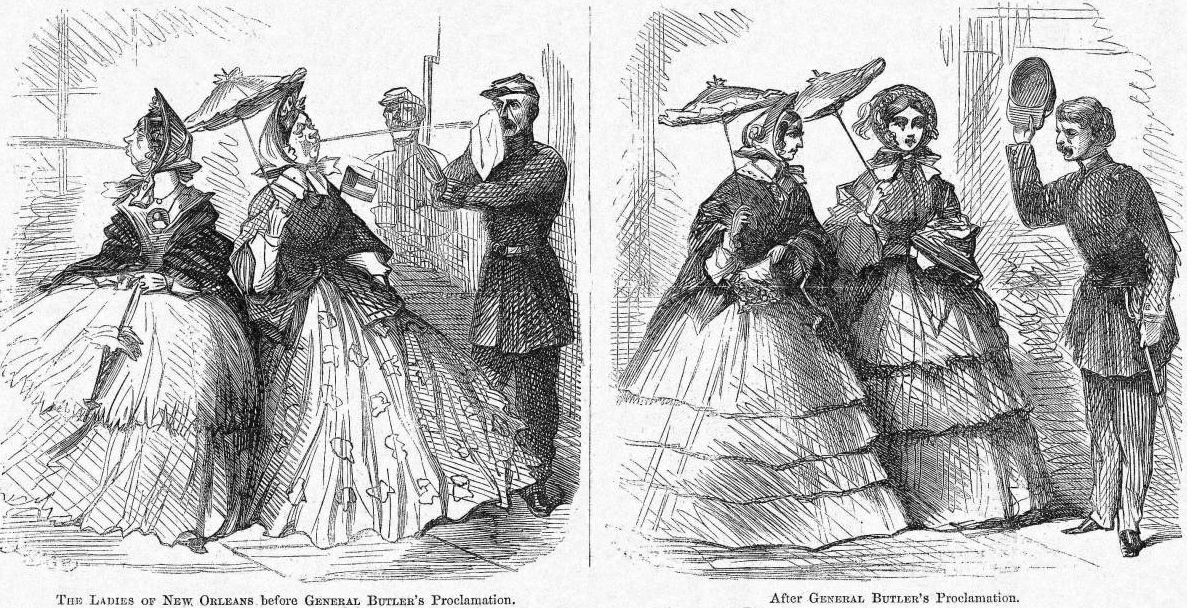
But the ladies of New Orleans! That, to be sure, is another matter. These ladies were far too enlightened to participate in the tumult of war, like the goddesses of Olympus, or to cast themselves into the flames, like the women of Sagunt.6 They have invented a new and safe mode of heroism, a mode that could have been invented only by female slaveholders and, what is more, only by female slaveholders in a land where the free part of the population consists of shopkeepers by vocation, tradesmen in cotton or sugar or tobacco, and does not keep slaves, like the cives7of the ancient world. After their men had run away from New Orleans or had crept into their back closets, these ladies rushed into the streets in order to spit in the faces of the victorious Union troops or to stick out their tongues at them or, like Mephistopheles, to make in general “an unseemly gesture,” accompanied by insulting words. These Magaeras imagined they could be ill-mannered–“with impunity”.
This was their heroism. General Butler issued a proclamation in which he notified them that they should be treated as streetwalkers, if they continued to act as street-walkers. Butler has, indeed, the makings of a lawyer, but does not seem to have undertaken the requisite study of English statute law. Otherwise, by analogy with the laws imposed on Ireland under Castlereagh, he would have prohibited them from setting foot on the streets at all. Butler’s warning to the “ladies” of New Orleans has aroused such moral indignation in Earl Carnarvon, Sir. J. Walsh (who played so ridiculous and odious a role in Ireland) and Mr. Gregory, who was already demanding recognition of the Confederacy a year ago, that the Earl in the Upper House, the knight and the man “without a handle to his name in the Lower House, interrogated the Ministry to learn what steps it intended to take in the name of outraged “humanity”. Russell and Palmerston both castigated Butler, both expected that the government at Washington would disavow him; and the so very tender-hearted Palmerston, who behind the Queen’s back and without the foreknowledge of his colleagues recognised the coup d’tat of December 1851 (on which occasion “ladies” were actually shot dead, whilst others were violated by Zouaves8) merely out of “human admiration”—the same tender-hearted Viscount declared Butler’s warning to be an “infamy”. Ladies, indeed, who actually own slaves—such ladies were not even to be able to vent their anger and their malice on common Union troops, peasants, artisans and other rabble with impunity! It is “infamous”.
Among the public here, no one is deceived by this humanity farce. It is meant partly to call forth, partly to fortify the feeling in favour of intervention, in the first place on the part of France. After the first melodramatic outbursts, the knights of humanity in the Upper and Lower House, as if by word of command, discarded their emotional mask. Their declamation served merely as a prologue to the question whether the Emperor of the French had communicated with the English government in the matter of mediating, and whether the latter, as they hoped, had received such an offer favourably. Russell and Palmerston both declared they did not know of the offer. Russell declared the present moment extremely unfavourable for any mediation. Palmerston, more guarded and reserved, contented himself with saying that at the present moment the English government had no intention of mediating.
The plan is that during the recess of the English Parliament France should play her role of mediator and, in the autumn, if Mexico is secure, should open her intervention. The lull in the American theater of war has resuscitated the intervention speculators in St. James and the Tulleries from their marasmus. This lull is itself due to a strategic error on the part of the North. If, after its victory in Tennessee, the Kentucky army had rapidly advanced on the railway junctions in Georgia, instead of letting itself be drawn South down the Mississippi on a side track, Reuter and Co. would have been cheated of their business in “intervention” and “mediation” rumours. However that may be, Europe can wish nothing more fervently than that the coup d’tat should attempt “to restore order in the United States” and “to save civilisation” there likewise.
Die Presse. June 20, 1862.
NOTES
1. The reference here is to the Polish insurrection of 1831 which was put down with unexampled savagery by the generals of Nicholas I.
2. From 1815 to 1849, the Ionian Islands were under British control; in 1849, a Greek uprising occurred there which was suppressed with great cruelty by the English.
3. It is approved. Ed.
4. Indian peasant cultivators who hold land under the ryotwari system. Ed.
5. In a state of nature. Ed.
6. During the Second Punic War, the inhabitants of the town of Sagunt, an ally of Rome, stoutly resisted the siege of Hannibal, the women fighting side by side with the men.
7. Citizens.
8. A body of soldiers in the French infantry, originally Algerians. Ed.
 Revolution's Newsstand