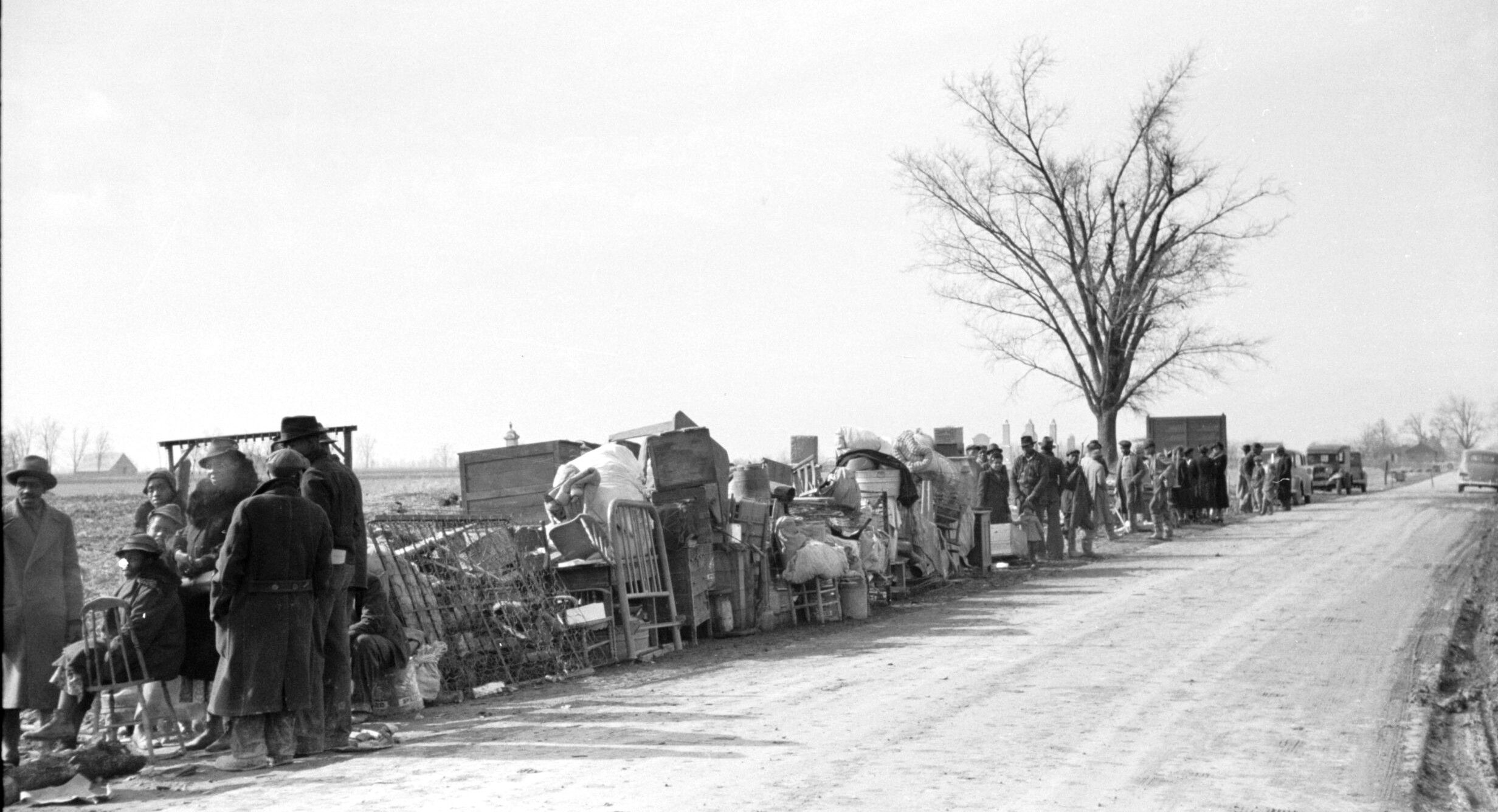
1200 evicted croppers begin a trek along the Arkansas-Missouri border with no place to go.
‘Sharecroppers Dramatize Their Plight in Sitdown on Missouri’s Tobacco Road’ from Socialist Appeal. Vol. 3 No. 3. January 21, 1939.
Police Start Drive To Break Up Sitdown
SIKESTON, Mo., Jan. 14. The State police proceeded today to break the demonstration of the Southeast Missouri sharecroppers, who have camped along U.S. Highway 60 and 61 since Tuesday, by forcing them to return to the farms from which they came.
Charging that the 13 camps established by the 1,500 croppers and their families constitute “a menace to public health,” the police took the action in agreement with the landowners but without consulting the croppers. The fact that the filth and poverty in which the latter live on the farms produce death-rates from malaria, typhoid, pneumonia and tuberculosis many, many times greater than the rates in the State as a whole is of little concern to the health authorities.
Sheer Desperation
It was in sheer desperation that the croppers camped on the highways to bring their plight to public attention. Evicted from their miserable shacks when they refused to accept a change in status to that of day-laborers, which would eliminate their one-half share of the government cotton reduction parity payment, or a reduction of their share of the crop from one half of the yearly produce to two-thirds, the croppers are now being compelled to accept the masters’ terms.
Last year the parity payments amounted to about $100 for a cropper, about one-third of his income. The laborer received from 75 cents to $1 a day for 100 to 120 days and no advanced credit from the planter to which the cropper is entitled. An increase in day laborers would bring the day rate down to as low as 40 cents for 10, 12, and 14 hours.

Already living on a level below that of the city slum dweller, the croppers revolted in such large numbers that the planters were taken off guard. Hundreds of families were unable to reach the highways for lack of trucks in which to haul their meagre belongings. The 1,500 who camped on the highways had nothing more than old, worn and tattered blankets and roadside fires to protect them from the snow and the freezing weather. Not a single regular tent could be found in all 13 camps. The scanty food which they had taken with them from the farms was consumed before the end of the first day. The two-score or more children, some no more than 5 months old, had to go without milk for several days. Children, old folks, men and women all were deliberately permitted to grow cold and hungry so that they would submit to even more wretched conditions of servitude than they experienced last year.
Promises of Relief
Governor Stark promised relief in the form of tents and foods but found one pretext after another for not supplying it. Tents could not be given without the “approval of the army.” The Red Cross found that they could do nothing since these homeless, starving people were not “in their field.” The federal authorities in control of the seven surplus commodity warehouses in this region refused to recognize the croppers’ committees and insisted that each applicant make a personal appearance and reply to a detailed and complicated questionnaire. It was several days before they gave meagre hand-outs to the croppers. The St. Louis Industrial Union Council sent much-needed truck loads of food on the third day of the demonstration.’
The morale of the croppers could not be broken by the efforts of the state and federal authorities and the landowners. The landowners, who at first scoffed at reports of the croppers’ revolt, were soon painfully astounded by the response and organized their reactionary campaign against the movement. At Charleston yesterday (Thursday) they adopted a resolution which stated, “that the government relief and charitable agencies [should] refrain from encouraging this movement by giving aid and assistance.” State Senator James C. McDowell, a local land-owner, blamed “agitators” for the “damnable scheme” and called for an investigation. A similar resolution was adopted on the same day by a meeting of landowners in New Madrid.
Whitfield Threatened
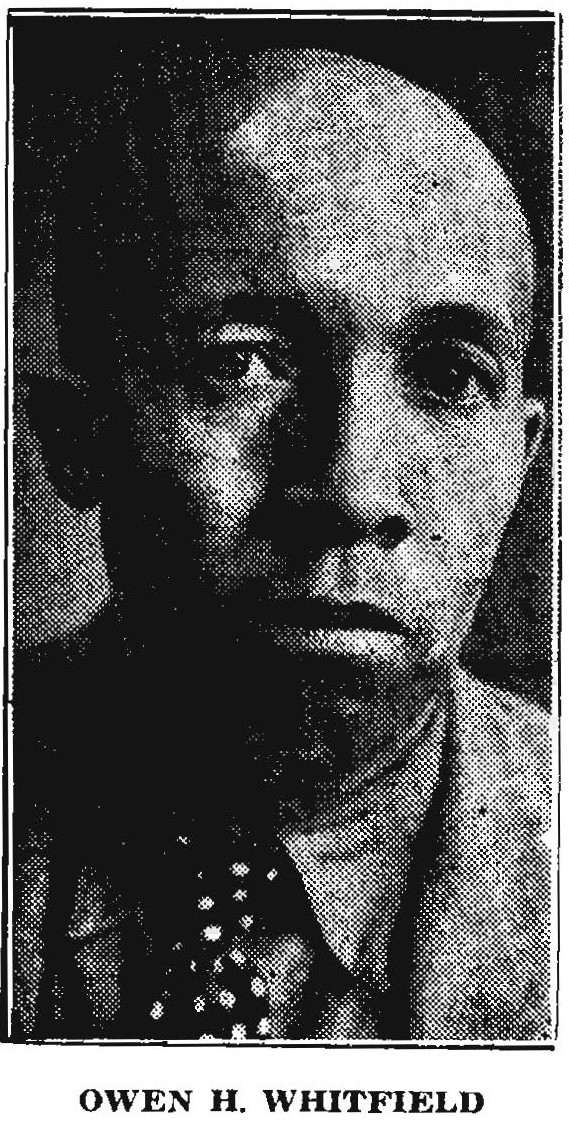
Threats of violence against Owen H. Whitfield, local leader of the croppers and vice-president of the Southern Tenants’ Farmers Union, were made by the planters. He left the field and is now in St. Louis seeking assistance for the croppers. Today, when J.R. Butler, president of the Union sought to advise the sharecroppers, he was “escorted” by the state police to the Missouri-Arkansas border. At present the croppers are without any leadership.
The landowners, insurance companies and individuals, however, prefer that the croppers produce profits for them while they are stricken with starvation and disease by malnutrition and unsanitary conditions. The landowners have received some benefits from the cotton-reduction plan of the Roosevelt administration. The law which provides for a reduction of cotton-crop acreage and government payments neither provides for the croppers and laborers who are thus thrown out of work, nor contains a safeguard against the conversion of croppers to laborers, that is, against depriving the croppers of their share of the parity payment.
Press for Action
The evicted croppers here expected that the federal authorities, witnessing their plight, would establish rehabilitation projects for them similar to the one existing near here, at La Forge. There, 100 families have been settled on about 67 acres of land and a loan of $7,000 each and have cooperative stores and community cultural life. Plenty of land is available for such projects. However, the government will make no move unless compelled to by the organized efforts of the labor movement and the tenants, croppers and day-laborers.
The trade unions, particularly the C.I.O., must be aroused in Support of these downtrodden people. Direct relief must be extended. The St. Louis Industrial Union Council must be supported in its relief work. At the same time the C.I.O, and Labor’s Non-Partisan League should demand of Congress immediate appropriations for the relief of the croppers and laborers and the establishment of cooperative farms for the 20,000 croppers and laborers of Southeast Missouri and the more than 700,000 croppers in the cotton belt of the South.
The Militant was a weekly newspaper begun by supporters of the International Left Opposition recently expelled from the Communist Party in 1928 and published in New York City. Led by James P Cannon, Max Schacthman, Martin Abern, and others, the new organization called itself the Communist League of America (Opposition) and saw itself as an outside faction of both the Communist Party and the Comintern. After 1933, the group dropped ‘Opposition’ and advocated a new party and International. When the CLA fused with AJ Muste’s American Workers Party in late 1934, the paper became the New Militant as the organ of the newly formed Workers Party of the United States. After the Workers Party (International Left Opposition) entered the Socialist Party in 1936, the Trotskyists published Socialist Appeal as the paper of the “Left Wing Branches of the Socialist Party” replacing New Militant as the main voice of Fourth Internationalist in the US. Socialist Appeal became the weekly organ of the new Socialist Workers Party in early 1938 after the expulsion of the Trotskyists from the the Socialist Party. Edited by James Cannon and Max Shachtman,Felix Morrow, Albert Goldman, in 1941 Socialist Appeal became The Militant again.
For a PDF of the full issue: https://www.marxists.org/history/etol/newspape/themilitant/socialist-appeal-1939/v3n03-jan-21-1939.pdf
 Revolution's Newsstand