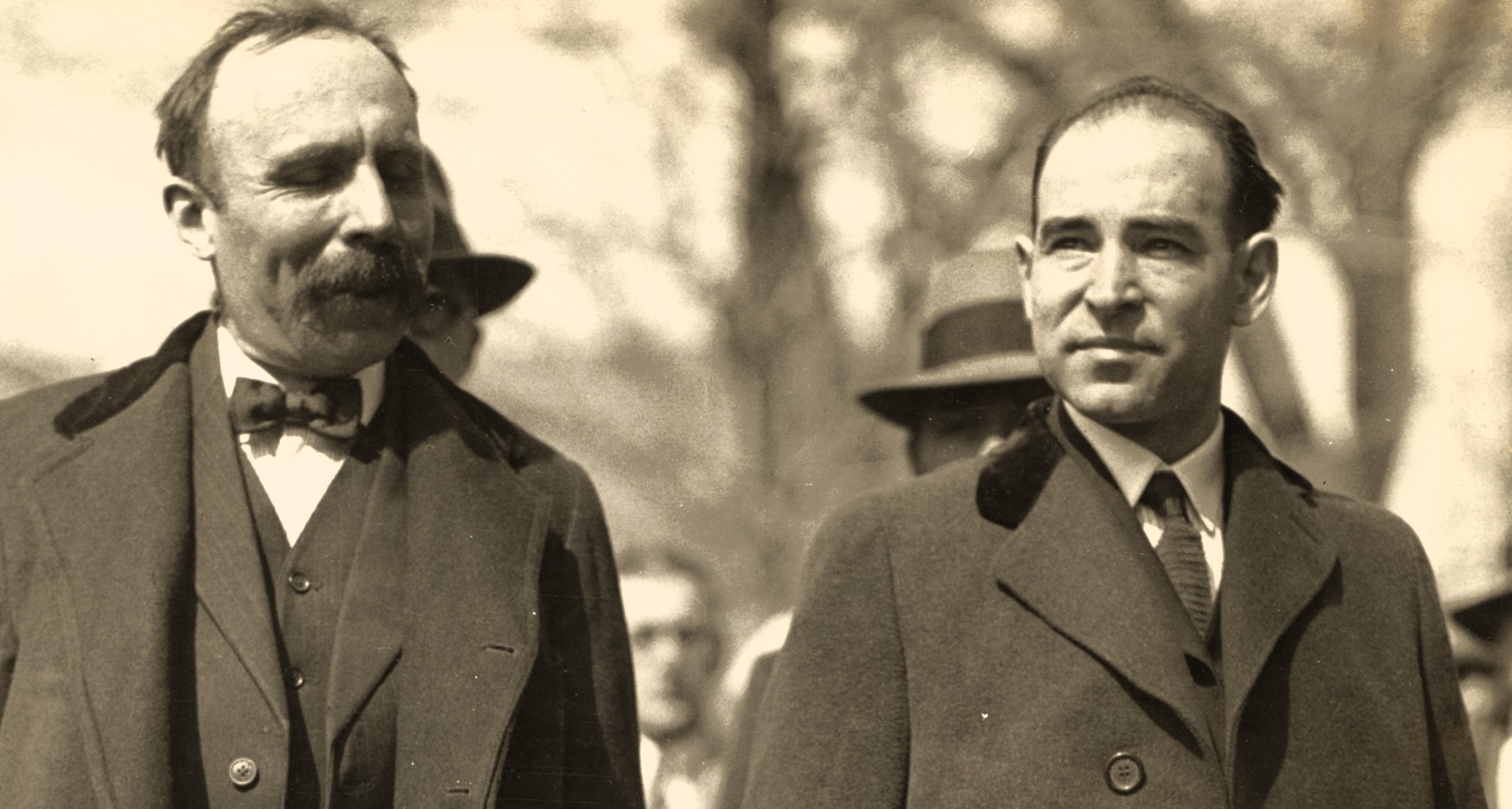
Chaplin, himself a former political prisoner, on Sacco, Vanzetti, and the law’s injustice.
‘In the Shadow of the Electric Chair’ by Ralph Chaplin from Labor Defender. Vol. 1 No. 1. January, 1926.
Sacco and Vanzetti are still in prison!
This appalling fact bears eloquent testimony to the strength, complexity and cussedness of the capitalist machinery of persecution. It also reveals the lamentable weakness of labor’s defense. Both of these workingmen are unquestionably innocent of criminal intent or deed; and yet both are in prison.
Of course, it is easy to adopt the fatalistic attitude and say, “Well, such is capitalism and such are the courts that do its bidding.” It is easy to make a remark of that kind when one is on the outside and one’s own hide is not involved, but a statement of this sort doesn’t sound so sweet when one is in prison and the only way out seems to be the door that leads to the death chamber.
If labor defense means anything it means that workingmen unjustly “framed” and accused should be protected both in life and liberty from the clenched fist of masterclass retaliation. Sacco and Vanzetti are not the only example of working-class helplessness in the face of judicial barbarity. Tom Mooney, Ford and Suhr, Centralia are all cases of this kind. There are others not mentioned and others yet to be.
One is safe in saying that there will be persecution added to persecution as long as the present system lasts or until labor develops the power to protect its own.
The technique of defense is almost as necessary to the working class as the technique of combat. It should be studied at least as carefully. One of the best ways to discourage the labor baiters of the country in their desire to build up a modern inquisition is to show them that it is not easy to get workingmen accused of political crimes in prison nor to keep them there. But they will have to be shown. And that is the thing, with the possible exception of the I.W.W. war time cases that no one has succeeded in doing as yet. The International Labor Defense, profiting by the mistakes and achievements of the past should be able to do yeoman service in this cause.
The vengeful tenacity with which capitalism hangs on to its fettered victims is one of the marvels of the world—that and the apathy of the organized American workers who witness without protest the persecution of its militant members. Mooney is still in prison, Sacco and Vanzetti and the Centralia group are still in prison while Richard Ford, after having served ten long years for a crime he didn’t commit, has been rearrested in order once more to endure the ghastly mockery of a trial and the ghastlier tragedy of imprisonment for life. If any part of the labor movement were only one-half as alert to defend as the other side is to punish, there would be but little difficulty. But the trouble is the workers are seldom alert to their own immediate interests let alone such comparatively remote things as frame-ups and arrests of certain workingmen for labor activities.
Then too, it is easy to forget. Life, outside of prison walls, moves speedily these days. It is not to be wondered at that people forget. San Quentin and Folsom are full of young men arrested for “criminal syndicalism” and serving from one to ten years. Many were tried and convicted long after the first arrest of Anita Whitney and no doubt, cannot even remember that incident. All of them, or many, were boys in short pants at the time of the big I.W.W. arrest in 1917. There are thousands and thousands of us out here who have to think hard to recall the names of Kaplan and Schmidt, Ford and Suhr, Rangel and Cline, as well as Mooney and Sacco and Vanzetti. I have even heard new members of the I.W.W. confuse the names of Frank Little and Joe Hill. The man on the street has heard little or nothing of these cases. And yet, no matter who he is, these cases are things that DO concern him. And he should and can be made to know and to care about them all.
It isn’t so much that people can be interested and inspired to action for labor defense because of altruistic or humanitarian motives. Many men and women these days are so motivated and are willing to help. They are good folks and may their tribe increase. But the big thing, particularly with the workers, is to show that these cases are a menace to the life and liberty of any worker with dissenting opinions or the wrong accent or color in America. That is where an organization like the International Labor Defense comes in. If life and accident insurance are good things for everyone, surely liberty insurance is even a better thing, especially for all of us who work for a living in this day and age.
Economic power would be the proper and no doubt most effectual weapon of defense for labor if labor were only awake and aware of its power. No doubt, the boycott would help if it were used with impetus and direction. But one thing that can and must be done is to build up and use to the limit the power of publicity. Let us not delude ourselves that publicity is not a force—and a mighty one. The Dreyfuss case, in France is an example, the federal I.W.W. cases another example. Mass meetings, on an international scale and tons of printed matter with adequate machinery for distribution are as necessary for workers today as were the bows and arrows of his primitive ancestors. But, here in America, even this mighty force is hampered with exasperating limitations unless used in a way to produce pressure at the one place where results are to be obtained. Take the Centralia case for example. All the national publicity we can conceive of will not swerve the governor of the sovereign state of Washington from his vindictive course unless that publicity is centered largely on the capitol building at Olympia.
During the so-called “amnesty” drive of 1923 three million postcards were printed, each one bearing the president’s name and address on the reverse side. These post cards presented the demand “Free political prisoners by Christmas.” Hundreds of thousands of these little messages reached their destination. Back of each one of these post cards stood a sympathetic individual or organization or a member of the amnesty league which had been organized by the defense to arrange meetings, get newspaper and magazine publicity and to distribute amnesty literature and cards. I was told in Washington, D.C., just before the last federal prisoners were released that it required a moving van each day to remove the bales of protests that we had caused to be sent to the executive mansion.
If the Sacco and Vanzetti case had been a federal instead of a state case there is little doubt but both the prisoners would be free men at present. California, Washington and Massachusetts are sovereign states and strong for their rights. One of these rights seems to be that of heresy hunting and witch burning without molestation from the outside. The problem is difficult. But it is one that will have to be met and overcome. After all the purpose of a defense organization is to get workers out of jail. It is also a good thing to keep the light of publicity burning so brightly that it will be hard to thrust new victims behind the bars. As I understand it, this is one of the purposes of the newly organized International Labor Defense. On this point alone it deserves the support, moral and financial of workers and friends of labor everywhere.
Personally, I would like to see something done for Sacco and Vanzetti. I’m sure all right thinking workers inside and outside of prison feel the same way about it. If there ever was a case of horrible injustice this is one. The men, both of them shoe workers, were arrested on suspicion while distributing radical literature. They were held a day or two and then charged with murder and robbery in connection with a bank hold up in a nearby town. Needless to say, they are innocent. There is a wealth of evidence to prove this point. But they were radicals and the open season for radicals was still on. The red raids of Palmer and company were all the style. A bank had been robbed and a man murdered. It would be a feather in the cap of the police to apprehend the bandits. These men were foreigners and radicals and so a great deal could be said to work up public feeling against them. It mattered little whether these sad-eyed, softspoken Italians were guilty or not; they would do just as well as the bandits for the punishment—maybe better. They have been in prison for over five years now, standing in the shadow of the electric chair every moment of this time.
Labor Defender was published monthly from 1926 until 1937 by the International Labor Defense (ILD), a Workers Party of America, and later Communist Party-led, non-partisan defense organization founded by James Cannon and William Haywood while in Moscow, 1925 to support prisoners of the class war, victims of racism and imperialism, and the struggle against fascism. It included, poetry, letters from prisoners, and was heavily illustrated with photos, images, and cartoons. Labor Defender was the central organ of the Scottsboro and Sacco and Vanzetti defense campaigns. Editors included T. J. O’ Flaherty, Max Shactman, Karl Reeve, J. Louis Engdahl, William L. Patterson, Sasha Small, and Sender Garlin.
PDF of full issue: https://www.marxists.org/history/usa/pubs/labordefender/1926/v01n01-jan-1926-LD.pdf
 Revolution's Newsstand