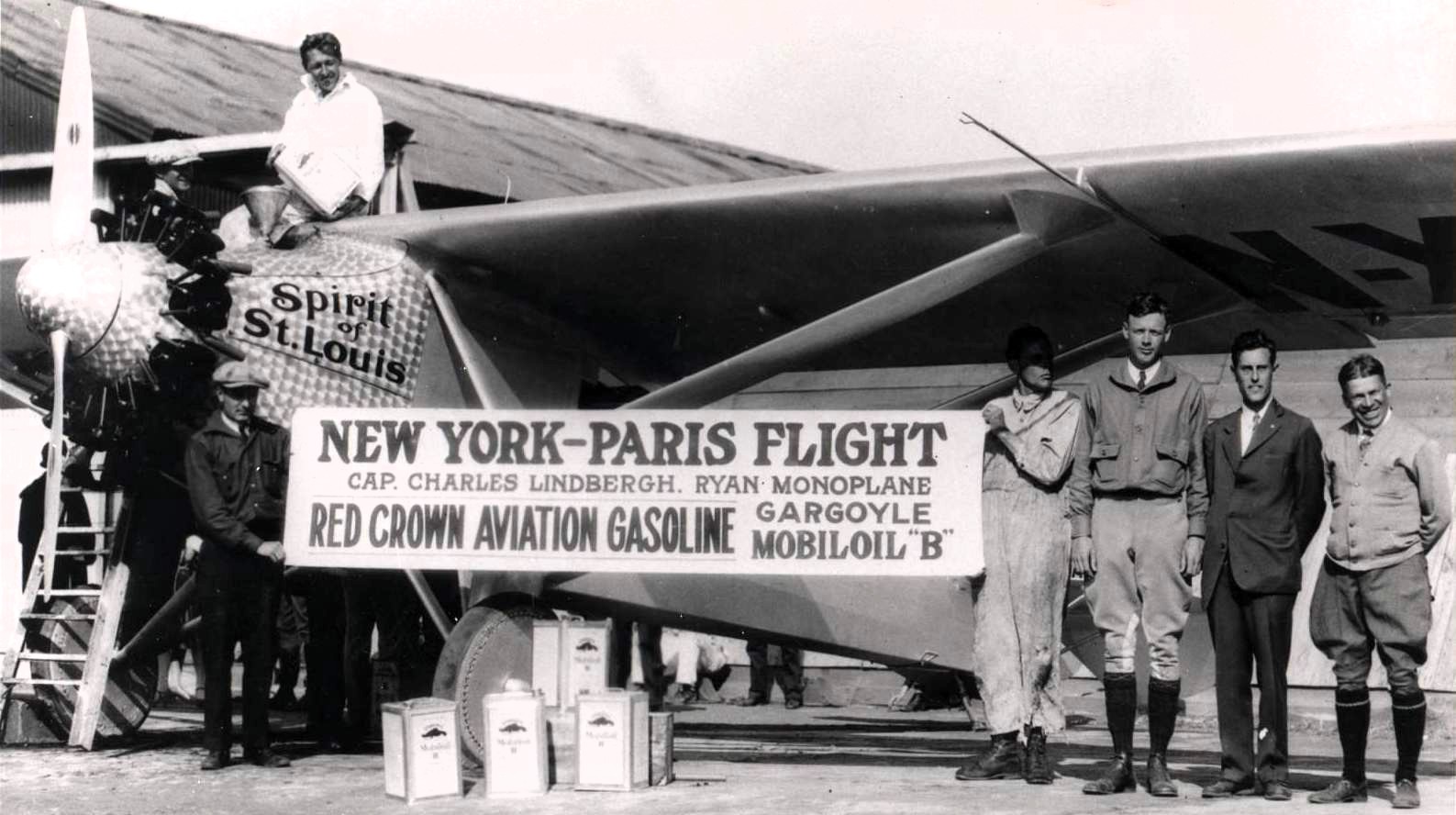
O’Flaherty on the immigrant radical’s son who became a poster boy for a rising U.S. imperialism.
‘Lindbergh As a Militarist Kite’ by Thomas J. O’Flaherty from The Daily Worker Saturday Magazine. Vol. 4 No. 133. June 18, 1927.
WHEN young Charles A. Lindbergh landed in Roosevelt Field, after making the flight from the west coast in two hops the newspapers did not pay very much attention to him and when they did he was referred to as the “Flyin’ Fool” as Mrs. Gibson in the Hall-Mills murder case was the “Pig Woman,” and other celebrities that lend themselves to publicity but lack respectability are given sobriquets, on the short side of dignity.
Lindbergh then was more or less an “unknown soldier” a young aviator in the air mail service. Public attention was concentrated on the squabbles between Levine who was backing the Chamberlin flight and Bellanca the designer of the plane that was to make the trans-oceanic trip to Paris.
Suddenly the “Flyin’ Fool” took the air and almost as suddenly landed in Paris.
Then the American government got busy. It saw in the feat of this daring youth the opportunity of putting on the greatest drive for militarism since Woodrow Wilson read his message of war against Germany before the joint session of congress in April 1917.
Soon Ambassador Herrick was running around like a chorus girl sticking his mug in front of every camera that tried to get a “shot” at the young airman. Even the ambassadorial pajamas that were conscripted to adorn Lindbergh’s limbs occupied as much space in the newspapers as they would on a clothes line. Lindbergh, the son of a Minnesota radical suddenly became a world figure to whom kings and president were doing homage.
Lindbergh’s feat placed him so far above the average king or capitalist potentate in courage and ability that they are not fit to wipe the grime of a day’s flying from his countenance, but this was not the reason these parasites hailed the young flier. They wanted to bask in the warm rays of his reflected glory and leechlike suck into their degenerate political anatomies the popular life blood that a healthy, virile, pioneering aviator had inherited from his rebellious father who fought the capitalists all his life and died with their curses on his lips.
The harpies of the decadent European aristocracy and of the equally parasitical capitalist class moved to extract the maximum advantage from the young man’s accomplishment. The French government, the tool of the French money lenders, speculators and industrialists, saw an opportunity to put in a good word in behalf of the cancellation of the French war debt to the United States, but the American government, while hailing France in eulogistic terms and stressing the friendly relations between the two countries shook its head sadly at the suggestion that “glorious France” should assume the ignoble role of an international dead beat. “Nothing doing on debt cancellation” said Washington in effect, “we like you, but we must have our dough, or at least keep the bill hanging over your head to bedevil your sleeping hours and render you more amiable to concessions that our bankers, industrial capitalists may demand in their future dealings with you.”
The King of All the Belgians that is what the son of the libertine Leopold calls himself–got a “piece” out of Lindbergh to use the language of sporting circles. (Lest there be any misunderstanding, a little explanation of the term in quotes may be necessary. Boxers, wrestlers, runners, swimmers and other performers of this type are surrounded by hordes of professional promoters who live on those who take the punches, the half-nelsons and toe holds, those who crack their wind on the track or their lives in the swirling waters. Each human harpy gets from twenty to one per cent of the earnings of the professional athlete. This is what is called getting a “piece out of him.”).
The “piece” Albert of Belgium got out of Lindbergh was publicity and the opportunity to have his pictures taken with the young American. Perhaps the next time the monarch sends his agents to do a little panhandling in the United States, Morgan will have less difficulty in floating his loan when he reminds the investors that the king was a friend of the hero “Lindy.”
Lindbergh went to England and visited the king in Buckingham Palace. I am not sure whether George consented to be snapped with the American birdman, but the Prince of Wales, who is equally at home in pub, dance hall or in front of a camera was hauled out to do a little bit of drumming for the empire. It also gave Ambassador Houghton a chance to figure in the news even though by this time Lindbergh did not need any pajamas. It also gave the American ruling, class a chance to take a couple of chuckles at the expense of their English “cousins” and an opportunity to impress upon the old empire the fact that their former colonial empire now has the ships, the planes and the aviators too, in case the old empire should try conclusions with her western rival.
Lindbergh talked peace and friendship between nations. Ambassador Herrick took advantage of the occasion to roar against Communism and the Soviet Union. All the capitalist jackals out of their lairs felt that this was the time, when the people of the world scanned the papers for news of this daring young man, to turn loose their blasts against the only government that is really for peace and against the revolutionary working-class movement in all countries which would utilize aviation and aviators not to carry bombs for the destruction, of human lives in crowded cities, but to bring the peoples of the earth nearer to each other and cut distance to a fraction of what it is now.
Our young hero returned to the United States on a warship. He was received in Washington with greater acclaim than was Admiral Dewey on his return from the conquest of the Philippines. Heroes have short lives, as heroes. The people forget. Only those who cash in on their day of glory are the winners. And the winners in the “Lindy” case–besides the young hero himself, who by the way may be or was a “Flyin’ Fool,”but not so much so that he would turn down a wad of dough, newspaper liars to the contrary–are the militarists, the makers of airplanes and gas bombs and business in general from the vendor of gasoline to the badge-peddler.
Many people thought Lindbergh’s flight would be a peaceful influence. He said so. When he spoke in Washington he brought a message of peace from the French people. The French would prefer that he succeeded in lopping a billion off the war debt. But even while he was talking peace the militarists were busy preparing the minds of the masses for the big appropriations that congress will be asked to cough up when it reconvenes. And what better means could be devised to prepare the public mind for this purpose than to put their words into the new national hero, the unassuming young fellow who had the nation in an orgy of excitement and admiration over his feat.
Soldiers, sailors, war planes, generals, colonels and politicians surrounded Lindbergh. There was little talk of the old Lindbergh, the aviator’s father that this gang would have tarred and feathered during the war. The young eagle could fly higher than the parent bird, but his talons would be used–not to rend the enemies of the masses–but the slaves of the ruling classes. Still there were reports that “Lindy” was not willing to be utilized for war and preparedness propaganda. But when he reached New York, the financial and commercial capital of the American empire, he did not leave us in suspense very long.
At a banquet given in his honor at the Commodore Hotel, Lindbergh repeated his speech with a fresh addition. This is where Lindbergh comes out in the role of a militarist decoy. We quote from a report of his speech that appeared in the New York Times of Wednesday, June 15:
“In the meantime, the most important thing for us to do is to develop the trans-continental branch lines, which we already have. A commercial air service in America gives a reserve in case of war, which we can develop in no other way. Experienced pilots cannot be trained as quickly as airplanes can be built. We do not invite war: yet one of the surest ways of averting it is to have a trained personnel which can be mobilized quickly in case of war. A commercial air service will give us that personnel in the matter of fighting planes in case we are forced into conflict. Our planes in the army airport are the most developed in the world, although we have very few of them. And I have no hesitation in saying, without the least exaggeration, that the pilots of the United States army have no equal in the civilized world.”
Of course we admit that it would be utopian to expect that even a strong willed person, placed in the position Lindbergh is in at this period of the heyday of American capitalism could resist the powerful influences that are being brought to bear on him by the ruling classes. No well informed person would believe for one moment that Lindbergh would receive the necessary financial backing or government sanction for his attempt unless the capitalists were perfectly sure of him. His financial backers risked their money on the flight in the hope that success would make their factories hum with increased business and the government knew what a valuable salesman for larger military appropriations the first man to fly across the Atlantic would be. If Lindbergh were a pacifist or an anti-militarist, instead of a willing tool of capitalism his welcome, when he arrived here would consist of a customs inspector going thru his baggage.
Last Wednesday Lindbergh was guest of honor at a luncheon given by the State Chamber of Commerce and Merchants’ Association. The “fat boys” cheered him from the depths of their barreled bellies. Lindbergh did not disappoint them.
This country did not want war he said. What country does? But the best way to avoid a war is to be prepared for it. So said the peaceful ex-kaiser of Germany back in the peaceful spring of 1911. We have not a sufficient personnel nor enough equipment for our air force. To quote him directly:
“Commercial aviation should be developed in this country. The personnel and equipment that would result from such a development would be of great value in the event of war.
“New York would be a vulnerable spot in case of war, because it has not a proper airport. I hope in the near future this will be corrected.”
This is the cut-and-dried preparedness propaganda. And lest he might offend the feelings of the officer class and the manufacturers of battleships, heavy artillery and shells, Lindbergh showed that he is a good diplomat. He said:
“The air force will never take the place of the army and navy, but the army and navy need a strong air force.”
And those owners of billions stood on their seats and rocked the ceiling with their cheers. And well they might. Here was a godsend. The “Flyin’ Fool” of aviation, had developed into the “Flyin’ Tool” of American militarism.
The Saturday Supplement, later changed to a Sunday Supplement, of the Daily Worker was a place for longer articles with debate, international focus, literature, and documents presented. The Daily Worker began in 1924 and was published in New York City by the Communist Party US and its predecessor organizations. Among the most long-lasting and important left publications in US history, it had a circulation of 35,000 at its peak. The Daily Worker came from The Ohio Socialist, published by the Left Wing-dominated Socialist Party of Ohio in Cleveland from 1917 to November 1919, when it became became The Toiler, paper of the Communist Labor Party. In December 1921 the above-ground Workers Party of America merged the Toiler with the paper Workers Council to found The Worker, which became The Daily Worker beginning January 13, 1924.
PDF of full issue: https://www.marxists.org/history/usa/pubs/dailyworker/1927/1927-ny/v04-n133-new-magazine-jun-18-1927-DW-LOC.pdf
 Revolution's Newsstand