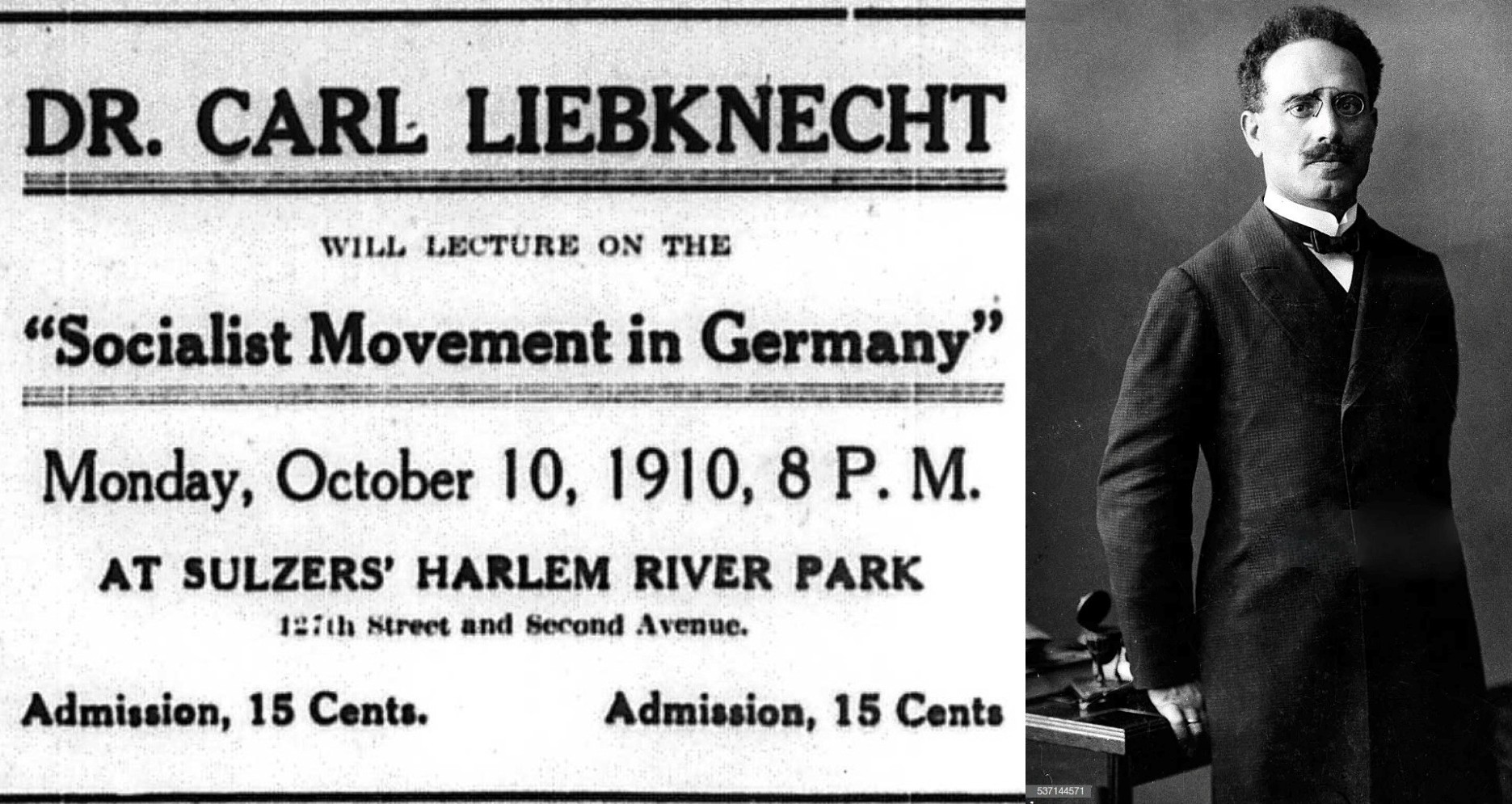
Liebknecht begin his U.S. speaking tour with a ringing defense of internationalism.
‘Liebknecht Makes Two Speeches in Night’ from The New York Call. Vol. 3 No. 284. October 12, 1910.
Brilliant German Socialist Greeted by Great Throngs in Brooklyn and at Lipzin Theatre.
The thousands of people who packed the Brooklyn Labor Lyceum to overflow last night, to hear Dr. Karl Liebknecht, carried with them a vision which will linger in their minds to the end of their days, and a lesson which will bear fruit to the Socialist movement in America in the near, one might almost say immediate, future.
Liebknecht’s address last night was a sort of a cursory report of what the working class of Germany and of Europe was doing for the liberation and regeneration of the world.”
Together with this report went the advice of the expert general and leader, who has been born and raised in the atmosphere of revolution and international Socialism, as to what the workers of America should do to make the international onslaught on capitalism most effective.
Workers of World Uniting.
Liebknecht informed his audience that the day of nationalism is gone so far as the working class is concerned. Today, he said, workers are no longer divided, according to nation or language. Workers of all lands are soldiers of a great international army which is marching under the banner of Socialism.
In the first part of his speech, Liebknecht went into a detailed description of the reaction in Prussia. He pointed to the almost daily conflicts between peaceful citizens and police officers who are armed to the teeth and seek to prevent the workers from giving the least expression to their feelings and views.
From the political reaction the speaker next went over the social and economic reaction, or rather progress of capitalist oppression. He showed how capitalism while prating of nationalism and patriotism knows of no nationalities, of no patriotic ties when the question of dollars and cents comes.
Krupp’s Patriotism.
“Krupp,” Liebknecht cried, “is a German patriot. The managers or owners of the Krupp gun works are all considered among the best and most patriotic types of Germans. Yet the same company will sell guns, cannons, and any and all ammunition to England, to America. Yes, oven to France, the supposedly bitterest enemy of the German fatherland and German people. To France they sell the most modern of machine guns with which to kill the German people in case of war. This is capitalist patriotism for you.
“In this morning’s paper I see that a certain Mr. Taft, a brother of your president, who came on the same ship with me expressed himself as very much pleased with Prussia. He viewed there, the newspapers said, a parade of 60,000 troops while standing by the side of him who was sent to us by the Grace of God. Yes, Mr. Taft is charmed with Prussia, charmed with its progress.
Germany’s Reaction.
“Now who do you think is more competent to speak about conditions in Germany, Mr. Taft or myself? And I tell you that Germany is today foremost in the ranks of the great reaction. But this reaction is not taking place alone in Germany. It is world wide. The reaction is sweeping America the same as it is sweeping Germany. When the German government was dispersing street meeting I too used to think that it was only in Germany that such things could take place until one day I picked up my paper and saw what was happening to your cradle of liberty in Philadelphia, where America, the “freest country of the world,” was denying its citizens the right of free speech and free assemblage. “The march of capitalism knows no bounds, knows no limits, national or racial. The people of the world, the entire world are today divided not in nations, but in classes, the oppressors and the oppressed. The oppressors are already well organized for their selfish fiendish purposes.
The working people must next organize on international lines. And it is here that you Socialists of America have a special mission. You must be the advance guard of the international proletariat because your position is most advantageous. You have that which we are still struggling for–the ballot.
Germans Fight for Ballot.
“While we, in Germany, are now entering upon a fight which will bring in Its train innumerable hardships, perhaps dangerous consequences to many, which requires sacrifices on every side by the hundreds, by the thousands, you Socialists of America have had that struggle won for you by your ancestors, by past generations. You can enter this struggle against capitalism most advantageously, most effectively.
“Do not let a Taft or an ambitious politician fight the trusts. They will not fight the trusts. They cannot. Trusts are our enemies, your kings, and they must be fought by you.
“Enter upon this struggle for International Socialism with all the faith and zeal in the world, for you are not fighting for a vision, for a dream, but for a natural law. For Socialism must follow upon capitalism, as surely and as inevitably as day will follow this night.” The chairman of the evening, Lore, at the conclusion of Liebknecht’s speech warned the audience that on November 6 is election day when they will have the opportunity to put the advice of Liebknecht into practice by depositing their ballot for the candidates of the Socialist party and seeing that their neighbors do the same. The United Singing Societies gave several selections.
From Brooklyn Liebknecht was hurried is an automobile to the Lipain Theater, where a benefit for the Meyer London campaign was given.
Here Liebknecht made a few remarks which brought down the audience in thunderous applause. He briefly pointed out the valiant champions in the cause of Socialism which the Jews of Russia produced, and expressed his belief that the Jews of America will be no less faithful to the cause of International Socialism than the Jews of Russian, and that they will show this faith to the Socialist movement at the next election by adding Meyer London to Congress.
The New York Call was the first English-language Socialist daily paper in New York City and the second in the US after the Chicago Daily Socialist. The paper was the center of the Socialist Party and under the influence of Morris Hillquit, Charles Ervin, Julius Gerber, and William Butscher. The paper was opposed to World War One, and, unsurprising given the era’s fluidity, ambivalent on the Russian Revolution even after the expulsion of the SP’s Left Wing. The paper is an invaluable resource for information on the city’s workers movement and history and one of the most important papers in the history of US socialism. The paper ran from 1908 until 1923.
PDF of full issue: https://www.marxists.org/history/usa/pubs/the-new-york-call/1910/101012-newyorkcall-v03n284.pdf
 Revolution's Newsstand