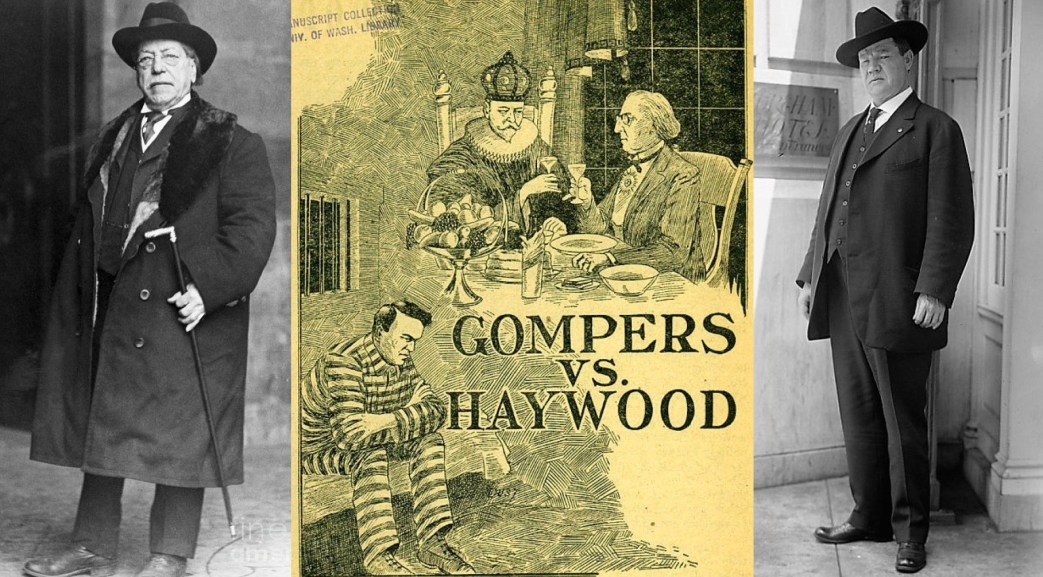
Full text of brief I.W.W. pamphlet contrasting the revolutionary unionism of William D Haywood, then in Leavenworth Federal Penitentiary under the Espionage Act, and the conservative craft unionism of the American Federation of Labor’s Samuel Gompers, cheer-leader of the U.S. war and pictured dining with the Czar. Haywood and his 100 co-defendants would all be found guilty, with Haywood sentenced to 20 years. After the exhaustion of appeals in 1921, Haywood skipped bail and was secreted to exile in Soviet Russia. There he worked as a labor advisor to the Bolshevik government, dying in Moscow City in 1928 and buried in the Kremlin Wall.. Gompers died in Mexico on December 6, 1924, during a State Department project to install anti-Communism into Mexican unions. Gompers would be buried just yards from the rotting corpse of oligarch Andrew Carnegie.
‘Gompers vs. Haywood’ Published by the Industrial Workers of the World, Chicago. 1918.
At Laredo, Texas, an international labor conference was held recently. A resolution was introduced by Mexican delegates, calling for the release of class war prisoners in the United States. Gompers, seconded by Charles Moyer who, with Haywood of the I.W.W., was tried at Boise, Idaho, in 1907, on a framed-up charge for the murder of ex-Governor Steunenberg of Idaho, made this the occasion for condemning Haywood, and asserting that he, in serving a sentence of twenty years at Leavenworth, was but getting his just deserts.
The rat, whose union of miners exists only on paper, is not worth wasting words upon. Suffice to say that a coward in prison, he is no less the coward when he attacks a man who has been condemned by the masters of industry for his activities in behalf of the workers.
The action of the Mexican delegates to this convention will stand a monument to their courage and worth in after years and will also serve. to keep fresh in the minds of American workers the craven, belly-crawling attitude of Gompers and Moyer.
Mr. American Workingman, let us compare these two–Gompers and Haywood–using the records they have written in the annals of Labor.
Gompers recently returned from a “triumphant” European trip where he hobnobbed with the kings of Italy and England. Haywood, Convict No. 13,116, at Leavenworth Penitentiary. Honestly, Mr. Workingman, which do you consider the most representative of your class?
Gompers, who in England made senile attempts to dictate to British workers who knew what they wanted and carried out their program after politely hearing what he had to say. Haywood, who sent this message to the Workers of the World before being sentenced to twenty years at hard labor: “I can only say that I still adhere to the principles set forth in the Preamble of the I.W.W.” Mr. American Workingman, in a strike in which you are concerned, which of the two would you consider the truest to your interests?
Gompers, who insists upon craft unions, each of them having separate time contracts with employers, thus compelling one craft to scab on the other. Haywood, who has always consistently advocated the One Big Union of all workers, thus making “An Injury to One, an Injury to All.” Mr. American Workingman, there is as wide a difference between the men as there is between the principles they advocate. Can you honestly say that Gompers is right and Haywood wrong?
Gompers derides the action of the class-conscious workers of Europe in their attempts to establish a Socialist Republic and Industrial Democracy. Haywood, whose life has been one long cry to the Workers of the World to rise and shake off the chains of wage slavery, and who has at all times been in close touch with the European movement. Mr. American Workingman, wage slavery is as prevalent in Europe as it is in America. Do you stand with Gompers and nationalism, or with Haywood and the world movement?
Gompers receives the admiring plaudits of the entire capitalist press. Haywood and the I.W.W. are condemned as bitterly as Gompers is fulsomely lauded. Mr. American Workingman, the press owned by your masters is an unerring guide. Will you also condemn the men and the cause they misrepresent and vilify? Or will you figure for yourself that what the capitalist press condemns is good for the workers? And that the idea and individual it praises must be looked upon with suspicion?
Gompers does not go beyond the motto: “A Fair Day’s Work for a Fair Day’s Pay!” and has nothing more to offer the working class as a whole. Haywood and the I.W.W. have inscribed on their banner the revolutionary watchword: “Abolition of the Wage System.” Mr. American Workingman, will you be content to always work for a wage, knowing that the wage system is slavery? Or will you now line yourself up with your fellow workers in America and Europe in the glorious struggle to get for the worker the full product of his toil?
Gompers acts on the assumption that the working class and the employing class have interests in common. Haywood and the I.W.W. assert that the interests of the employing class and the working class are diametrically opposed. Mr. American Workingman, are you willing to believe that the more profit the boss gets from your labor the better off you are? Or do you reason for yourself that the shorter your hours and the bigger your pay, means more for you and less for your boss?
Gompers has nothing to say about the value of industrial organization of the big business interests, but condemns the idea of industrial organization for the workers. Haywood and the I.W.W. believe industrial organization is the only method by which the workers can hope to wage a successful fight for the betterment of their conditions and their final emancipation from wage slavery. Mr. American Workingman, do you honestly believe that different craft unions in the same industry, compelled to scab on one another by their contracts with the boss, can be as useful to you as One Big Union of the entire industry?
Gompers spoke disdainfully of the Italian and French syndicalists, remarking that they were influenced by professors. Haywood and the I.W.W. recognize these same syndicalists who now form the majority group among the organized workers of both these countries, as our comrades and fellow workers in the world struggle of the worker against the employer, the slave who possesses only his labor power against the master who owns the tools to which the worker must have access in order to live. Mr. American Workingman, you see for yourself how European events are. shaping. Do you wish to blindly follow a self-satisfied, strutting parrot, who lightly condemns the greatest organized effort the workers have ever made, or will your reason tell you that the American movement which most closely allies itself with the triumphant march of the European worker is the one to tie to?
Gompers is greeted by the king of Italy and at the same time his pretenses are exposed by Italian workers. The king of Italy has sent no word to Haywood in his prison cell, but the workers of Italy and France in their journals have given the story of the great I.W.W. trial at Chicago and demand the release of class was prisoners in the United States. Mr. American Workingman, will you follow the lead of Gompers in slandering the I.W.W. and class conscious workers of Russia, or will you join your Italian and French fellow workers in sending words of cheer to the class war prisoners at Leavenworth and co-operate with them and us, in securing the release of all who have gone to prison for you and your class?
Gompers, in high favor with the capitalists of America and European royalty and distrusted by European workers. Haywood, Convict No. 13,116, cursed by the capitalists of America and vilified by the capitalist press, but highly esteemed by European workers. Mr. American Workingman, the time has come when you must choose between these two men and the ideals they represent. Take your stand now and prove your manhood! Do not wait until the One Big Union overtakes you and then join because there is nowhere else for you to go. With shoulders squared and head erect, follow the dictates of your reason, regardless of being jeered at by the ignorant and perhaps persecuted by the minions of capitalism. Join the I.W.W. and do not shirk your full share of the task of winning the world for the workers.
Gompers or Haywood. We accept the challenge made at Laredo. These two men stand at the parting of the ways for the worker. Will you follow the downward path designated by Gompers into the bog of jurisdictional squabbles, where your feet will be mired in the muck of time contracts; or will you heed the beckoning finger of Haywood, who from his prison cell points to you the arduous trail which leads to the broad road of Industrial Unionism and to the goal of Industrial Democracy?
Mr. American Workingman! Choose now, and choose wisely!
For further information address: General Secretary-Treasurer, 1001 W. Madison Street., Chicago, Ill.
Access to PDF: https://digitalcollections.lib.washington.edu/digital/collection/pioneerlife/id/8963
 Revolution's Newsstand