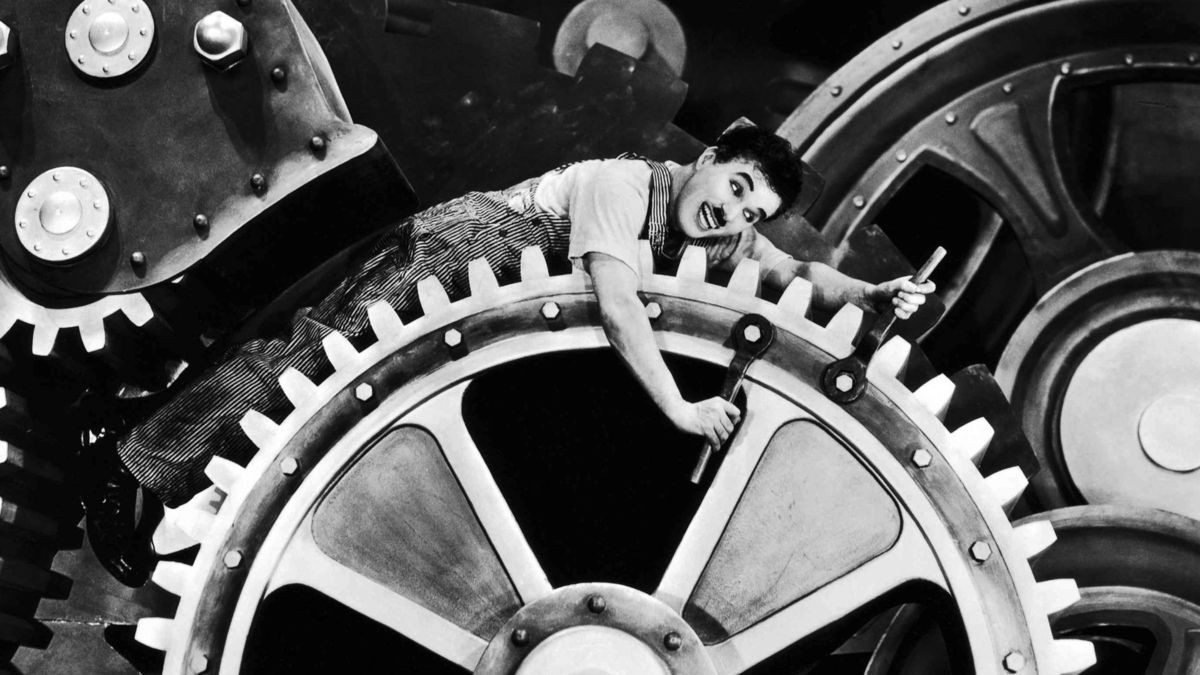
Scott Nearing with an excellent, considered essay on the dichotomy of the machine; social inventions produced by workers with an enormous capacity to liberate, but whose function is to further enslave.
‘The Man and The Machine’ by Scott Nearing from The International Socialist Review. Vol. 18 No. 1. July, 1917.
The Tool Maker.
MAN has been called the tool-making and tool-using animal. Among living creatures, he alone has supplemented his powers by the use of tools. The tool augments man’s possibilities. “Without tools, he is nothing; with tools, he is all,” writes Carlyle. Ideas, taking shape in the tool, have placed man far in the lead of his competitors. Even the king of beasts falls an easy victim to his weapons.
With neither defensive armor nor offensive powers, man, without tools, must rank as one of the weakest of earth’s inhabitants. Armed with the tool, he is able to place all living things under his domination. Nature and all of her creatures bow before the tool-magic.
The kingdom of man rests upon the tool, which, in its turn, depends upon the thumb, the forefinger and the forehead. Among all the animals, none, except man and the man-like apes, can place the end of the thumb against the ends of all of the fingers; therefore, except for the anthropoids, no animal can make or successfully use a tool. This mechanical possibility, guided by the light of intelligence that burns in the frontal lobe of the brain, organized and coordinated through man’s reason, has built civilization.
The tool gives man his power over the universe. He fashions the tool; wields it; owns it.
A sense of possession goes with the fashioning of the tool. The savage who hollowed his canoe from the log or chipped the flint for his spear head owned the thing he had made. It was his because he fashioned it. Men love the work of their hands, because their hands have done the work.
The man who wields a tool feels the power of his mastery. It is his. Backed by the strength of his arm and guided by the light of his brain, it pulsates to its task. He pushes, swings, pulls, directs. The tool user is master of his tool.
Ownership carries with it a sense of proprietorship. The man has fashioned and wielded the tool. He owns it. It is his. The title, the right of possession, remains in the man to whom the tool belongs.
The power of the tool, backed by man’s master guidance, is the title to his kingdom. He has the earth. He has been told to master it and possess it.
The Tool and the Machine
The modern tool is the machine. Ever since the first rude wooden spear was fashioned, ever since the first fish bone was shaped into a needle, the first clay was molded into a bowl, and the flint was chipped and fitted to the arrow; from the most primitive beginnings down to the present day, man has been perfecting the tool. He has seen in it new possibilities and dreamed into it new wonders of invention.
Only yesterday, the man made, wielded and owned the tool. Today—what transformation! The tool has left the narrow confines of its age-long prison and appeared in its true form as a machine.
Between the tool and the machine there is this most fundamental difference. The tool user fashioned, wielded and owned the tool; the machine user neither fashions nor wields his machine. Robert Burns describes the cotter, leaving his work on Saturday night. He “collects his spades, his mattocks and his hoes,” throws them over his shoulder and trudges homeward. How unlike this is the picture presented by modern industry. Even on the farm, in these last few years, the mattocks and hoes have yielded place to plows, cultivators, potato diggers, seeders and a host of other horsepower machinery that performs the work that was formerly the product of the cotter’s back and arms. Carry the parallel one step further and make it in terms of industry. “Collects his electric cranes, locomotive engines, steam rollers and blast furnaces.” The words bespeak the contrast.
Electric cranes, locomotive engines, steam rollers and blast furnaces are machines—intricate, huge, costly. They are the product of an age-long evolution of the tool—but they are more than the tool. The thumb, forefinger and forehead have made a being that is alive with a tireless, superhuman power.
The machine is intricate. No man can make all of the parts or engage in all of the processes that go to the construction of any one machine. Men do not fashion the machines they use.
The machine is huge. No man can toss it upon his shoulder and carry it to his cot. No man can wield it. The machine is not carried about as was the tool, from place to place. It is not raised or swung or wielded. Instead it is fixed in a place, to which the man comes to do his work.
The machine is costly. No man can own the machinery with which he works. First, because it is too expensive for each man to own, and second, because where many men work with one machine, like a locomotive, if one should own it, another would necessarily be denied ownership. Aside from collective ownership, there is no possibility for the individual to own the machine.
The huge, intricate, costly machine cannot be fashioned, wielded and owned by the man who uses it. The rail mill and the printing press differ essentially from the smith’s hammer and the pen. The machine is a super-tool—a new entity—for behind it, within it, driving it relentlessly, are the eternal powers of nature which drive the universe. Jove’s lightnings play through the dynamos and along the wires. Water, earth and air concentrated in the machine, toil for man.
For centuries men have harnessed the wind and the water, but it is only in recent years, with the development in iron and steel making, the use of coal, the steam engine, power-driven machinery, the turbine, the dynamo, organic chemistry and applied mechanics, that nature’s powers have been called upon to render effective service. When at last those forces were utilized—when nature was called upon to do man’s work in the multitudinous activities of modern industry, the tool had been pushed aside by the machine, which, from that time forward was destined to heed the beck and call of the human race.
The Possibilities of the Machine
The machine is the offspring of man’s genius and nature’s power. Is it to be a ministering angel? Is it to be a Frankenstein monster of destruction? Man has called this thing into being. Can he control the child of his imagination, the creature of his hands? The thumb and forefinger and the forehead have created a new being—the machine. They have bent nature to do their work. Can the forehead still rule the earth?
During untold ages mankind has struggled against want and privation. It was the effort to escape from this struggle that called the machine into being.
The life of man was bitter. In the jungle, on the plain, under the mountainside, dependent on nature, he lived, precariously, from hand to mouth, warring continually with the forces by which he was surrounded; or else, a unit in some form of social organization, he earned black bread and a pallet of straw through unremitting toil. Conquest, tribute, slavery, serfdom were means of escape which raised a few above the crudities of the wolf struggle, while they ground the majority of mankind into dust. Many slaves lived lives of hardship and subjection in order that one philosopher might make excursions into the realms of metaphysics, or one author pen his lyrics.
The difficulties in the way of securing a living were so great! The odds against man were so stupendous! It took so much human energy to raise a pitcher of water or a bushel of wheat, to fashion a sword or polish a cup, that a full day of arduous toil produced little more than a bare living. It was only when many men, laboring and living on a very little, gave the surplus of their production to one whom they called “master” that the one man—the master—had freedom and leisure to think, speculate, experiment.
The thinkers believed that they saw a great future for the human race. Could they but find a means of multiplying man’s power! That means was first, in small measure, the tool, and later, in immense proportion, the machine.
The machine has vanquished that most ancient enemy of mankind—famine. The machine has made want and privation eternally unnecessary. The industrial regime produces enough for all. No stomach need be empty, no back naked, no head shelterless. The machine has given man a hundred hands where before he had only two. Flour, woolen yarn, leather, clapboards, may be had in ample abundance. If each man will do only a moderate amount of labor, the people of every country that employs machinery would be provided with all of the necessaries of life.
The supply of these necessaries can be insured without overwork. There is no need for a twelve-hour day. The users of machinery may be well supplied with all things needful to life with a few hours’ work each day, leaving ample time for the unfolding of the human spirit.
Leisure is as much a product of the machine as are bread and shoes. The command, “In the sweat of thy face shalt thou earn thy bread” is so mitigated by the powers of the machine that men may earn a generous living and have time to play and think in the same number of hours that formerly produced a bare subsistence.
The machine augments the possibilities of life. By multiplying human productive power it increases the number of things that man may have at the same time that it enlarges his possibility of leisure.
The Fruits of the Machine.
What has the machine done? With so vast a possibility there should have gone some measure of achievements. Machinery has multiplied human productive power. Has it, at the same time, augmented health and happiness?
The machine has led, as might readily have been predicted, to the piling up of phenomenal masses of wealth. Man’s productive power has been multiplied by marvelous achievements. New resources are utilized. Old ones are employed to better purpose. New methods, improved devices, save labor, time and energy, while they increase output. The change in the method of breadbaking gives an excellent idea of the advance in productive efficiency. Once or twice each week, in the old-time home, came baking day. The fire was tended, the oven made hot, and the dough, raised over the previous night, was kneaded, cut into loaves and set into the pans. The housewife baked her bread with simple hand tools. Even when the baking was a complete success the toil was severe. But the baking was not always a complete success; failure was frequent, and the “bread that mother used to make” was frequently heavy and unpalatable. It is in the modern bread factory that bread-making is put on a permanently expert basis.
The successful factory bakers make and keep on hand a good supply of first-class yeast. This yeast is mixed with the flour and other ingredients of the bread in accordance with an exact formula which represents the result of years of study and experiment. When the bread is ready for the oven, it is brought in great troughs and dumped into the hopper of the bread machine. The machine first cuts the dough into proper sized loaves, sprinkling flour on each piece. Then these loaves pass into the part of the machine that rolls, kneads and shapes them. They are then dropped into the pans, which are taken by an endless carrier to a chamber kept at a certain temperature, where the dough rises; to a second and third chamber, and then into the oven. After about three-quarters of an hour in the oven the bread is dropped out, perfectly baked, passed into a machine, wrapped in paper and sent out to the trade. Nearly two hours have elapsed since the bread entered the machine as dough. During that time, no hand has touched it, but, in the course of its thousand-foot journey, it has been made into high-grade bread, in a machine tended by a dozen men whose sole duty it is to see that the machine does its work. The housewife, in a day’s baking would make a dozen loaves of bread. This machine makes fifty thousand loaves in the course of a night.
The bread machine is complex, intricate, huge, costly. An outlay of a hundred thousand dollars is necessary to install one machine; but once at work, under proper direction, it increases the productive power of human energy to an extent that is almost unbelievable.
The bread machine, invented and perfected by the human brain, and guided by the human hand, spells plenty for the sons of men. If grain can be raised in sufficient quantities, no one, henceforth, needs to suffer for lack of the facilities for converting that grain into a usable form.
The bread machine is an individual unit in the productive mechanism. The power of mechanical production is illustrated even more strikingly in great unified industries that have sprung into being during the past half century. Among these none yields more wonderful results than the steel industry.
There was a time when iron ore was dug from the ground with pick and shovel, loaded on wagons, hauled to a furnace, and after an immense expenditure of energy, converted into pig iron. This pig iron, in turn, was reheated and made into some form of wrought or cast iron or steel.
The modern steel industry is built on machinery. The iron ore is dug from the Superior mines by a steam shovel, thrown on cars that run to the lake front by gravity, dumped into pockets that shoot the ore directly into the hold of the ore steamers which carry it to one of the lower lake ports, picked up from the holds of the steamers by great grabbuckets and thrown on cars, carried to the blast furnace, emptied on the ore dump, shifted by an endless conveyor up into the furnace, and there, with coal and limestone, under a forced draft of heated gas and air, made into molten iron. Without more ado, this molten iron is carried to the converter, turned to steel, poured into molds, run over to the rolling mill, passed through the rolls, and dropped out on the pile as a finished rail. In this whole process, from the ore mine to the rail pile, the lifting and carrying, heating, hammering and rolling have been done by machinery. In the entire process, human hands have played no direct part. Only with lever, switches and mechanical devices, they have busied themselves in guiding the titanic powers of nature.
Man’s hand is no more mighty than it was in past ages, but, backed by the tireless energy of machinery, it is able, with but a slight effort, to turn out products that even the strength and cunning of Seigfried could not have forged.
The United States Bureau of Labor tells the story in figures. Twelve-pound packages of pins can be made by a man working with a machine in 1 hour 34 minutes. By hand the work would take 140 hours 55 minutes. The machine is ninety times quicker than the hand. Furthermore, “the machine-made pin is a much more desirable article than the hand-made.” “A hundred pairs of men’s medium grade, calf, welt, lace shoes, single soles, soft box toes, by machine work take 234 hours 26 minutes; by hand the same shoes take 1,831 hours 40 minutes. The labor cost on the machine is $69.55; by hand, it is $457.92. Five hundred yards of gingham checks are made by machine labor in 73 hours; by hand labor in 5,844 hours. One hundred pounds of sewing cotton can be made by machine labor in 39 hours; by hand labor in 2,895 hours. The labor costs are proportionate.” The same facts hold true of agriculture. A good man with a scythe can reap one acre a day; a good reaper and binder does the same work in 20 minutes; six men with flails can thresh 60 liters of wheat in half an hour. One American thresher can do twelve times as much (740 liters). Commenting on these and similar figures, the government report states: “The increased effectiveness of man-labor, aided by the use of machinery…varies from 150 per cent in the case of rye, to 2,244 per cent in the case of barley. From this point of view, a machine is not a labor-saving but rather a product-making device…”
This, then, is the machine—a thing conceived by man’s inventive genius and utilizing nature’s power to supply human needs. The machine is man’s energy and strength, multiplied many times.
The Machine and the Future
The machine has been hailed as the world’s savior from drudgery. Within it lay infinite possibilities of happiness and well-being.
This was the promise of the machine. Its performance sounds an ominous note—a note of warning to all well wishers of the future. The machine has subordinated the man, thrusting him aside, and taking from him the precious heritage of craftsmanship, upon which he had relied for education, for civilization itself. Instead of the apprenticeship which was so essential an element in hand industry, the machine has put highly specialized occupations, reeking with monotony and speeded to the top notch of human staying powers. Large scale industry, integration, combination and centralized financial control are all a part of the industrial revolution which has followed in the wake of the machine.
C. Hanford Henderson, in his “Pay Day,” writes: “This institution of industry, the most primitive of all institutions, organized and developed in order to free mankind from the tyranny of things, has become itself the greater tyrant, degrading a multitude into the condition of slaves—slaves doomed to produce, through long and weary hours, a senseless glut of things, and then forced to suffer for lack of the very things they have produced.”
The machine threatens to inaugurate a new slavery—a slavery of the individual worker to routine, mechanical production, a slavery of the community to an irresponsible, self-constituted, industrial plutocracy. The former menace has become a reality. The latter threat is still a nebulous, shadowy uncertainty. Let it become certain, and the political democracy of the eighteenth century is dead.
That combination of steel and fire, which man has produced and called a machine, must be ever the servant, never the master of man. Neither the machine nor the machine owner may rule the human race.
The machine may be separated from its evil effects. Says Carlyle: “Cotton spinning is the clothing of the naked in its result; the triumph of man over matter in its means. Soot and despair are not the essence of it; they are divisible from it—at this hour, are they not crying fiercely to be divided?”
There is one last test to which every act of machine or man is subject: What is its effect upon the men and women of the community? “The man’s the gold for a’ that.” It is the happiness and wellbeing of the families of a community that sets the stamp of final social approval upon any measure.
The machine is indispensable to civilization. Without it we must revert to some form of serfdom or of slavery. The machine is the device that must lift all mankind out of the morass of economic degradation onto the tableland of economic sufficiency. The machine, as the servant of mankind, and not of any particular coterie of men, will decrease drudgery, increase the number and richness of things that all may possess, and the amount and quality of the leisure that all may enjoy.
Machinery is the servant of all. The children of men, joint heirs to the untold advantages that may accrue to the world from the use of machinery and of the present industrial order, are learning from the Industrial Regime to look forward to a true Industrial Democracy.
The International Socialist Review (ISR) was published monthly in Chicago from 1900 until 1918 by Charles H. Kerr and loyal to the Socialist Party of America. During the editorship of A.M. Simons it was largely theoretical and moderate. In 1908, Charles H. Kerr took over as editor with strong influence from Mary E Marcy. The magazine became the foremost proponent of the SP’s left wing growing to tens of thousands of subscribers. It remained revolutionary in outlook and anti-militarist during World War One. It liberally used photographs and images, with news, theory, arts and organizing in its pages. It was closed down in government repression in 1918.
PDF of full issue: https://www.marxists.org/history/usa/pubs/isr/v18n01-jul-1917-ISR-riaz-ocr.pdf
 Revolution's Newsstand