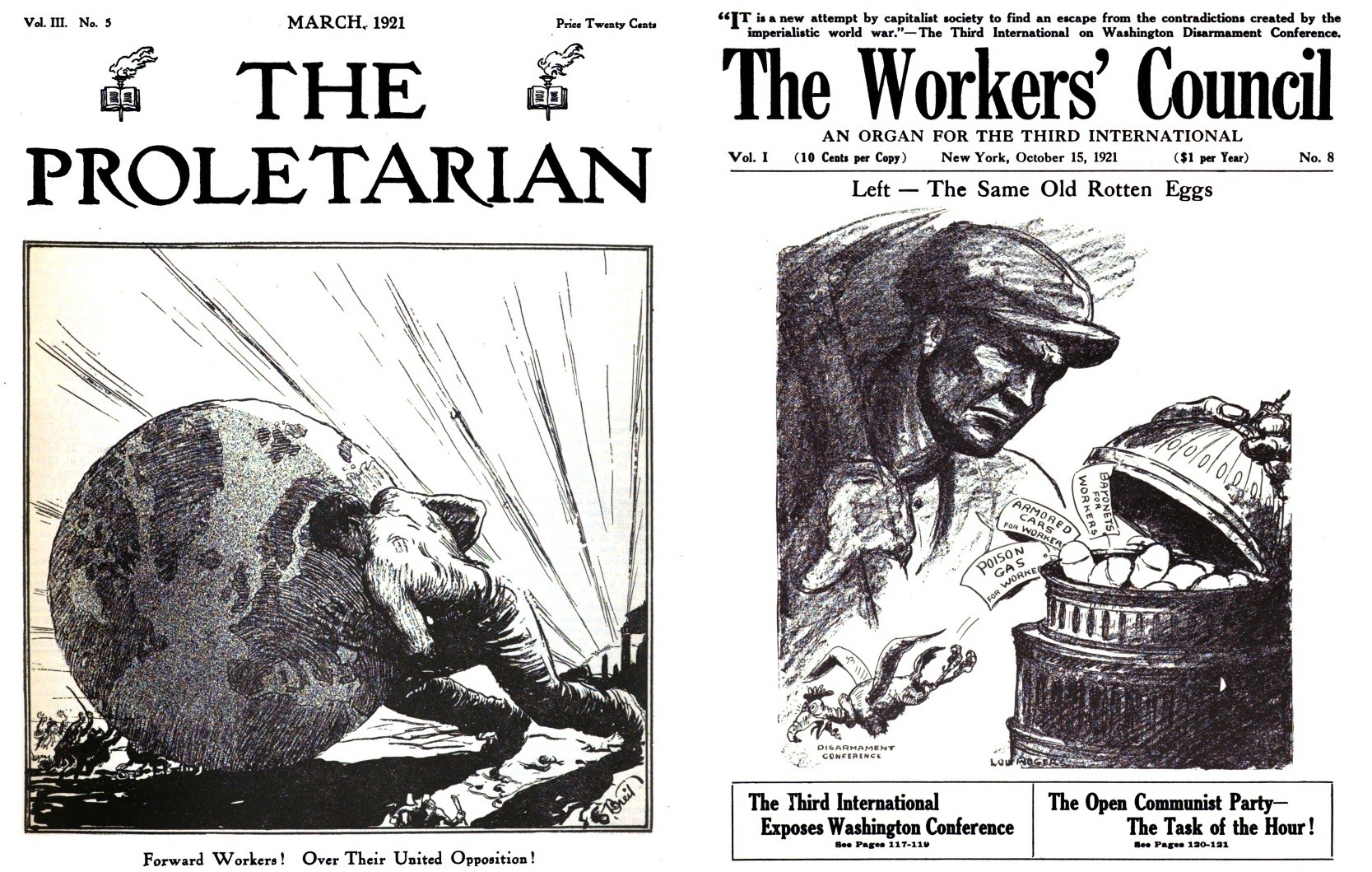
Then in the Proletarian Party, but about to be editor of the United Toilers of America’s ‘Workers’ Challenge’, Harry Wicks pour scorn on the new Worker’ Council group organized two years after the Communists split to win the Socialist Party of America to the Third International. It included important members such as J. Louis Engdahl, Benjamin Glassberg, William Kruse, Moissaye J. Olgin, and J. B. Salutsky. Most would leave the SP after its 1921 Convention, joining the Workers (Communist) Party in December, 1921 after a short independent existence. Wicks himself would, with the majority of the United Toilers, join the Party in the summer of 1922, working with Engdahl, here an object of derision, on the Communist Party’s leadership and the Daily Worker’s editorial board.
‘Another S.P. “Left Wing” Develops’ by H.M. Wicks from The Proletarian. Vol. 3 No. 6. May, 1921.
The latest arrival in the field of the numerous groups in the United States pretending to adhere to the principles of the Third (Communist) International is a group in the Socialist Party of America, calling itself “The Committee for the Third International.” The active workers in this group have long been associated with the Socialist Party and have consistently supported its reactionary policy, until within the past year.
This Committee has issued a curious magazine called “The Workers’ Council,” which reminds one of some of the propaganda issued by the Cleveland, Ohio, branch of the “left-wing” of 1917-1919; again one is reminded of the “November Bolsheviks” of inglorious memory who constituted the New York branch of the old “left-wing.” This new “left-wing,” like the old one, is endeavoring to capture the decrepit Socialist Party through indiscriminate use of the slogans and terminology of the Bolsheviki of Russia, without expending the necessary mental exertion which would enable it to understand the significance of the revolution itself. This new aggregation, like the old one, seizes upon a few formulas that have a definite place in the revolutionary movement, and continually repeat them without any attempt to place them in their historical setting. The new left-wingers have all their lives played the game of compromise, of reformistic opportunism, of social quackery; to call them utopians is to good naturedly compliment them. Muddlehead is the only word in the language that adequately and concisely describes the molecular movement in their cranial apparatus. During the period of revolt within the ranks of the Socialist Party (1917-1919) the individuals whose names appear on the new publication masqueraded as sympathizers with Bolshevism, while using every weapon at their command to basely attack and besmirch the one group in the United States that was carrying on an intelligent revolutionary propaganda–the Marxian group. When whole blocks of the When whole blocks of the membership of the Socialist Party were expelled by the bureaucratic national executive committee, when this gang of incompetent dictators refused to turn over the affairs of the party to their duly elected successors, when this same gang used the police force of the city of Chicago to evict its opponents from a convention to which they were elected, Mr. J. Louis Engdahl, the most prominent figure in “The Committee for the Third International” used his position as editor of the Chicago Socialist to vilify the groups who were making at least a pretense of conforming to the principles of international socialism. Like all the reformists, utopians and just ordinary politicians, the Marxian group was their target for the most vitriolic assaults; but, then, as now, they could not be induced to engage in a debate with our group on any question confronting the proletariat of the world.
A communication, appearing in “The Workers’ Council” and signed by Engdahl and one Steven Bircher, of Newark, N.J., declares that the twenty-one points are not a hindrance toward Socialist Party affiliation, but then they hastily add: “All discussions as to its applicability in the United States at the present time should be carried on within the International, not from without.” There seems to be a doubt in the minds of the committee as to whether the twenty-one articles do apply to the United States, but they are willing to accept them now, while not agreeing fully with them, and then endeavor to change them later. If any other interpretation can be placed upon that assertion I would like to know what it is. The next sentence is somewhat more illuminating and we there discern the motive for the expressed desire for affiliation: “The party should and must if it is to survive as a revolutionary working class organization give its whole hearted support to the Third International…” (emphasis mine.)
We now see why this committee desires affiliation of the party with the Third International; it is a question of apparently changing front or perishing and in order to save the party organization they are willing to endorse the twenty-one articles and endeavor to change them by “boring from within” the International. However, the implication in the sentence just quoted is that the Socialist Party was once a revolutionary working class organization, which is erroneous to say the least. The Socialist Party of America never was, is not now and never will be a revolutionary organization; it has seldom, if ever, been responsible for a single piece of Marxist literature being published in its entire existence. It is simply a machine through which politicians of the type of Stedman, Berger, Hillquit & Co., mask their deception and betrayal of the workers. Even at the moment Engdahl was writing articles for the organ of his committee he was, and is now, serving on a publication committee that is endeavoring to start another yellow daily paper in the city of Chicago. All labor unions and other working class organizations are being circularized by this inglorious combination of political skates in order to inveigle the gullible workers into supporting this latest project of unscrupulous adventurers. It has been a sufficient length of time since the workers had their pockets stripped to support the late unlamented “Chicago Daily Socialist” so now they are to be again systematically trimmed by Stedman, Frankle, Engdahl & Co. I suppose Mr. Engdahl will have the audacity to assert that the daily when launched will be an organ of the Third International! The labor unions are asked to contribute to a one-hundred-thousand dollar fund before the paper is launched and they kindly requested the union of which I am a member (Typographical Union No. 16) to contribute one thousand dollars. The politicians sent a speaker to the meeting to misrepresent their purpose, but I am happy to record the fact that I blocked the donation by exposing the Socialist Party for what it is and at the same time giving my fellow workers a lesson in revolutionary theory and practice. It is too bad Mr. Engdahl couldn’t have been there; he would have had an opportunity to write some more scurrilous attacks upon the Marxists of the United States as he did in 1919-20.
That “The Workers’ Council” is an organ of a section of the Socialist Party cannot for a moment be questioned when one turns to the so-called editorials and reads them. The editor says:
“The Workers’ Council…will endeavor to become the expression of revolutionary Socialism, as it was conceived by Karl Marx and Frederick Engels in the Communist Manifesto of 1847…”
Then follows a gem that permits us to accurately measure the Marxism of these miserable pretenders. The second article in the magazine is captioned, “A Place in the Sun,” and deals with President Harding’s inaugural speech and attempts to compare Harding to Woodrow Wilson. Says this new apostle (?) of the Third International:
“Whatever our opinion may be of the gentleman who now occupies the White House, it must be admitted that he, unlike his weakly vacillating predecessor, leaves no one in doubt as to his position. He is the servant of the imperialist interest of America and does not care who knows it. He is determined upon an aggressive foreign policy that will establish the American capitalist class firmly as a factor in the world market.”
After a page of verbosity and what passes among the yokels, who follow the standard of the Socialist Party, for sarcasm, in an endeavor to prove the above assertion, the article concludes:
“In short, the United States, in a single week, has openly broken with its traditional policy of aloofness in international affairs. The administration steered the ship of state into a course that can have but one ultimate outcome, new international difficulties and new wars, without pretending to consult congress, the recognized expression of the will of the people…”
No Marxist would ever be guilty of such a complete abandonment of the scientific method of interpreting current history, for as an exhibition of appalling ignorance the two quotations surpass anything that has come to my notice for quite some time. The declaration that Mr. Harding leaves no one in doubt as to his position and the reference to Mr. Wilson as “weakly vacillating” is really comical! As to Mr. Wilson I am sure no one would accuse him of vacillation, unless it be the superficial observer who never gets beneath the merest froth on the surface of the tumultuous sea of history. To the average Socialist Party member and to the average romanticist in the labor movement Mr. Wilson may have appeared vacillating and even hypocritical, but to the Marxist, who observes the underlying motives that prompt social action the course of Mr. Wilson was brutally, but in a way, admirably consistent. Never for one moment did he waver in his set course as the representative of American imperialism; when Europe was plunged into the war Mr. Wilson admonished us to “remain neutral in thought as well as in deed,” which was at that time to the interest of American capitalism; when England blockaded Germany Mr. Wilson protested, in the interest of American capitalism; then England assured Mr. Wilson it was a necessary war measure, but that the Allies would absorb all the commodities the American capitalists could supply, the objections to the blockade were tabled, which was also in the interest of American capitalism; when German victory threatened the enormous loans of Morgan & Co., further action was taken by Mr. Wilson, still the consistent servant of American capitalism. To the superficial observer Mr. Wilson reversed himself between 1914 and 1917; to the Marxist he stood steadfast as the consistent representative of American imperialism. When he went to Versailles, he still held to his course, when he endorsed the League of Nations and insisted that the Treaty of Peace be incorporated therein, he served the same interests as at the opening of the conflict. That his illness removed him from the field of activity before his term expired is no evidence of vacillation; but even that illness did not impair his sense of responsibility to those he represented. He vetoed the Lodge resolution for a separate peace with Germany, for its passage would have endangered the finance capitalists who had billions of dollars invested in the Allied cause. The interests of the finance capitalists of America and the Allied powers, being identical as against the interests of all the rest of Europe, the material basis existed for the destruction of national boundaries as far as capitalism is concerned, so the United States then abandoned its aloofness, which had before been its “traditional policy.”
Opposed to the interests of the finance capitalists was the large group of manufacturing capitalists, who maintained that the United States must get back to its policy of isolation in world affairs and attend strictly to the affairs of this nation, which, to them, constituted the manufacture of commodities for the world market. Whereas the Democratic party and Mr. Wilson represented the finance capitalists (imperialists) the Republican party represented the same class it has always represented since its inception, the manufacturing class. While the imperialists of the world were squabbling over the partitioning of the world, the manufacturers were demanding an immediate settlement of the diplomatic conflict and resumption of trade with any nation that desired American commodities. The entire conflict between the Republican and the Democratic party was based upon the question of acceptance or rejection of the League of Nations and the Treaty of Versailles. The exponents of isolation won the day, the League and the Treaty were repudiated, the imperialists were rebuked and as Mr. Harding said in his inaugural speech: “In a deliberate questioning of a change in national policy, where internationality was to supercede nationality, we turned to a referendum of the American people. There was ample discussion and there is a republic mandate of manifest understanding.” Again he said, “America can be a party to no permanent military alliance, it can enter into no political commitments, nor assume any economic obligations which will subject our decisions to any other than our own authority.” There in plain words is the assertion that there is no abandonment of the old established policy of isolation. This attitude is mistaken by the confused editors of the “left-wing” publication as an “aggressive foreign policy that will establish the American capitalist class firmly as a factor in the world market.” The question arises: What part of the capitalist class is referred to? The finance capitalists are established in the world market, but they need a vigorous spokesman of international imperialism to guard their interests; a spokesman such as they had in Mr. Wilson. The manufacturing capitalist has suffered at the hands of the finance capitalist during the imperialistic conflict and he will have no more of internationalism, so he demands “hands off European affairs” in order that channels may be opened to him through which he can dispose of his manufactured product.
Mr. Harding now finds himself in office and pressure being brought to bear upon him by the finance capitalists, so he is between two horns of a dilemma–either repudiate the manufacturing capitalists whose interests served him in his campaign or incur the hostility of the finance capitalists. Not wishing to do either he endeavors to straddle the issue, an attitude that can be maintained only a very short time. That he will eventually be forced, by the inexorable conditions, to support the imperialists against the manufacturers cannot be doubted, but the indisputable fact remains that he does not, as yet, serve the interests of the finance capitalists on the stage of world imperialism.
Of course, it is quite simple to repeat the monotonous and brainless dirge of the pseudo-revolutionists: “There is absolutely no difference between the Republican and Democratic parties.” It doesn’t require any brains to reiterate such a dogmatic formula, whereas an attempt to analyze the fundamental difference between political parties requires a degree of mental application that would incur cerebral disaster in the anatomy of a Socialist party member.
There is nothing in the entire publication of the “Committee for the Third International,” that is a product of the editors, to distinguish it in any way from the standard Socialist Party publications. One statement from another article, “The Bitter Lesson,” on page four of “The Workers’ Council” deserves to be quoted for the amusement it will furnish one familiar with Marxian economics. Says this hybrid:
“Taxes are sky high. The war must be paid for. It must be paid for out of production for there is no other way. Either profits must be sacrificed or the workers must be sacrificed. Since the profit mongers are the lords of industry the worker must pay.”
It seems almost inconceivable that one connected with the radical movement in any capacity could create such drivel, but the above is an actual quotation from a Socialist, published in New York; possibly in New York this “left-wing” comic supplement of the Chicago Socialist–it serves as the funny section of the New York Call.
The writer of the above quotation evidently imagines that if there had been no war the workers would have secured a larger share of the products of industry, that is, that part that the cruel (?) capitalists will now force them to sacrifice in order that the taxes incident to the expenses of the war may be paid.

Just what this new organ of “revolutionary propaganda” is endeavoring to accomplish is not quite clear. Perhaps it is the result of the machinations of the “underground” romanticists, who solicit every variety of reformists, anarcho-syndicalists and even avowed anarchists for their membership as a means of augmenting their depleted ranks. Possibly Mr. Engdahl and his associates are preparing to play the mole and burrow in the ground in the vain and futile hope of undermining capitalist society, while the Marxists, whom they hold in contempt, will continue working in harmony with the traditions of scientific socialism and the principles of the Communist International, preparing the way for the triumph of the working class in the United States; an eventuality the confusionists in the labor movement will not be able to recognize when it arises before them.
The monthly organ of the Proletarian Party of America, The Proletarian originally served a left wing faction in the Socialist Party of Michigan led by John Keracher, and was printed in Detroit and Chicago from May, 1918 until July, 1931. The Proletarian Party then published Proletarian News, from 1932 until 1960. Part of the early Communist movement, the Proletarian University and the Proletarian refused to join with others in going underground after the Palmer Raids, though it eschewed electoral politics. The Proletarian Party attempted to gain admittance to the Third International to no avail. The Party eventually took over the left wing publishing house Charles H. Kerr & Co.
PDF of full issue: https://www.marxists.org/history/usa/parties/ppa/1921/0500-proletarian-v03n06-opt.pdf
 Revolution's Newsstand