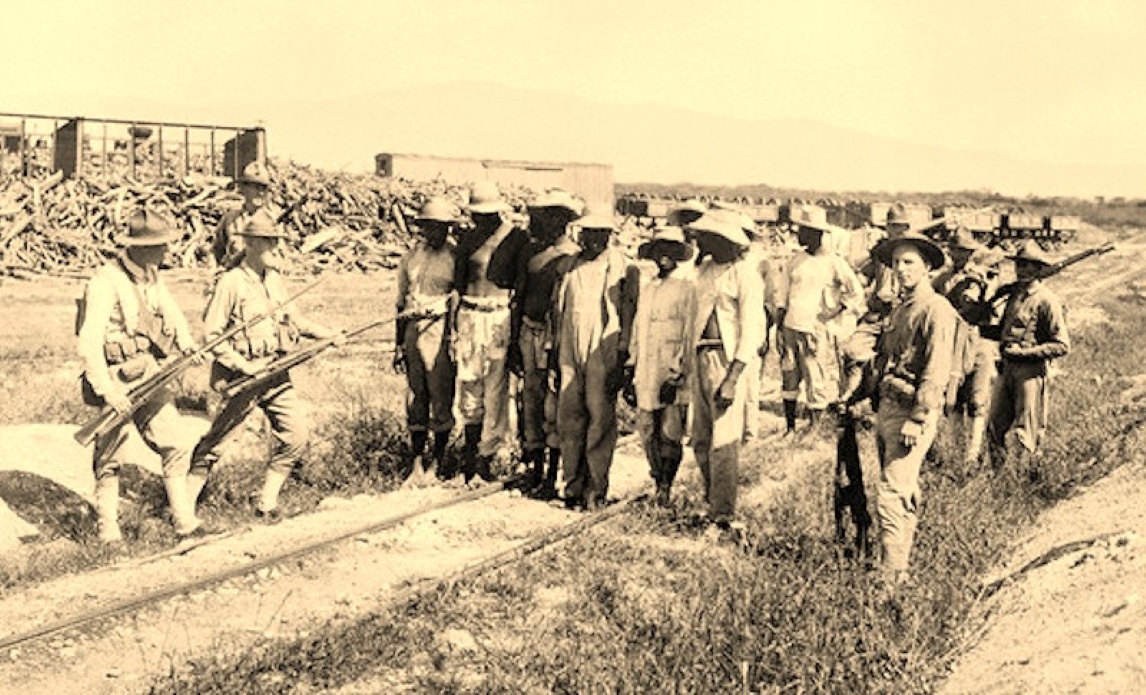
A detailed history of National City Bank of New York’s absolutely gangster play to take control of Haiti’s finances with the help of U.S. marine bayonets. J. Wilenkin was a leading figure of the early U.S. Communist Party and its Russian language federation.
‘Dollar Diplomacy in Haiti’ by J. Wilenkin from Negro Worker. Vol. 2 No. 5. December, 1929.
The rumblings of the Wall Street crash in New York resounds all over the world and especially in Latin-America as the recent cable information from Haiti proves it.
According to reports of the State Department of the U.S. an armed uprising of Haitian peasants of the city of Jacmel took place December 5. The first thing the rebels did was to cut off the telephone and telegraph wires in order to prevent the bringing home of information to the Powers that be of the Haitian Republic.
The Secretary of State Stimson asserts that the insurrection in Haiti has started in the latter part of October by university students who have developed a strike at that time.
There are also serious uprisings in Los Cayes, an important coffee plantation centre possessed by American interests. Twenty-five American concerns suffered a great deal because of the existing unrest in Haiti. Haiti is considered as a protectorate of the United States. Hence the American Government acts there as a dominating Power, and the American High Commissioner at Port Au Prince, the capital of Haiti, has enforced Martial Law which as a matter of fact exists there quite a few years.
At Port Los Cayes has occurred a clash between the workers of the city and U.S. marines. The latter fired at the natives killing five and wounding twenty. After this assault the Secretary of State Stimson has deemed it necessary to despatch 500 marines, a cruiser and a few aeroplanes. Thus we see that the US Government is preparing to suppress the Haitian rebellion.
Stimson contemplates to explain the cause of all the uprisings of the different strata of the Haitian population and states that in connection with the coming elections, “political agitators were inciting to further strikes” as a result of which the strike wave is spread throughout the country. Is this the real cause of the present insurrection in Haiti? The American Government attempts to obscure the real issue which forced the natives of Haiti, the oppressed Negroes of this Republic to uprise and rebel as a matter of fact against the US big capitalist interests, against American imperialists and its lackey, the United States Government.
Let us see what has actually forced the natives of Haiti to rebel.
The Negro Republic of Haiti is one of the countries in the Caribbean Sea, whose economic and strategic importance doomed it as inevitable prey to American aggrandizement.
The importance of the Caribbean region to the United States, lies in its proximity, above all in its commercial advantages as a source of raw materials and a market for manufactured goods.
As a strategic military addition to the Panama Canal it is also of great value to American Imperialism. The opening of the Panama Canal raised the Caribbean to a commanding position among the trade routes of the world. In addition the Caribbean is the gateway to the Panama Canal, the American: magnates are trying their best to subdue it to their power and treat it as a vassal region. The strategic importance of the, Caribbean has impelled the United States to secure naval foothold: in that region. By turning Haiti and Santo Domingo into protectorates, the United States Government has acquired the Mole St. Nicholas in the former, and Samana Bay in the latter as first class naval bases.
Thus it is not surprising that the US imperialists are greatly interested in Haiti’s affairs. As far back as 1817 the United States attempted to obtain control of the harbors of Samana Bay, on the Easter Coast of Santo Domingo, and of Mole of St. Nicholas, on the Northwest Coast of Haiti, as stated, for avowed uses as naval bases. In 1891 the United States sent Admiral Gharardi with a considerable fleet to Port au Prince, capital of Haiti, to negotiate for the cession of Mole St, Nicholas, but the Haitian Government refused to discuss the matter and the fleet was recalled.

But the strategical importance of Haiti is not the main thing. The industrial, commercial and financial interests of the U.S. imperialist in Haiti is of still greater import. The policy of the U.S. State Department in Haiti became definite only then, when the National City Bank of New York, the largest and most influential financial enterprise of the country, has entered into Haiti. In 1881 the National Bank of Haiti, founded with French capital, was entrusted with the administration of the Haitian treasury. In 1910 this bank was re-organised in connection with a new government loan taken by French bankers, and replaced by the National bank of the Republic of Haiti, which, like the old institutions, was entrusted with the administration of the Haitian treasury. Under the contract with the French bankers the bank was to make certain annual loans to the Haitian Government.
Soon after this financial operation was performed, the National City Bank became interested in this affair, and Secretary of State Knox, under the Presidency of Taft, pursuing the latter’s policy of “dollar diplomacy” intervened in the matter and objected to the contract saying that “some American banking interests ought to be represented,” He called a conference of the New York bankers, with the result that in 1911 the National City Bank, Speyer & Co., Hallagarten & Co., and Ladenburg, Thalman & Co., each became subscribers to 2,000 shares of the new bank.
This success of the American bankers required a great struggle for the US imperialists were at that time not as powerful in world financial affairs as they are now. German interests, exceedingly powerful in Haiti at that period both commercially and politically, demanded a large participation in the re-organised bank and opposed American participation. The attitude of the French Government, however, was emphatically against inclusion of German capital without American participation, and the final arrangement, completed in 1910, gave only about 2,500 of the total of 40,000 shares of the National Bank of Haiti, to the “Disconto Gesellschaft” a semi-governmental German institution. About 8,000 shares, as stated above, were held in New York by the four above mentioned prominent banks and a few shares in Haiti. The remainder of the stock was held in France.
Shortly after the European War broke out, Secretary of State Bryan, during the Presidency of Wilson, having interviews with the American bankers “suggested–according to reports of Senate Haiti Hearings–the advisability of the American interests acquiring the French shares in the bank, and making it an American bank. The suggestion was repeated from time to time, and after some extended conferences…the National City Bank purchased all the stock held by the other three American parties.” This occurred in 1917. Two years later, “after several suggestions from the State Department…the National City Bank purchased all the assets of the French institution for $1,400,000”. Hence the National Bank of Haiti fell into the hands of the largest financial concern of the United States–the National City Bank of New York, i.e., into the hands of the greatest financial interests of the world.
The State Department took upon itself to insure the bankers investment. On six occasions during 1914 and 1915 the Department made direct proposals to Haiti to obtain control of the customs taking as a pretext the internal political disturbances. In October 1914, Secretary of State Bryan (the same Bryan; who during the Presidential elections of 1896, 1900 and 1908 was running as a Presidential candidate issuing anti-imperialist slogans), wrote to President Wilson: “It seemed to me of the first importance that the naval force in Haitian waters should be at once increased, not only for the purpose of protecting foreign interests, but also as evidence of the earnest intention of this Government to settle the unsatisfactory state of affairs which exists.” (Foreign Police Associations, “Seizure of Haiti”).
When a revolutionary outbreak occurred in the North Province the State Department took advantage of the situation of that time in order to propose to President Zamor that he would be kept in power if he would sign a treaty: turning over the custom houses to American control. The President refused to compromise the independence of Haiti and resigned. On December 10 the newly chosen President was formally presented with an identical proposal by the American Minister in Haiti, and again the proposal was turned down. (Senate Haiti Hearing).
One week later a contingent of United States Marines landed in Port au Prince, proceeded to the vaults of the National Bank of Haiti, and in broad daylight forcibly seized $500,000 and carried it abroad the gunboat Machias. The money was transported to New York and deposited in the vaults of the National City Bank. This money was, as a matter of fact, the property of the Haitian Government which had deposited it for the redemption of paper currency. Haiti at once protested against this violation of her sovereignty, and her property rights and requested explanation from the United States. The latter didn’t deem it necessary to respond. According to the testimony of Roger S. Farnham, Vice President of the National City Bank, before a Senate Committee in 1921, this raid of the marines was arranged by the State Department and the National City Bank. There is no doubt that the State Department contemplated by depriving Haiti of ready money to force its Government to sign a treaty turning over the custom houses to the control of the American Government, which could this way protect the interests of the United States imperialists collecting all the debts imposed upon the Haitian Government by the American financial interests.
On January 28, 1915, Secretary of State Bryan wired via the Navy Department to Admiral Caperton, in command of American forces in Haitian waters, as follows:
“You will issue to that Government a warning that any attempt that might be made to remove the funds of the bank will compel you to take into consideration means to prevent such violation of foreign stock-holders’ rights.”
In March 1915, the United States Government sent a mission to negotiate with the Haitian Government for American control of the customs, and again Haiti turned the proposal down. In May another commission arrived and presented the draft of an agreement providing for military protection and intervention by the United States Government, for arbitration of claims made by foreigners, for prohibition of the cessions of Mole St. Nicholas, or its use to any other Government. The last clause shows clearly that the Washington Government fulfils the orders of its masters, i.e., the Wall Street magnates with the National City Bank of New York at the head. For Germany, as the U.S. Government had been informed, not only contemplated but had taken preliminary steps towards securing exclusive customs control of Haiti and a naval base at Mole St. Nicholas. This proposal was being negotiated when on July 27 a revolution broke out in Port au Prince. No doubt that it had been provoked by the Powers that he of Washington and Wall Street as similar methods were used in the case of Panama and Nicaragua. President Guillaume Sam fled to the French Legation, and on the same day a number of political prisoners were massacred in the prison of Port au Prince. On the morning of July 28 President San was dragged out of hiding and killed. During all these disturbances not a single American or other foreigner was molested. Nevertheless, on the afternoon of July 28 an American warship dropped anchor in the harbor of Port au Prince and marines were landed by Admiral Caperton. And all this had been done by the order of the State Department in order to assist the American large capitalist interests in their expansion policy. The Haitian legislature met to elect a new president to fill the vacancy caused by the assassination of Sam. Under order from the State Department, Admiral Caperton forced the legislature to postpone the election until the American naval officers could canvass the situation. The purpose of this interference with the elections of a nominally independent Republic is shown in the message sent by Admiral Caperton to the Navy Department on August 2, 1915:
“Large number Haitian revolutions, largely due existing professional soldiers called Cacos…They have demanded election Bobo President…Stable Government not possible in Haiti unless Cacos are disbanded and power broken.
“Such action now imperative at Port au Prince if United States desires to negotiate treaty for financial control of Haiti. To accomplish this must have regiment of marines in addition to that of Connecticut…As future relations between United States and Haiti depend largely on course of action taken at this time, earnestly request to be fully informed of policy of United States.”
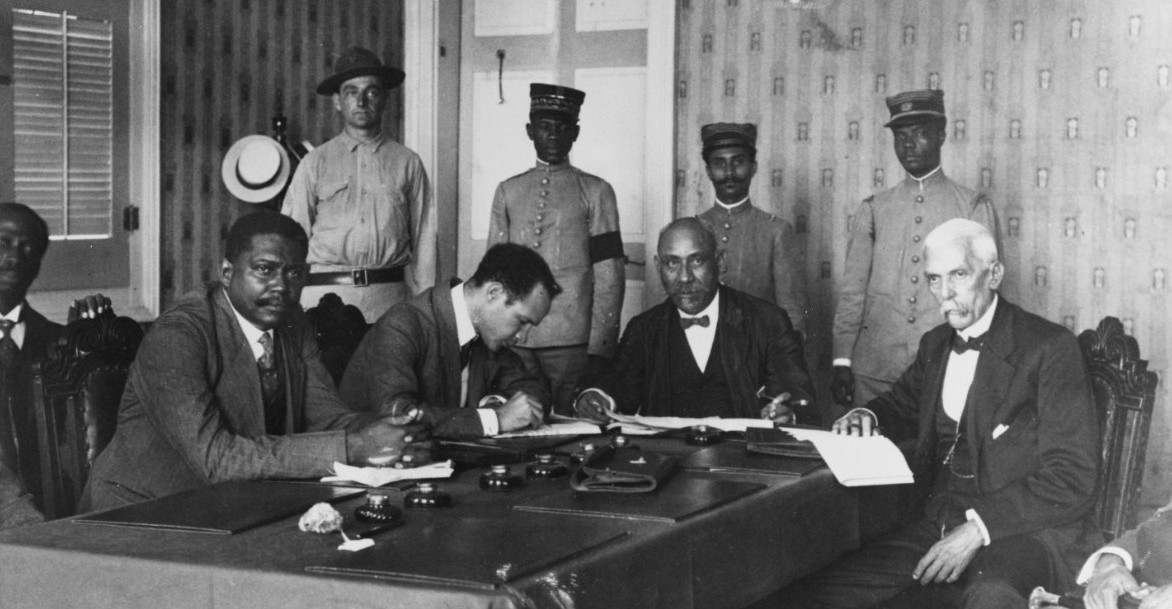
Admiral Caperton now attempted to force, at the point of marine bayonets, the treaty which the State Department and National City Bank had failed to obtain through negotiation and through financial pressure. The first step was to obtain a candidate who would be willing to serve American purposes. Such a candidate was found in the person of Sudre Dartiguenave, who offered, if elected President of Haiti, to accede to any terms made by the United States, including the surrender of customs control and the cession of Mole St. Nicholas. Regarding this candidate Admiral Caperton wired the Navy Department at Washington on August 5, that he “has never been connected with any revolution” and “realises Haiti must agree to any terms laid down by the United States…If elected must be sustained by American protection.”
Dartiguenave was acting not out of choice, but out of a realisation that before the rifles of American marines Haiti was helpless. He begged only “as far as possible to avoid humiliation.”
Admiral Caperton, frankly protecting the interests of the National City Bank, ordered the Government of Haiti to restore the treasury service to the National Bank of Haiti, which the Government had withdrawn in January when it discovered that it could not draw money at its own discretion. On the day on which the Haitian legislature “voted” for the new President, U.S. marines guarded the doors of the chamber and Admiral Caperton’s chief-of-staff circulated among the congressmen, imposing upon them the henchman of American Imperialism. Dartiguenave was “elected” and acted as a true lieutenant of Wall Street.
We are not in a position to give the full history of the suppression of Haitian people, especially the toilers of this country, by American imperialism. Since that time U.S. capitalism prevails not only in financial affairs but also in industrial, commercial and agricultural pursuits of Haiti. The United States Government is as a matter of fact ruling Haiti, dictating and controlling each step the Haitian people are contemplating to undertake. Such a state of affairs had its influence upon all the strata of population provoking them to resistance. The present uprisings are, no doubt, a sequel of the oppression of a nation depriving it of any opportunity to determine its own destiny. Especially this oppression is felt by the poor peasants and agricultural workers who are exploited by the American capitalists applying their methods of intensive work in a country with a tropical climate.
The present rebellion in Haiti is a sign of time showing that the Latin-American countries are not willing to stand the political and economic oppression of the American imperialists.
The duty of the Profintern and the Comintern is to aid the revolutionary elements in Haiti in organising in the first place the agricultural wage earners. They are the most exploited workers in Latin America as the U.S. plantation owners are the most ruthless exploiters in the world. The poor peasants also should not be neglected for they are treated as peons.
First called The International Negro Workers’ Review and published in 1928, it was renamed The Negro Worker in 1931. Sponsored by the International Trade Union Committee of Negro Workers (ITUCNW), a part of the Red International of Labor Unions and of the Communist International, its first editor was American Communist James W. Ford and included writers from Africa, the Caribbean, North America, Europe, and South America. Later, Trinidadian George Padmore was editor until his expulsion from the Party in 1934. The Negro Worker ceased publication in 1938. The journal is an important record of Black and Pan-African thought and debate from the 1930s. American writers Claude McKay, Harry Haywood, Langston Hughes, and others contributed.
PDF of full issue: https://www.marxists.org/history/international/comintern/negro-worker/files/1929-v2n5-dec.pdf
 Revolution's Newsstand