
In this chapter Scott Nearing explores the core of the Revolution’s remaking of the old school system, the ‘Universal Labor School’, foundational schooling for every child from 8 to 17 across the Soviet Union.
‘IV. Social Education–The Labor School’ by Scott Nearing from Education in Soviet Russia. International Publishers, New York. 1926.
IV. SOCIAL EDUCATION–THE LABOR SCHOOL.
Soviet elementary education is called social education. It is carried on in the labor school. The labor school is the first division of the mass school–the first section of the Soviet school system. All children in the Soviet Union are required to go through the labor school.
Social education is divided into two parts. Children enter the labor school at eight, and complete the first part of the school at twelve years of age. The second part of the labor school extends to fifteen years of age in some schools and to seventeen in others. There is a difference of opinion among Soviet educators as to whether children are ready for specialized (professional) education at 15 years of age, or whether they should continue general education until they are seventeen. Hence the difference in the number of years spent by children in the second part of the labor school.
Most social education is carried on in the villages. Only about one-ninth of the elementary school buildings are located in the cities. In January, 1924, the total number of schools in the Soviet Union is given as 92,857. Of these, 81,306, or 87.5 per cent. were in the villages. The city schools were larger, of course, but the village schools far more numerous.
The ordinary village school in the Soviet Union is as badly equipped for educational work as was the average village school in rural United States toward the end of the last century. Village communities are largely illiterate. Children of school age are always wanted to run some errand or to do some chore. These home demands come first, and school duties take second place. During the harvest time it is practically impossible to keep the village children in school.
Conditions in the ordinary Soviet village are still largely against successful school work. Still, I visited some village schools that were beginning to handle the new course of study for elementary schools with excellent results.
One teacher in a two-room village school has been in the educational system since 1916. Until 1923 she had used the old Russian system.
“The old system was very easy,” she explained. “We just taught reading and writing and a little arithmetic. The class recited in unison. All the teacher had to do was to open the book at the proper page and start the class going. It was just like a machine.”
Then she spoke about the new system. It was very different, she said. There was almost no book work connected with it at first. The children were expected to study their homes, the street they lived on, the village, its government and its sanitation. They examined all of the wells and looked up the matter of water impurities. The new education is just a matter of observation and comparison. There is no more book-lesson work, and no more recitation in unison.
“The teacher has to prepare the lesson each day. The pupils are consulted about what shall be done next. The teacher must think the lessons out, step by step. It is particularly hard for us because we are not prepared or trained to do such work. Most teachers are even afraid to try it. I was afraid at first, but since I have started it I like it much better than the old system. It gives the teacher a chance to do some original work. The children get a great deal more also. They have an opportunity to grow.”
She then went on to explain that the older children were making a sanitary inspection of the village during that week. It had occasioned much comment and not a little discomfort, because some of the villagers were emptying refuse into a stream where other villagers were compelled to wash their clothes. Of course the children had no authority, but their inspection had caused a great deal of discussion-provoking publicity.
Education in this village, a thousand miles from Moscow, was still very backward. The new ideas were penetrating, however.
Another village four-room school had a “model” class in one of the rooms. This model class was organized on the new Soviet plan. It was a beginners’ class, and there were no books. Instead the children had begun the school work in late September by making collections of leaves, seeds and other products of autumn. These collections were made outside of school hours, brought into the school, arranged and discussed. Names were given to all of the seeds, leaves and flowers. The opening of school, for this class, had consisted of a month’s study of botany and climatology.
The children had also made models of fall activity. There were hay-cocks, straw-stacks, barns. One small boy had modeled a team of oxen in clay. It was his first effort; the work was very crude, but there was a fine swing in the bodies and legs of the animals.
These children had never been in a kindergarten. They were in school for the first time at eight years of age. Instead of beginning with books, they had begun with life–the life of the village in autumn. They were observing it, analyzing it, discussing it. The teacher read something about it from books. The children were not so far along. So they used the autumn for their books, studied it with great enthusiasm and in a month they had learned a great deal about the things that were happening all about them.
The head teacher in this school was a man of perhaps twenty-four. He had taken a special course in the “new system” and was working out the details for the first time with his class. He liked it. The children were enthusiastic about it.
He showed me the meagre equipment and the simple, home-made devices for carrying on the work. “We are very poor here,” he said. “When school opened the teachers and the older children scrubbed the place out, and we have been trying to paint it and do some repairing. The village is just recovering from the war and the famine. But a great many people here are interested in seeing some real educational work done, and we are going to succeed.”
This village too was remote from the centres of population. Yet the new education was being organized there. The children had a tiny co-operative, where they bought their own ink, paper and pencils. Each class was organized, with its class committee and class officers. Two years before this region had been devastated by civil war. Already, however, new schools were growing up from the ruins which the war had left.
These were typical village schools, with old, inadequate equipment, with teachers who were groping about for ways to put the new educational system into effect. They had not yet felt the impact of the new order. Some villages were worse than this, and some were much better. Educationally most villages are still backward.
Some day, if plans materialize, all village children will have seven years of general (social) education, and three or four years of education in professional schools devoted to training workers for the principal occupations carried on in the village. At the moment, this time is still well in the future.
Most Soviet village schools have made comparatively little progress. They serve the most backward part of the population. They will probably be the last to feel the impulse of the new educational movement that is sweeping across the Soviet Union. In order to see this movement in its real proportions, one must go to the industrial centres and to the cities.
City labor schools, or as they are frequently called, seven year schools, are housed very much as elementary schools are housed in the United States. They have buildings accommodating several hundred (sometimes more than a thousand) children. The halls are wide and the stairs convenient. Few of the buildings are new. In lighting, ventilation, toilet accommodations and gymnasium facilities they are far behind the best of the elementary schools in the United States. There are a number of features however that are quite distinctive. This is particularly true of the subject-matter used in the earlier grades, of the methods of presenting this subject matter and of the organization of students and school administration. These differences can be best brought out by two or three illustrations.
One day I walked, unannounced, into a public elementary school on the outskirts of Moscow. It was a small school, badly housed in a former private residence. Its physical equipment was distinctly below the Soviet average. The first room that I entered housed the beginners’ class of about 35 children.
The teacher of this class welcomed me and explained the work that the class was doing. Her pupils had been in the school for about two months. Few, or none of them, had ever been to kindergarten. They were using the “book-less” method of first year work.
Each child began the year with a note-book. The teacher used some simple word such as dog, and asked the children to put it in their note-books. Of course, they drew it. Next the teacher used a phrase “boy and dog.” The children drew pictures of both, and put a dash for the word that they could not picture. In the same way, verbs were introduced and represented by dashes. During the first few weeks their pencil work consisted in making pictorial representations of simple words, phrases and sentences. It was not until the concept of phrases was well fixed in their minds that the children began to do any writing.
When I visited this class the children were learning to build letters into words and phrases. Each exercise was drawn or written by the child in his note-book. The children were very eager to show their books and to explain their drawings. Each seemed to feel a certain pride of authorship. In some cases this was thoroughly justified as certain of the books were very creditable.
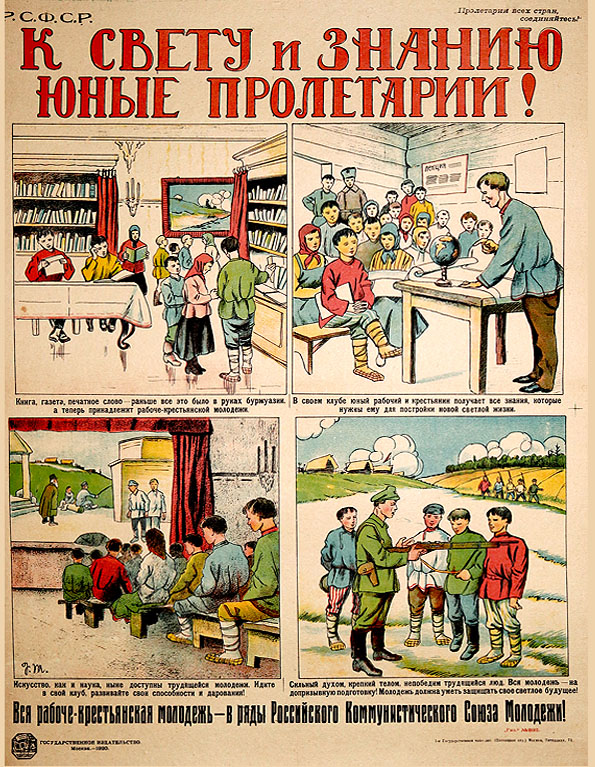
This book-less work, or, as it might also be called “note-book method,” was supplemented by a system of trips, excursions and group projects. At the time of my visit the class was busy with a superficial study of “our street.” This study consisted in listing all of the objects along the street and then making a class drawing on a roll of paper. Each of the children contributed something to this drawing. The child either drew directly on the paper, or else drew something separately and pasted it on. The result was a picture of the objects along the street as the children had seen them. The work was progressing finely, and the children seemed to take a real pride in it.
All of this activity was in the realm of the concrete. Most children of seven or eight are quite ready to draw objects that are called to their attention. They do not write because writing involves the use of symbols which are quite beyond the grasp of many young children. These children were beginning their school work with drawing, and going to the more abstract letters only as they were able to make the connection in their minds between concrete objects and abstract ideas.
The class project–in this case the members of the class all working together on a picture of the street–plays a very important role in all Soviet education. These children were all living on or near this street. They traveled it each day. What better method of social education than to ask them all, as a group, to observe the street along which they were walking, and then all join together to make a picture of its various parts?
Other classes in the same school were following out the same method. One older group that had made a trip to a factory was preparing a class report on the factory, with text and illustrations. The class was divided into small groups, each one of which was responsible for some one phase of the factory work.
The system used in this beginners’ class is little more than an extension of the ordinary kindergarten method, with the concept of the class project added. Even that idea pervades kindergarten games. The children in this class took a great share in planning the course, and each day one of them dictated to the teacher a record of the work accomplished by the class during that day.
The woman in charge of this beginners’ class had been. teaching in Moscow schools for twenty years. The book-less class project system had been used in her class for only two years. I talked to her at length about her experience with the two systems.
“This new method is far harder on the teacher,” she said. “Under the old system things moved along easily. You took the book, opened it at the first page and started. When you were through with page one, you went to page two. Every day was much like the last, except that you were on a different page. The book-less system makes each day a new problem. It has many possibilities. Before we finish with one problem, we talk things over with the children and decide what is to be done next. Of course the class outline gives the general direction, but the details are settled by class and teacher together.
“When a decision is made we must find ways of putting it into effect. If the children decide, for example, to make a class drawing, we must find a way to buy paper, crayons and paints. If they decide on a trip or an excursion, we must find car-fare. The number of possibilities is large and it is sometimes a real problem to come to an agreement. The teacher under such a system cannot keep ahead of the class. She must stay with it. We go on together with the children, and keep a record of our voyage.”
Another teacher in the same school, who had also taught under the old regime, told a bitter story of hardship during the war and the Revolution,–small salaries, often unpaid for long periods of time; lack of fuel; shortage of supplies. Still, she said, the new way was better. “The children get twice as much out of this as they did out of the other. They feel that they are a part of the school. Go into any of our classes, and you will find an interest and an enthusiasm that the old system never aroused.”
This book-less method would not be so impressive if it were being tried out in a dozen or even in a hundred Soviet first grade classes. It can be found in experimental schools and in some of the best private schools all over the world. But thousands of Soviet first grade teachers are experimenting with some variant of this method at the present moment. It is one of the ways in which Soviet school authorities are trying to introduce children to the schools and to the community in which they live.
This little Moscow school was physically worse than average, though it was in the Soviet capital. Now look at another school, with an equipment better than average, but located in the coal fields of central Russia, in the city of Stalinov.
Stalinov is a city of about 40,000 people who are engaged in mining, steel and machine manufacturing and railroading. Since 1923 the First City School (elementary) has been working on the new system. There are eighteen classes in this school, ranging from a first class with children of eight years to a seventh class, with children of about fifteen years.
Children in the early grades follow much the same system as that which is in use in the Moscow school just described. They work upon simple unit topics and carry out class projects. The work is planned from week to week by teachers and pupils, following the general line of the course of study. Each class keeps its record of daily progress.
All of the older children in the school were working in class-rooms organized on the laboratory plan. Each room was devoted to one subject,–mathematics, social science, biology,–and when the children wanted to do class work in one of these subjects, they went to the proper laboratory. They did their work in class groups, however, and not individually, as under the Dalton plan.
The laboratories were equipped with maps, charts, books of reference. Many of the charts had been made by the students. In each laboratory there were several tables around which the students were gathered–four, five or six at a table. They were all working in groups. On entering the room you looked in vain for the teacher in a commanding position, sitting behind a desk at the top of the room. Instead you found her at one of the tables, working with that group. The students at the other tables were going on, meanwhile, with their activities. The laboratories gave the impression of reading or reference rooms in some large city library. There was no sense of school “discipline.” Each of the persons in the room was going about his business as if he really meant it.
The Principal at this First City School was a middle-aged woman who had spent her entire working life in the Russian schools. “We are trying to relate the work of the school to the life of the city,” she explained. “We no longer teach subjects, such as arithmetic, spelling, geography. That type of specialization has been given up. The students in each class work on problems–one problem at a time. The problem is taken out of the life of the community. The younger the children, the more local and concrete and simple the problem. The children visit the institutions they are studying, analyze them, explain them and, where possible, suggest ways for improving them.”
I asked for more detail about the course of study. The first topics taken up related to the homes and families of the children. The children told the names of their parents, their occupations, the work that went on in the home, the method of organizing the home, the relation between their family and the other families in the neighborhood. The life of the home and the neighborhood was thus carefully reviewed, and its social meaning was discussed. Suggestions were also made as to the possibility of reorganizing the life of the neighborhood on a more workable basis. Second year students went on to the life of the city (or town). In the third year the country or district was the topic. In the fourth year the subject was the province. The fifth year group took up the Soviet Union. Following that came a study of the commercial and economic relations of the chief countries of the world.
During the first four years, this method went very well. One group of children, working with one teacher, could make a study of the local institutions with comparative ease. When, however, it came to the work of the higher years, the field to be covered was so much greater and the questions that arose were so technical that no one teacher could hope to answer them all. As a matter of necessity, therefore, after about the fourth year the work was divided among the laboratories. Each of the upper grade teachers therefore handled a laboratory and a specialty. That did not mean a redivision of subjects on the old basis. The teachers specialized. The classes continued work on their own unit problems.
This is one of the points of controversy in the Soviet schools. The “complex system,” or unit problem system, succeeds very well for the first three or four years. The children like it and the teachers are able to handle it effectively. Then some form of specialization becomes necessary because of the intricate nature of the problems that have to be handled. The old method was to let the child specialize geometry, ancient history, physical geography, mechanical drawing. The aim of the Soviet school authorities is to keep the classes at work on unit problems, but under the direction of a number of teachers who are specialists in particular fields.
I talked over this question with many of the Soviet educators. Stanislav Shatsky, Director of the First Experiment Station of the Russian Republic, has reached the conclusion that some form of group project, applied to life in the country, is the solution. A part of his experimental work is carried on in Moscow, and another part in the villages in the immediate neighborhood of Moscow. He has been trying to find an answer to this particular educational problem, and he is practically convinced that it involves the education of the old elementary students in an environment where they can carry to completion projects that pertain to the maintenance of life–the provision of food, clothing and shelter.
Such a school system would be very expensive. Shatsky believes that a school of this type could be made about thirty per cent self-supporting. It would mean that city children from twelve to sixteen would receive a considerable portion of their education in the country.
Other educators said frankly that they had found no answer to the problem. At the moment this is one of the gaps in the Soviet plan. The educational leaders know this and are doing their best to find a way out of the difficulty.
The students in the First City School were organized. Each class had a class committee of three members, one of whom was the class secretary. The class secretary was also the representative of his class on the school committee of eighteen.
The school committee of eighteen (one representative from each class) elected a president, a secretary, a chairman of the sanitary committee, a chairman of the sports committee, and a committee of three to carry on the cultural work of the school.
The school committee was in general charge of all matters concerning student activities. Together with the class committees they handled all cases of discipline.
There was no evidence of an effort on the part of the teachers to regulate the conduct of children in the class rooms or in the halls or other parts of the school. That task seemed to be entirely in student hands. This does not mean that there was disorder in the school. On the contrary, the children in the halls and elsewhere went about their affairs in a quiet business-like way. There was some noise when classes were changing rooms, but during the class periods the school was very quiet. All breaches of school discipline were referred at once to the proper student committee.
The Student President of the school was a tall, energetic boy of fifteen. I talked with him at some length about the problems of student organization. “What is your chief difficulty in handling this job?” I asked him.
“Discipline,” he answered promptly. “We have no trouble with club work and the like. They almost take care of themselves. But discipline takes a lot of thought and time. Each class is supposed to handle its own discipline as far as it can. When a matter gets beyond the class, it comes before our school executive.”
“What happens then?”
“We settle it amicably if we can. If that is impossible, the executive holds a trial and reaches a decision. The whole eighteen participate in such a trial.”
“Is their decision final?” I asked.
“No, not final. Any decision they reach comes before the school committee for review.”
“Who is on the school committee?”
“There are four members–the principal, the assistant principal, a representative of the workers in the school (clerks, janitors) and the president of the student body.”
“So you, as president of the student executive, have a chance to present the case of the student organization before the school committee?” I inquired.
“Of course,” said he.
“Are you usually upheld?”
“Yes, usually. We try to make decisions that are within reason.”
“Does the school committee have anything else to do except to review your decisions?” was my next question.
“Surely,” he answered. “It plans and directs all of the work of the school.”
“And you, a student, sit as a member of that committee?”
“Of course. We are going to school here. Is not the school organized for the students?”
I changed the line of my questions. “Does not this work take a great deal of your school time?”
“Not so much,” was his answer. “We divide the work among us, and the members of the student committee help each other out. Then you must remember that we learn a lot by this sort of thing.”
I met President Forer for this interview in the students’ room. It was a small, well-kept social room under student control. Its care fell to the committee on student club work. There was a business-like air about the room that gave the impression that someone was taking an interest.
As for the student sub-committees, the Sanitary Committee was responsible for seeing that buildings and grounds were kept in a sanitary and orderly condition. The Sports Committee was responsible for school sports and recreation. The students had a clubroom, a wall-newspaper, and a reading-room, all of which came under the control of the Club and Culture Committee.
Among the students of this school, 6 per cent were Young Communists and 28 per cent were Pioneers. These forms of student organization are classed in the Soviet Union as “political.” They are encouraged among the students, but they cannot be directed by teachers. The Pioneers in this school were under the direction of a Young Communist, who was a student in a local college. In the United States he would be called a scout master.
This Pioneer group was well organized and very active. “What is a Pioneer?” I asked one of the older boys. He replied:
“A pioneer is a student whose business it is to build a new world.”
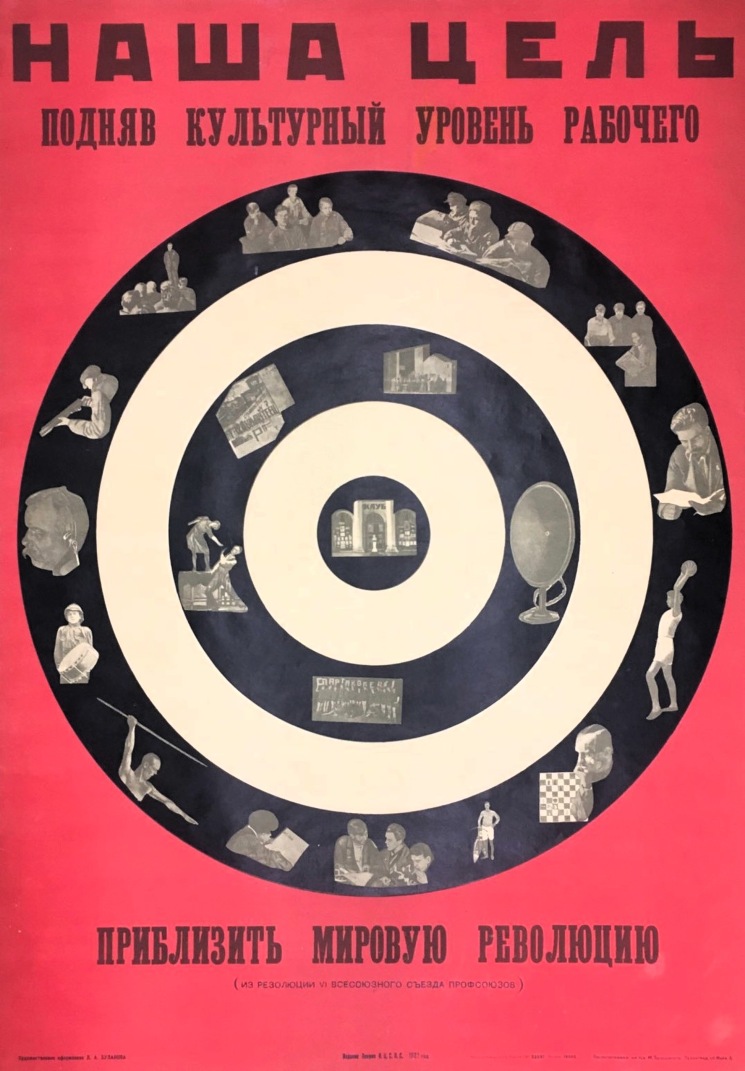
Ten miles away, in another steel town (Dimitriersk) I visited a school of about the same size, in which there was a threatened epidemic of scarlatina. There I had a chance to see a very complete school-health system at work.
Special emphasis was laid in this school on the outlining of the course of study. The students took part in making the outline. When it was completed, it was posted in each room—a small book containing an outline of the work for the next few weeks. The copies in the various rooms seemed to have been thoroughly used.
Here, as in other Soviet elementary classes, the course centered about the home, the town, the region, and the activities that were going on there. In the upper years of this school there were laboratories, one for each major body of material.
“Is this the Dalton Plan?” I asked the principal.
“No,” he answered, “we have abandoned the Dalton Plan. It produced too much individualism by setting up each student to do his own task. We want the students to learn group work. That is what they will be called on to practice when they get out into the world.”
Students who finished this school, at about fifteen years of age, were supposed to understand the home, the family, the neighborhood, the town, the district, the Soviet Union, economic and political relations, and the chief current events of the world. This was the social side of their education.
“That is one of the greatest differences between the old school and the new,” the Principal told me. “I have spent my whole life in the schools of this town, and I know both systems well. Under the old system we dared not talk politics. Under the present system every child is supposed to have a thorough knowledge of the world he lives in, with all of its economic, political and social relations.”
The school was still in an experimental stage. “We are working the whole problem out as best we can,” one of the teachers explained. “We are not sure of anything as yet, except that we are getting better results under the present plan than we ever got under the old.”
Soviet students sing a great deal. There was a girls’ choir in the Dimitriersk school that did very fine work.
The students in this school were thoroughly organized as they were at Stalinov. They were responsible for discipline, and took charge of the various details of the student activities. They were also represented on the school administration committee.
Fifteen per cent of the students at this school were required to pay tuition. All children of workers or peasants came free to the school, but the children of the shop- keepers and other representatives of the business and professional classes paid in proportion to their income. In no case was the amount of tuition large.
At Rostov I visited the Pokrovsky Elementary School with its eleven hundred students. In the higher grades, the classes numbered about 25. The school was in a transition stage between the old system and the laboratory plan for the upper years. Most of the work that I saw was ordinary classroom work, but the method used was the laboratory method. The children worked in groups upon problems that were prepared for a period of three months in advance and posted up in the class rooms.
The sociological laboratory in this school was equipped with statistical and other publications. Some of the books were dated 1925, and had just come from the press of the State Printing House in Moscow. The equipment in this laboratory was not extensive, but it was excellently organized for the use of the students.
Student organization was very thorough in this school. Each class had a class committee of three. The committee kept the record of attendance, was responsible for the class discipline, and, in collaboration with the teacher, initiated the planning of class work.
All members of class committees were members of the student school committee. The total membership of the committee was about 75. The student school committee elected an executive committee of seven which was the responsible body in charge of student affairs. There were sub-committees on sanitation, on economic activities, on sports and on student culture work. There was a school organization of Pioneers. It had been recently organized, and had about fifty members.
This school, with its educational activities was in the hands of a school committee, made up as follows:
Teachers–37
Students (one from each group or class)–25
Parents’ organization–3
From city council–1
Workers in school–1
Pioneers in school–1
Young Communists–1
Central Labor Union–1
Large factory near school–1
School Principal–1
Total–72
This school committee met once a month. For working efficiency it was divided into two sections, one dealing with the work of the first four years, and the other dealing with the work of the last three years.
Executive direction of the school was in the hands of a school executive committee consisting of the principal, the assistant principal, the secretary of the teaching staff, the president of the student body and one representative of the parents. This principle of representation and administration was preserved throughout the Soviet Union. In all of the schools that I visited there was a general and rather numerous school committee meeting occasionally and a small executive committee meeting frequently. The school teaching staff always predominated in the latter organization.
One of the Moscow elementary schools, the Edison School (named “Edison” because it specialized in electricity during the eighth and ninth years) had only 35 per cent of its pupils on the free list. The others paid from 50 kopecks (25 cents) to 14 rubles a month, according to the income of the parents. The school was located in a district where many shop-keepers and professional people lived. All children from this social group are expected to pay tuition.
The complex method was used in only the first three years of the Edison School. Then the laboratory plan was substituted. It had been tried out for some time in chemistry and physics. This year, for the first time, it was introduced into sociology, mathematics and literature classes.
I had a talk with the professor of chemistry about the workings of the Dalton Plan. He shook his head doubtfully. “Perhaps,” said he, “if you could reduce the classes to half their number it would be possible to proceed on a basis where each child or group of children is working on an individual problem. But that would mean doubling our laboratory space, and we have no extra room. He was keen and eager, but he did not see the new scheme as a practicable one with his large classes.
Student organization in the school was very thorough. Each class had its class committee and the school had a general student committee and an executive committee. The student president, Alexander Charitonov, was a boy of fifteen from the seventh year class. No girl, he said, had ever been elected to the office of student president, although they were members of the executive committee. He gave a very good account of the student activities in the school. As elsewhere the student executive committee had its chief difficulty with discipline. “But,” said he, “thus far we have succeeded in handling all cases of discipline that have come up this year. Not once have we been forced to appeal to the faculty.”
The general school committee of this school consisted of all the teachers (about 50); the school doctor; a representative of the district Communist party organization; a representative of the technical workers (janitors, clerks, etc.) of the school; 12 students (three from each of the four upper classes; and 15 representatives of the parents. (This is the only instance I found where the number of parents on the school committee was larger than that of the students.) This school committee met about once a month.
School administration was carried on by a school executive committee consisting of: the director, the assistant director, two teachers, one representative of the students and one representative of the parents.
I might cite many more instances of schools which, with minor variations, follow along these same general lines, experimenting with subject matter that will relate the children most thoroughly to the lives they have to live; experimenting with methods of handling this subject matter that would permit the students to take part in its selection, and that would give them a chance to do their work in groups; experimenting with methods of student organization; experimenting with the governing committees of schools. No two of the elementary schools that I saw were exactly alike, and yet all of them were working at the same problems, and in every one of them I found that teachers and children were enjoying the work of rounding out a new educational system.
Readers familiar with the work that is being done in the best experimental schools of Germany, Switzerland, England and the United States will exclaim that there is little of novelty in any of this; that each one of these experiments can be found somewhere outside the Soviet Republic. Probably this is true, but elsewhere these experiments are being carried on in a few isolated schools, with specially picked students. Outside the Soviet Union, where are such experiments being made with hundreds of thousands of school children, taken, just as they come, from their neighborhoods?
Every idea that I met with in the Soviet elementary schools (with the possible exception of the forms of student organization and of school governing committees), I have met with in experimental schools elsewhere. But in the Soviet Union the ideas are being tried out on whole populations. From the experimental work that is now being carried on around them, the new Soviet educational system is growing up.
Education in Soviet Russia by Scott Nearing. International Publishers, New York. 1926.
Foreword, I A Dark Educational Past, II The Soviet Educational Structure, III Pre-School Educational Work, IV Social Education—The Labor School, V Professional Schools (High Schools), VI Higher Educational Institutions, a. Higher Technical Schools (Colleges), b. Universities, c. Institutes, VII Experiments With Subject-Matter—The Course of Study, VIII Experiments With Methods of Instruction, IX Organization Among the Pupils, X The Organization of Educational Workers, XI Higher Education For Workers, XII Unifying Education, XIII Socializing Culture.
International Publishers was formed in 1923 for the purpose of translating and disseminating international Marxist texts and headed by Alexander Trachtenberg. It quickly outgrew that mission to be the main book publisher, while Workers Library continued to be the pamphlet publisher of the Communist Party.
PDF of later edition of book: https://archive.org/download/in.ernet.dli.2015.123754/2015.123754.Education-In-Soviet-Russia.pdf
 Revolution's Newsstand