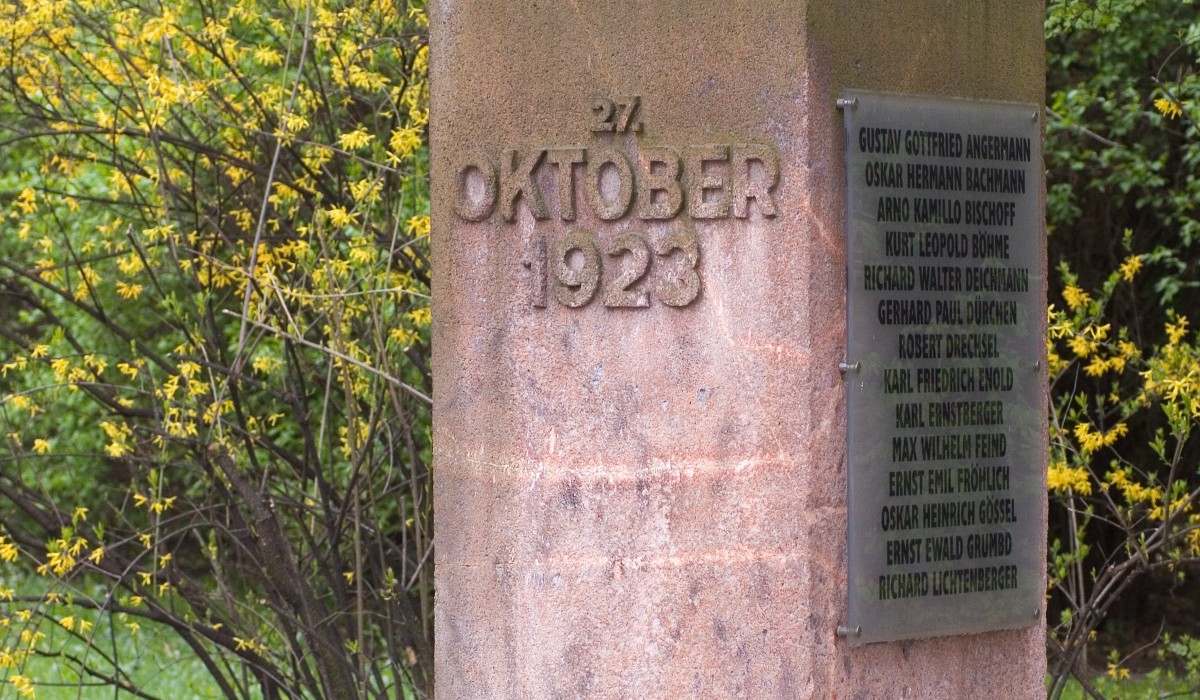
A turning point in German and European workers’ history was 1923’s failed ‘German October’ and its aftermath. A divided Communist Party before October remained divided after. Veteran leader August Thalheimer with a major discussion piece looking at the tendencies within the Party and their differences over the “united front from below.” Questions and debates which will find echos in all revolutions.
‘The Discussions in the C.P. of Germany: A Warning Signal’ by August Thalheimer from International Press Correspondence. Vol. 4 No. 28. May 8, 1924.
“The communists will have to exert their utmost endeavours in order to lead the labour movement, and our whole social development, upon the straightest and directest path to the world victory of Soviet power, and to the dictatorship of the proletariat. This is an incontestable truth.
“But it is only necessary to go one small step further apparently in the same direction and the truth becomes converted into an error. It is only necessary to say, as the German and English radical communists say, that we recognize one straight path only, that we permit no deviation to be made from the course, no making of compacts, no compromises, and we are at once involved in an error capable of doing serious harm to Communism, an error which has indeed already done it much harm.”
N. Lenin, “Radicalism, the Infantile Malady of Communism”.
I. The Platform of the Left: Against the United Front. Decisive Struggle in October. “Cognizance” of the Political Resolution of the Executive.
According to the Party press correspondence of 6. March 1924, No. 4, the Party Conference of our Party district of Rhineland-Westphalia-South, held on 3. March, after hearing and discussing in detail speeches by Ruth Fischer and Walther Stöcker, passed the following resolution by 60 votes against 21:
“The Party Conference of the Rhineland-Westphalia-South District section of the CP. of Germany, held on 3. March, points out that the CP. of Germany and the Comintern are involved in an acute crisis owing to the policy of the reformist and opportunist groups. The district Party conference regards the disputes being raised by the Russian opposition in the Russian CP. as an attempt to weaken the dictatorship of the proletariat and to endanger the Soviet power, and stands unanimously for the decision of the Russian Central Committee and for the resolution unanimously passed at the Russian Party conference. The Party conference has duly taken cognizance of the resolution passed on the German question. It demands that the struggle be carried on with the utmost energy, in the CP. of Germany and in the Communist International, for the destruction of all reformist and opportunist tendencies. The conference states that the policy of the united front tactics, of the labour government and of the seizure of real values, was the expression of the reformist currents in the Party which led to the failure of the CP. of Germany in October of last year. It expressly approves the views held by the Party opposition in these fundamental questions.
“The conference declares that in October of last year the decisive revolutionary struggle was a historical necessity. Neither the avoidance of the struggle, nor the substitution of the final struggle by so-called rear-guard fighting, partial action, or similar manoeuvres were permissible.
“The conference regards it as the task of the Reich Party Conference, to create the prerequisites for the final liquidation of all opportunist and reformist tendencies. This will only be possible when the leadership of the Party is placed in the hands of the Left. The district Party conference resolves that the leadership of the district be placed in such hands as will assure that the district will be led acording to the views of the Left.”
Thus runs the resolution.
The resolution was passed after an address from comrade Ruth Fischer. It is nowhere stated, or even’ indicated, that the speaker was not in agreement with this resolution. Thus the resolution must be regarded as in accordance with the views of the Left.
The same train of ideas, expressed more briefly, is contained in the resolution passed on the 5. March by the Berlin functionary meeting of our Party, in which we find it expressly stated:
“The Left will not depart by a hair’s breadth from its views on the question of the united front, and with regard to the intermediate slogans for which it has fought in the Party.”
The Elberfeld resolution, which must be thus regarded as a really authentic expression of the views of the Left, contains the following extremely characteristic points:
1. The rejection of the united front tactics, not only for the present, but also for the past, and not only for the German section, but for the whole of the sections of the Comintern. This last may be gathered from the fact that these tactics are unreservedly designated as reformist, and further from the fact that the views held by the Party opposition on these fundamental questions are “expressly” approved;
2. the resolution declares that the decisive struggle was a necessity in October, that is, that it should have been undertaken. To be sure the first sentence of this paragraph speaks of a “historical necessity”, an expression obviously intended to intensify the character of the necessity. (In reality the term “historical necessity” is a weak and inaccurate expression, and not invariably synonymous with “political necessity”.) But in the next sentence the substitution of the final struggle by so-called rear-guard fighting, partial action or similar manoeuvres is declared to be unallowable. There is thus no doubt whatever but that what is meant is that the Party should have undertaken the decisive revolutionary struggle in October, that it was a political necessity, and thus absolutely imperative.
3. The resolutions passed on the German question have been taken “cognizance” of. This term can scarcely have been chosen out of negligence. For in the preceding sentences the decisions of the Russian C.C. and of the Russian Party conference on the Russian question are emphatically approved. The approbation, or even the carrying out, of the resolutions passed by the Executive on the German question is not expressed, but is avoided and evaded.
These three questions form the core of the Elberfeld resolution, are decisive for the platform of the Left. They point out serious dangers, they are actual warning signals.
II. What are the Political Consequences of dropping the United Front, and on what Premises is such a Line of Action based?
Of what does the danger and inadequacy of this platform consist, in what does it deviate from the true line of Communism? It might be said that the condemnation of the united front from above in the past possesses no significance for the present. For in the present we in Germany reject the tactics of the united front from above, that is, we do not negotiate with the Social Democratic leaders. On this point no differences of opinion exist. Neither is this rejection anything new. It was already contained in the well known theses issued by the Central Committee at the beginning of November last year, in which we read:
“The leaders of Social Democracy have thus finally broken with the proletariat. Our future attitude to these leaders of Social Democracy can only be a fight to the death…Until the so-called left Social Democrats bring about an open, clear, political and organizatory rupture with the right leaders of Social Democracy, they are their accomplices…The united front of the proletariat is to be built up from below. The CP. of Germany must go everywhere to the Social Democratic workers, to the lower strata of Social Democratic functionaries, with the watchword: Break away from the betrayers of the proletariat. Unite and gather round the flag of the German CP.”
Thus no difference of opinion exists in the question of the rejection of the united front from above since the October defeat in Germany.
But the views of the Left carry us considerably further to the “small step further in the same direction”, where the truth becomes converted into error.
Not only is the united front from above, the workers’ and peasants’ government, and the seizure of real values rejected for the past in Germany, but the united front tactics are rejected wholesale and entirely, as reformist, and with them the united front from below, and the application of united front tactics from above, the slogan of the workers’ and peasants’ government, and the slogan of the seizure of real values, for other countries. Now it is certainly no trifle to assert that for two years our Party has been pursuing false and reformist tactics, and that its leading slogans and fighting methods have been false and reformist. To do this is to facilitate considerably the efforts of Social Democracy in its fight against us. And the assertion is again no trifle, for the reason that these tactics were not only the tactics of the so-called “Right” or Party majority, but at the same time the tactics of the Communist International. The Communist International has repeatedly observed and condemned errors in the application of these tactics in Germany and other countries. But the tactics themselves, as such the slogans of the workers’ and peasants’ government, and of the seizure of real values, have been repeatedly and expressly approved by the Comintern, and their application prescribed for other countries.
But even the tactics of a united front from above are not yet out of date for some countries outside of Germany. Are they no longer suitable for application to France? It is certain that they can still be employed here. In France the slogan of the workers’ and peasants’ government is an imperative necessity of the hour, as a fighting slogan against the probability of a Left bloc, whose coming into existence obviously expresses the existence of widespread democratic-pacifist illusions (or of a democratic-pacifist “psychology”) among broad strata of the working class and petty bourgeoisie. The slogan of the seizure of real values meets a question which is just beginning to be a burning one in France, now that the currency is depreciating with greater rapidity, and it will speedily become apparent that the taxation methods hitherto employed by the bourgeoisie are insufficient, so that the gradual expropriation of the petty bourgeoisie, and the lowering of the standard of living of the proletariat, will begin to take place as they have done in Germany. Should we accept the views of the Left, we should be obliged to reject these slogans for the CP. of France. In this we should be expressly in the company of the “right”, for it is well known that the Right of the French CP. carried on an obstinate struggle against the united front tactics.
Are the tactics of the united front from above out-of-date for England? We do not think so. And within certain limits and along certain lines, they are still suitable for application in Italy, where our Party has called upon the parties of the II International to form an electoral bloc against Fascism. Errors have been committed of late in the application of the tactics of the united front from above, both in France and in England. (Especially with regard to the attitude towards the Labour Party.) But solely for this reason, to reject the tactics of the united front from above, for these countries, wholesale, and for the present epoch only, is the “small step further which converts the truth into an error”. Such a judgment signifies that we are to throw overboard the materialistic dialectics which require that given general tactics be adapted in every case to the exigencies of time and place, to the demands of the situation as a whole. We in Germany committed the error of not changing the slogans of the Workers’ government and the seizure of real values rapidly enough when the political situation became acute. The error now being committed by the Left is an error of the same nature, but in the opposite direction. This is not the way to correct errors, but the way to perpetuate and multiply them.
For Germany in the present period we have the slogan of the united front from below, upon which the theses of the Central Committee and the political theses of the Executive are in agreement. In this regard the theses of the Executive are more elastic than those of the Central Committee. Does the Left consider the tactics of the united front from below to be false for Germany at the present epoch and in the immediate future? This is the logical conclusion to be drawn from the Elberfeld resolution, but it is not stated openly and definitely. And this must be done. The question is one of far-reaching importance for the policy of the Party, for our everyday political and trade union work.
It is not our intention to enter here into the consequences which have already followed on these views. It is however obvious that a viewpoint which totally rejects the united front tactics as reformist is bound to have serious and harmful political effect.
The foundation for the tactics of the united front, in their various forms of application, is given as soon as the “proletarian vanguard has been ideologically won over”, and it is merely a question of “finding forms for the drawing in or transition of the masses into the proletarian revolution” (Lenin).
The fundamental principle of these tactics was given by Lenin as early as 1920, in the following sentences, which, it seems to me, precisely meet the needs of the case in Germany today:
“The proletarian vanguard is won over ideologically, that is the main point. Without this it is not possible to take even the first step towards victory. But it is still a long way from here to victory. Victory cannot be gained by the vanguard alone. To fling this vanguard alone into the decisive struggle, before the broad masses have taken up a position in which they either afford direct support, or at least benevolent neutrality and complete certainty that they do not aid the enemy this would not be merely foolish, but criminal. But to bring this whole class, the whole of the broad masses of the working people, to this position, this requires more than propaganda and agitation. It requires personal political experience among the masses. This is the fundamental law of all great revolutions, and is now being confirmed with surprising force and clearness, not only in Russia, but in Germany as well.” (The heavy type is mine. A. Th.)
Where do we stand in Germany? The vanguard of the proletariat has been won over. And more than this. We have already encircled the Party with a belt of sympathisers, of a breadth varying with the circumstances. But we have not yet a firm majority sympathising with the aims and principles of Communism, and the theses of the Executive also show that we had not this in October either. We’ are on the road to it. That is the task before us. And the realization of this task means that we need the united front tactics in an altered form adapted to the present circumstances, the tactics of the united front from below.
It is evident that, if the concrete prerequisites for these tactics are not clearly understood, there will be more groping about in a fog, and one error will be substituted by another. Thus tactical errors in the present are inevitable when the tactics of the immediate past are not comprehended on the basis of their concrete premises.
It is of course clear to every Marxist that the tactics of the united front from below, and with these all united front tactics, become unsuitable for application under certain circumstances and for certain countries. This point is reached as soon as the majority of the workers have been won over for the aims and principles of Communism, that is, as soon as the object of these tactics has been gained by their correct and persevering application. They are no longer suitable of application in countries where Communism is victorious, where the proletariat has established its class dictatorship, and has thereby suppressed all other parties. And on the other hand, these tactics must not be applied too soon; their employment is impossible or extremely limited where the firm proletarian vanguard has not yet been formed.
But it is possible to imagine another eventuality, in which it would be necessary to drop the united front tactics in any form, after we had already made use of these tactics, after we had already won over the revolutionary vanguard for Communism, and although the employment of these tactics had not yet attained its object of grouping the majority of the working class around the communist parties.
What eventuality is here indicated? Of what does it consist, of what can it consist?
Such an eventuality can only arise when the working class of any country has suffered so severe a defeat, so great reverses, that the revolutionary vanguard is shattered, and the workers are faced with the task of building it up afresh; and when at the same time the working class has reached a point where no mass action is possible for a long time, but only revolutionary agitation and propaganda.
This in truth is the premise upon which a dropping of the united front tactics (in any form) in Germany at the present time is unexpressedly based: the prospect of a considerable period of time during which the C.P. is confined solely to agitation and propaganda; a long and weary prospect, and a profound depression of the activity of the working class.
But if mass action is possible and intended, then the united front cannot be dropped. That is clear.
But the Left accomplishes the feat of demanding that the united front be dropped, and of simultaneously proclaiming the prospect of mass struggles in the near future. One thing or the other. Here it is necessary to speak plainly.
The Left likes to talk of liquidationism (an idea which it first learnt from the “Right”). The ideas upon which the dropping of the united front in Germany are based have certainly much in common with liquidationism, but they are not the ideas of the so-called “Right”.
As we have not yet a certain proletarian majority in Germany, we must hold fast to the tactics of the united front. As our reverses have not been so severe as to compel us to set about building up a revolutionary vanguard afresh, we must not abandon the united front. But since, and owing to the October retreat many essentials have been changed, and the form in which we apply the tactics must change accordingly. United front from below instead of from above.
The essential circumstances whose changes render a change in our united front tactics necessary are as follows:
a) The change in the form of the capitalist dictatorship; the bourgeois democracy has been transformed into the big capitalist Fascist dictatorship. Even though the military state of emergency has been dispensed with, the “civil state of siege” still obtains, the parliament subordinates itself to the military dictatorship, and the Fascist “purging” of the state apparatus is permitted to continue, so that the big capitalist Fascist dictatorship still essentially exists.
b) The democratic illusions have been dispelled from the consciousness of broad masses of the workers, and these are giving their sympathy, partly, to the proletarian dictatorship, in part to the Fascist dictatorship. The petty bourgeoisie, in its majority, inclines to the latter, and is even followed by sections of the working class, as the last elections in Saxony, Thuringia, and Mecklenburg prove, and as the Reichstag elections will certainly prove still further.
c) The open or concealed going over of Social Democracy into the camp of big capitalist Fascism, its open treason to the working class, palpable to broad masses, and the dropping of democratic reformist demands by Social Democracy.
d) The change in the relation of forces within the organized active core of the working class.
Still another change must be accorded attention. The Pan-Germans (Fascisti) have already obtained an organizatory footing among the town and agricultural workers. They have founded political, military, and trade unionist organizations, and in many of these groups workers preponderate. They operate with a demagogic slogan, that is, with a fraudulent pseudo anti-capitalist and anti-junker slogan. After the Saxon, Thuringian and Mecklenburg elections we heard a lot of talk that special attention must be devoted to the Fascist movement. Practical proposals, new tactical ideas, have not been forthcoming.
It seems to me that the new idea which is adapted to the circumstances, could very well be a special form of the employment of the tactics of the united front from below, towards such Fascist organizations which for the greater part consist of workers. This is only by the way. I will perhaps deal more exhaustively with the question on another occasion.
Let us now deal with the altered circumstances and the resulting necessity of tactical changes. Let us take for example the “transition slogan” of the “Seizure of Values”. The demand was first raised by the Social Democracy. It was then taken up by us and linked up with the demand for the Control of Production, the establishment of State Trusts and the Workers’ Government. To what end? To attempt: either to attain common action with the Social Democrats for this demand, or, if they refused to act with us, to expose them before their own adherents and, the non-party masses. The carrying on of a mass struggle under this slogan would have brought us to the limits of the capitalist Order and in due course would have led us beyond these limits. Social Democracy sabotaged the struggle under this slogan. Was the struggle therefore of no avail? No, it opened the eyes of tens of thousands of Social Democratic and trade union organized workers with regard to the Social Democracy and brought them to us. The practical experience that the Seizure of Values was not carried out, led broad masses to a perspective which must come to extend beyond the limits of the capitalist Order and of the bourgeois state.
The propaganda made for the seizure of real values, and the negative result so far as execution was concerned, were preparatory work, a preparatory school in which the masses learned the slogan of socialisation, of the complete expropriation of the big capitalists and big landowners. This is clear to everyone capable of dialectic thought.
Social Democracy has now completely dropped the slogan of seizure of real values. It stands for the Stinnes program of stabilisation. It has retired from a position which it only held hypocritically, for the sake of appearances. Thus this slogan has no other foothold here in Germany at the present time than that of the united front. But as a revolutionary propaganda slogan it does not go far enough, whilst as a slogan of action, as a demand corresponding to the need of the day, it is too far removed from anything which the German working class, in the present situation, can immediately take up.
The above may serve to show what has been false in the development of the Left as regards the united front tactics, as evidenced by the Elberfeld and other resolutions. It is clear that this estimation of the united front tactics not only for the past, but for the present, not only for the Communist Party of Germany, but also for other countries, is false and harmful, a relapse into a Left infantile sickness, or rather a reappearance of the Left infantile diseases as diseases incident to puberty, to hobbledehoy period: for the Party has left its childhood behind it.
III. The Decisive Struggle in October.
What is the significance, for the present time, of the phrases that “the decisive revolutionary struggle was a historical necessity” in October, and that “neither an avoidance of the struggle, nor the substitution of the final struggle by so-called rearguard fighting, partial action, or similar manoeuvres, was permissible”?
Either these are mere phrases, not intended to be taken seriously, a drifting with and an exaggeration of a trend of feeling existing among a section of the members. If this is the case, then a non-permissible and dangerous game is being played, dangerous above all to those who believe that they can play with such phrases. For the members, and beyond these the rest of the working class, take such phrases seriously, have to take them seriously, and have to act seriously upon them under some circumstances. Those who play with such ideas are thus responsible for what follows if their words are taken seriously, as they must be taken. The “decisive revolutionary struggle” is not a game.
If the phrases are really meant seriously, what follows there from? In October we still had no firm majority in the working class. This is not contested and cannot be contested. The fact is also unequivocally expressed in the first draft of comrade Zinoviev’s thesis. Our arming was insufficient. The first decisive factor was the cleft in the proletarian front, the standing aside or even the enmity of broad masses of workers. The lack of military equipment may be replaced to a certain extent in ordinary war, and in civil war still more, by the mass and tensity of the will to victory. But victory is impossible without the support of the majority of the working class, or at least its benevolent neutrality. This is a fact founded on experience. Neither is it possible here to indulge in Ifs and Whens: “if we had secured a majority by means of better preparatory work” (the preparatory work could certainly have been better, and should have been thoroughly examined and criticised). The majority was not ours at the moment when the decision had to be made as to whether we should enter the decisive battle or not. (Moltke observed rightly that in war, errors committed in the marching up can scarcely ever, or rarely be subsequently retrieved. He himself retrieved his own in the campaign of ’66.) We should have suffered an annihilating defeat. Our greatest error, after the grave preliminary errors of the marching up, of our political, military and organizatory preparation, did not consist of the fact that we did not strive for the revolutionary decision which was at that time beyond the powers of the working class, but that we did not draw on all the powers which we actually possessed for our resistance and for our rearguard fighting. I shall later on deal with the question of the comparative forces and reciprocal relations among the classes during revolutionary struggles in general, and in October in particular.
What is the consequence of the attitude adopted by the Left, of the lack of recognition of the real errors of our marching up, and of our preparation for and carrying out of the struggle? The consequence is obviously the impossibility of improving these errors, the repetition and enhancement of error in one direction or another. That is, we shall either be involved in a struggle so imperfectly prepared for, so handicapped by insufficient insight into the reciprocal relations among the classes, that it is bound to end in defeat, or we shall be led to abandon even those partial struggles which the powers of the working class would enable it to cope with from time to time.
“Defeated armies learn well.” Let us learn, but let us not repeat and enhance the errors already committed, or a second and even severer defeat is inevitable.
But does not defeat play a decisive role in the process of the revolutionary development of the working class? The struggle in June 1848, the Commune in 1870-71, the defeat suffered by the Russian working class in December 1905, the January and March struggles in 1919 in Germany?
Yes, it is clear to every revolutionist that these defeats were immeasurably fruitful for the working class. But every defeat is not fruitful for the working class; it depends upon the concrete circumstances. It is a question which has to be carefully examined in the light of these circumstances. In June 1848 almost the whole of the Parisian proletariat fought against the big and petty bourgeoisie and the rabble. It was systematically provoked by a bourgeoisie determined to put a stop to all proletarian nonsense about a social republic, and anxious to disarm the workers of Paris. The Parisian proletariat suffered a bloody defeat. All Europe trembled at the concussion. The course taken by revolution made a decisive turn, not only in France, but in Germany and Austria as well. The bourgeoisie which had been rising against feudalism and absolutism now reversed its tactics in the face of the threatening proletarian revolution, turned against the proletariat, and entered into compromises with the feudal classes, the junkers, and royalty. The petty bourgeoisie vacillated. In the June struggle the Parisian proletariat fought as a class, turned its face towards its final goal amid streams of blood, underwent the profoundest class experiences in the midst of a frightful struggle, and laid the foundation for the next stage of the fight. The June struggle dispelled the delusions of the Parisian (French) working class as to a peaceful transition to Socialism, and it collided at the same time with the third class of French society, the peasantry, but without learning all that this could have taught it. On the other hand, the June struggle gave an accelerating impetus to the development of counter-revolution. The Second Empire, the rule of Louis Bonaparte and the Bonapartist military dictatorship, were the results. And, as Marx observes with his customary insight, revolution matures on counter-revolution. The Commune of 1871 was the fruit of the June struggle of 1848.
The June struggle and the June defeat were historically fruitful as mighty class experiences for the proletariat, by which the proletariat became more mature, raised its class consciousness to a higher level, and thereby prepared a higher stage of the struggle.
The Commune and its defeat in 1871 played the same role. Here again the greater part of the Parisian working class engaged in the fight. They were defeated, and not only with the aid of Bismarck and the French bourgeoisie, but by rural France, the peasantry. But the Commune has proved a treasury of fresh
class consciousness, of moral force for the proletariat of all countries. It is a landmark of progress in the consciousness of the whole working class of the world. In the Commune the dictatorship of the proletariat first took tangible shape within the compass of a world city. Without the June defeat of 1848 there would have been no Commune, and without the defeat of the Commune there would have been no victory for the Soviet dictatorship in Russia in October 1917.
And then the barricade fighting in Moscow in December 1905, the transition from mass strike to armed insurrection. These brought the Russian working class its first experience of proletarian insurrection. Without December 1905 there would. have been no 1917. The acute aggravation of class warfare as experienced at the beginning of the rising in 1905 was, in the first place, the starting point enabling the proletarian class struggle of 1917 to be carried out on a higher level, and in the second place it gave the impetus causing the revolution of 1917 to at once accompany the democratic republic by workers’ Soviets, so that the bourgeoisie was pressed abruptly forwards, far beyond its own actual aims, by a working class wiser by the experiences of 1905. Without the barricade fighting in Moscow in December 1905 there could have been no thought of either March 1917 nor October 1917. Plekhanov, who lamented in 1905 that armed insurrection should have been resorted to, was rightly derided as a Philistine by Lenin.
In January 1919 there were certainly more than half a million workers who took part in the struggle in Berlin, either as immediate participators or as sympathizers. Precisely as before June 1848, the Ebert-Scheidemann group had systematically provoked the struggle at the behest and with the aid of the bourgeoisie, in order to disarm the armed revolutionary workers, to put an end to the workers’ councils, and to secure the position of the national assembly, that is, of bourgeois democracy. Our object was: the energetic defence of the threatened positions (the weapons of the working class, the presidency of police, etc.). It was perfectly clear to us that the overthrow of the Ebert-Scheidemann clique was beyond our powers at that time. It would have been wrong to make for the revolutionary decision, but it was right to defend with the utmost energy the threatened positions, and thus to pursue an aim, limited by the obtaining conditions. This course of action bore fruit. The first revolutionary fighting traditions were created.
All these historically fruitful defeats of the proletariat have one feature in common: that the greater part of the working class has taken part in the struggle. The defeat has shown the proletariat as a whole the limitations of its class consciousness and fighting methods, has dispelled illusions, introduced the new and more advanced stage of the struggle, prepared fresh forms of struggle, become a source of moral force and forced the hand of counter-revolution, against whose efforts the billows of revolution again rise higher and higher.
But if we consider the events of July 1917 in Russia and those in October 1923 in Germany, what do we find characteristic of the situation?
The greater part of the working class had not yet joined hands with the vanguard. In July 1917 Petrograd was far in advance of the rest of the country, was an outpost which could well be stormed, but scarcely retained. The case was similar in March 1921 in central Germany, and in October 1923.
To insist at such a moment on the revolutionary decision “is equivalent to a battle in which 10,000 soldiers plunge into conflict with an enemy force numbering 50,000, instead of standing still, of turning aside, or even making compromises, whilst waiting for the reinforcement of 100,000 men which is sure to arrive, but which cannot be on the spot at the moment. That is childish intellectualism, but it is not the serious policy of the revolutionary class” (Lenin: “Radicalism, the infantile malady…”).
In such a situation, when the revolutionary vanguard does not bring along with it the greater part of the working class, a defeat cannot be regarded by the working class as one of its historical advances ending in defeat, but as a strategic error, a lack of judgment on the part of the revolutionary party. The result is a temporary alienation, a withdrawal of this majority from its party.
In view of the grave mistakes of the Left platform in this question, and of the want of clearness obviously still ruling in our Party with regard to it, and in view of the dangers threatening the Party and the working class if these errors are not discovered, acknowledged and amended, it is necessary to discuss the question very plainly, especially in a case like our present one, where one error is replaced by another equally great or even greater, even though this may prevent our being able to say: look, we have made no mistakes, we have been perfectly right. The interests of the Party as a totality are of higher importance than the creation of a feeling of fractional self-satisfaction upon an erroneous basis, and the mistakes committed by any side are to be thoroughly recognized and removed, without consideration of fraction.
It is considerably easier to generate a feeling of panic during a retreat, and to play this off against the leaders of the retreat, but it is a question whether such action is more useful to the Party.
In N. Machiavelli’s Discourses there is an interesting chapter on the question of why the Romans, as opposed to the Greeks, did not execute their defeated generals. Machiavelli convincingly defends the conclusion that the Romans acted more cleverly and advantageously than the Greeks. This chapter appears to us to be capable of much useful application, from a non-military and not merely historical point of view.
IV. The Missing Dots to the i’s.
The Elberfeld resolution (and not only this) confirms, even more rapidly and thoroughly than expected, what we foresaw and forecasted as to the inevitable consequences of the defeats, the want of clearness, and the lack of complete expression in the political resolution of the Executive.
In the declaration submitted as a supplement to the verbal declaration made by Clara Zetkin on behalf of Walcher, Pieck, Hannack, Brandler, Hammer and Eisenberg at the Presidium Session of the Comintern on 21. January 1924 to comrade Zinoviev, chairman of the Executive, we read:
“(The Theses) contain no unequivocal decision as to whether it was right, in the given circumstances, that the Party did not take up the armed struggle for power…They do not contain the necessary criticism of the faults and defects of the policy pursued by the so-called ‘left Party Opposition’, and it is thus made extremely difficult to convert the opposition from its errors, and to effectuate co- operation between the Party majority and the opposition.” It might seem as if this criticism relates to “trifles”, to non-essentials. Facts have now shown us that this is not the case. The lack of clear expression in the resolution left innumerable small loopholes through which relapses into Left infantile complaints have been made possible. The Left believes its errors to be justified by that which is not contained in the resolution, by that which is left veiled and undecided. Those errors of the Left which are not plainly stated are regarded as justified, are continually repeated in resolutions and take practical effect. These resolutions and platforms are not mere scraps of paper. They are bound to have effect throughout the whole Party, and they are already doing so.
It follows therefore that this negligence must be made up for as rapidly as possible, the “forgotten” dots must be placed over the i’s. Otherwise there is danger ahead.
V. The Centre or “Middle group”.
According to the report published by the Rote Fahne of 6th March, Comrade Koenen is said to have made a sharp attack upon the Right, and to have threatened that it is going to be “crushed”. He is further said to have opposed the idea that the middle group is to continue to exist permanently. This is not intended, since the Centre inclines more and more to the left. Unity can thus be arrived at to the advantage of the Party. On the next day Comrade Koenen published a correction of this report, and stated that his observations had been incorrectly reported. Above all he had never said that the Centre inclines more and more to the left and that unity in the Party should be thus attained. The following is a brief statement of the authentic wording of his remarks:
“The object held in view must be the liquidation of the Right, and alt who oppose this object must be crushed. The great mistrust obtaining in the Party renders it imperative that all group formation be done away with, so that we may form a firm core for active work. The Moscow decisions form the required basis (the italics are Koenen’s. We of the Centre will everywhere energetically defend these decisions…”
It is the Centre itself which has been “crushed”. It proved unable to stand firm against Left currents. No wonder. We foresaw and forecasted this too. The original theses of the Centre were immediately characterised by us in the Fahne der Revolution, as a mixture of inextricable contradictions of “left” premises and “right” conclusions. We observed at the time that these contradictions could not possibly hold together very long. Either the “left” premises or the “right” conclusions would have to be abandoned. To this must be added that the Centre announced everywhere that it had been seduced by the Right, and brought accusations against the whole policy of the Party as pursued since Leipzig. The members drew correct conclusions from these premises. They rightly concluded that leaders capable of being seduced so thoroughly and continuously were no leaders at all. They drew left conclusions from left premises. It is characteristic that although the Centre announced that it would refute this article (Left Premises Right Conclusions), it made no attempt to do so. The theses forming the platform of unity with the Left were dropped. And my criticism of these contradictions was even followed by a still more annihilating one from the ranks of the Centre itself, from Comrade Gerhardt. Thus one position after another was abandoned without partial fighting and given up to the Left. Therefore it is no wonder, but entirely natural and inevitable, that the Centre should be “wiped out”. But its action has unfortunately taken effect upon the whole Party. The concessions made (generally tacitly) to K.A.P. (Communist Labour Party) views, by which the alliance between Centre and Left was made, are still taking political and organizatory effect. We gave warning of this danger in good time. But without effect at first. For the “Right” had to be “liquidated” or “crushed”.
Another “small step further” in the turning towards the Left, and the “truth becomes converted into error”, the victory becomes a defeat.
This was inevitable.
VI. The Left.
At the same Berlin functionary meeting at which Koenen made the above declaration, Comrade Scholem of the Left had previously declared in his address, that: “Brandler, Thalheimer, and their consorts are finally set aside. And for the reason that they have tried to drive the Party towards the right…We shall regard everyone as our enemy who does not hold firmly to the positions held by the majority at the coming party conference, to the position of the Left. The Left will not tolerate under any circumstances that a Social Democratic nucleus be formed within the Party…”
This is exceedingly kind of Comrade Scholem. He has also taken the opportunity of arriving at the recognition of various things, though different to what he imagines. That the “Right”, supposed to be represented by Brandler and myself, has been finally done away with. This sentence is an advance. For this “Right”, these “Social Democrats” were a flight of imagination. And it is of great advantage to the Party that comrade Scholem can assure us that it exists no more, has finally expired.
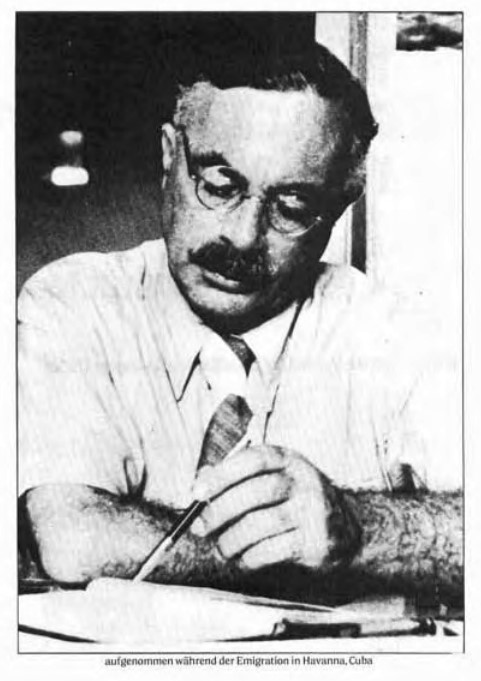
Further. If the acute crisis in the Party serves any purpose at all, it is that all sides learn thorough lessons from it. But this is not the case with comrade Scholem, nor does the Left show any signs of having learnt anything. The Party is making a trial with the Left. Of what does this consist? Precisely in testing whether it is capable of learning anything, not merely from other people’s errors, but from its own as well. We too considered such a trial to be dangerous, but unavoidable, since it was not rendered possible for the group hitherto forming the majority to maintain a secure leadership. It was our duty to await the first results of this trial. Now that we have these before us, it is equally our duty to adopt a critical attitude towards them and to utter a warning against the rocks and sandbanks threatening the Party if the Elberfeld resolution is to form the decisive platform of the Party, if typical Left infantile diseases are not openly and effectually combatted. Dangers from the Right, in so far as they exist, and of course they do exist, cannot be wiped out by means of Left infantile diseases. It is rather enhanced by them. These infantile diseases must above all be combatted with the aid of the thinking brains Centre. among the Left. The Centre has proved itself to be–Centre.
The Left has at least shown energy, if in a wrong direction. It is not yet too late for it to learn, to recognize and retrieve the errors of the past, without consideration for fractional self-love or dogmatism. If the Left does not do this, then it will prove that its victory has made it lose its head, as Levi’s defeat made him lose his.
The above criticism is intended to help the Left in its task of learning. If it learns, it will retain its participation in the Party leadership. If it does not learn, then its victory will only be an apparent one.
VII. Social Democracy and our Party Differences.
If the Social Democrats believe that they can derive any benefit from our Party differences, then they will be ridiculously disappointed. They have no cause to rejoice. All our disagreements are precisely about the question of how we can best and most speedily get rid of the putrefying corpse of Social Democracy, how we can induce the Social Democratic workers to quit this party and join the Communists. In our desire to attain this goal we are at one. Our differences are concerned with the ways and means. The stupidity and clumsiness with which Social Democracy fancies that it can utilize our differences for its own ends can arouse nothing more than our contempt and derision.
Our Party will emerge stronger and more mature from these differences. They are complaints common to the period of puberty, to the epoch of adolescence accompanying the transition to ripe manhood. But the complaint attacking the German SP. is incurable and deadly and the party is only keeping up the appearance of being alive.
But we must not forget that we have not yet got rid of the corpse of Social Democracy, that it is still in the midst of the working class, and that the laws of inertia, which rule in the mental world as well as in the physical, bunder its speedy decay. Much depends on our attitude, if this process of decay is to be accelerated, and so far completed as is necessary to render the establishment of the dictatorship possible.
Postscript.
After concluding the above article, I had the opportunity of perusing “Der Funke” (The Spark), formerly “Tactics and Organization”, published by the district organizers of the German CP., Berlin-Brandenburg. The introductory article of this little paper fully confirms what I have written with regard to the Elberfeld resolution. “Der Funke” designates it as its task (and as the task of the whole Left) “to create a Communist Party”. “It is our task to become a Communist Party, that is, a Party cast in one piece, with uniform ideology and an organization hard as steel, with leaders who are clear as to their aims, really leading the Party and possessing its confidence.” “The Russian Bolsheviki” the article goes on to say, “had an easier task in some respects than the German Communists. They first built up their party, in ideology and organization. But we have to drag at our heels the inheritance of Social Democracy, we have to re-form a given mass party, we are confronted by enemies whom the Bolsheviki knew nothing of.” It is further considered that the Bolsheviki had the advantage of being able “to create the ideology of the Party with the utmost care, to a great extent untroubled by the pettiness of daily work and daily events”.
Several points in the above sentences are worthy of notice. In the first place there is the idea that the Communist Party of Germany, after five years of organized existence, after five years of co-operation with the Communist International, 10 years after the Marxist left took up the struggle against Kautskyism in Germany, after the experience of November 1918, after the ideological political work accomplished by Rosa Luxemburg and Karl Liebknecht, after the discussions with the Communist Labour Party and with the Communist Working Union (K.A.G.) assumption that after all this we are no more advanced, in the development of the Communist vanguard of the German proletariat than Russian Social Democracy was developed at the time when the “Iskra” (The Spark) was founded. Such a fundamental failure to grasp the situation and the main task of the Party can scarcely be surpassed. In May 1920 Lenin wrote: “The proletarian vanguard has been won over, that is the main point. Until this is done, it is not possible to take even the first step towards the goal. But it is still a long way from here to victory. Victory cannot be won with the vanguard alone.”
And shortly before this: “The most important of all though of course not by any means everything has already been done in forming the vanguard of the working class, in its transition to the side of the Soviet power against parliamentarism, to the side of proletarian dictatorship against bourgeois democracy. All forces must now be concentrated on the next step, one which appears to be of less importance and is actually of less importance from one point of view but which therefore approaches nearer to the practical solution of the task, and this is: forms must be found for the participation and transition of the masses to proletarian revolutions.”
Thus Lenin wrote in May 1920 (“Radicalism, the infantile disease of communism.” P. 70).
Are we in 1924 so far behindhand with the tasks of 1920 that we have to begin from the very beginning in the work of winning over the proletarian vanguard? I do not think so. There exist no doubt that we have made advances since that time in the conquest of the proletarian vanguard, very great advances, and we have progressed at the same time in the ideological education of the vanguard. To be sure, this task is today “not by a long way” yet accomplished. But should we today concentrate our chief energies upon this first step, the winning over and schooling of the vanguard, or upon the next step, the “forms for the participation or transition of the masses to proletarian revolutions?” There is no doubt whatever that during the present fighting period this next second step is our chief task. The “forms for the participation or transition of the masses to proletarian revolutions”, of which Lenin said in 1920 that they must be found, have been found in the various forms and methods of application of the united front tactics. It is perfectly clear that anyone who so entirely fails to recognize the main task of the Party at the present juncture as the Left fails to recognize it, is bound to take up the attitude of the Left towards the united front tactics, is bound in practice to reject these tactics (even whilst accepting them in words). The purport of the Elberfeld resolution is thus not accidental, no result of unhappy formulation, but is typical and characteristic of the standpoint of the Left. Another characteristic point is the attitude of the preface of the “Funke” to the “pettiness of daily work and daily events”. It finds these a burden. And this is again a logical conclusion if the main task of the Party does not consist of incorporating the whole working class, or its overwhelming majority, in the communist vanguard, in the systematic utilization of petty daily events, that is, in current action. This “Funke” will not prove a second “Iskra”. It gives no light to the Party, but it sheds light enough upon the ignorance of those leading members who are incapable of comprehending the main task of the Party during the present fighting period. It would have been better if the leading writers had adopted a more modest role, for it is no light matter to ascribe to oneself the part of a Lenin or Plekhanov. Such presumption is only possible to those who understand as little of the history of the Russian Communist Party, of the work of a Lenin and of a Plekhanov (at the time when the latter was still a revolutionary Marxist) as they understand of the history of the German Communist Party and of the movements out of which it has arisen.
It is further interesting to note that in the “Funke”, No. 1, it is openly stated that “the middle group possesses no right of political existence, no point of view, and no principles; this was our opinion from the beginning, and we have never concealed it”. It is openly stated that this “superfluous group” must be politically combatted until its ideology is overcome and its organization liquidated. This is clear enough.
This middle group has already made great concessions, far too great concessions, to Communist Labour Party views in its collaboration with the Left. And it has been vanquished. It has permitted or promoted deviations from the correct communist line at times when it was its plain duty to fight these with utmost energy. But it did not want to do this, and could not do it, for the group desirous of co-operating with the Left without making ideological concessions to Left deviations, the so-called Right, was for the Centre not merely its greatest enemy, but the sole enemy. According to the viewpoint of the Centre, no danger threatened from the Left.
I believe that I have been able, with the aid of the programmatic utterances of the Left, to show that this danger from the Left exists, and will, if not combatted, land the Party on a shoal or a reef.
International Press Correspondence, widely known as”Inprecor” was published by the Executive Committee of the Communist International (ECCI) regularly in German and English, occasionally in many other languages, beginning in 1921 and lasting in English until 1938. Inprecor’s role was to supply translated articles to the English-speaking press of the International from the Comintern’s different sections, as well as news and statements from the ECCI. Many ‘Daily Worker’ and ‘Communist’ articles originated in Inprecor, and it also published articles by American comrades for use in other countries. It was published at least weekly, and often thrice weekly.
PDF of full issue: https://www.marxists.org/history/international/comintern/inprecor/1924/v04n28-may-08-1924-inprecor.pdf
 Revolution's Newsstand