
Ralph Chaplin on the 1911 strike of Chicago’s ‘spotknockers,’ the photoshop of a century ago.
‘The Spotknockers’ by Ralph H. Chaplin from International Socialist Review. Vol. 12 No. 3. September, 1911.
NOBODY who knew them believed the spotknockers capable of striking. They had a few doubts about it themselves because their organization was young and inexperienced, and because they had tried the stunt previously and had failed most dismally. The bosses knew something of tactics and acting upon the principle that by giving the spotknockers rope enough they would hang themselves, a strike was precipitated on the fifth of July in the very dullest period of a dull year.
The strike occurred at the Chicago Portrait Company, the best organized and largest concern of its kind in the world. The bosses at this place treated the strike as a joke from the first. They had been accustomed to see the boys strike at one door and scab at another. Many of the most ardent strikers of the last unsuccessful union in a previous strike, those who would fairly bubble over with effusive, school-boy oratory when at the union hall, would go home and have a sister or wife sneak around to the back door of the shop and take out a bunch of work to do at home. Secure in their belief that the spotknockers were not class conscious and knew nothing of class solidarity and thus could not organize effectively the bosses put two ads in the papers, one for girls to learn the business (experience not necessary) and one for “male artists to do work at home.” Then they lured a few scabs to work on the inside with the inexperienced girls, made arrangements with a couple of scab studios in town to handle some of the work that the strikers refused—and went their way rejoicing.
The strikers have been out, at the time this is written, for an even month, but the scabs are still on the job, the improved machines that have made the spotknockers’ skill useless, are still on the job and all the allied crafts necessary for the completion of a finished, spotknocker picture are working overtime.
“You will be perfectly safe,” one of thestraw-boss hirelings assured a prospective scab. “These spotknockers are not teamsters.” They understand the game, all right. They would be afraid of striking teamsters, but not of striking spotknockers. It seems that the further one goes from the class feeling of unskilled workers the more faded, weak and atrophied becomes class-consciousness and the real working class fighting spirit.
The skill of the spotknocker has been made useless by the machine, just as the skill of the wood carver has, for instance, and the skill of thousands of other skilled workmen has been made valueless and obsolete by machine production. Under the pressure of a constantly lowering wage scale and the speeding up process necessitated by the new method of production, the spotknocker, inspired by the alluring ideal of forming a “job trust,” a “labor monopoly” that would enable them to force the prices back to the standard of the good old days, struck blindly at the machines that were displacing them.
It is probable that working people generally do not know what a spotknocker is, so I will explain and show how it happened that this hitherto, most “respectable” and exclusive band of the working class was forced into doing such an “inartistic,” “undignified” and “ungentlemanly” thing as to strike.
A spotknocker is a commercial artist, a portrait artist—that is, he was an artist until modern machine production made him something else. His business is to copy and enlarge portraits from photographs (the kind you have hanging on your walls, size 16 by 20 inches, framed in six-inch oak burnished with gilt).
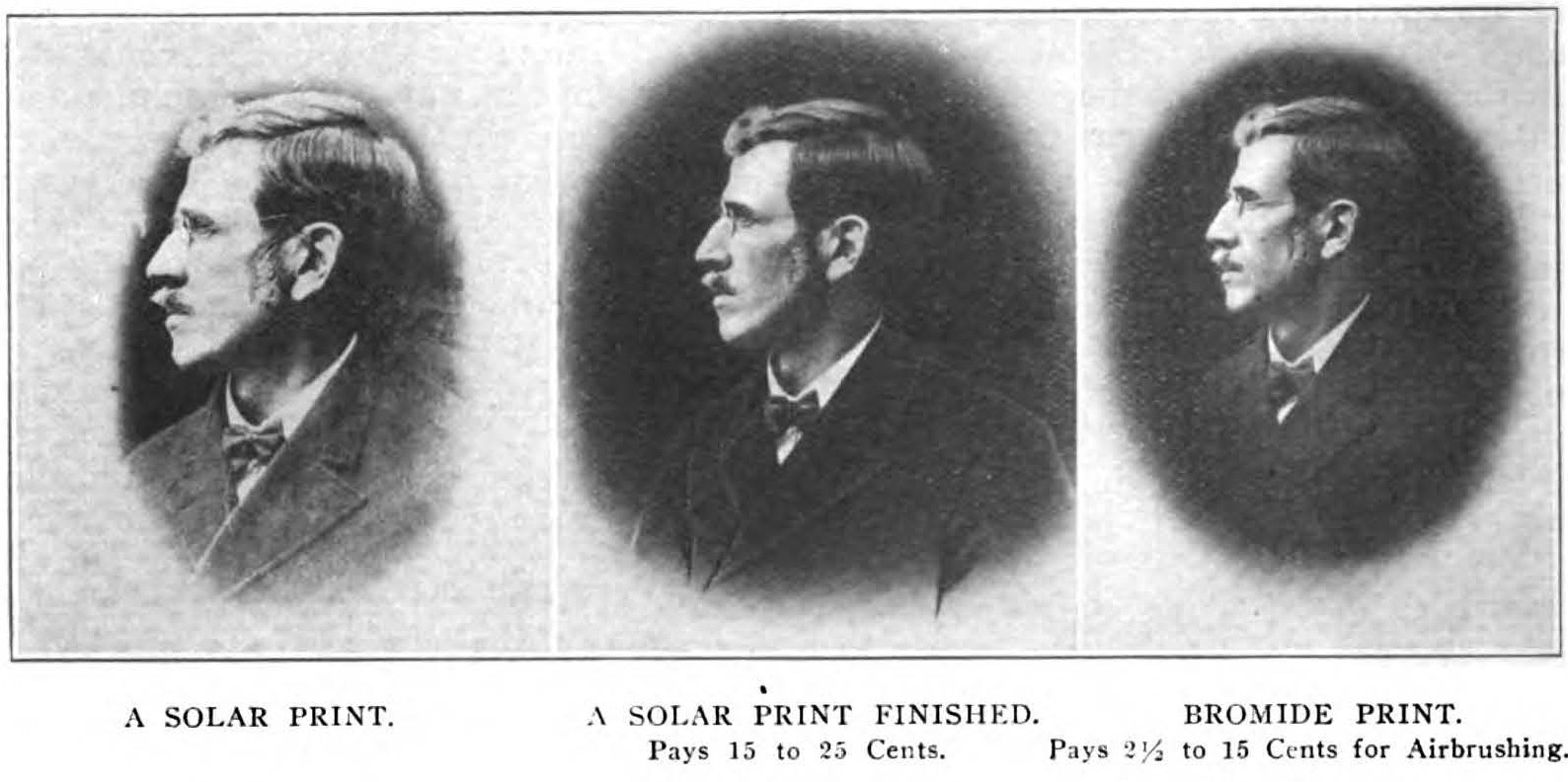
A long time ago he got a couple of dollars or so for a single picture. Now he gets anywhere from cents to a quarter for touching up the machine-made article. In the good old days he was wont to wear a silk hat on Sundays, to let his hair grow bushy like a “Ham” actor and to wear tone of these big spaghetti-catching, Elbert Hubbard neckties. People used to point him out as an “Artist.” He prided himself upon being a “professional man” and was” respected and looked up to by the (muddle-headed, middle class) community.
But, as has happened throughout the whole wide world, the heartless modern system of machine production invaded his snug little narrow world and tore him rudely from his lofty perch and placed him down with the common workman. The machine, all oblivious of his “artistic temperament,” made his cherished skill useless. Gone are the palmy days of plug hats and dazzling sparklers when the artist used to “put it all over” the common herd. Gone are the dizzy, cloud enveloped heights that he has haunted from time out of mind. The unsympathetic machine has made him a mere “Spotknocker” instead of an “Artist.” Nothing else, as one boss has it, but a mere “air-brush hand.” Instead of a spacious studio where the pale light filters through high windows, he now has a stall in a big grey room where he works eight hours a day with perhaps fifty or a hundred others of his kind.
For thousands of years pictures have been made with a stick with a few hairs at the end of it, but the brush has been torn from his delicate grasp and replaced with a vicious, little spraying apparatus of steel that is worked by compressed air. This devilish contrivance, in connection with the solar and bromide prints that the spotknocker retouches, has made his skill largely useless by multiplying his efficiency and dexterity an hundred fold and by making it possible for unskilled people to do the work. Before these things were invented two or three portraits were considered a good day’s work. At the present day the man who works at the easel next to mine must speed up to the tune of one hundred and fifty pictures a day if he wants to make a living wage.
And all this time spotknockers have been wondering what could be the matter with them. Some people have wondered if they will ever live long enough to find out.
Thus it happened that the machine became the artist and the artist became the “spotknocker.” It is his business now to merely stipple or “knock” the spots that the machine overlooks. Instead of one hundred and fifty artists, we now have one spotknocker. God be with us! The boys at the C.P. Co. are out on strike, the bosses are having a game of billiards at the Chicago Athletic Association and the inexperienced girls, the scabs, the unorganized solar and bromide printers and the machines they use, are still on the job.
There are not as many spotknockers engaged in grinding out “chromos” as there were ten years ago, although the volume of business done is greater than ever before. So prolific is our labor that four or five hundred of us, working mostly in Chicago and some of the larger cities of the country, Canada and Mexico, are capable of polluting the entire continent with them.
Somebody told me once that spotknockers are wage-slaves gone to seed. The unskilled workers look upon him as a freak who talks a lot and is unable to do a man’s work in the world. His bosses take him as a joke and doctors, lawyers and other “respectable” professional folk pity his pitiable pretensions to professional “dignity.” One of the boys in the shipping department said, after he had thoroughly convinced himself that the spotknockers had really struck, “By –! those candy artists are becoming almost human after all I” Heavens…what will become of us?”
Almost entirely isolated from the great main current of working-class struggles, hopes and victories, the spotknocker, in spite of the intolerable pressure that has been brought to bear upon him, is still stagnating in a marsh of reactionary, middle-class sophistry, still content with conditions if he can get a few pennies more for the pictures he makes, that he may draw more sharply the line that separates him in his narrow circle from the great working class. He still believes that he is able to “beat the game,” playing according to capitalist rules. He is still nursing middle-class ambitions, insipid ideals and hopeless platitudes and every possible hobby from Astrology and Christian Science down to middle-class “reform” socialism. He is being pushed down into the ranks of the unskilled workman and he is squealing and squirming and kicking, but he has not yet awakened to the need of clear cut socialism and the revolutionary labor movement of today. It is natural that he should have developed this point of view, but it is just as natural that he should abandon it, as he is forced lower and lower into the ranks of the unskilled.
As the commodity that he sells in order to live, his labor power, is cheapened by machine production he will more and more begin to get next to the whole rotten game. For the first time he will begin to realize what life is really like when he discovers that the class struggle is not confined within the grey walls of a spotknocking studio or by the narrow circle of some chaste-like skilled craft union. Instead he will begin to acquire
that clear, implacable and healthy hatred for capitalistic “ideals,” “morality” and such bunk and drivel. He will learn to take his place gladly in the great, worldwide fight of the working-class to emancipate itself from the present crushing system of exploitation. The greatest thing in the world after all is to learn how to fight and fight effectively on the job and at the polls.
The International Socialist Review (ISR) was published monthly in Chicago from 1900 until 1918 by Charles H. Kerr and loyal to the Socialist Party of America. During the editorship of A.M. Simons it was largely theoretical and moderate. In 1908, Charles H. Kerr took over as editor with strong influence from Mary E Marcy. The magazine became the foremost proponent of the SP’s left wing growing to tens of thousands of subscribers. It remained revolutionary in outlook and anti-militarist during World War One. It liberally used photographs and images, with news, theory, arts and organizing in its pages. It was closed down in government repression in 1918.
PDF of full issue: https://www.marxists.org/history/usa/pubs/isr/v12n03-sep-1911-ISR-gog-Corn.pdf
 Revolution's Newsstand