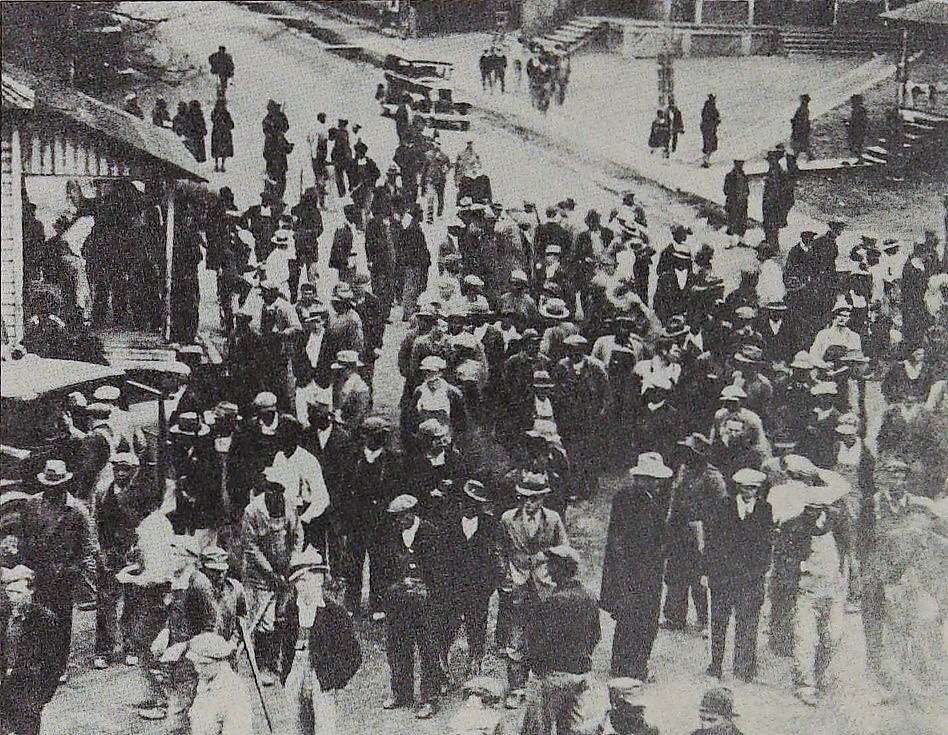
Given that the area around Birmingham, Alabama has an almost unique combination of iron ore, coal, and limestone deposits, the three main ingredients in making steel, it was destined to become the industrial center of the South–and a place of intense class and racial conflict. The Labor Research Association’s Myra Page, who focused years of her activity on the needs of Southern workers, reports on Communist activity, with the sheriff and the Klan always around, in the states mines and mills, attempting to unite its deeply divided Black and white working class.
‘Those Alabama “Reds” in Action’ by Myra Page from The Daily Worker. Vol. 11 No. 107. May 4, 1934.
COMMUNIST miners and steel workers of Alabama have studied the Open Letter of our Party to the membership, especially its directives “to make the turn to the shops.” “That’s right,” they say, “that’s talkin’.” And resolutely, in the face of great terror and semi-legal conditions, they have set out to build the Party in the big trustified industries of Alabama. True, we have only the beginnings of this work as yet. But even these first months of rooting ourselves in the very vitals of industry and the working class have produced results that might well be studied by our entire Party.
Last month, the first issue of the Communist unit’s shop paper in the Steel Trust’s powerful T.C.I. appeared–The Blast. It proved up to its name, creating a sensation both among the millmen and miners, and in the superintendent’s office. Some T.C.I. workers’ homes were raided in the night, by company thugs. By day, the management called factory meetings, where cajoling was intermingled with open threats. Straw bosses did their best to discover what damn Bolsheviks had the nerve to put out this sheet, distributed right in the mills! The workers confined their talking, however, among themselves. There, they did plenty. What a swell job!
Wanted–50 More Copies of Shop Paper
“If I could get hold of about 50 extra of these,” a white steelman confided to a fellow Negro worker, “I’d sure put them to good use.” He got them. A biting cartoon of one hated foreman, a speed-up demon, caricatured with horns, tail and pitchfork, complete, proved the main hit.
Evidently it hit the foreman too. Calling his department together, he said in an aggrieved tone, “Boys, why do you write such things about me?…I’ll lay off. And remember, no more pictures.” Soon the second number of “The Blast” will be out, helping to launch the red Steel and Metal Workers’ Industrial Union in this heavy industry center of the South.
Last week Y.C.L. units were organized in the T.C.I. Party units and are already at work in mills and mines of the Republic Steel. Sloss-Sheffield and others. Several C.W.A. jobs have been organized solid by our Communist units. Solidarity of Negro, White Workers Through this turn to the shops, and only through this, by taking up the day-to-day struggles there, our Party has been finding the one key to its toughest problems in the South. Before this, we had not been able to draw in but a scant handful of southern white workers. We had hardly begun to cement that solidarity of Negro and white which is the prime pre-requisite of any working-class advance in the South, and of the further growth of the national liberation movement of the oppressed Negro people.
Until we began basing our work in the shops, unity of southern labor could not be achieved. Roused by the magnificent Scottsboro campaign, several hundred southern Negro workers and croppers had taken up the struggle and joined our Party. But the white workers, laboring under all the bogies of race prejudice and red scares, remained almost untouched. Only a small minority realized that Scottsboro had anything to do with the solution of their problems.
They repeated, many of them, the press lies that “that Communist Party ain’t for white men. It’s just a n**r-lovin’ society.” The point was, that we had not found the means of proving to them, in actual struggle, that the Communist Party’s uncompromising fight for Negro rights and freedom of the Black Belt was an essential part of their fight (of the whole working class) for better conditions and freedom.
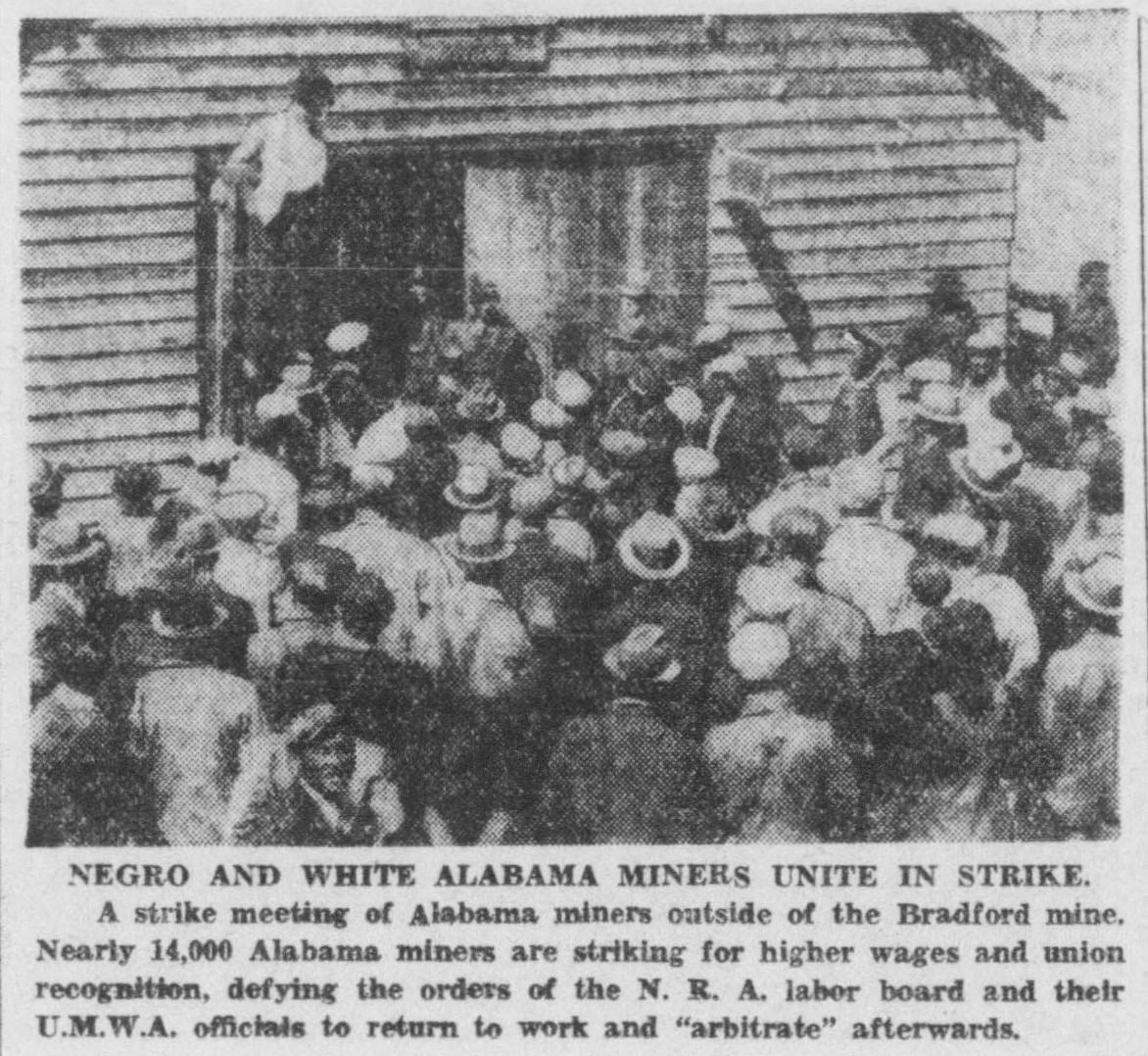
Once in the shops, organizing and carrying on struggles right on the job, today we are making progress in welding the revolutionary unity of Negro and white. Here is the place to break through the vicious Jim Crow caste system. Men who slave side by side below ground or around blast furnaces are not slow to understand the value of unity against their common boss and corporation job-owners. From these struggles against speed-up and wage-cuts and for union rights, the Communists explain and lead their fellows to understand the whole capitalist system and the goal of workers’ rule and a freed Negro people. Then while not easy, it becomes much easier to win southern workers, white and Negro, for our full Communist program.
It is one of capitalism’s fatal contradiction that within its most vital parts, precisely at the point of production, it creates those conditions which force the working class to struggle, and struggling to begin to unite. This is as true for those divisions along race lines as of any other shackle with which the masters would bind their wage slaves; in the shops the shackle both girds and cracks. As one Birmingham miner put it, “When you go down to dig coal, the company doesn’t I care what’s the color of your skin. All they care about is coal. Cheap coal.”
Communist demands for equal pay for the Negroes, and no discrimination, militant unions in which all Jim Crow is barred, is meeting with wide response among white as well as colored workers. They see it is to the advantage of both. And seeing this, it comes easier to see farther–how the whole Jim Crow system is a clever policy of the corporations to divide and rule. As Negroes form about four-fifths of Alabama’s heavy industries, the urgency of our program is easily apparent.
Since the turn to the shops, the Party has been growing fast. In the last months, scores of miners, steel workers, C.W.A. workers and unemployed have joined our Party. More than a hundred of these were white workers, some of whom a short time ago were members of the Ku Klux Klan. District No. 17 today has nearly a thousand workers, staunch proletarian Communists, Negro and white, the vanguard of the southern working class. Terror of the corporations and its white shirts bands can not break their ranks.
We have only begun this rooting of our Party in the shops. We have many weaknesses in our work to overcome. Above all, our mine and mill units must become leading organs of active struggle in each shop, leading and winning the workers, by militant Bolshevik deeds. Propaganda, leaflets are not enough. Action and more action is what is needed. Our tempo must be faster: events demand it. The turn is far from complete.
Must Expose N.R.A. to Southern Workers
Moreover, the anti-working class character of the N.R.A. is far from being exposed before the southern workers. Many illusions persist about Roosevelt and the Federal Government. Confused, dissatisfied, the workers do not clearly see as yet how the Blue Eagle is daily becoming more and more a fascist swastika. Firmly rooted in the mills and mines, the Party can arouse the workers against the imminent dangers of fascism and war, and make clear to them the revolutionary way out of their misery and oppression.
In Alabama and the South generally, the issue of who is to lead the workers is immediate and acute. The workers are in ferment, having suffered to the limit. They want an end to the wage differentials (“Why is a ton of coal mined in Illinois worth more than one in Alabama? Because we ain’t organized!”) In no uncertain terms, they have rejected company union schemes, in the mine field, Republic Steel, T.C.I. and other places.
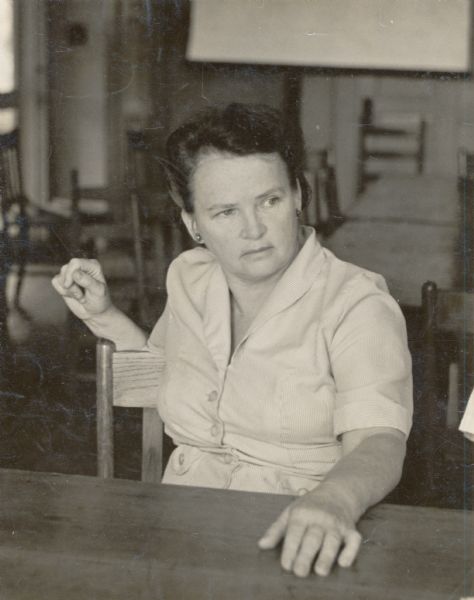
But the A.F. of L. has big prestige among them. They don’t know as yet how these Greens and Lewises, Mitch and Tighe can soft-soap and wax militant in speech, then go directly into conference with the corporations and negotiate the worst kind of sell-outs. But the recent mine strike, described in an earlier article, proved a costly lesson. So did the laundry strike. The fight for equal rights for Negro workers on the job and in the union is never raised by the A.F. of L. officials; quite the contrary. Nevertheless, when strike struggles occur, Alabama workers have been moving in the direction of unity, closing ranks. Many white workers told me, with some surprise and frank admiration, what good strikers and firm union men the Negroes made, and how they kept out scabs.
Bosses Capitalize A.F. of L. Unions
Not only is the A.F. of L. coming in with full force and the tacit consent of the companies, to capitalize on the unionizing spirit among the workers. The Socialist Party officials have suddenly “discovered” the South. Their ambitious program for expanding in the South both in the cities and among the share-croppers, is of course on a Jim Crow basis. It would be dangerous to console ourselves that the program will remain largely on paper. The Reverend Thomas recently toured the South, taking time to speak to Birmingham’s laundry strikers, and counseling them to be “quiet and peaceful.” At the same time, he waxed eloquent over the laboring man’s rights.
When Tighe, one of the infamous betrayers of the Great Steel Strike of 1919, spoke on unionism to Birmingham’s massed steel workers, the meeting was called in the city’s main auditorium. Negroes were jim-crowed in the balcony. Morgan controls both the mills and the city, and it was his men who saw fit to grant this meeting place. Any opposition that these corporations show to the A.F. of L. is largely front-page stuff. The rest is fear of the rank and file “getting out of control” of the Mitches and Tighes.
Will the Communist Party take the leadership of the coming big struggles in the South? Or will the big A.F. of L. officials together with Socialist misleaders betray them? Our failure to win leadership or even really to influence the course of past strikes ought to prove a timely warning. By spreading and strengthening our turn to the shops, and by building stronger fractions and oppositions in the U.M.W.A. and other A.F. of. L unions, and a strong Steel and Metal Workers’ Union, we shall be able to decide the question in the Party’s and southern workers’ interests.
The Daily Worker began in 1924 and was published in New York City by the Communist Party US and its predecessor organizations. Among the most long-lasting and important left publications in US history, it had a circulation of 35,000 at its peak. The Daily Worker came from The Ohio Socialist, published by the Left Wing-dominated Socialist Party of Ohio in Cleveland from 1917 to November 1919, when it became became The Toiler, paper of the Communist Labor Party. In December 1921 the above-ground Workers Party of America merged the Toiler with the paper Workers Council to found The Worker, which became The Daily Worker beginning January 13, 1924. National and City (New York and environs) editions exist.
PDF of full issue: https://www.marxists.org/history/usa/pubs/dailyworker/1934/v11-n107-may-04-1934-DW-LOC.pdf
 Revolution's Newsstand