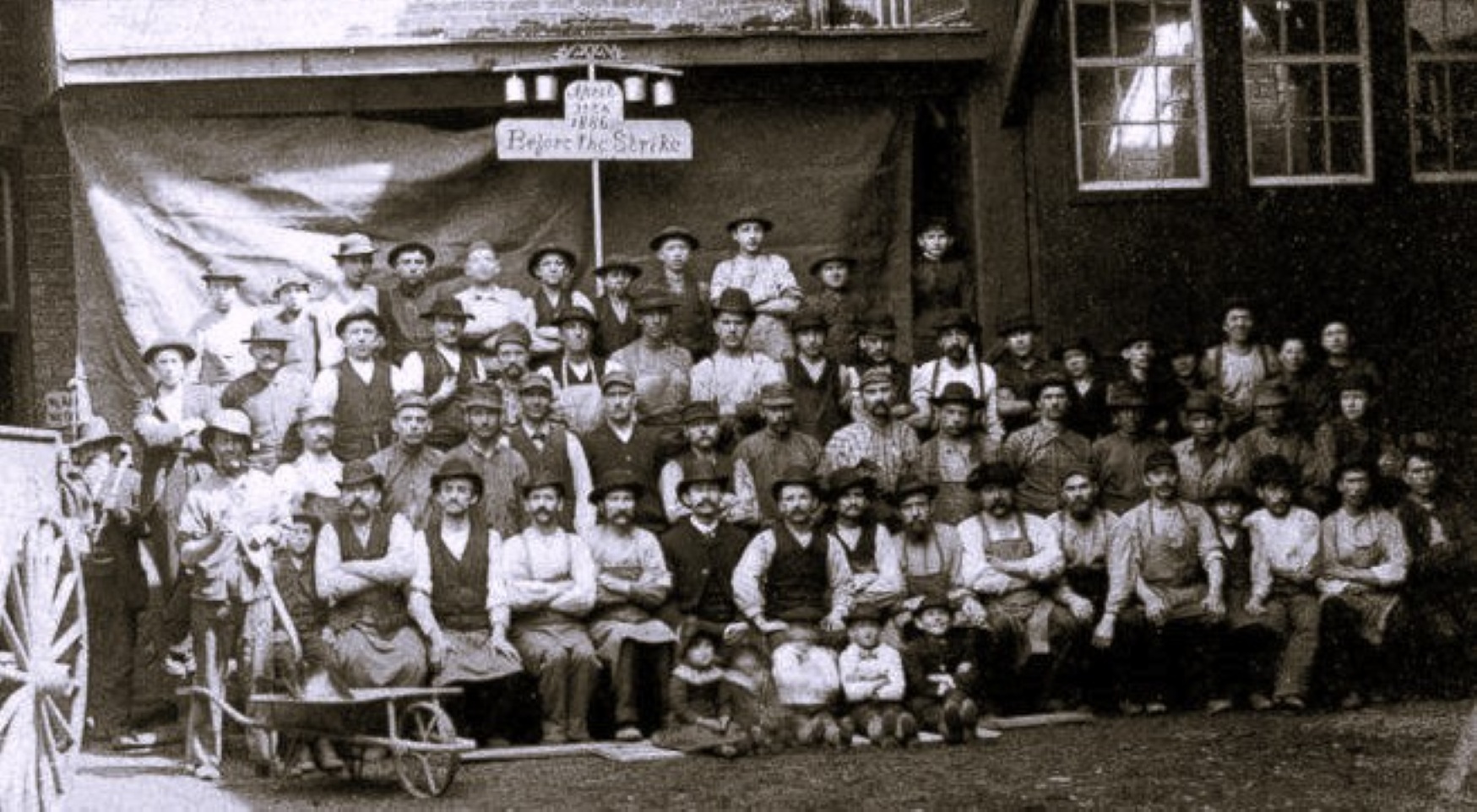
Ten thousand Chicago proletarians organized by the International Working People’s Association march behind revolutionary banners, marshaled on horseback by Samuel Fielden, August Spies and Oscar Neebe to a picnic at Ogden’s Grove on July 26, 1885. There feasting, drinking, music, a speech by Albert Parsons, and evening dances.
‘A Great Demonstration of the Working People of Chicago’ by Albert Parsons from The Alarm (Chicago). Vol. 1 No. 28. August 8, 1885.
REVOLUTIONARY–A GREAT DEMONSTRATION BY THE WORKING PEOPLE OF CHICAGO, UNDER THE AUSPICES OF THE INTERNATIONAL.
Thousands March Beneath the Crimson Banner, Emblem of “Liberty, Fraternity, Equality.”
A PROTEST AGAINST BOURGEOISIE DISORDER AND GOVERNMENT BY THE VICTIMS OF AUTHORITY.
The Workers Demand Economic Liberty, the Inalienable Right of All to Work and Live.
THE SOCIAL REVOLUTION
The International Working People’s Association, sometimes called Anarchist-Communists, decided some time ago that it was necessary to show forth the revolutionary spirit of the Chicago working people against the existing order of things, especially as the Trades-Assembly had, through the manipulations of some of its political aspirants, endeavored to carry the labor organizations of the city into the dirty cesspools of political action. Accordingly the following circular was issued and addressed to the labor organizations of the city, viz.:
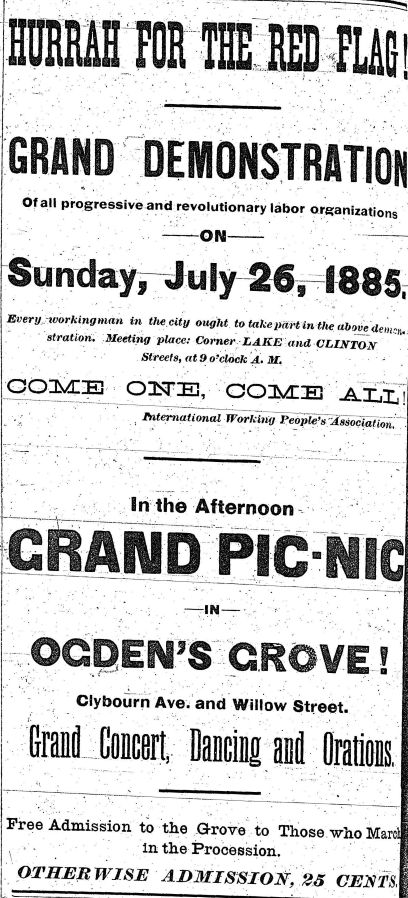
CHICAGO, June, 1885. To the Officers and Members of The International Working Peoples Association intends to prove the numerical strength of the outspoken revolutionary labor movement of this city, and has made all preliminary arrangements for a public demonstration in the form of a street parade and picnic on Sunday July 26, 1885, at Ogden’s Grove.
Every working man and working woman is invited to prove by his or her presence that the Red Flag is the true symbol of united labor, and thereby rebuke the political confidence men and vagabonds who betray the workers to their despoilers.
Labor organizations are requested to notify the secretary of the arrangement committee of their intention to participate in the procession, and also of any other matters pertaining to it. Respectfully,
THE COMMITTEE OF ARRANGEMENTS. B. RAU, Sec., 107 Fifth Ave.
On the morning of Sunday, July 26, the sun rose bright upon a cloudless sky. The weather was auspicious and by 9:30 strains of music were heard upon the air and the various organizations began to assemble at the place of rendezvous on Clinton and Lake streets. By 10:30 the procession had formed on Market street between Randolph and Madison, and the line of march taken up. The procession was composed of seventeen groups of the International, in addition to the following trades unions: Progressive Cigarmakers’ Union Furniture Workers’ Union, International Carpenter’s and Joiners’ Union, Central Labor Union, Trimmers and Tassel Makers’ Union, Metal Workers’ Union, German Carpenters Union, Frescoe Painters’ Union and Butcher’s Union. The Lehr and Wehr Verein, the workingmen’s military organization, presented a soldierly appearance in their blue blouse and black pants, and were armed with Colt’s navy revolvers (it being unlawful for workingmen in Illinois to parade with rifles.) Thousands of spectators lined the sidewalks to witness the formation of the procession which began to move off to the martial strains of four brass bands. Comrades Samuel Fielden, August Spies and Oscar Neebe were mounted on horses and acted as marshals. Several thousand men took their places in the line of mar bearing aloft the following inscriptions, painted in white letters upon red banners:
“We mourn not so much for General Grant as we do for the little child which was starved to death yesterday;” “Exspoiliation is legalized robbery;” “Down with the throne, altar and money-bag;” “The fountain of right is might. Workingmen, arm!;” “Freedom without equality is a lie;” “Not to be a slave, is to dare and do–Victor Hugo;” “Our civilization: the bullet and policeman’s club;” “Government is for slaves, freemen govern themselves;” “United we stand, divided we fall;” “The greatest crime of our time is · poverty:” “Proletarians of all countries, unite;” “The ruling morality is the money-bag;” “Wage system slavery, co-operation means freedom;” “Private capital is robbery,” “Government makes classes; no government means no classes, means equality;” “Every government is a conspiracy of the rich against the poor;” “Millions labor for the benefit of a few; we want to labor for ourselves;” “In the absence of law, all are free.”
As the line moved down Madison street to Clark, and thence north on Clark, it presented a very significant and imposing aspect. The crimson banner of solidarity was conspicuous all along the procession, which stretched for a half mile through the streets. There were a number of allegorical representations displayed, two of which are deserving of special notice. One was a burlesque on the boasted “liberty” of the “American sovereign.” To a long fiat wagon were attached two mules, only their heads and ears being visible; each of these animals was covered with a cloth, on one of which was printed in large letters the words, “Our Representatives,” on the other, “Our Senators.” The driver was attired in striped pants of red, white and blue, with white plug hat, making up the typical costume of “Uncle Sam.” In the center of the wagon was a large barrel with a placard bearing the legend “Five and Ten Cent Drinks.” Standing by the barrel was a dummy policeman of large size, bearing aloft a club in one hand while the other encircled the barrel. Attached to his back was a card inscribed “One of the Finest,” and beneath in large letters were the words, “Liberty Enlightening the World.” Surrounding the wagon and covering the wheels was a white cloth on which was printed the words, “Americans, Long Live Your Liberty.” The tableaux excited a great deal of comment as everyone of the tens of thousands who witnessed the spectacle recognized the picture by recalling to mind the scenes witnessed only a few days before when the police authorities used their clubs upon the people during the street car strike, striking down hundreds of citizens in the name of “law and order.”
The other feature was the appearance at the head of the American group of a beautiful red banner, borne aloft by Comrade Crowley, with four ladies, Mrs. Parsons, Mrs. Swank, Mrs. Ames and Mrs. Poller, holding the four silken cords as color guards. Several other ladies followed in the rear. The sight was so unusual as to elicit comment and applause all along the line of march, and our brave revolutionary sisters withstood the heat of the sun and the tire of walk throughout the whole line of march.
The line of march occupied about three miles before the grove was reached, and all along the line was cheered by the spectators.
Reaching the grove the processionists found it already well-filled with a large crowd of attendants, where they soon scattered beneath the cooling shades of the trees and booths. After a hearty repast of “basket lunches,” with lemonade, pop and beer, the large dancing platform was filled with a happy throng tripping the light-fantastic to the strains of an elegant band. In a distant part of the grove was another band giving concert music in the most delightful manner. This music was given alternately and kept up throughout the afternoon and evening until a late hour.
By 2 o’clock fully ten thousand people were in the grove, enjoying themselves to the utmost. At 5 o’clock the bugle call sounded and Comrade Neebe introduced Comrade A.R. Parsons to the audience for a speech. The speaker said that it had been expected that Comrade W.J. Gorsuch would be present to address us, but as he had been arrested, and was under bail to appear before the court in Cleveland, Ohio, on Tuesday following, it was impossible for him to come. Comrade Gorsuch, said the speaker was held for inciting the striking wage-slaves of Cleveland to revolt against their slavery; this was a crime in the eyes of the “better classes,” and they were punishing him for it. The freedom of our boasted liberties were being put to the test, and it was now becoming apparent to the most patriotic of the working class that their freedom was confined to a strict observance of the commands of capitalists, refusing to do which they were arrested and punished according to “law and order.” The speaker pointed to the growth and development of the modern system of industry. That 30 years ago there were not 500 “tramps” in America, while today there were over two million houseless, homeless wanderers tramping over the country begging a fellow worm to give them leave to toil. Thirty years ago there were not 50 millionaires in America, today there were 25,000 of these property beasts. Thirty years ago there were not 15 billion dollars worth of wealth in the whole country; today there was over 55 billion dollars worth. Where was this wealth? Was it in the hands of those who created it? No! On the contrary, the workers were poorer than before. There were four times as many criminals, four times as many suicides, four times as much insanity and disease now as then. It was four times as difficult to obtain an opportunity to work and earn a living now as then, notwithstanding the fact that during the past thirty years the power to produce wealth had increased over a thousand-fold. The same was true of all other countries. Everywhere the concentration of wealth into the hands of the privileged few who, under the private property system were allowed to live and amass these fortunes by plundering the workers, the useful classes. Shall this condition of things continue forever? No! It cannot. The wants of the people, their necessities, their desire to live would soon compel them to violate “law and order” and force them into open revolt. This was the social revolution in which the “Property Beast” would be slain, and the right to life, liberty and happiness guaranteed to all by giving every human being the right of free access to and use of the means of existence. Then there would be neither masters nor slaves; neither governors nor government; no law–but the natural-law–which all must obey in order to live; the “free society,” where all do as they please, it pleasing each to restrain the other from doing wrong to any one, in other words, Anarchy. The time draws apace when the wage-slaves will be called upon by their necessities to act. Are you ready for action? Beware what you say. The property beast panoplied with the shield of “law and order,” is armed to the teeth ready to mow you down in cold blood upon the streets. Have you each provided yourselves with knives, pistols, guns, and dynamite? If not, then you are unprepared to meet the organized hirelings of capitalists, who as shown in the recent conflicts with laborers use their bayonets, clubs and Gatling guns force labor to submit to their dictation and authority. To be forewarned is to be forearmed. Be therefore prepared that when you do strike the blow it will be for victory and not for defeat. The speaker said that everywhere in the west, in Kansas, Missouri, Nebraska and Iowa where he had been recently, he found misery, want and hunger in the midst of the greatest abundance. The workers everywhere in those sections hailed the redeeming cry of “Liberty, Fraternity, Equality,” as their savior: They were ripening for the revolt, and they sent words of cheer and hope to their comrades in the cast.
The speaker concluded with three cheers for the “social revolution,” which was given with unbounded enthusiasm.
The band struck up the Marseilles Hymn, which was joined in and sung by the thousands assembled around.
Comrade Samuel Fielden then spoke briefly. He spoke of the need of organization and unity. He pointed to the significance of the active participation of the women in the labor movement and that it would not be long before the men would be driven to co-operate. He declared that a civilization such as we had today was like a whited sepulcher, “fair without, but filled with dead men’s bones within.” It was freedom based upon slavery. The toilers of the world were the builders of its palaces, the creators of its wealth, and yet they dwell in hovels and live in squalor and wait. This can not endure forever. We would be less than brutes were we to permit our off spring and our class to suffer and perish under such conditions.
The speaker closed by exhorting every one to join the International, to attend its meetings, take its newspapers, read its books and prepare mentally and physically for the inevitable conflict of force between capitalists and their laborers.
Comrade Schwab closed the meeting with a short address in the German language, which was enthusiastically received. A notable feature of the day’s proceedings was the absence of that capitalistic “preserver” of the peace known as the policeman. Here was over ten thousand people assembled together for a whole day and part of the evening, and yet there was no trouble, nothing to mar or disturb their pleasure or comfort. If there were any persons present disposed to violate the rights of others they were summarily disposed of by those present, who were a “law unto themselves,” in every instance. Thus passed one more memorable day of the labor movement in Chicago, and the hands of the people were strengthened, and the conviction deepened, and the preparations increased for a final struggle between the upholders of privilege and the defenders of the equal rights of all.
The Alarm was an extremely important paper at a momentous moment in the history of the US and international workers’ movement. The Alarm was the paper of the International Working People’s Association produced weekly in Chicago and edited by Albert Parsons. The IWPA was formed by anarchists and social revolutionists who left the Socialist Labor Party in 1883 led by Johann Most who had recently arrived in the States. The SLP was then dominated by German-speaking Lassalleans focused on electoral work, and a smaller group of Marxists largely focused on craft unions. In the immigrant slums of proletarian Chicago, neither were as appealing as the city’s Lehr-und-Wehr Vereine (Education and Defense Societies) which armed and trained themselves for the class war. With 5000 members by the mid-1880s, the IWPA quickly far outgrew the SLP, and signified the larger dominance of anarchism on radical thought in that decade. The Alarm first appeared on October 4, 1884, one of eight IWPA papers that formed, but the only one in English. Parsons was formerly the assistant-editor of the SLP’s ‘People’ newspaper and a pioneer member of the American Typographical Union. By early 1886 Alarm claimed a run of 3000, while the other Chicago IWPA papers, the daily German Arbeiter-Zeitung (Workers’ Newspaper) edited by August Spies and weeklies Der Vorbote (The Harbinger) had between 7-8000 each, while the weekly Der Fackel (The Torch) ran 12000 copies an issue. A Czech-language weekly Budoucnost (The Future) was also produced. Parsons, assisted by Lizzie Holmes and his wife Lucy Parsons, issued a militant working-class paper. The Alarm was incendiary in its language, literally. Along with openly advocating the use of force, The Alarm published bomb-making instructions. Suppressed immediately after May 4, 1886, the last issue edited by Parson was April 24. On November 5, 1887, one week before Parson’s execution, The Alarm was relaunched by Dyer Lum but only lasted half a year. Restarted again in 1888, The Alarm finally ended in February 1889. The Alarm is a crucial resource to understanding the rise of anarchism in the US and the world of Haymarket and one of the most radical eras in US working class history.
PDF of full issue: https://dds.crl.edu/item/54013
 Revolution's Newsstand