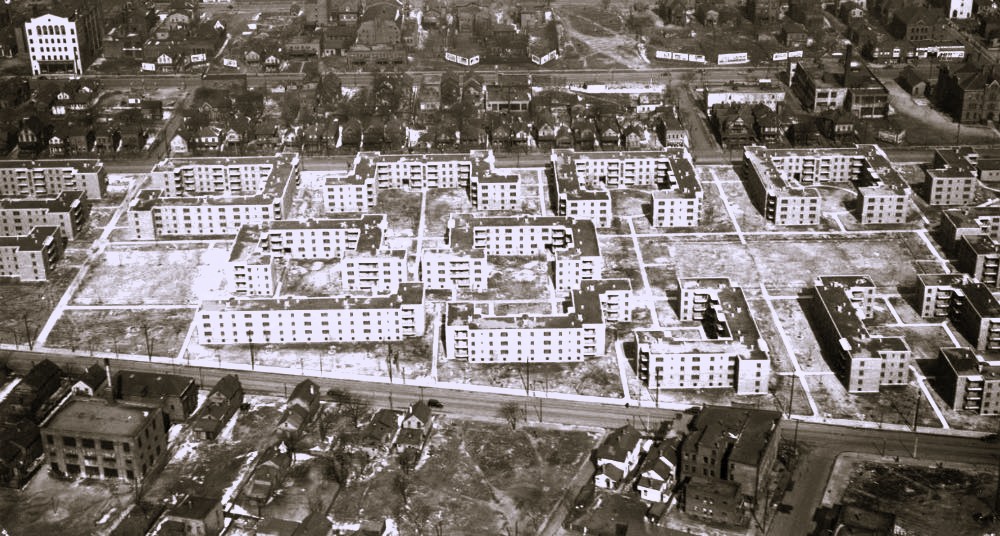
Having a large percentage of the working class as homeowners has created a specific set of problems for the left when addressing the issue of housing. Here, a C.P. discussion piece from the Depression/Popular Front-era on conditions of, and relating to, the working class property-owner.
‘The Housing Question’ by E.C. Greenfield from The Communist. Vol. 15 No. 9. September, 1936.
THE HOUSING SHORTAGE ACCORDING TO ENGELS
The present housing situation is nothing new. The “housing shortage” has always been a sore spot in capitalist society. Engels pointed out in 1872 that the “housing shortage” brought forth all manner of quackery and reforms. A “housing shortage” of large-scale proportion had developed in Europe that had penetrated even to the upper strata of the middle class. The shortage of houses came at a time when the transition from manufacture and small-scale production to large-scale industry was taking place. Engels wrote at that time as follows:
“On the one hand masses of rural workers are suddenly drawn into big towns, which develop into industrial centers; on the other hand the building plans of these old towns do not any longer conform with the conditions of new large-scale industry and the corresponding traffic; streets are widened and new ones cut through, and railroads run through the center of the town. At the very time when masses of workers are streaming into the towns, workers’ dwellings are pulled down on a large scale. Hence the sudden housing shortage for workers…”
American company-owned towns with all their evil housing conditions find their similarities in Engels’ times when the whole philosophy of factory-owned homes developed out of the capitalists’ idea of housing workers, borrowed largely from Proudhon.
In developing his polemics against Dr. Sax, a contemporary of his, Engels further points out:
“The big rural factory-owners particularly in England have long ago recognized that the building of workers’ homes is not only a necessity, a part of the factory equipment itself, but also that it pays well. In England whole villages have grown up in this way and some of them later developed into towns. The workers, however, instead of being thankful to their philanthropic capitalists, have always raised considerable objection to their ‘cottage system’. Not only are they compelled to pay monopoly prices for these houses because there is no competition, but, immediately a strike breaks out, they are homeless because the factory-owner without any more ado throws them out of his houses and thus renders resistance difficult.”
Thus we see at the present time the need for a sharper fight against foreclosures and evictions as a weapon to assist the workers to win their economic demands. When workers are faced with a loss of their lifetime savings invested in their homes, they are more easily tempted to take what is offered to them in the way of wages.
AMERICA’S BOOM PERIOD OF AUTOMOTIVE PRODUCTION
In the last few decades we have been brought face to face with the realization of what Engels was discussing. To be sure, it was always part of America’s development. (A. Bimba, The History of the American Working Class.) Since the development and rapid rise of the automotive industry we have seen classic examples of these phenomena in boom towns like Detroit, Cleveland, Toledo. The underlying causes pointed out by Engels hold good for the largescale real estate land developments and housing shortages of today.
Take Detroit, for example. When the upsurge in mass production of automobiles got in full swing, old narrow streets were widened to take care of the tremendous automobile traffic. The workers were forced by a sudden shortage of homes to buy houses and lots farther in the outskirts. These were built and owned by the automotive giants and bankers. Cleveland had a more gradual development; nevertheless, its boom periods developed identical conditions.
The “housing shortage” today takes place in the decay of capitalism when large real estate developments have collapsed and there are taking place mass foreclosures and evictions.
Ever since the “Florida Real Estate Bust’’, the real estate situation throughout the country has been such that it has wiped out the savings of millions of small property-owners. The Florida Fiasco marked the beginning of the long downward spiral of real estate values. Some time before the stock market crash, building houses ceased as a family venture and as a business. For years unpaid special assessments and taxes have been piling up on building allotments all over the country and they still remain unpaid.
Year after year, the accumulated debt has risen so high that the debts exceed the value of the lots. This, coupled with the tremendous bond investment required to improve all this property, is reducing cities and townships to actual bankruptcy. One need go no further than Brooklyn, a suburb of Cleveland, for an example of how the draining of the entire tax resources to pay off bonded indebtedness has endangered the health and safety of the entire community by bankrupting it. Today, in the outskirts of our cities, we see miles of paved streets, graded parkways, ornamental lighting systems, sidewalks and fireplugs, in fact every improvement is on these lots with the exception of homes to live in.
CREATING ARTIFICIAL SHORTAGE OF HOMES
Let us examine a little more in detail the existing housing shortage as it applies directly to the Cleveland metropolitan area. According to the Real Property Inventory, published by Howard Whipple Green for 1935, the number of vacant family units has decreased from 9 per cent in 1932 to 3 per cent in 1935, a 33 1/3 per cent decrease in three years. This 3 per cent vacancy totals 9,765 units as against a 9 per cent totaling approximately 29,000 units vacant in 1932.
Question: What caused this rapid decrease in the number of vacancies? Nineteen-thirty-two marked the peak of dwelling foreclosures immediately following the crash of 1929, although they had been steadily on the increase since 1926, in 1930 it reached a record high of 5,000. In 1932 there were nearly 3,000 homes foreclosed. This immediately caused a large doubling up of families. This, coupled with the great amount of tenants who could no longer pay rent and were evicted, created a total of 12,642 extra families in 1932.
This particular economic condition of the masses caused by unemployment is the basic reason for the 29,000 vacant dwelling units.
These figures shed a great deal of light on why the strength of the Small Home and Land Owners Federation was so great in the year of 1933 and they also have a great deal of bearing on why the Home Owners Loan Corporation immediately started pouring liquid assets into the defunct banks that were stuck with this property.
HOW THE HOME LOAN REDUCED THESE VACANCIES
Well over 30,000 home loans were issued in the metropolitan district of Cleveland since 1933, which had a great deal of bearing on the undoubling of these 12,000 extra families pointed out before.
The next process in ridding the city of vacancies in dwellings was the outright demolishing of homes, which has caused an undue amount of suffering and misery, particularly on the Negro population of this city, where most of the so-called slum clearing projects are in operation.
Figures show, according to Howard Whipple Green, that 3,004 family units have been demolished since 1932 and up until October, 1935. Of these, 1,369 were demolished in 1935. Six hundred and six of these demolished family units in 1935 were demolished to make way for slum housing. These slum housing projects are in districts of densely populated Negro sections. “Cedar”, “Central”, “Outhwaite” and the “West Side” housing project areas are all located in these Negro districts. These families, forced to move elsewhere, have simply been forced back, so to speak, into the adjacent neighborhoods surrounding the projects. The adjacent territories are composed largely of very old tenements and dwellings as dilapidated and unfit for human habitation as the ones that have been torn down.
This intense over-crowding has virtually turned entire districts into rows of disease-breeding houses and fire-traps. The cremation of a Negro mother and child in one of these fire-traps on East 55th Street, closely adjacent to the Outhwaite slum project, is only an indication of the fire hazard that exists in these over-crowded sections, caused by the slum clearances. And—all of this is done in the effort to create an intense housing shortage, to boost rents and to increase real estate property value now in the hands of the bankers.
In 1931 the banks were bankrupt, their assets frozen. Through the “Home Loan” set-up they received over $4,000,000,000, allowing them to liquidate thousands of mortgages on a refinancing basis which makes the home-owners pay double, and the banks to make more profit. This was augmented by direct loans to the bankers from the R.F.C. Next came the Federal Housing Act which loans money to those who can qualify to build homes. These loans are based upon a very high interest rate.
With all of these schemes the banks are still unable to stimulate an increase in home building. The allotments are still lying idle and piling up debt. If a shortage of homes is to be created, thousands of dwellings (according to the bankers), must now be demolished. Therefore, slum clearance projects. This forces thousands of tenants in the slum districts to seek quarters somewhere within their means in other sections of the city. This will quickly create a new slum area and drive those who can afford it in the invaded neighborhood, to seek homes elsewhere.
Although there has been a great deal of ballyhoo concerning how these slum clearing projects will eventually bring forth dwellings in low rent brackets, it will be some time before tenants can live in them.
FARM FORECLOSURES WILL INCREASE URBAN HOME SHORTAGE
Although some attempts by government loan agencies and other manner of farm relief have been made to ease up the farm situation with respect to foreclosures, the small farmer is being converted from one who owned and worked his own farm to one who must either work as a farmer for wages or seek other employment in urban centers.
Reports from all over the country show that foreclosures are on the increase. One Western Congressman states that 3,000,000 people, including masses of farmers, will lose their homes in 1936. In Cleveland, 20,249 dwellings were foreclosed since 1926. This means that a great many farmers will be driven from their land and forced to find cheap dwellings in the more urban districts. The urban dwellers are also losing their homes by the thousands, lowering the standards of living and forcing them into lower class neighborhoods.
Aiding this artificial shortage is the banker’s brutal stand taken through his rental policy. He refuses to rent homes to any tenant who cannot show paid-up receipts for the past year. The foreclosed home-owner has no credit standing at all.
In every section of the city you will notice homes that have been vacated. They are either in dilapidated and deteriorated condition or boarded up by the bankers. The result is that an actual shortage of dwellings exists even now.
This artificial creation of the housing shortage is driving the small savings and loan associations, whose investments are mainly tied up in real estate involving inhabitable homes, to cry out to the high heavens. A document published by the Atlas Savings and Loan Company (one of the larger savings and loan associations) states:
“We, therefore, find ourselves today with unpaid deposits of $2,200,000 in real estate.” They further state, “due to the great amount of property on sale in this country, acquired by other financial institutions through foreclosure proceedings, it is exceedingly difficult to interest persons in the purchase thereof.” They sum up the situation as follows: “As long as the company is compelled to carry this amount of real estate, further cash distribution will be almost impossible.”
The policy of the real estate speculators today is through government subsidies to finance the building of homes on their long idle and debt-burdened allotments and to sell these to strata of the middle class, skilled and technical workers who are still in better circumstances.
In 1933, facts and figures show that the working class and lower strata of the middle class by a large majority were more rigidly tied to the land than perhaps in any other country. Let us examine the following figures set forth by the Central United National Bank:
Valuation of Non-Farm Homes 1933
Number of non-farm homes in the United States–10,503,386
Valuation–Number of Homes
$1,999.00 or less–1,896,048
$2,000.00 to $2,999.00–1,167,325
$3,000.00 to $4,999.00–2,343,769
Total Homes Below $5,000 Valuation
The average bracket of working class homes 5,407,142.
This means that nearly 5,500,000 families, totaling over 20,000,000 people, in the working class brackets were home-owners in 1933.
Middle Class Strata
$5,000.00 to $7,499.00–2,297,029
$7,500.00 to $9,999.00–989,468
Total homes between $5,000 and $10,000 valuation–3,286,497
This means that over 3,250,000 families of the ordinary middle class, totaling over 13,000,000 people, were also home-owners in 1933. We can conservatively estimate that 34,774,556 people under these two classifications are what Engels termed “tied to the land”, not in the same manner as farmers but ideologically as owners of private property.
Speculative land booms following in the wake of the industrial development of America have produced among the workers and middle class the largest individual home-owning population perhaps in the world. Out of an estimated 27,500,000 families in America, 10,503,386 of them, besides the farming population, are individual home-owners in the United States. Of these 10,503,386 urban home-owners, 8,693,639 are middle class and working class families.
When we compute the millions of foreclosures that have taken place during the crisis and will take place in the next few sort months throughout the country, we can see we have reached that stage in capitalism where the farmer and urban property-owners are being virtually jerked out by the roots from the land and property they have been ideologically and economically tied to. We have seen in the farm revolts in the West and the militant uprising of the small home-owners in the cities, the transformation Engels speaks of—when the most stable and conservative population is turned into a “revolutionary hotbed”—but this “revolutionary hotbed”, in its political confusion, can be organized by the Hearsts and the Liberty League reactionaries into fascist bands of reaction unless the Communist Party can develop a very concrete program that will lead these disillusioned small property-owners step by step until they are convinced, as Engels put it, “that the solution lies only in the expropriation of the present owners through the seizure of political power by the proletariat”.
An examination of what has been done to organize this section of the people can be summed up as follows:
1. Movements among the farmers against foreclosures, developing penny sales and eviction struggles. Also movements to boost, by farmer strikes, the price to the farmer for his products.
2. Movements among the urban small property-owners against high taxes, eviction and foreclosure. For lower interest rates, water rates and other utility rates. A more or less general moratorium demand for both farmer and urban dwellers. In the main, most of the real action developed into struggles against evictions.
In Cleveland there has been a more steady and stable movement than elsewhere among the urban home-owners. The Small Home and Land Owners Federation is still a vital active force in the struggle against foreclosure and evictions. In Cleveland concessions are still being won and the issues are still sharp, but on the whole the movement is slowing down.
Again I must draw to your attention that the home-owners are going through a wearing-down process of struggle and, until we are successful in breaking down their illusions concerning recovery and jobs, we are not going to see any great broad movement in this field, although there will be sporadic struggles of mass proportions around certain cases. To hold this movement together and strengthen it must be a task that the Party cannot neglect. Although the homeowners have narrowed down considerably they are and will remain an organized force in the movement. How it is broadened will be determined on how we, as Communists, tackle the problem.
There are other more economic factors that also tend to narrow down the movement and it is with these factors we have to deal primarily if we are to organize home-owners on a large mass scale.
1. Many home-owners are not anxious to struggle for their homes because they are simply disgusted with trying to keep them. They see no advantage of struggling against eviction only to gain as a reward a long period of indebtedness that in the end they are afraid they cannot meet.
2. Those that still have fair incomes but not enough to keep their highly inflated mortgage paid up figure very correctly that they can buy as good a place at present much cheaper and thereby lower their payments and debt and also get out of the higher tax districts.
Of course, when large numbers of home-owners start leaving “better” neighborhoods for cheaper neighborhoods it will start crowding the cheaper neighborhoods, resulting in more foreclosures against the delinquents to supply the demand, again intensifying the “housing shortage”.
There will also be those who will want to try solving the housing question by accepting the present government scheme of Federal Housing Administration. (F.H.A.)
The F.H.A. loans money through the banks and not directly to the prospective builder, providing he can furnish the lot to build on. The interest rate, although placed at 5 per cent, by the time carrying charges, insurance, etc., are added becomes around 9 per cent.
Other restrictions, such as a guaranteed income sufficiently high to exclude working class people, give a direct play to the upper middle class who are now being economically pressed. Plans for homes that will cost from $1,700 up to build are being worked out by the government. In this district they are planning on 20,000 deals of this nature. Already papers are carrying stories of “housing shortages”, publicizing the F.H.A. This whole set-up is one to relieve, at the expense of the masses, the big bankers who are swamped with developed real estate allotments.
THE BANKERS WAY OUT
The bankers’ way out of this dilemma is to increase the taxes of the poor to make up the bankers’ tax delinquency—to create an artificial shortage of homes in order to create demand for their debt-ridden allotments—to make even the taxpayers pay through the government subsidies to finance their housing schemes.
The people of Cleveland have just had another tax raise foisted upon them in the “seven mill levy”. This saved the situation temporarily for the bankers in Cleveland. How temporary this arrangement is, is demonstrated by Councilman Artl’s proposal to lift another million out of the pockets of the people for fire apparatus. With all of this the tax delinquency has increased 900 per cent in the last decade and the city indebtedness has increased 360 per cent. As the tax delinquency increases, the bankers, through their control of tax commissions, continue to raise the tax rate on small property-owners, in order to secure the interest payments on their bonds.
All of these housing schemes are going to intensify the misery of the working class home-owner and tenant. Rents will go higher. They are already on the increase. Working class home-owners will face more foreclosures and evictions. For—it will be in these sections comprising the $4,000 and less valuations that will attract the “diminishing” middle classes as they try to recuperate their economic condition, thus forcing the mortgage-holders who want to again make profit on their holdings, to take the houses out of the hands of those who can no longer pay and sell or rent them to people in better circumstances.
We are confronted with a new development in “housing shortage”. A “housing shortage” of a different character than heretofore.
Heretofore, housing shortages were the natural consequence of expanding large-scale industry under capitalist society. Now we face a housing shortage created by legal means to help bolster decaying capitalism. Real estate development of the old character has reached its peak. From now on America’s great mass of urban home-owners will become fewer in number. It is in this phase of capitalist society that we can best and quite properly put forth a program of housing for tenants and present home-owners.
We must organize these working class and lower middle class urban home-owners around a housing program at the expense of the rich and in the interests of the poor.
Toward such a program I will present the following proposals:
1. A more intensive drive to stop foreclosures and evictions.
2. Lower taxes on the small urban home-owner.
3. Lower rents for tenants.
4. A more intense educational program to bring out the true character of this housing crisis. This educational campaign to be conducted on the radio and developed into a housing program of a wide nature.
It is Point 4 that I wish to develop in more detail in this document.
A HOUSING PROGRAM
Capitalist society can never again enter into that boom period where gigantic enterprise of private housing plans can be initiated. There will be no more vast real estate developments based on the investment of private capital because: Gigantic industrial expansion that must be the forerunner of large-scale real estate development cannot take place in a depression of a “special kind” spoken of in the Open Letter. From now on the government will have to take a hand in the housing question. The R.F.C., F.H.A. and H.O.L.C. are all only indications of further moves in this direction. This means that the housing situation, regardless of anyone’s feelings in the matter, goes into a much higher phase of politics.
If we do not take a hand and bring forth a housing program, we can be sure the fascist-minded Hearsts and Liberty Leaguers will. Huey Long was close to such a thing in his “Every Man a King” idea.
SUMMARY AND PROGRAM
Cleveland papers say that Cuyahoga County is in need of 20,000 new homes and they talk about a government financing scheme to help provide them. On the surface this looks as if the government is actually trying to solve the housing shortage, but when we examine their plans and schemes as outlined in this document they are simply intensifying the housing situation by creating more taxes, by over-crowding, by the outright destruction of dwellings and increasing of foreclosures and evictions to make way for a building program to enrich the bankers and the land sharks. The government’s present housing plan will in no way solve the housing question for the unemployed or for those who have their incomes driven down to an extremely low standard of living.
The program for the home-owners and tenants should be one that demands: Low-priced homes and rentals, not high taxes and high rents. If the municipal government would foreclose the “tax default” real estate allotments and take in exchange land for the debt, the government could build decent habitable dwellings for the benefit of those impoverished through the crisis.
There are 8,851 families in Cleveland living either with their families or friends and according to Howard Whipple Green this is a very conservative figure. There are over 9,000 vacant dwellings in Cleveland. We should demand homes, not crowding and congestion.
Foreclosures on dwellings increased over 100 per cent since 1934. We should demand cheap government loans and no foreclosures.
The government has been unable to solve the unemployment question, therefore we should demand jobs for the youth and adequate unemployment insurance and old-age pensions for the unemployed.
PROGRAM
1. Low-priced homes and rentals, not high taxes and high rent.
2. Do away with dangerous overcrowding and congestion.
3. Cheap government loans, not foreclosures, a moratorium on all H.O.L.C. loans for those unable to pay.
4. Jobs for the youth and adequate unemployment insurance and old-age pensions.
5. Support to all trade unions in their struggle for higher wages.
This simple and easily-understood five-point program would be one that could unify the various mass groupings who are fighting for some kind of economic reform. It is a united front program that, if carried forward properly, could tear the mask off the demagogy of Coughlin, Hearst and the Liberty Leaguers.
The kind of a housing program that would be acceptable to the home-owner, both of the kind who own a few renting units and the kind who own just their own homes, would be one that offered a solution to the foreclosure problem and the problem of indigent tenants.
The working class home-owner who rents his upstairs floor is faced with a fundamental problem when he takes a stand against foreclosure and eviction. If he organizes against the banks to stop foreclosures because he is unable to pay for reasons of unemployment or no income, he cannot consistently direct his fight against the unemployed tenant who is in the same fix. The unity of these two sections of the working class is impossible as long as the small home-owner is forced to carry the burden of housing the unemployed. The homeowner relies to a certain extent, if he is the owner of a double house or other extra properties, upon rents to carry the overhead of taxes and mortgage payments on his property. Even though he is inclined to understand that unemployed tenants are not to blame for not paying rent he will in most cases enter into competition for that market of renters who are still able to pay rent. The home-owner has found that all efforts at trying to get rent subsidies from relief agencies are disastrous to his position as a home-owner. He cannot meet his taxes and mortgages under these conditions.
The unemployed tenant has no choice in the matter. He is forced to remain in the house as long as he possibly can because the relief agencies will take no consideration of his case until he is evicted. Therefore, any rational solution to this problem must be one that takes the entire burden of housing the unemployed off the backs of small home-owners while at the same time gives housing security to the unemployed tenant. Therefore, a housing program adjusted to this condition must be one that gives housing to the unemployed, in housing units built and maintained by the government.
Of course, a movement of this kind would have to draw upon broad masses for support if we are to go any place. In my opinion it would be a very strong basis for uniting the youth and old-age movements into the united front advancing the move for a Farmer-Labor Party which, of course, would have to be the final answer for such legislation.
However, I think now is the time to raise such an issue and start agitational work around a concrete housing program for the working class, organizing it much in the fashion that Father Coughlin did by radio propaganda. I think any housing program that the Party brings forward should be initiated by the Small Home and Land Owners Federation, the same as the Unemployment Insurance campaign was initiated by the Unemployment Councils. It is an issue we cannot afford to neglect.
In this document I have sharply pointed out a condition which, if allowed to develop and without the Party taking action to shape and guide it, will eventually be a reactionary boomerang. If these small property owners who are now being torn loose from their homes by the development of the capitalist crisis, in their confusion fall in line with the Coughlins, Hearsts and others, they will have a base in nearly every organization in the country including the trade unions. Approaching it from this viewpoint, a working class housing program would tie in and help cement the unity of the youth movement, the old-age pension and social insurance movements and the trade unions.
There are a number of journals with this name in the history of the movement. This ‘Communist’ was the main theoretical journal of the Communist Party from 1927 until 1944. Its origins lie with the folding of The Liberator, Soviet Russia Pictorial, and Labor Herald together into Workers Monthly as the new unified Communist Party’s official cultural and discussion magazine in November, 1924. Workers Monthly became The Communist in March, 1927 and was also published monthly. The Communist contains the most thorough archive of the Communist Party’s positions and thinking during its run. The New Masses became the main cultural vehicle for the CP and the Communist, though it began with with more vibrancy and discussion, became increasingly an organ of Comintern and CP program. Over its run the tagline went from “A Theoretical Magazine for the Discussion of Revolutionary Problems” to “A Magazine of the Theory and Practice of Marxism-Leninism” to “A Marxist Magazine Devoted to Advancement of Democratic Thought and Action.” The aesthetic of the journal also changed dramatically over its years. Editors included Earl Browder, Alex Bittelman, Max Bedacht, and Bertram D. Wolfe.
PDF of full issue: https://www.marxists.org/history/usa/pubs/communist/v15n09-sep-1936-communist.pdf
 Revolution's Newsstand