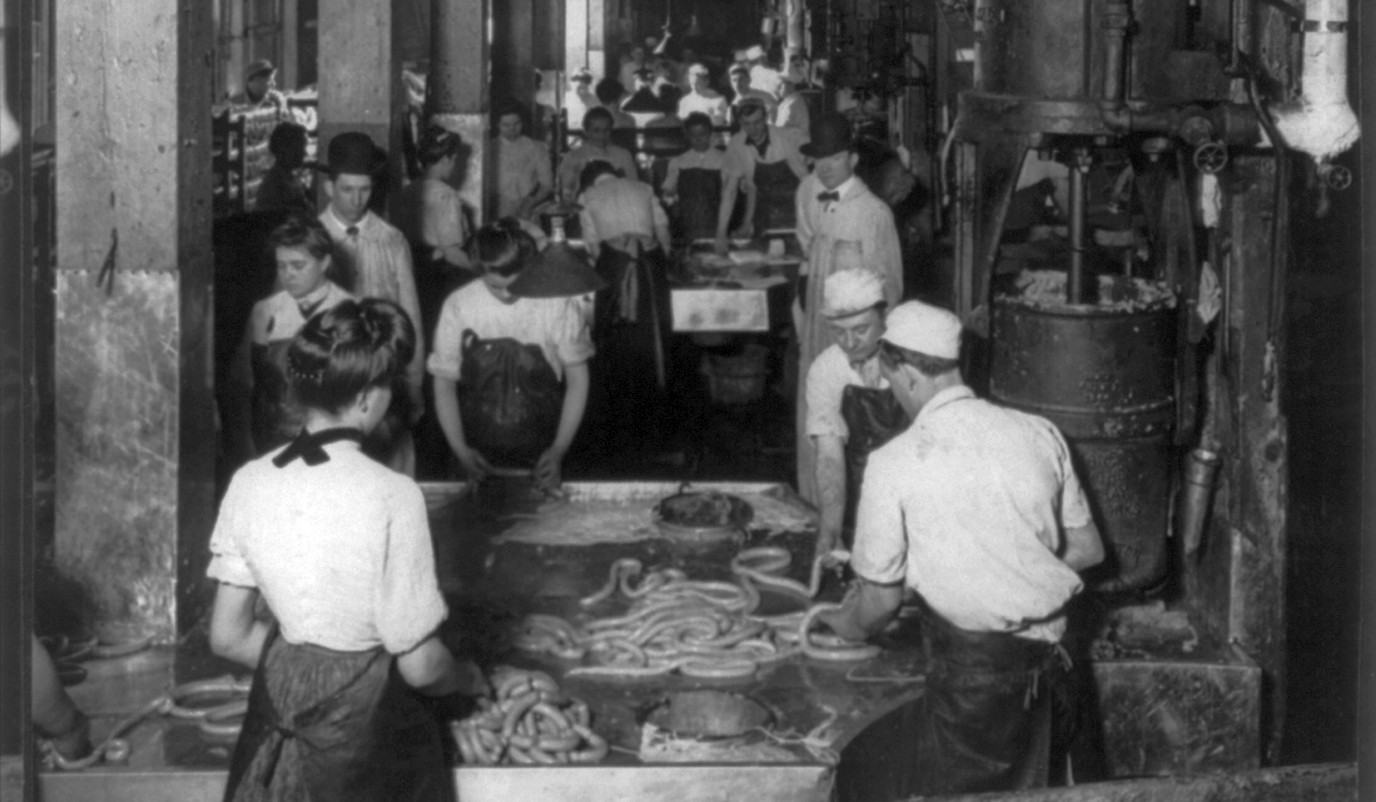
Internal C.P. report on the difficulties in bringing forces to bear, concentration, in the mammoth Chicago meat-packing industry.
‘Concentration in the Chicago Stockyards’ by A Woman Packing-House Worker from Party Organizer. Vol 7 No. 5-6 May-June, 1934.
I WOULD like to give a picture of just what we have in the stockyards in Chicago so that the comrades will not get the impression that it is just a large factory. The stockyards are located in one concentrated territory. The stockyards surrounded by a large fence form Packinghouse Town which is controlled by three large trusts: Armour, Wilson, and Swifts. 40,000 Negro, White and Mexican workers are employed there and wield tremendous influence in the city.
We find, realizing the importance of the stockyards, that the A. F. of L. and an independent union, the Stockyard Labor Council, have been making every effort to get the workers under their leadership. The A.F. of L. has already organized under its leadership the stock handlers and the butchers. In the smaller shops the stockyard Labor Council has 100% organization. The status of our union is very weak. In connection with this industry, there is an article in the April Party Organizer by comrade Bill Gebert, our district organizer, in which he discussed in detail the question of the three unions and the unity conference that is being developed. This article should be read in order to understand the situation in this industry.
As far as our methods of concentration are concerned, they have been very general, with very little work accomplished. Concentration has been more or less a question of coming down to the stockyards and selling the Young Workers, distributing a leaflet, etc., not realizing that the territory around there, the blocks where our comrades live, and our unions are, is where the comrades should carry on work, amongst the yards workers.
In the stockyard industry, there is a trend towards drawing in women, to replace men, paying them lower wages, women being paid 37 1/2 cents an hour and men 42c¢ an hour and up. Women are being drawn into this industry because they are preparing them to take the place of the men in the event of war. Therefore, we agree with Comrade Browder’s report that special emphasis must be placed upon the question of developing women into leadership of our movement, and drawing women workers into our movement.
The main problem at the present time that faces our union and our movement inside the yards is the development of systematic work for department nuclei and department groups. The only way in which these can be built is on the basis of the particular grievances of the workers in each department. In the stockyards, we have three major grievances. The terrific speed up being the major grievance. In one department two lines ran 700 hogs an hour with four girls doing the labelling. Now 500 hogs are run and one girl does the labelling. This speed up is characteristic of every department resulting in many accidents. As a matter of fact most workers go once every three months to the doctor, Another grievance is the wet floors and stairs that result in accidents to the workers.
In this connection when we discussed the question of special youth demands, we did not consider the question of these major grievances but were looking for something special. However, we found out that any grievance that affects young workers, is a youth demand, while affecting adult workers, also.
Our nucleus also had a bad outlook stressing more the importance of outside work and belly-aching about lack of section concentration. In my department, we succeeded in getting together a group of girls who discussed the question of sticking together, and formed an action group as a result of which we dominated the entire floor. Grievances arose to which the entire group reacted, and we were able to win various demands, such as rest periods, etc. I developed a deep, personal friendship with one of the girls and came in contact, thru her, with workers from another strategic department of the industry. In this other department thru personal contact, we succeeded in putting up a fight for a half hour rest period. This shows how thru personal contact we are able to carry on work. Thru this personal contact also we built another definite group in that department.
One of the weaknesses in my work was the failure to raise the political consciousness through consistent studying, etc. of the workers and actually recruiting them into the Y.C.L. and Party and more into the union. This is a serious weakness of many of our shop workers at the present time.
One of the major problems is the Negro question. The stockyards is the center of white chauvinism in Chicago. In 1919 the bosses utilized the Negro workers to break the strike which resulted in race riots. The company is doing everything possible to maintain this race hatred. If it is known that white and Negro workers associate together, they are immediately fired and blacklisted from the yards. Inside the yard, there is a tremendous discrimination, with Negro workers working in the worst possible jobs. In the offal department which is one of the dirtiest, wettest departments, where the guts are cut, only Negroes are employed. In the sliced bacon, one of the clean departments, only white workers are employed. However thru our work, we did succeed, thru our actions and thru many discussions with the workers, in breaking down chauvinism to such an extent that we established social relationships between the Negro and white girls inside the dept. and after work in the homes.
There is another weakness of the Party District I would like to name that is the fact that the Party has absolutely failed to give the Y.C.L. Nucleus real guidance. Our unit has no Party rep attending meetings, the Party doesn’t have discussions with us and take up our problems. The Party District has never taken up the question of the Y.C.L. unit and has no discussion with us personally on our work, ‘This is something the Party must change. In closing I would like to say the following: We realize that we’ve got to increase our tempo so we will be able to lead the coming strike struggles. We’ve decided therefore to make a challenge, and we have a basis to fulfill it, that we challenge the Pittsburgh packing, house Y.C.L. to establish 2 department nuclei by the time of the National Convention of the Y.C.L., June 15.
The Party Organizer was the internal bulletin of the Communist Party published by its Central Committee beginning in 1927. First published irregularly, than bi-monthly, and then monthly, the Organizer was primarily meant for the Party’s unit, district, and shop organizers. The Organizer offers a much different view of the CP than the Daily Worker, including a much higher proportion of women writers than almost any other CP publication. Its pages are often full of the mundane problems of Party organizing, complaints about resources, debates over policy and personalities, as well as official numbers and information on Party campaigns, locals, organizations, and periodicals making the Party Organizer an important resource for the study and understanding of the Party in its most important years.
PDF of issue: https://archive.org/download/party-organizer_may-june-1934_7_5-6/party-organizer_may-june-1934_7_5-6.pdf
 Revolution's Newsstand