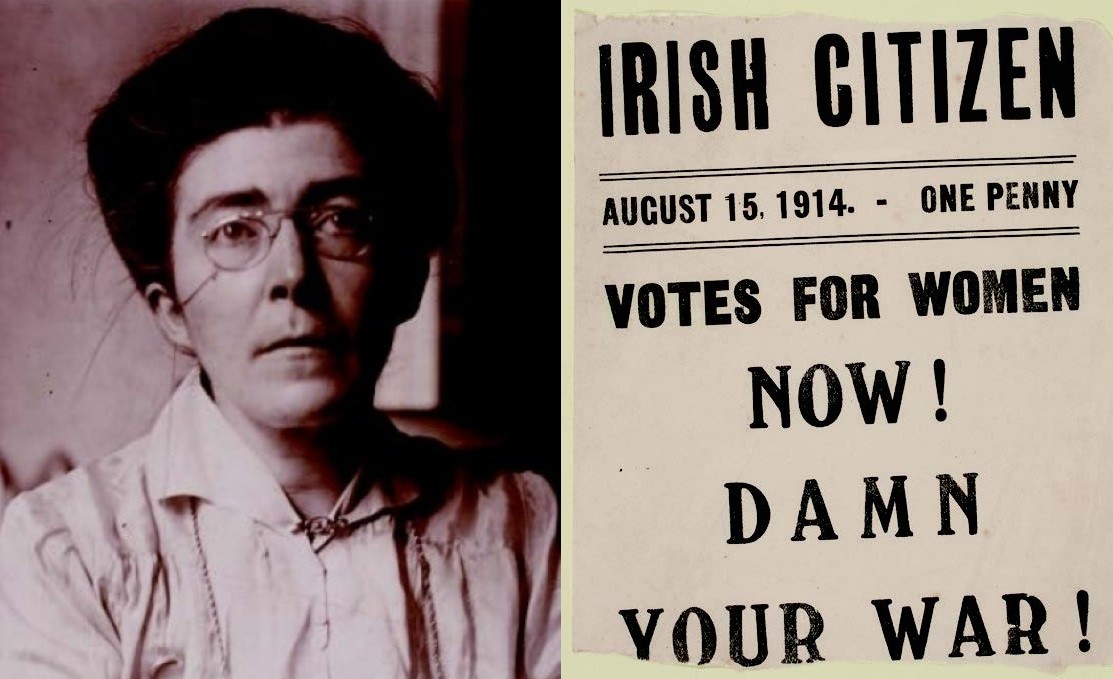
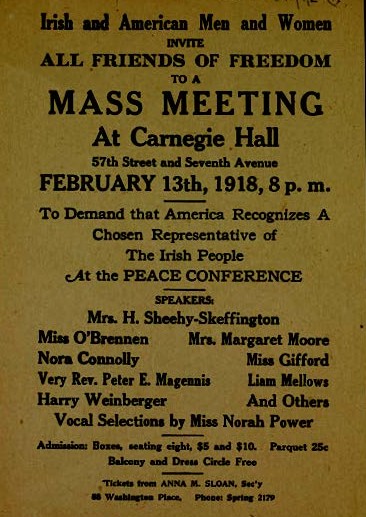
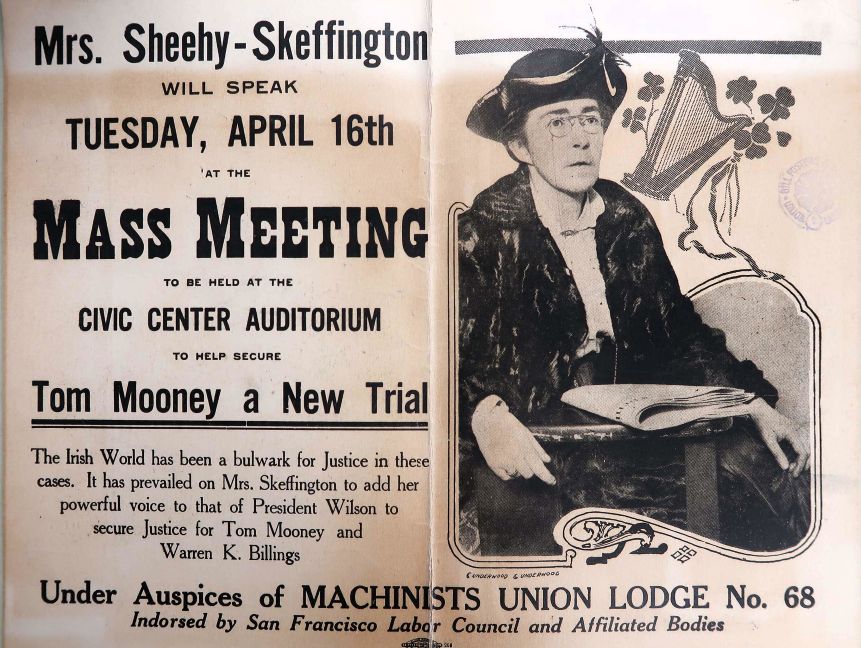
Hanna Sheehy Skeffington writes on Sinn Fein’s historic victory in Ireland’s December 14, 1918 elections, taking 73 of 105 Irish constituencies in the British parliament. Refusing their seats, they created Ireland’s revolutionary Dail Eireann on January 21, 1919 and the War of Independence began. Skeffington was a Socialist, feminist, and Irish Republican, she was also the wife of Francis Sheehy Skeffington, summarily executed by the British Army during the 1916 Easter Rising. Touring the United States a number of times, she was well-known in radical circles here.
‘Ireland and the British Elections’ by Hanna Sheehy Skeffington from The Liberator. Vol. 2 No. 3. March, 1919.
THAT the “Mother of Parliaments,” as the British House of Commons describes itself, is moribund is the outstanding feature of the recent general election. It was a “snap” election purposely hastened on by Lloyd George in the hope (which has been realized) that he and his party would be triumphantly returned. The old House having sat long beyond its appointed time, its life prolonged artificially as a war measure” had become hopelessly unrepresentative and fossilized. Lloyd George seized the happy moment of the armistice followed by “victory” jubilations to rush the election. His election platform was simple to baldness–” Hang the Kaiser,” “Make the Germans Pay” and “Rapid Demobilization.”
The Coalition romped home with an enormous majority. How can it be explained? The franchise had been considerably widened, extended to most men of twenty-one and to women over thirty. The franchise is still based on property in Great Britain, one of the many remnants of feudalism still surviving in that country. For the first time absent voters were allowed to vote, the soldiers and sailors on active service being accorded the privilege, while C.O’s were disfranchised. But the privilege was rendered nugatory in most cases by red tape and official chicanery. A very small percentage of soldiers and sailors used their votes, there being a general feeling of resentment among them at the “rushed ” election. Many of them, owing to change of quarters, did not receive their voting papers in time to record their vote. In many cases the soldiers received merely the paper with the names of the candidates without any guidance in the form of election addresses or literature as to who was who, while in many cases there was strong canvassing from the superior officers who put pressure on the men to vote Coalition. Result, indifference or hostility. Many soldiers refrained from voting, many deliberately spoiled the ballot-paper by writing across it we want to go home or some such device, while many elected their candidate for some entirely flippant reason, regarding the whole thing as a huge game–and perhaps they were not far wrong. One major, to my knowledge, voted for a candidate called “Kelly” because he “knew several decent fellows called Kelly.”
It is estimated that only about sixty per cent of the entire voters recorded their vote. Never was such a Never was such a “quiet” election. It might be described in Britain as a sullen affair. The women voters, however, seem to have exercised the new franchise pretty thoroughly–in fact, this has been called a woman’s election. In most constituencies women were nearly thirty per cent of the electorate, while in Irish constituencies they were usually even more, reaching often fifty per cent. In Ireland there is a much larger average of women than men. In all cases women were eager to exercise their new privilege. Lloyd George bid openly for their favor and possibly many supported him under the mistaken impression that he was mainly responsible for the granting of the vote to them. The fact of the age limit, restricting women voters to thirty probably helped the Coalition, for older women, like older men, are more usually conservative in habit of mind. In Britain the women seem certainly (from whatever reason) to favor Coalition, while in Ireland they are predominantly Sinn Fein. Had the younger women possessed the vote in Ireland on the same basis as the younger men did Sinn Fein would have won still more seats–possibly eighty, instead of seventy-three–and would in all cases have greatly increased Sinn Fein majorities. If, as the French say, “ce qui femme veut Dieu veut” holds good it seems evident that Providence in Britain is Coalition, while Providence in Ireland favors an independent Republic.
Nothing can more clearly show the inherent differences between the two peoples than the result of this election which swings Britain to reaction and Toryism and Ireland to the opposite extreme, the subversion of constitutionalism. Ireland is more unanimous for Sinn Fein and a Republic than Britain is for Lloyd George and a dictatorship. And the largest party elected to the British Parliament after the Coalition is Sinn Fein, so that, as a wag has humorously put it, if the Coalition loses the confidence of the country the King will have to ask Mr. De Valera, the Sinn Fein leader, to form a ministry, as the head of the largest opposition party is expected by parliamentary procedure to do in case the government fails.
The House of Commons when it meets (probably in the end of February) will be shorn of many of its historic figures, the casualties on all sides being enormous. John Dillon and Tim Healy go into exile (the one involuntary, the other voluntary), with Liberals of the older school (most of them former cabinet ministers), such as Mr. Asquith, Sir John Simon, Mr. McKenna, Mr. Runciman, Mr. Masterman, labor leaders such as Mr. Henderson, independents and pacifists (I.L.P.) like Philip Snowden, Ramsay McDonald, George Lansbury (editor of the Herald), Brailsford (author of “Steel and Gold “), Joseph King, the champion “questioner.” Sixteen women candidates, many of the most notable women of the hour, ran–Mrs. Despard, the veteran Socialist and feminist, Christabel Pankhurst, Mrs. Pethick Lawrence, Mary MacArthur, but all were defeated. The only woman returned is the “rebel Countess,” Constance de Marcievicz, the Sinn Fein leader, who fought under James Connolly in Easter week and who was condemned to be shot but given penal servitude instead. Constance Marcievicz, M.P., is now in Holloway Jail.
One thing is certain through all these changes and uncertainties and that is that English Liberalism which under Gladstone and Campbell-Bannerman played a not unworthy role in the past is forever gone and, as far as the present generation is concerned, it is unlamented, for it lost by its abandonment of its own principles. And its chief executioner is Mr. Lloyd George, who is mainly responsible for its undermining and subsequent downfall.
The general result of this election will be to divert progressives from thoughts of political to thoughts of industrial or direct action. Already there are signs that organized labor may yet exercise a veto more absolute than that of the House of Lords, “the weapon of the general strike.” People have discovered quick remedies and short-cuts during the war, and the demobilized soldier on his return will be apt to become impatient of Parliamentary tactics.
In fact signs are not wanting that Mr. Lloyd George may find his overwhelming majority an unwieldy white elephant, that his triumph is nominal rather than real and not like to be enduring. The extreme Tory wing will sway the councils of the government overmuch. It is probably owing to this consciousness that the opening of Parliament is being delayed on various pretexts.
But the chief lesson of the General Election is that Ireland has put her case for self-determination and has declared with a huge majority in favor of that principle, a principle to assert which the United States entered the war. This was the one issue on which the election was fought in Ireland, whether or not Ireland desired to remain within the British Empire. The noes have it. Even the province of Ulster has returned a majority in favor of self-determination. There is, in fact, a much larger minority against self-determination in Bohemia (thirty-five per cent) than in Ireland. In Alsace-Lorraine, out of 19,000,000, 350,000 represent the Teutonic minority. In Bosnia there is a powerful Mahommedan section numbering over one-third of the entire population. In Russian Poland there is but sixty-four per cent of Poles. Ireland with her seventy per cent Sinn Fein has therefore a stronger case for self-determination than any of these small nations.
Of the newly-elected Sinn Fein members forty are in English or Irish jails, mostly without trial, while about a dozen more are on the run,” wanted on various “sedition” charges. Two were arrested since election, Cathal Brugha, M.P. for Tipperary, for giving his name in Irish to the police, and Mr. William Sears, Mayo editor of the Enniscorthy Echo, “for an inflammatory” speech. The Sinn Fein election director was arrested in the middle of the election campaign and interned (without charge) in England, Sinn Fein election addresses and literature were seized by the police during the campaign, meetings to select candidates were in some cases dispersed by the police as “illegal assemblies,” and Sinn Fein funerals have also recently been declared “illegal assemblies by the authorities, while the whistling of certain airs has also caused arrests and people have even been taken up for “seditious dancing and illegal “fishing in prohibited areas.’ West Cork has been declared a prohibited area” and it is still necessary to obtain a passport to enter any part of it. Above six hundred men and women of all classes and creeds (countesses, university professors, shopkeepers, farmers, schoolboy scouts, ballad-singers, musicians, cartoonists, lawyers, poets, stonecutters, farmers, shop-girls, editors, printers) have been arrested and held on various charges. Recently Australian and Colonial soldiers have been put under arrest by the military police for wearing Sinn Fein badges, the jails through the country are full to overflowing, and in Belfast recently complaints were made that the ordinary criminals were being overcrowded owing to the inrush of ” politicals.” At Christmas under the leadership of Austin Stack, M.P. for Kerry, the “politicals” as a protest against the ill-treatment of one of their number, Sean Dolan, M.A., took possession of one entire wing of the prison and held up the authorities for several days until certain demands were conceded by the government. On Jan. 5th, “Prisoners’ Sunday” was celebrated throughout Ireland, over 300 meetings being held for the purpose of calling attention to the continued detention in prison of Sinn Feiners and to demand their release. Many have now been held in custody since May last.
In general once again the recent elections have shown that Ireland on social and economic questions is far ahead of Great Britain–as far ahead as both countries are behind the rest of Europe. In fact Ireland would certainly make a much better hand at governing Great Britain than Great Britain can ever make at governing Ireland. In many reforms Ireland has already led the way. Ireland disestablished the church fifty years ago while Britain talks about doing it–sometime. Ireland abolished her feudal landlord system many years ago after a fierce agrarian agitation and is now free of the “squire-and-parson” incubus that Britain still grumbles The Irish University system is more democratic than the British, especially where women are concerned. British women, denied forty years ago medical degrees and training in their own country, had both freely granted by the Dublin college, and today the women still barred out from degrees in Oxford and Cambridge have those conferred on them by the Dublin University. Ireland recently defeated the threat of conscription by a one-day strike when everyone downed tools throughout the land, and thus gave an object lesson to the rest of the world as to how militarism could be successfully resisted without resort to bloodshed or violence. And when, in 1916, Ireland proclaimed her republic she was the first nation to establish by public proclamation absolute equality in citizenship to women and to men on the same basis. Since then Russia appears to have followed her example, but the democracies of Great Britain and the United States have not yet democratized themselves thus far. And now Ireland is the first to perceive the futility of Parliamentarianism by pledging her Sinn Fein members to a policy of abstention or strike, a policy which may ere long be taken up by other progressive parties. As a witty Irish writer puts it, just as Parnell and his followers helped to shake “the House” by attending it and obstructing business, so the new Sinn Fein party may help to “bring down the House”–by abstention. Most prophets give Lloyd George’s Parliament from six months to a year of life. And after that–who knows?
The Liberator was published monthly from 1918, first established by Max Eastman and his sister Crystal Eastman continuing The Masses, was shut down by the US Government during World War One. Like The Masses, The Liberator contained some of the best radical journalism of its, or any, day. It combined political coverage with the arts, culture, and a commitment to revolutionary politics. Increasingly, The Liberator oriented to the Communist movement and by late 1922 was a de facto publication of the Party. In 1924, The Liberator merged with Labor Herald and Soviet Russia Pictorial into Workers Monthly. An essential magazine of the US left.
PDF of full issue: https://www.marxists.org/history/usa/culture/pubs/liberator/1919/03/v2n03-w36-mar-1919-liberator-hr.pdf
 Revolution's Newsstand