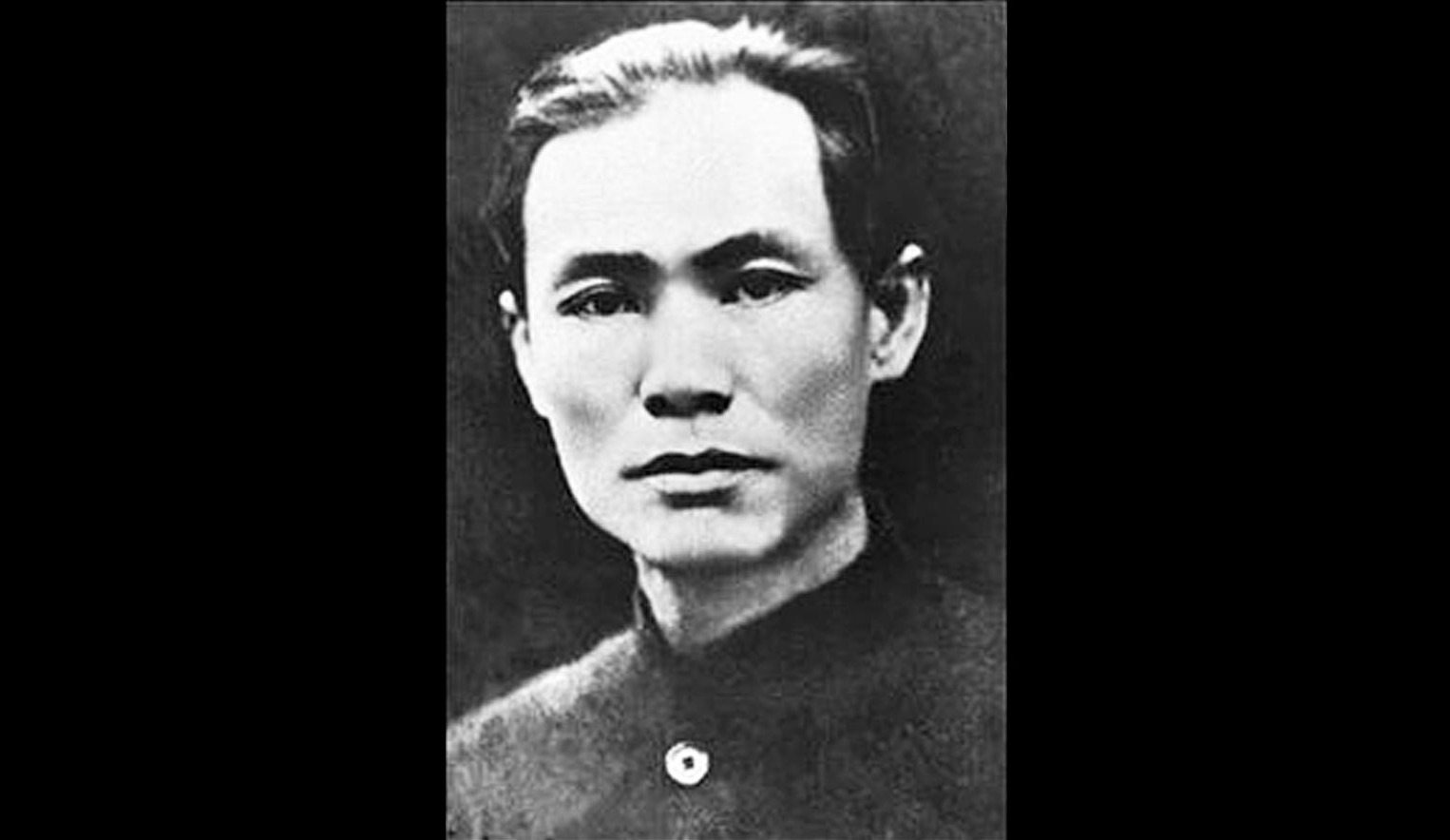
Born to a poor peasant family in 1885 Su Zhaozheng would become a sailor out of Hong Kong, found and lead the Seaman’s union through the 1922 Seaman’s strike and the 1925 General Strike to become Chair of All-China Federation of Trade Unions. A leading Communist he was elected, in his absence, as the Chair of the ‘Canton Commune.’ Harrison George recounts the life of his comrade in the Pan-Pacific Trade Union Secretariat who died of appendicitis on February 5, 1929.
‘Sou Chou-jen (Su Zhaozheng–蘇兆征)’ by Harrison George from The Daily Worker. Vol. 8 No. 304. December 19, 1931.
Chairman of the Canton Soviet, the first workers’ commune in the Far East, Sou Chou-jen, symbolized in his own person the revolutionary soul of the oppressed hundreds of millions of Asia.
I met Comrade Sou first at Hankow, in 1927, at the sessions of the Pan-Pacific Trade Union Congress, when Hankow was besieged with a ring of white armies under Chiang Kai-shek and Feng Yu-hriang, and its “redness” already visibly fading with inner treachery at the hands of the polished scoundrel, Wang Chin-Wei.
Sou was then Minister of Labor in the “left” Kuomintang government. And an unpleasant job it was, with continual intrigue of Wang Ching-Wei and the reactionary military leaders undermining the labor program they publicly had to pretend to support, and Sou continually having to clash with the “right wing” Communist leadership that consented to all the stealing away of the rights of the masses—particularly the disarming of the “Red pickets.”
These “Red pickets” were the guardians of the revolution. Gaunt from their lives of starvation, they kept revolutionary order. And woe to the factory owner who refused to obey the conditions set by the workers and legalized by the “labor code” written by Sou Chou-jen.
“The Red pickets” would gather up Mr. Owner and take him to the jail provided by the trade unions and let him sweat there until he decided to shorten the hours and lengthen the pay as per the “labor code.”
It was against the Communists, with their “labor code” and the “Red pickets” that the reaction finally unloosed the most ghastly terror. But Sou loved the “Red pickets” as would any revolutionary. Clothed in their poor rags of blue denim, these workers from the docks and factories, defied the imperialist might of the 54 warships of all sizes and all nations laying at anchor with their frowning guns facing the city, and calmly went about their business with belts of cartridges swung round their shoulders and heavy Mausers strapped to their sides.
Such was Hankow before it “turned white” and the blood of these heroic workers ran like water as the Kuomintang butchers took vengeance.
But the executioner’s knife never got Comrade Suo Chou-jen. Warned and secreted by the workers, his life was saved as it was saved a hundred times before and afterward. As it was saved earlier, in March that year, when Canton “went White” and thousands were executed by Chiang Kai-shek’s local general Li Chi-sen. Canton was Comrade Sou’s home, if a seaman who had twenty years sailing can be said to have a home. In Canton Comrade Sou had his first experiences of class struggle. And in Canton and British Hong Kong he had organized the most historic strike of Asiatic history in 1925, a strike that tied up the two great seaports of the East and brought the haughty British to their knees.
Canton was the nerve center of the Chinese revolution, and Sou Chou-jen was its leading spirit. Tireless, modest and brave beyond all reckoning, Comrade Sou led the masses to victory after victory in the two years the strike lasted. Under his leadership the trade unions flourished and the Communist Party rooted itself deep into the hearts of the masses.
What more natural, then, than that—when the Canton workers in December 1927 rose in arms and elected the first Soviet on the shores of the Pacific, they elected Comrade Sou Chao-jen as the chairman or the president of that Soviet, though he was a thousand miles away in Hankow.
Comrade Sou was then risking his life every moment for the Communist Party of China, building up the the Party in the Yangtze Valley, quietly going from Hankow to Shanghai and back, fighting the opportunist elements and building the Party which was later to raise the red flag of a Soviet China over 80,000,000 people in Central China.
Not a moment in that work was Comrade Sou free from the threat of death at the hands of Chiang Kai-shek’s beheaders, as he traveled with a prize of $50,000 gold on his head.
Hundreds of simple workers have been tortured to death to force them to reveal Sou’s whereabouts. But not one ever uttered a work of betrayal, not even when their flesh was being cut off in pieces from their living bodies! Such was the love and loyalty inspired by Sou Chao-jen, head of the Canton Commune!
Sou continued his work. More, he took the still greater risk of worming his way through the Imperialist bloodhounds circling the Soviet border, and got to Moscow in. March 1928 to attend the Fourth Congress of the Red International of Labor Unions and, later, the sixth Congress of the Communist International.
But the privations and hardships had told. Comrade Sou was frail and ill.
While he recovered somewhat during his stay as guest of the Soviet workers, he returned too soon to duty in China, and there, under the hardships of illegal work, he died of appendicitis early in 1929.
Comrade Sou was a real leader, pushed up by the millions of toilers of the Far East in their struggle for freedom. He was their leader, but he belongs in the great heart of the international proletariat. Beside him. Gandhi is an insect, sniveling and posing before the imperialist overlords.
Unlike Sun Yat-sen, the bourgeois Nationalist, Sou avoided personal fame. Comrade Sou was no “noisy” revolutionist. Except when addressing an audience, his voice was rarely raised above a tone of low conversation. He was modest, yet daring. But he never swerved from duty, and in opposing wrong policies he was firm and full of fire. A real leader!
This was the chairman of the first Soviet in the Far East, the Canton Commune! And though he is dead, yet the soul of his courage and the heart of his class loyalty lives on and forever! It lives in the Red Army of Soviet China, now the only force rallying the million masses in the fight not only against the Japanese seizure of Manchuria, but against all imperialisms now trying to dismember the whole nation! And upon the red banner of victory there will be inscribed together the story of the Canton Commune.
The Daily Worker began in 1924 and was published in New York City by the Communist Party US and its predecessor organizations. Among the most long-lasting and important left publications in US history, it had a circulation of 35,000 at its peak. The Daily Worker came from The Ohio Socialist, published by the Left Wing-dominated Socialist Party of Ohio in Cleveland from 1917 to November 1919, when it became became The Toiler, paper of the Communist Labor Party. In December 1921 the above-ground Workers Party of America merged the Toiler with the paper Workers Council to found The Worker, which became The Daily Worker beginning January 13, 1924. National and City (New York and environs) editions exist.
PDF of full issue: https://www.marxists.org/history/usa/pubs/dailyworker/1931/v08-n304-NY-dec-19-1931-DW-LOC.pdf
 Revolution's Newsstand