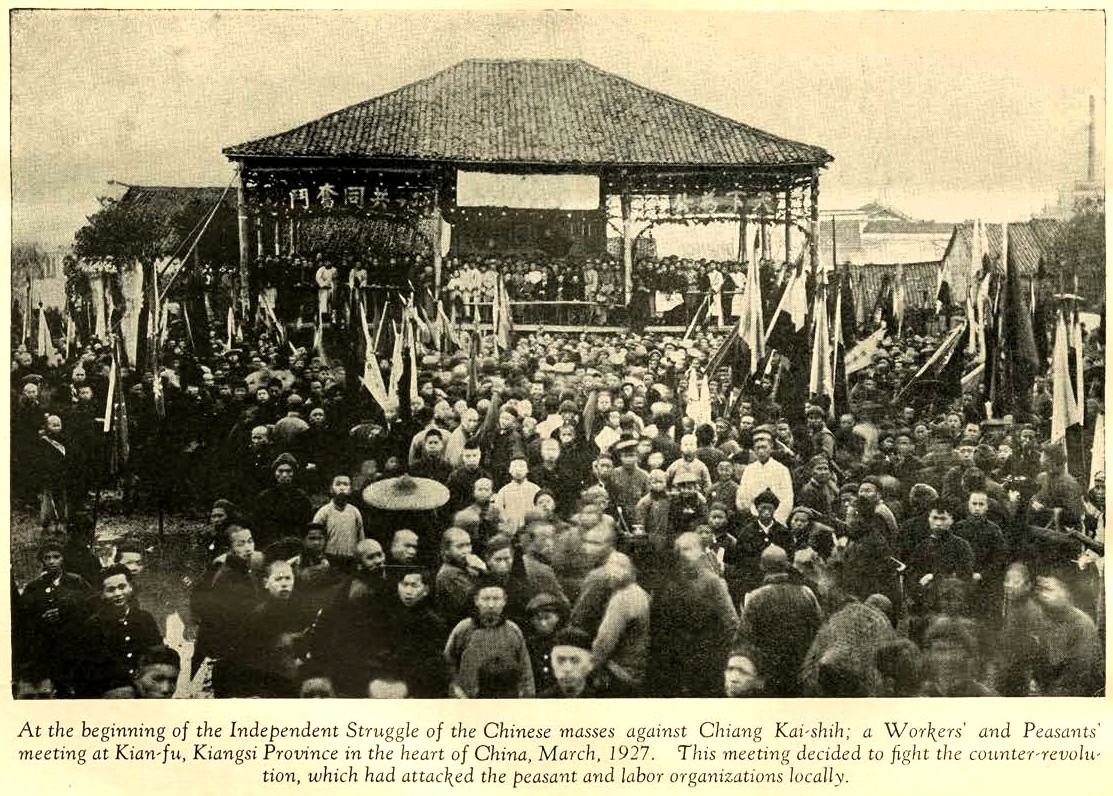
Co-report to Alexander Lozovsky’s given by Ting Tai-Yeh at the Profintern’s Pan-Pacific Trade Union Conference held in Vladivostok in August, 1929 looking at the role of inter-imperialist rivalries in dismembering China.
‘The Struggle Against War and Imperialism’ by Ting Tai-Yeh from Pan-Pacific Monthly. No. 33. December, 1929-January, 1930.
COMRADE Losovsky in his speech fully describes the perspectives of a new war in the Pacific Ocean and discussed in great detail the tasks confronting the revolutionary trade unions in the countries of the Pacific. I shall therefore only dwell on the role which China will play in the war on the Pacific Ocean; and most of all I shall discuss the question relating to the conflict on the Chinese Eastern Railway.
Before the war the chief competitors for supremacy in China, were Czarist Russia, Germany, France, England, Japan and the United States. But now, after the world war, the main competitors are U.S.A., Japan and England; as you know, China has tremendous sources of raw material as well as a great reservoir of cheap labor and it is for that reason that the imperialists are fighting for supremacy in China.
England has penetrated China before any other power. Along the Pacific coast England has built her ports and sphere of influence and is at present straining all its efforts to maintain its privileges in China. Japan also established its domination in Southern Manchuria, and is also doing all in her power to retain her supremacy. The United States entered China at a time when the country was already divided amongst the great imperialist powers; but the United States as the strongest imperialist power, is not only seeking markets for its products but also markets for investments of capital. It is for this reason that the United States is striving to penetrate China. As is well known, the United States already established its economic influence in South America, Canada, Australia and other countries. But the United States is not satisfied with these achievements.
In order to establish its supremacy in China the United States must defeat its competitors, Japan and England outside China. But this question cannot be solved in a peaceful way, it can only be solved by the means of war.
There is an opinion in existence that the United States is helping the Chinese nationalist bourgeoisie to carry out the industrialization of the country. This opinion is a mistaken one; anyone that says this does not understand the real significance of imperialist politics and particularly the policy of the United States. We could cite many examples showing that the imperialists of the United States are also robing and enslaving the colonial nations no less than the imperialists of any other country. The Philippine Islands and many other islands belonging to the United States are in fact colonies which do not differ from the English colonies and the colonies of Japan. We know very well that the American bourgeoisie, far from being anxious to industrialize China, is interested in procuring raw materials for the industries of the United States. The American bourgeoisie wants markets for its industrial products as well as markets to invest its capital. When the American imperialists do in exceptional cases permit some industrialization in the colonies, this is done entirely for its own interests.
Comrades, American imperialists are fully aware of the fact that they can penetrate in China only by means of war. This they never forget. In recent years there were many rumors spread that the Americans will give loans to China. The American government is now paying very much attention to the Nanking militarists. Through that recently some agreements were completed which showed that the United States in the near future will give some loans to the Chinese government, but what will these loans go for?
The American imperialists have already mapped out their plans. They will build radio stations in Shanghai and other cities. They will build roads, aeroplane factories, etc. But can we call this industrialization? Of course not. The American are doing this in order to prepare military bases on the shores of the Pacific Ocean for future wars. At present it is true these institutions are of a commercial character, but we know very well that at any given moment all these institutions can be put on a military basis.
At present the competition between England and the United States is the most important problem in world politics. But this, comrades, does not in the least diminish the significance of the rivalry between England and Japan. The American imperialists at present are not satisfied with the military agreement concluded between England and Japan. You know, comrades, that at the Washington Conference (1922) the United States forced Japan and England to give up its military agreement concluded in 1902, and the United States is uneasy about the renewal of this agreement. This is why the United States besides establishing its military bases in the Philippine Islands and other places on the Pacific, is also trying to build new military bases in China, in order to be able to successfully fight England and Japan. As far as Japan is concerned, she possesses a whole series of islands in the Pacific Ocean as well as an excellent military base in China and Formosa.
England is the oldest imperialist power and possesses military bases in the East, beginning from the Mediterranean Sea through the Red Sea and as far as Hong-Kong, but she is not satisfied even with that. She wants to establish a further military base in China. This is clear from the agreement concluded by England with the Nanking government, which shows that England will prepare officers for the fleet as well as increase the armies in the Pacific.
Such, in brief, is the situation on the Pacific and the preparations of the great powers for a new clash. Remember the words of Lenin, who stated that as soon as the military power of the United States will surpass that of England, then we will have a new war, and this analysis of the great teacher will soon be realized. An American. naval officer of high rank only recently in a speech in New York declared that the United States is preparing for a war against England. But, comrades, we must also remember that this war is being prepared not only in order that the imperialists should fight among themselves, but also to fight the Soviet Union, to fight the emancipation of the colonial and semi-colonial countries. The imperialists recognize that the mere existence and development of the Soviet Union is a menace to the capitalist system of exploitation. They know very well the organic connection which exists between the militant republics of labor and the revolutionary movement in the colonial and semi-colonial countries.
The imperialists in carrying out their plans will use the feudal landlords and the national bourgeoisie of the colonial and semi-colonial countries. We know very well that the militarists in China were helped by the imperialists and that until the present time England is supporting the patriarchal system in India. The great emancipation movement in the Eastern nations endangered the imperialist power, particularly the great revolution in China in the years 1925-1927.
Since that time the imperialists attempted to break the united front of the national bourgeoisie. The national bourgeoisie has at present passed into the camp of the counter-revolutionaries. Since that time the national bourgeoisie cannot play any longer a revolutionary role. She has become the tool in the hands of the imperialists against the revolutionary movement. The present conflict on the Chinese Eastern Railway is a provocation against the Soviet Union by the Nanking militarists, while carrying out the instructions of the imperialist powers.
We know full well that without the help of the imperialists the Nanking militarists would never dare to attack the Soviet Union. We have in China a continual war between the militarists.
Some people think that the war between the Nanking government and the Kwangsi clique is a fight between the bourgeoisie and the feudal nobles. This is not so. This fight is a reflection of the struggle between England and the United States, which is now going on in China. Chiang Kai-shek is the tool of American imperialism, while the Kwangsi clique is the tool of British imperialism. Chiang Kai-shek represents the big trading capitalists in the ports. He is therefore in great need of a united Chinese market. The Kwangsi clique represents the smaller traders and the feudals who are interested mainly in the local markets. Besides this fight corresponds with the fight between the clash of English and American interests. America is pressing for the positions gained by England, while England is counter-attacking. When the war between the Nanking and Kwangsi cliques ended it did not mean the unification of the country. The present period in China is very similar to the period of nine or ten years ago between the period when the first war ended another one will begin. As far as the conflict on the Chinese Eastern Railway is concerned, we pointed out already that it is nothing more nor less than a provocation of the Chinese militarists acting on behalf of the Great Powers. On this question I would like to point out that France is very much interested in this railway, is no less than any other power interested that the railway should not be controlled by the Soviet Government. We know very well that French capital was invested in these railways. Japan also wants to gain the control of the railway because she has great interests thru Manchuria, which she wants to spread to Northern Manchuria. England, the oldest organizer of anti-Soviet attacks, is, of course, ready at any time and in any place to organize an attack against the Soviet Union. She also wants to use this railway in the fight against the Soviet Union. It also concerns America, for she is very anxious to use this railway in her fight against the Soviet Union, as well as against Japan.
We know very well that in Manchuria the United States plays an important role.
America is greatly interested to invest capital in Manchuria. She is planning to establish an international banking control over the Chinese Eastern Railway under the influence of the United States. We must also recall the other conflicts of world imperialism against the Soviet Union, such as the raiding of the Embassy in Nanking, Shanghai, the closing of the Far Eastern Bank, etc. All these are part and parcel of the anti-Soviet plan which the imperialists have been preparing for quite a long time.
Comrades, we want to declare from this platform that the present conflict on the Chinese Eastern Railway is not a conflict between the toiling masses of China and the Soviet Union. On the contrary, this conflict helps to strengthen the fraternal connection between the masses of these two countries. This conflict represents a struggle between a world imperialism, the Kuomintang and the whole counter-revolution, on the one hand, and the Soviet Union, the toiling masses of China and of the whole world on the other hand. This is a conflict between these two. great forces, the armies of revolution and counter-revolution. At present war has not been officially declared. The imperialists are using all their reactionary forces against the U.S.S.R. In case of war these reactionary forces will be used to a still greater extent and this will expose still more to the masses the role played by the national bourgeoisie, will show to the masses that it is no longer able to play any revolutionary role. Anyone who still has illusions about the national bourgeoisie can only be regarded as an opportunist against whom we must carry on a merciless fight.
What is the present condition of the worker and peasant organizations in the colonies? We must state that at present the condition of these organizations differs radically from that of five or six years ago. In 1922 the Seamen’s strike showed the strength of the Chinese workers. The Chinese peasantry has manifested its power only in 1926. At present the Chinese Revolution is not in the same state of upheaval, but it is gathering its forces. That this is so can be proved by the following figures. In 1928, a year after the reaction in China, 239,000 people participated in the strike movement in Shanghai and in 1929, as you know, the workers and peasants dissatisfaction was growing from day to day.
Last the agrarian population suffered year defeats in many districts, but in spite of this, in spite of the White Terror, the partisan movement in China is growing very fast. It is interesting to recall the following facts. The so-called Red Guard, which only two years ago had 2,000 people, has at present 30,000 soldiers who are lead by the Communists. This is a good illustration of the present development in China. As far as other countries of the Far East are concerned, you know that in Bombay and Calcutta the strike movement is growing from day to day. Thousands of workers are taking part in this movement. The hegemony of this movement in the colonial and semi-colonial countries belongs to the workers and peasants, who are the real driving force. Therefore, in order successfully to carry on our fight against imperialism we must devote the greatest attention possible to the organization of the workers and peasants.
Besides, we also know that where the workers’ organizations are strong, imperialism is weak. For example, during the Shanghai strike the strike committee ordered that in order to trade with Canton one must get the permission of the strike committee and the American, Japanese, French and other imperialists were forced to submit to this order. In Hankow we had the example when the workers captured the English Concession, in Changsha, when the American oil company refused to function during the revolution, the workers established their own control, and in Canton, where a Soviet power was established, all the imperialists were driven out. These examples show that only when we have a real organization of the workers and peasants can we drive out the imperialists from the colonies and semi-colonies, and this is why our first task in the fight against imperialism is the tasks of organizing the workers and peasants.
The workers and peasants organizations in the colonies and semi-colonies have their own special weaknesses as well as advantages. The advantages consisting that in the colonies reformism has no favorable economic base. for new development. This is why it is easy to achieve the radicalization of the masses. What is the weak point in the movement in the Eastern countries? It is that the industry is not developed and the number of workers is not great. This explains why peasant and petty bourgeois dispositions are prevalent in the workers and peasants organizations. Even though reformism has not a favorable base for the development in the colonies as it does have in America and Europe, still under the leadership of international reformism, it is a menace even for us in the colonies. Albert Thomas, this famous traitor of the working class only last year made a trip over China to persuade the workers to give up the principles of the class struggle. The Japanese reformists are attempting to organize a Pan-Pacific Conference of trade unions to counteract the activities of the Pan-Pacific Secretariat. This is why we must organize systematic campaigns to expose the treacherous role of the reformists in the colonies.
Comrades, the imperialists of all countries are preparing a new war, but the present world situation is different from that during the first war. During the first war, revolutions occurred in many countries in Europe which had not received any help from the colonial and semi-colonial countries. We had no such thing as an uprising in the colonial and semi-colonial countries. But at the present the situation is different. The radicalization of the masses in Western Europe and America is taking place at the same time when the revolutionary movement is growing in the colonies and semi-colonies.
Comrades, we enter the third period of post-war development. We must organize the workers and peasant masses. We must carry on a systematic campaign to expose the treacherous role of world reformism. We must prepare for a new revolutionary upheaval and for the establishment of the Soviet system the world over.
The Pan-Pacific Monthly was the official organ of the Pan-Pacific Trade Union Secretariat (PPTUS), a subdivision of the Red International of Labor Unions, or Profitern. Established first in China in May 1927, the PPTUS had to move its offices, and the production of the Monthly to San Francisco after the fall of the Shanghai Commune in 1927. Earl Browder was an early Secretary of tge PPTUS, having been in China during its establishment. Harrison George was the editor of the Monthly. Constituents of the PPTUC included the Australian Council of Trade Unions, the All-China Federation of Trade Unions, the Indonesian Labor Federation, the Japanese Trade Union Council, the National Minority Movement (UK Colonies), the Confédération Générale du Travail Unitaire (French Colonies), the Korean Workers and Peasants Federation, the Philippine Labor Congress, the National Confederation of Farm Laborers and Tenants of the Philippines, the All-Union Central Council of Trade Unions of the Soviet Union, and the Trade Union Educational League of the U.S. With only two international conferences, the second in 1929, the PPTUS never took off as a force capable of coordinating trade union activity in the Pacific Basis, as was its charge. However, despite its short run, the Monthly is an invaluable English-language resource on a crucial period in the Communist movement in the Pacific, the beginnings of the ‘Third Period.’
PDF of full issue: http://www.fau.digital.flvc.org/islandora/object/fau%3A32145/datastream/OBJ/download/The_Pan-Pacific_Monthly_No__33.pdf
 Revolution's Newsstand