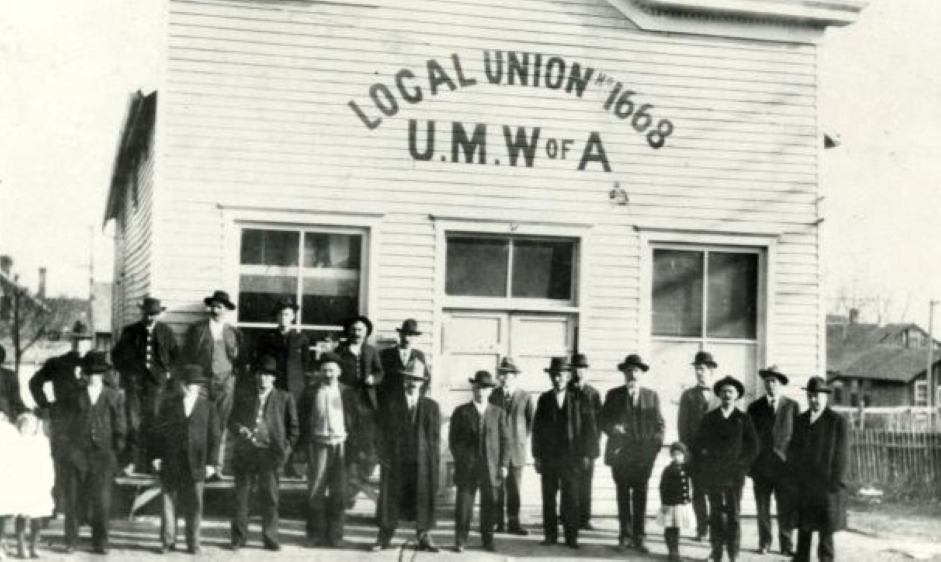
Reports of Flynn’s meetings in Denver and Louisville, Colorado.
‘Colorado Workers Hear Elizabeth Gurley Flynn’ by Pat Noonan from Solidarity. Vol. 6 No. 270. May 15, 1915.
Difference Between Craft And Industrial Union Action, Made Clear To Coal Miners
Denver, Colo., May 5. A fair-sized audience came to hear this most remarkable speaker at the East End Turner Hall, May 2, at 8 p.m. Miss Flynn’s subject was: “War; Can Labor be Neutral?” It was treated as that subject has not been presented in Denver before. The audience was more than satisfied after she had concluded, for they believed all had been said that could be said on this extensive subject. Socialist Party members were conspicuous by their, absence, evidently fearing that the economic truths uttered might be dangerous to their political sophistry. The meeting was a great lesson for political socialists.
Our audience was not as large as it might have been; this was mainly due to the conspiracy of silence. maintained by the press of this city. Only one, the Express, gave us any announcement. Members on the Post staff who appeared fair and willing to place their service at our disposal, found that the Chamber of Commerce, which to a great extent controls all news in Denver and Colorado objected to any announcement of the meeting. Yet, after the meeting was over, a lengthy write-up of the speaker came out in the front columns of this same Post. This more clearly the pressing necessity of organized labor–of the modern industrial type–owning their own press.
A literature sale of $5.50 and a collection was taken up to carry out the meeting at Louisville, Colo., In Louisville E.G. Flynn’s banner subject and speech reached the miners’ ears. And how appropriate: “Solidarity–Labor’s Road to Freedom.” The few who braved a bad night of rain and wind expressed their regret that the Louisville and Lafayette people did not know what a great lecture they had failed to hear. How powerful was her encouragement to the beaten miners. How she pictured the great Paterson strike; its failure and then compared the spirit of the workers in the two strikes. How the silk workers went back after five months of strenuous fighting, well aware that all that could be done to win the strike had been done by the I.W.W. and its representatives, and how that spirit carried itself to the mills; how the strike on the job (sabotage) was plainly visible and carried on effectively until better conditions were obtained by the silk workers. Then she pictured the sad condition of the coal miners in the Louisville district. After five years of fighting and suffering and hunger, they were driven back, not to the mines, as the union miners are black-listed, but to, defeat and oblivion, their jobs gone and themselves and families trying to exist on a path of ground with a shack on it. All the while, under the district contract system of the United Mine Workers the miners of Wyoming were working and supplying coal to the striking Colorado district.
Referring to the conviction of Executive Board Member John Lawson of the U.M.W.A., who was convicted of the murder of a gunman at Forbes, Colo., during the strike, she showed the hand of Big Business behind the courts of this capitalist-ruled nation; if J.R. Lawson was guilty of murder, J.D. Rockefeller was guilty of a thousand murders. The necessity of workers rising as one man over the entire world at this outrageous sentence was shown by the speaker, who also brought to the attention of her audience the cases of Ford and Suhr, Rangel and Cline, and others. The power to save these men from life imprisonment or death lay in the organization of the working class in such a manner that they can paralyze the production of the country and of the world if necessary. She urged them to regain confidence in their power, and to organize in the One Big Union, where no division of forces in struggles can exist. She pointed out that the entire miners’ organization, using A.F. of L tactics, will surely be broken to pieces; Colorado today, Illinois tomorrow, etc. That their hope lay in organizing solidly in the new modern movement of labor, the I.W.W., where no contract, system ties the workers’ hands forcing them to scab on one another; where no districts act alone, but the entire working class against the master class. With such an organization there will be no Ludlows, no five years of strike, and struggle, no gun-powder organizations–but Solidarity of the workers; Labor’s Road to Freedom.
The most widely read of I.W.W. newspapers, Solidarity was published by the Industrial Workers of the World from 1909 until 1917. First produced in New Castle, Pennsylvania, and born during the McKees Rocks strike, Solidarity later moved to Cleveland, Ohio until 1917 then spent its last months in Chicago. With a circulation of around 12,000 and a readership many times that, Solidarity was instrumental in defining the Wobbly world-view at the height of their influence in the working class. It was edited over its life by A.M. Stirton, H.A. Goff, Ben H. Williams, Ralph Chaplin who also provided much of the paper’s color, and others. Like nearly all the left press it fell victim to federal repression in 1917.
PDF of full issue: https://www.marxists.org/history/usa/pubs/solidarity-iww/1915/v06-w279-may-15-1915-solidarity.pdf
 Revolution's Newsstand