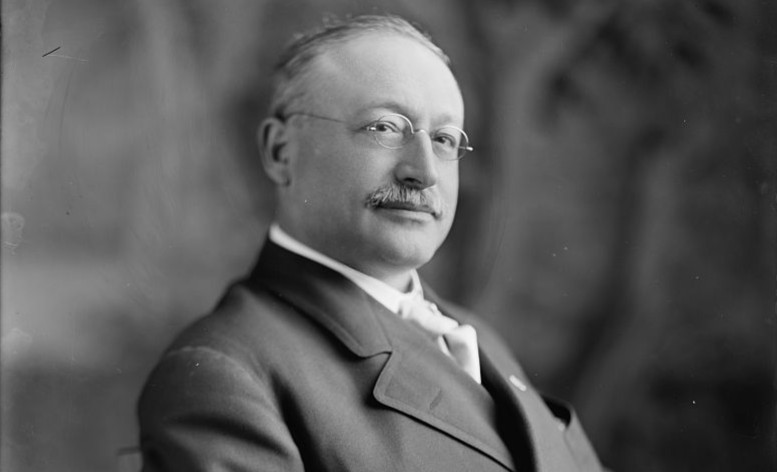
Bruce Rogers on the division between Debs the revolutionary and Berger the reformist over compensation to capitalists in a socialist transformation. Debs say take them. Berger says pay them.
‘Our Bourbon Socialism’ by Bruce Rogers from Industrial Worker. Vol. 2. No. 19. July 30, 1910.
Debs knew that Milwaukee had opposed him in the convention of 1908; opposed him by every trick and wire pulling of caucused chicanery and jockeying political barter; opposed everything he had stood for in the then-recent defense campaign of Moyer, Haywood, and Pettibone.
Most of us regarded the series of tragic events in the Rocky Mountains as a siege, a give-and-take warfare of attack and retaliation.
We felt that the victims of the kidnapping conspiracy were innocent, even if guilty under capitalist pronouncement, and we were determined that they should not hang. Not so Milwaukee. She said to the capitalists, “Do your will with the murderers, if you find them such.” Debs had been told that in Brand’s Hall Berger had said of his “Arouse Ye Slaves” call, that it was “asinine.” Yet Debs took his two outstretched hands straight to Milwaukee.
The supreme moment in the Socialist campaign had arrived. Behold Everybody’s Magazine was giving us the ear of the outside public, the public which would not listen to us, nor read of us. Lincoln Steffens—big, honest, and coldly fair—was on the job and wished with all his might that he might do us a good turn. Debs, dab burn his hide, led Lin Steffens right up onto Berger’s verandah! Yes, sire, mind you, to be interviewed as the Socialist Presidential nominee. If you will take one of your outside friends, who knows neither Debs nor Berger, and nothing of the Socialist movement, to the public library and have him read that interview you will find that Berger was the man interviewed, and it all makes Gene look like thirty cents “Mex.”
Steffens opened his firing with the old stock objections, among them the saw about incentive, and the submergence of the individual. Berger hadn’t been asked and what he did may be better described by a certain phrase of the street than genuine Anglo-Saxon. He butted in with “Haf I not individuality? Unt Deps?”
Then came the supreme question, the real meat of Steffen’s visit. Straight from his bow he shot the arrow: “How will you acquire the trusts (industries)?”
Debs answered truly, “Take them.” Berger, with his purple neck pulsing, said, “No, you vill not, not if I vas there, Deps. You shall not say this for the party. It is my party as vell as your party. Ve vill pay dem! Ve vill pay dem!”
So there now. The working class, having through much travail produced several hundred billions of wealth, must go to work all over again and produce an equivalent of wealth with which to pay for that which has rightfully been theirs as created by them all along. And we are to have all this toil and sweat, blood and dirt and tears all over again under the benevolent guardianship of your Bourbon Socialism! For “We are to do nothing revolutionary.” Reforms only, and we are not to alarm even the capitalist masters. What are the great “leaders” of Socialism to do? What may they do save to float on the placid current of Milwaukeeism? In fact, already booted and spurred, we find them riding its bosom.
Can reforms help the proletariat? Can the snare help the catch? Reforms are the stock of politicians, whether Republican, Democrat, or Socialist. Mugwump, standpatter, or demagogue, we always find them tory. Search the world over, go where you will, your politician is a cavalier who rides the workingman up to the palace gates and then hitches the patient ass on the outside. He bids goodbye to virtuous principle and walks a primrose way with the bawd expediency, seeking always the perfumed couch of his own yearning. Our books of law literally bulge with reforms void or voidable, always, when they promise good to the working class. Reforms which really have teeth and fangs to them are for the throat of labor.
Take old-age pensions. If the capitalist class should inaugurate this reform in America, which would be merely to advance the wage slave to the more advantageous position of a chattel slave—I say, if they should do this, either through their present retainers or through our Bourbon Socialists, it would set the industrial republic back a cycle. Where do you find more ardent and unreasoning defenders of the present insupportable order than the bronze badged “heroes who fit for the flag,” hangers-on around the city halls and courthouses all over the country, and functioning as janitors, stool pigeons, and general step-and-gofetch-its? In their youths they were abolitionists. In their age, when they sway a certain constructive patriarchal influence, they are pensioners. Have a care! They make many a quilled porcupine.
Reforms invariably result from economic pressures on the bourgeoisie and so far as the proletariat is considered, their sole effect is to render tolerable if not beautiful the capitalist or wages system. The revolution comes about because of the economic experience of the working class, and has for its accomplishment the abolition of the wages system and the entire overthrow of capitalism to the end that few may no longer waste while the many want and that the bosom of bounteous Mother Earth, swollen and taut with pearly plenty, may give abundant suck to us all.
The essential difference between a reformer and a revolutionist is that one of them means it. The first thing Milwaukee did after the great triumph was to say that “We are not to do anything revolutionary,” taking first pains to assure the capitalists that we were not going to disturb “business interests.” Eager capitalistic journals hastened to calm the Wall Street investor in Milwaukee securities, intimating that really it might even be better, for the Socialists would do no more than turn the rascals out. A bunch of local rascals hogging the graft is not always good for the out-of-town rascals. The World assured them that “the terrors of Socialism” for them “were terrors in name only,” while the Review of Reviews sees nothing in the Milwaukee program “subversive of property rights.”
As I see it, it is not enough that we shall not compromise with the capitalists, but as for my part I wish to occupy no position with which the capitalists can compromise.
We may come speedily to see that the Socialist movement may most unerringly have its expression in the industrial field, which is, after all, its native element and where its opportunity for action never lapses. At best political action may be had only in season, “the hustings,” as we say, while in the other we may keep eternally blasting away at the fires and altars of capitalism, but whatever we do let our bands strike up the del quello! Let us raise the cry, “No quarter! Down with capitalism and its gods.”
The Industrial Union Bulletin, and the Industrial Worker were newspapers published by the Industrial Workers of the World (IWW) from 1907 until 1913. First printed in Joliet, Illinois, IUB incorporated The Voice of Labor, the newspaper of the American Labor Union which had joined the IWW, and another IWW affiliate, International Metal Worker.The Trautmann-DeLeon faction issued its weekly from March 1907. Soon after, De Leon would be expelled and Trautmann would continue IUB until March 1909. It was edited by A. S. Edwards. 1909, production moved to Spokane, Washington and became The Industrial Worker, “the voice of revolutionary industrial unionism.”
PDF of full issue: https://www.marxists.org/history/usa/pubs/industrialworker/iw/v2n19-w71-jul-30-1910-IW.pdf
PDF of full issue:
 Revolution's Newsstand