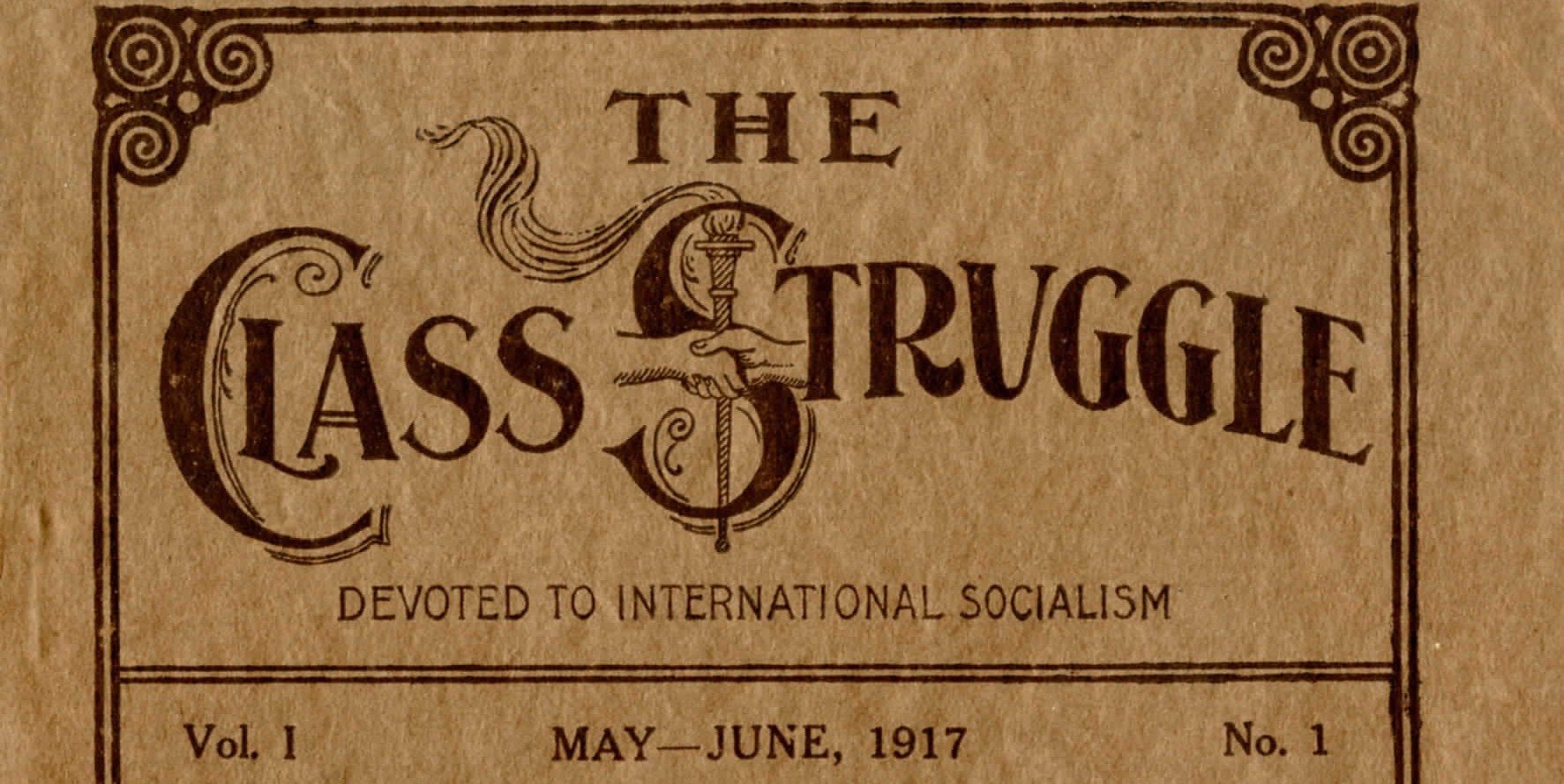
The editors of The Class Struggle with a statement of purpose for what would become the primary English-language paper of the Socialist Party’s left wing and emerging Communist movement. Hugely influential its first issue was produced in the immediate aftermath of the February Revolution in 1917 and over the next two years became a center of U.S. debate on the International, going through several convulsions, along the way publishing articles by Nikolai Lenin, Leon Trotzky, Franz Mehring, Karl Liebknecht, Rosa Luxemburg, Alexandra Kollonatai, Antoaly Lunacharsky, and Nikolai Bukharin, and many other leaders of the European Revolution, before its final issue in November, 1919 adhering to the Communist Labor Party.
‘The Class Struggle: The Task Before Us’ by Louis B. Boudin, Ludwig Lore, and Loius C. Fraina from The Class Struggle. Vol. 1 No. 1. May-June, 1917.
The world-war found the Socialists in a deplorable state of mental unpreparedness, and they were, therefore, quite unequal to the task of coping with the tremendous issues which it brought forward for immediate and radical solution. The questions to which an instant and categorical answer was demanded were not, indeed, new or unfamiliar to Socialists. On the contrary, they were intimately related to the fundamentals of Socialist philosophy and action, to questions, moreover, upon which the Socialist movement seemed to be in almost unanimous agreement—the questions of the international character of the Socialist movement and its opposition to war. But the war, like all great crises, served to reveal the latent weaknesses and defects of the Socialist movement as it then was. Its inexorable demands for instant and radical action revealed the fact that during the peace era that preceded it, the Socialist movement slurred over difficulties instead of solving them; that in order to save the formal unity of the movement agreement on fundamentals was assumed rather than obtained. Mere formal unanimity thus achieved was not only useless in the face of a serious crisis, but served to aggravate it greatly by creating confusion in many minds that would otherwise have been clear, palsying hands that would otherwise have been vigorous, and producing an atmosphere of betrayal where only disagreement existed.
Now, the problems which we have long evaded can no longer be shirked. Even the tremendous price which we have already paid for this evasion will not absolve us from the task of undertaking their solution. They are pressing upon us. The old International is dead. And unless we are willing to give up all hope of creating a new International based upon the international solidarity of the working class at all times and under all conditions, we must set about this work immediately and with a frankness that shall fully atone for the ambiguities and evasions of the past.
It is not a question of holding courts martial over traitors, nor of sitting in moral judgment over poor sinning souls. Recriminations are useless. The task before us is: to endeavor to attain clearness, of vision as a basis for future action.
The rock upon which the Second International was wrecked was the question of Nationalism. The international character of the Socialist movement had been so often proclaimed, that it was assumed without question or examination into its real meaning. But the great crisis proved that the Second International, instead of being a perfect union of the working class “one and indivisible,” was in reality, to most of its adherents, a mere confederation of national units to whom first allegiance was due in case of a conflict.
The first and most fundamental question, therefore, insistently demanding an answer at the hands of the Socialist movement, is the question of the doctrine of national defense. Another question brought forward by the war and demanding a clear and unequivocal answer is the question of the interest of the Socialist movement in the preservation of liberal-democratic institutions. And a third question, not so important theoretically but of grave practical import to the Socialist movement of the immediate future, is the question of the organization and tactics of the new International, and its attitude toward a possible capitalistic international.
Such are the questions which confront the Socialist movement everywhere; and these are the questions which must be answered by the Socialist movement of this country if it is to participate intelligently and effectively in the rebuilding of the international Socialist movement.
The general mental unpreparedness which wrecked the Second International was particularly marked in this country. An opportunistic leadership with limited outlook has kept the large masses of Socialists in this country in utter ignorance of the deeper currents of thought in the international Socialist movement. At the same time it discouraged all independent thinking, thereby destroying whatever chance there was of the movement in this country muddling through independently to some of the modes of thought indispensable to the modern Socialist movement, and preventing any serious and independent consideration of American problems. As a result, there is practically no independent Socialist thought in this country, and the Socialist ideas elaborated abroad usually reach us only as soulless and meaningless formulae and often as mere reflexes of old-world racial and nationalistic sympathies, animosities, and struggles.
It is, therefore, but natural that the great old-world conflict should have had a most demoralizing effect upon the American Socialist movement. Since the beginning of the great world conflict the Socialist movement of this country has presented a most pitiful spectacle. It has not only been unable to formulate a policy on the great questions involved, but has not even realized the gravity of the problem, and therefore naturally failed to make any serious attempt at its solution.
The bulk of the Socialists of American stock, whom the currents of European Socialist thoughts have hardly reached, are steeped in the vulgar pro-ally-ism generated in the stifling atmosphere of our export-stimulated love of freedom and humanity. From a sentimental point of view this does them credit. But in a great crisis like the present one, it is straight thinking and clearcut Socialist action that counts, and not sentiment
Opposed to this is the offensive and degrading pro-Germanism of a large proportion of our membership and the party bureaucracy, who seek to cover up the sins of Germany and of Germany’s majority-Socialists by the mantle of “neutrality.”
This part of the Socialist Party of this country was the only considerable body of American citizens who religiously followed President Wilson’s injunction to be “neutral in thought.” The action of the German Socialists in supporting the Kaiser’s government in this war was either openly approved by our official leadership, or else we were admonished not to disapprove of it on the plea of “neutrality.”
When Germany inaugurated a peace-propaganda in this country, our party entered upon a peace agitation which was not essentially different in character from that of Germany’s official and unofficial representatives. We not only waited with the launching of our peace agitation until the official and semi-official German propaganda in this country was ready for it, but the nature of our demands was largely a replica of that propaganda. The Socialist Party even entered into official relations with that propaganda, carried on in behalf of the governing classes of Germany, participating officially in “peace” demonstrations organized in its behalf.
One of the results of this demoralization was the debacle of the Presidential election of 1916.
Another is our complete and pitiful helplessness in face of the crisis which confronts us now that the tide of the Great War has reached our own shores, and the proletariat of this country is engulfed by its waves.
That the pro-ally element in our party should fall an easy prey to the war-fever when it reached this continent was only natural. To the alleged fight for democratic institutions generally, there was now added an imaginary struggle for the democratic institutions of this country. Their diseased imagination conjured up before their mind’s eye a sinister attack by Germany upon the free institutions of the United States, which they, of course, felt called upon to defend, even aside from any promptings of vulgar patriotism.
But the official leadership of the Party have done even worse: piling hypocrisy upon stupidity, only to ultimately land in the same camp as their pro-ally opponents. Their first move after the severing of diplomatic relations was a crude pro-German pronunciamento in favor of an embargo which was in itself sufficient to kill any attempt at an honest peace propaganda along Socialist lines. When this move had to be withdrawn, our National Executive Committee substituted in its place a purely bourgeois pacifist propaganda, instead of making the class struggle the basis of our opposition to war. The leit-motif of this propaganda was that “we” of the United States have nothing to fight for whatever “the others” may have at stake, that it was not “our” fight and we ought therefore to remain neutral. This was accompanied by shamefaced justifications of the German government’s ruthlessness, repeated assurances of our unfailing belief in Mr. Wilson’s high ideals, and occasional choruses of “Down with England.”
And to cap the climax, these great opponents of war hastened to publicly assure our capitalist class and its government that our opposition to the war will only last as king as they choose to remain formally at peace with Germany, but that as soon as war has been declared we shall do nothing to interfere with the war plans of our masters. Some of our “peace” leaders, among them our representative in ‘Congress, even going to the extent of promising to “stand by the country”—with all that euphonious phrase implies—in case the capitalist class shall rush us into the war which these “peace” leaders of ours had themselves declared to be a useless and wholly unjustifiable butchery of the masses of people of the United States.
In order to save the Socialist Party and the Socialist movement of this country from utter ruin, it is absolutely imperative that we revolutionize the concepts and modes of action of our movement. The revolutionary forces latent in the toiling masses of this country must be brought to the fore, consolidated, and organized into a living power. As a first step in this direction we must abandon the unprincipled arid enervating policies of pro-Germanism masked as peace propaganda, and the virtual repudiation of the class struggle conception of war and peace. A positive policy must be placed before the proletariat of this country, principles worth fighting for and ideals worth dying for.
Such a policy is indicated in the closing paragraph of the resolution adopted ten years ago by the International Socialist Congress at Stuttgart (1907), and reaffirmed by the International Socialist Congress of Copenhagen (1910) and Basle (1912), which declares that:
“In the event war should come notwithstanding the efforts of the Socialists to prevent it, then it becomes the duty of the Socialists to work for its speedy termination, and to use all the power at their command, utilizing the political and economic crisis produced by the war, in an effort to arouse the discontent of the people so as to hasten the abolition of the rule of the capitalist class.“
The last words particularly must be constantly before our eyes, to serve as our guide in whatever we undertake. The Russian Revolution has proven the great possibilities of this war, and the utter futility of the counsel which would prevent all attempts at revolutionary propaganda because the revolution was not an accomplished fact before it was begun. It is true that unfounded expectations, illusory hopes, may involve great and useless sacrifices. But the price required by the counsels of timidity which would not make a move in the class struggle before success has been assured and insured is far more costly, for it would render the revolutionary class absolutely impotent and would make any real revolution utterly impossible.
The foundation of a positive program such as is here suggested, must be laid by giving clear and inequivocal answers to the questions which we have formulated. And we herewith submit for the consideration of the Socialists of the United States what we believe to be the true Socialist position on the questions involved.
We emphatically and unqualifiedly repudiate the doctrine of national defense—believing this doctrine to be merely an idealogic fig-leaf for the shameful practices of our imperialistic age. Socialists must have none of it, if they do not want to become accomplices in the imperialistic designs of the ruling interests of the respective nations, and the wars which inevitably follow when these designs cross each other.
That does not mean that we are indifferent to the independence of all nations and particularly of small nations. Nor to their right to solve their own problems and work out their own destinies. On the contrary we feel very deeply on the subject. Socialism can only be brought about by the efforts of free men, and must be based on the fullest liberty of all races and nations. But we recognize the two-fold fact, that the small nations, who alone are in danger of losing their independence, are not in a position to defend it, and that none of the big nations would defend the independence of a smaller one except when such a policy is dictated by its own selfish interests. Such a protection is at best insecure, and makes of the small nations mere pawns in the imperialistic world-game played by the big nations. The only security of small nations as well as the protection against the forcible annexation of provinces of alien tongue and nationality—now possible, at least as far as the “civilized” world is concerned, only as the result of such extraordinary upheavals as the present world-conflict, if at all—lies in the ethical concepts and economic interest of the revolutionary proletariat. The freedom and independence of nations cannot, therefore, possibly be served by this nationalistic right or duty which is based upon and seeks to perpetuate a mode of thought which is directly contrary to the moral ideals of the revolutionary proletariat, which, nourished by group interests, is merely the elevation into an ideal of the sordid self-interest which rules the capitalist world both within and without the group called “nation.”
Rising superior to the selfishness of the group called “nation,” as they do to the selfishness of the individual, the Socialists can see that self-defense is as poor a protection in the case of a weak nation as it is in the case of a weak individual, and that the only real protection to the weak lies in an expansion and amplification of social norms and the protection which a larger society can give to its weak members as against the strong. Concretely, this means a federation of all the nations of the world—an ideal which lies in the opposite direction from the right or duty of national (self) defense.
And even before the Socialist ideal of a world-federation has been achieved the important matter cannot be left to the Socialist “nationals” of the country which is the subject of attack. On the one hand it touches a matter in which all Socialists, whether of that or any other nation are equally interested. And on the other hand, separate action by the Socialists of the country involved threatens the very foundations of Socialist internationalism—the very life-blood of the Socialist movement. Both the true interests of the nation involved, as far as the masses of the people are concerned, as well as the interest of the future of our civilization, which is intimately bound up with the growth of the power of the revolutionary proletariat, demand that whenever action in such a matter is necessary it should be taken concertedly by the Socialists of the entire world. In the domain of international relations we recognize the principle, long recognized by us in the domain of intra-national relations, that an injury to one is an injury to all. The Socialist movement denies the duty of national defense, but it also denies the right of so-called “neutrality” which is its nationalistic complement, both being based on the good capitalistic-individualistic maxim: “everybody for himself, and the devil take the hindmost.”
In place of both it seeks to substitute concerted action by the international revolutionary proletariat to prevent war in any part of the world and to prevent aggression by any nation against any nation.
The considerations which lead to a denial of the doctrines of national defense, also determine our position on the subject of defense of democracy as a cause for or a justification of our participation in war.
We are not indifferent to the fate of democracy. On the contrary—we believe that the Socialist movement is particularly charged with the duty of preserving and extending all democratic institutions. Furthermore, we believe that the revolutionary working class is the only social power capable of doing it. But far from this being a reason for our supporting any of the governments now at war, we believe that the interests of true democracy require that we refuse to join hands with any of these governments and the interests which support them and that we work for a speedy termination of this war by the action and pressure of the working class and the Socialist movements of the belligerent nations.
We deny that any of the nations engaged in this war fight for democracy, or that the ends of democracy will be subserved by either side winning a complete victory. This war is largely the result of the general reactionary trend which is one of the most essential characteristics of the imperialistic era in which we live. Modern imperialism is a world-wide phenomenon, although it may be more pronounced in one country than in another. Similarly, the reactionary trend which accompanies it, is as broad as our “civilization,” although in some countries it may assume particularly revolting forms while in others its forms may be less objectionable. The only hope of democracy lies, therefore, in those revolutionary elements of each country which are ready to fight imperialism in all its manifestations and wherever found, including the absolute refusal to participate in any imperialistic war whatever. The working class has no interest in the imperialistic ambitions of “its” “national” capitalist class, and must therefore refuse not only to fight for them aggressively, but also to defend them when “attacked” by “foreign” capitalists.
That no capitalist government can be depended on to fight for democracy, or indeed for any thing but sordid capitalist interests, is conclusively proven by the role which the United States government has played during this war. When the great war opened with one of the most lawless and ruthless acts in history, the invasion of Belgium by Germany—an act not merely abhorrent in itself, but completely annihilating the entire fabric of international law which must lie at the foundation of any international arrangement looking toward the ultimate abolition of war– our president solemnly enjoined upon the people of this country the duty of remaining neutral not only in deed by also in thought. By that declaration President Wilson officially and authoritatively announced to the people of this country as well as to the world at large that the existence of international law, the dictates of humanity, the fate of small peoples or of democratic institutions are matters that do not concern us. Not only will we, the ruling powers of the United States, not intercede in their behalf by some appropriate action, but we are entirely indifferent to them. We must not take sides for them even in the secrecy of our thoughts, lest we might betray our thoughts in some unguarded moment, thereby offending our prospective customers—regard being had to the fact that as matters then stood the Central Empires were as likely to be our customer as the members of the Entente.
As long as our trade was not interfered with we remained neutral. When such interference was threatened, as in the case of the first submarine campaign resulting in the destruction of the Lusitania, we protested. And no sooner were our selfish interests protected by proper concessions, we relapsed into our indifference. But now that these concessions have been withdrawn and the enormous export trade which we have enjoyed during the past two and a half years because of our neutrality are seriously threatened, we have suddenly awakened to the solemn duty resting upon us to come to the defense of the democracy, the civilization, and the other beautiful things which are menaced by German “barbarism” and inhumanity.
The hypocrisy of President Wilson and our capitalist class, of which he is the spokesman, is not exceptional. On the contrary—it is typical of capitalism everywhere. There is no hope for democracy in this quarter.
The hope of democracy lies in the awakening of the class consciousness of the working class—in the realization by the working class, among other things, of the fact that capitalist wars are not its wars, and that in order to be able to successfully carry on the fight for true democracy, political as well as industrial, it must fight capitalist war with all the means at its command.
We are not pacifists. We are ready to fight injustice. We are ready to fight for our ideals. We are ready to fight for the interests of the working class. But we are not ready to shoot each other in a family quarrel of the ruling classes— nor in order to settle the division of the world among our masters. In this country particularly and at this moment, we refuse to fight for the unrestricted right of our capitalists to grow fat on the woes of mankind, and for the unlimited opportunity of our capitalists to coin dollars out of the mangled bodies of what should be the flower of European civilization.
But in refusing to participate in capitalist wars we do not remain “neutral.”
Unlike the capitalist class and its smug representatives, we are not indifferent to the great struggle and its outcome. We are deeply interested in its progress, and even more so in its results. For we do not merely desire a cessation of the frightful slaughter. We are not peace at any price men. We know that a true and lasting peace can be founded only on the principles of justice and freedom which neither of the warring sides cares anything about, and which will surely be trampled under by the victorious side, whichever it should happen to be. This can only be avoided if the war is not permitted to run its capitalistic course: if the conclusion of peace is exacted by the pressure of the toiling masses of each country upon their respective governments. Only in such a case can a real and lasting peace be organized, for then the toiling masses which have exacted the peace will also prescribe the terms upon which it is to be concluded.
The latest events in some of the warring countries have shown that the masses are becoming astir—that they no longer, follow blindly in the path laid out for them by their ruling classes. This is the Socialist opportunity. Here lies our work: to direct the hunger-lashed masses into intelligent and constructive revolutionary action. Not to permit the anger of the suffering masses to spend itself in blind fury, but to use the forces of revolt thus let loose toward the abolition of all obstacles to a just and lasting peace and the reorganization of society. The termination of the war and the organization of the future peace must both be the result of an intelligent appreciation by the toiling masses of the forces which brought about this war, and of their own true interests which are opposed to this as well as all wars.
This can only come from a true understanding of the greatest of all historic struggles, of the Class Struggle. We must therefore bend all our energies to bring home to the toiling masses the full import of this struggle. We must show them the “two nations” within each nation, and help them to a realization of the fact that fundamentally each of these two nations—the capitalist as well as the working class nation—is international in character and scope. Only then will they realize that the capitalist wars of the present era, like the dynastic wars of old, are mere family quarrels which will immediately be patched up the moment the toiling masses should show any sign of revolt—the erstwhile “enemies” uniting their energies in an effort to crush the real “common enemy.”
The question as to which is the deeper and more fundamental division—that along national lines or that along class lines—lies at the basis of all our problems. “It is here that the old International has failed—in not laying the proper emphasis on the correct answer and therefore permitting confusion of thought, timidity of action, and attempts to serve two masters. The work of building the new International which will surely arise on the ruins of the old, like the work of speeding the termination of the great war and the establishment of a lasting peace, can only be done intelligently and with some prospect of success if it is based on a full understanding of this fundamental question, and a full realization that to compromise at this point means to invite a new disaster.
The class struggle is fundamental. It is the acid test of Socialist action. There is not and can be no Socialism that is not built solidly upon the basis of the class struggle. And the class struggle determines our course of action equally within the nation as well as in matters of international policy. The requirements of the class struggle compel the Socialist movement to adopt a policy of aggressive action against Capitalism. There can be no compromise in any shape or form with any party of the capitalist opposition.
The class struggle, moreover, excludes the narrow and deadening conception of political action as meaning merely the participation in elections and parliamentary legislative activity. In the vocabulary of Socialism, political action has a much deeper and broader meaning: it means the struggles and activities of the working class which have the overthrow of capitalism by the working class as their aim, and of Which parliamentary activity is only a part. The conception of political action as parliamentary activity only leads to that “parliamentary cretinism” denounced by Marx, which produces the illusion that the whole world and its social process revolve about the parliament.
This conception of political action is false theoretically, and in practice leads ultimately to disaster. In itself it cannot develop the independence and aggressive action of the working class which are necessary in order that it may achieve its final emancipation. But, related to the general mass action of the proletariat, parliamentary action becomes a vital phase of Socialist activity.
This conception imposes the task of developing a new form of economic organization—Industrial Unionism. Craft unionism, as typified in the American Federation of Labor, is an archaic form of organization. It is unresponsive to the industrial development of our day and to the revolutionary requirements of the coming crisis. The A.F. of L. has officially acquiesced to “Burgfrieden” in the coming war, has pledged its support to the government of the ruling class; moreover, it practices a form of “Burgfrieden” during peace, in its concept of the identity of interests between labor and capital—a theory that, however much violated in the every-day practice of the labor movement, exerts a potent influence in great crises, by narrowing the vision and weakening the fighting powers of the working class.
The Socialist Party itself cannot re-organize and reconstruct the industrial organizations of the working class. That is the task of the economic organizations of the working class themselves. But the party may assist this process of re-organization by a propaganda for industrial unionism as part of its general activities, and by co-operation with the most progressive forces in the labor movement. It is our task to do the pioneer work of the working class, to clarify and express its gropings after better things. It is the mission of the Socialist movement to encourage and assist the proletariat to adopt newer and more effective forms of organization and to stir it into newer and more revolutionary modes of action.
These are indication of the forces that must be invoked in the re-organization of the American Socialist movement. And the reconstruction of our own movement is the finest contribution that we can make to the general reconstruction of the International Socialist movement.
Our strategic power is great. Our course of action will influence profoundly the action of the whole international movement. May we meet this task in a spirit worthy of the revolutionary character of Socialism!
Herein lies our task: to bring the needed light and do away with confusion in our ranks, thereby doing our share for the reestablishment of peace upon secure foundations, to the reconstruction of the International and rejuvenation of the Socialist Party of America.
The Class Struggle and The Socialist Publication Society produced some of the earliest US versions of the revolutionary texts of First World War and the upheavals that followed. A project of Louis Fraina’s, the Society also published The Class Struggle. The Class Struggle is considered the first pro-Bolshevik journal in the United States and began in the aftermath of Russia’s February Revolution. A bi-monthly published between May 1917 and November 1919 in New York City by the Socialist Publication Society, its original editors were Ludwig Lore, Louis B. Boudin, and Louis C. Fraina. The Class Struggle became the primary English-language paper of the Socialist Party’s left wing and emerging Communist movement. Its last issue was published by the Communist Labor Party of America. ‘In the two years of its existence thus far, this magazine has presented the best interpretations of world events from the pens of American and Foreign Socialists. Among those who have contributed articles to its pages are: Nikolai Lenin, Leon Trotzky, Franz Mehring, Karl Liebknecht, Rosa Luxemburg, Lunacharsky, Bukharin, Hoglund, Karl Island, Friedrich Adler, and many others. The pages of this magazine will continue to print only the best and most class-conscious socialist material, and should be read by all who wish to be in contact with the living thought of the most uncompromising section of the Socialist Party.’
PDF of full issue: https://www.marxists.org/history/usa/pubs/class-struggle/v1n1may-jun1917.pdf
 Revolution's Newsstand