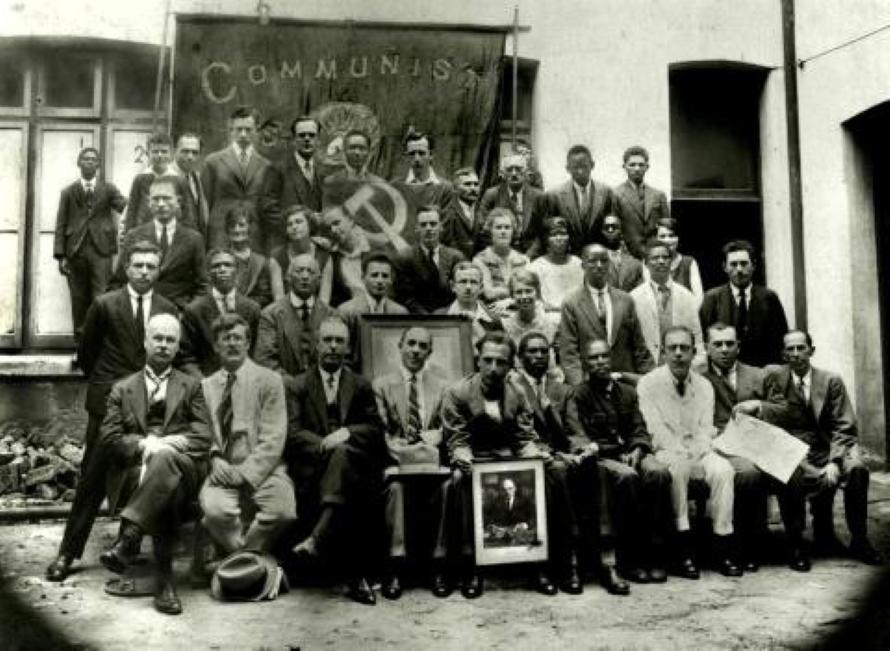
An article looking at the rise of mass movements in South Africa heralded by women in revolt against laws designed to destroy the traditional home-brew industry and force drinkers to buy European, capitalist, produced beer sold at municipal beer halls. Those halls would be the site of riots as women attacked them to protect their authority, customs, and livelihood.
‘The Red Spectre in the Black Continent’ from The Pan-Pacific Monthly. No. 34. February, 1930.
THE South African Worker,” the organ of the Communist Party of South Africa, began a leader on the present political situation in the country with a paraphrase of the words of the Communist Manifesto, “A spectre is haunting Africa–the spectre of communism.” And verily not a day passes without some sort of excitement in that extensive black continent which has for centuries furnished European imperialists with obedient humble slaves, always ready to turn their blood into gold for their enslavers and oppressors.
Not very much of what is going on in the various colonies of South and Central Africa reaches the ears of the outer world. The “democratic” states of Europe, whatever party happens to be at the helm, jealously preserve the secrets of their African rule. The world only found out by chance about the vast native rising in French Equatorial Africa which went on for several months in 1928, and there are merely stifled reports of native risings in Kenya (British South Africa). The imperialists are usually successful in drowning such risings in blood long before the outer world hears of them.
South Africa, or to be precise, the South African Union, a self-governing British Dominion, is no exception in the family of imperialist colonies. The natives exist under extreme oppression and exploitation. The colonizers, driving the native population from their lands, considerably lessening the communal basis of their life, have managed thus to make serfs of them. For the right of using a tiny plot of land, just sufficient to save him from starvation, but incapable of providing him with a decent living, the native is forced to work from 100 to 180 days a year on the land of his master. The farmers treat their serfs even worse than slaves used to be treated.
This is, however, not by any means the whole extent of the exploitation of natives. We live in an epoch of capitalist development when the elaborate industrial machine demands labor by the millions for its service. The native has therefore to be forced to work in factories, mines and docks; he must be made an industrial slave, and the exploiters have found a way to kill two birds with one stone. This way is the screw of taxation.
For the privilege of existing beneath the iron heel of a white master the native must pay a heavy per capita tax and a house tax for every native hut. Since work in his master’s fields does not allow him to scrape up the necessary money to pay his taxes the native must leave his family for several months and go to the town to earn the money. There also, however, he is involved in the complex police-capitalist system, which forces him to sell his labor for a song and scrape up the sum required at the cost of extreme privations and labor.
In the first place he must get a special passport from the police. By the end of a certain period not more than a few weeks he must have found work, or be arrested for vagrancy and sentenced to compulsory work which, however, does not free him from the necessity of paying taxes! It is obvious that the native is forced to take work at any price and still more obvious that the employers profit by this to pay him the most wretched wage.
Native workers get on an average not more than 2/4d to 3/ per day, although the cost of living in Africa is even higher than in the United States. Even this is not all that the native has to put up with. Practically all Negro workers, except small categories of personal servants (footmen, cooks, etc.) are forbidden to live in the towns themselves. They are given special locations where, for high rent, they are forced to exist in unhygienic, swarming dens. These “locations,” frequently situated at a great distance from their work, are seldom connected by traffic routes with the towns, and twice a day the Negroes have to trudge there and back.
Recruiting Slaves.
Bad, however, as are the conditions and work of these Location dwellers, they are nevertheless well-off in comparison with another category of native workers those employed in mining, the basic industry of South Africa. Such workers are recruited by the employers through a special Native Recruiting Corporation, getting hold of workers direct from the native settlements through its agents. The illiterate native, ignorant of any foreign language, affixes his finger-marks to a paper which is grandly called a contract and thus falls completely under the power of the mine-owners.
Provided with a sufficient convoy the agent takes his contracted workers to the central distributing station, whence they are sent to the various mines. These workers live in special compounds, under the permanent observation of native police, specially appointed for this purpose and directed by white superior offices.
They have to get a special permit to leave the compound. Workers caught with an expired permit are arrested. To leave work before the expiration of contract is also punishable by the law. All this, of course, makes it extremely difficult for native workers to organize, and any strike in the compounds is regarded as a riot and forcibly suppressed.
Despite, however, all this legislative protection, the capitalists do not feel quite easy and, in order to avert concerted action by the workers, they put workers from different tribes and races in the same compound, frequently those who have been keeping up mutual hostilities for years, thus causing constant fights between workers, especially after drinking bouts. And beer is part of the diet provided by the mine owners in the compounds. By thus setting the natives against each other the employers hope to keep them in subjection.
Such conditions for native workers give rise to wonder, not that unrest is beginning to show among them, but that so far there has been no wholesale Negro rising against the white oppressors. The lack of any serious movement of revolt must be put down to the lack, up to recently, of organized forces.
The old tribal leaders, as well as having lost all authority, have sold themselves long ago to the British and Boer enslavers and are assisting the latter to squeeze the last drop of blood from their own countrymen. The new national and revolutionary organizations are not yet strong enough to become centers for a general rising.
Although it is, however, too early as yet to speak of a mass national-revolutionary movement, the events of the last few months show that native South Africa is rapidly becoming revolutionary and is on the eve of great events.
It is precisely at such a moment that the so-called Native Bills (Anti-Native Legislation) played a most important part in the creation of unrest in the country. In essence these bills amount to the following:
The Cape is, at present, the only province in which natives with certain property and educational qualifications are entitled to a vote a passive one it is true. The nationalist party is endeavoring to attack this privilege. Premier Herzog introduced a draft under which natives in the future will be deprived of the right to elect together with whites. Instead of this, two electing lists–one for whites and the other for natives– are to be introduced. Those natives at present voting together with the whites will remain on general lists, but new native electors will not be entered therein. The natives are demanding not only their old electing rights in the Cape, but the spreading of these rights all over the territory of the South African Union.
Taxes the Cause of Unrest
The province of Natal, especially in its biggest town, Durban (the former port of Natal) has of late become the center of the greatest unrest, sometimes breaking out in disorders and conflicts with the police. Outwardly this movement has shown itself in “beer” riots. The Natal beer shops are municipalized, and the source of still further exploitation of the natives.
The Durban workers, most of whom are dockers, organized in the Natal Industrial and Commercial Workers Union1 demanded the closing of the beer shops. When this was refused they declared the beer shops under boycott and set up pickets. A strike was declared in June last, in which over a thousand workers took part, owing to the sacking of one of the pickets, a docker.
During the strike serious conflicts between native workers and the police (the latter reinforced by white roughs) took place on the 17th and 18th of June, resulting in eight deaths (six Negroes and two whites) and more than a hundred wounded. Despite however, police repression and even the open treachery of the reformist Champion, who appealed to the members of the Union at a meeting held after the rising under police protection, to cease hostilities and submit to police orders, the boycott movement did not come to an end. On the contrary, it spread to other towns in Natal.
Women have begun to play an important part in the movement and in some places, Estcourt, for example, serious conflicts have arisen between women and the police.
But the “beer” disorders are but the outward sign of native discontent, which, as we have pointed out, is based upon more profound economic and political causes. It is therefore no wonder that in November the Durban unrest acquired a still more general character. The natives are refusing en bloc to pay the per capita tax, thus bringing down upon themselves police repressions, such as raids on the huts of the workers and the use of poison gas.
The British papers, especially the conservative, are again spreading tales about the “hand of the Comintern,” although none know better than they that the cause of native unrest is their own oppressive policy towards the natives, which is forcing South Africa along the revolutionary path of the movement for national emancipation, in a united front with the other colonies and the revolutionary proletariat of the whole world.
Note
1. The Union of Industrial and Commercial Workers was at first a mass organization of Negro workers. Subsequently, however, Kadalie, the leader of the organization, began to sniff around the Amsterdam International and, after getting the Communists excluded from the organization, steered for reformism. Amsterdam was benevolent enough to send the Union a certain Ballinger, a member of the British I.L.P., to educate them in reformist ways. This work was crowned with “success.” The Union split into three groups. One, under Ballinger’s leadership, retained the old name and Amsterdam recognition; the other, under Kadalie’s leadership, is entitled the Independent Union of Industrial and Commercial Workers; the third, under Champion’s leadership, is known as the Natal Union of Commercial and Industrial Workers. As far as their leaders go all three groups are reformist, and the more revolutionary among the masses are gradually leaving them. Since last year revolutionary trade unions, combined in the Federation of Native Trade Unions, adhering to the R.I.L.U., have been organized in South Africa.
The Pan-Pacific Monthly was the official organ of the Pan-Pacific Trade Union Secretariat (PPTUS), a subdivision of the Red International of Labor Unions, or Profitern. Established first in China in May 1927, the PPTUS had to move its offices, and the production of the Monthly to San Francisco after the fall of the Shanghai Commune in 1927. Earl Browder was an early Secretary of tge PPTUS, having been in China during its establishment. Harrison George was the editor of the Monthly. Constituents of the PPTUC included the Australian Council of Trade Unions, the All-China Federation of Trade Unions, the Indonesian Labor Federation, the Japanese Trade Union Council, the National Minority Movement (UK Colonies), the Confédération Générale du Travail Unitaire (French Colonies), the Korean Workers and Peasants Federation, the Philippine Labor Congress, the National Confederation of Farm Laborers and Tenants of the Philippines, the All-Union Central Council of Trade Unions of the Soviet Union, and the Trade Union Educational League of the U.S. With only two international conferences, the second in 1929, the PPTUS never took off as a force capable of coordinating trade union activity in the Pacific Basis, as was its charge. However, despite its short run, the Monthly is an invaluable English-language resource on a crucial period in the Communist movement in the Pacific, the beginnings of the ‘Third Period.’
PDF of full issue: http://fau.digital.flvc.org/islandora/object/fau%3A32146/datastream/OBJ/download/The_Pan-Pacific_Monthly_No__34.pdf
 Revolution's Newsstand