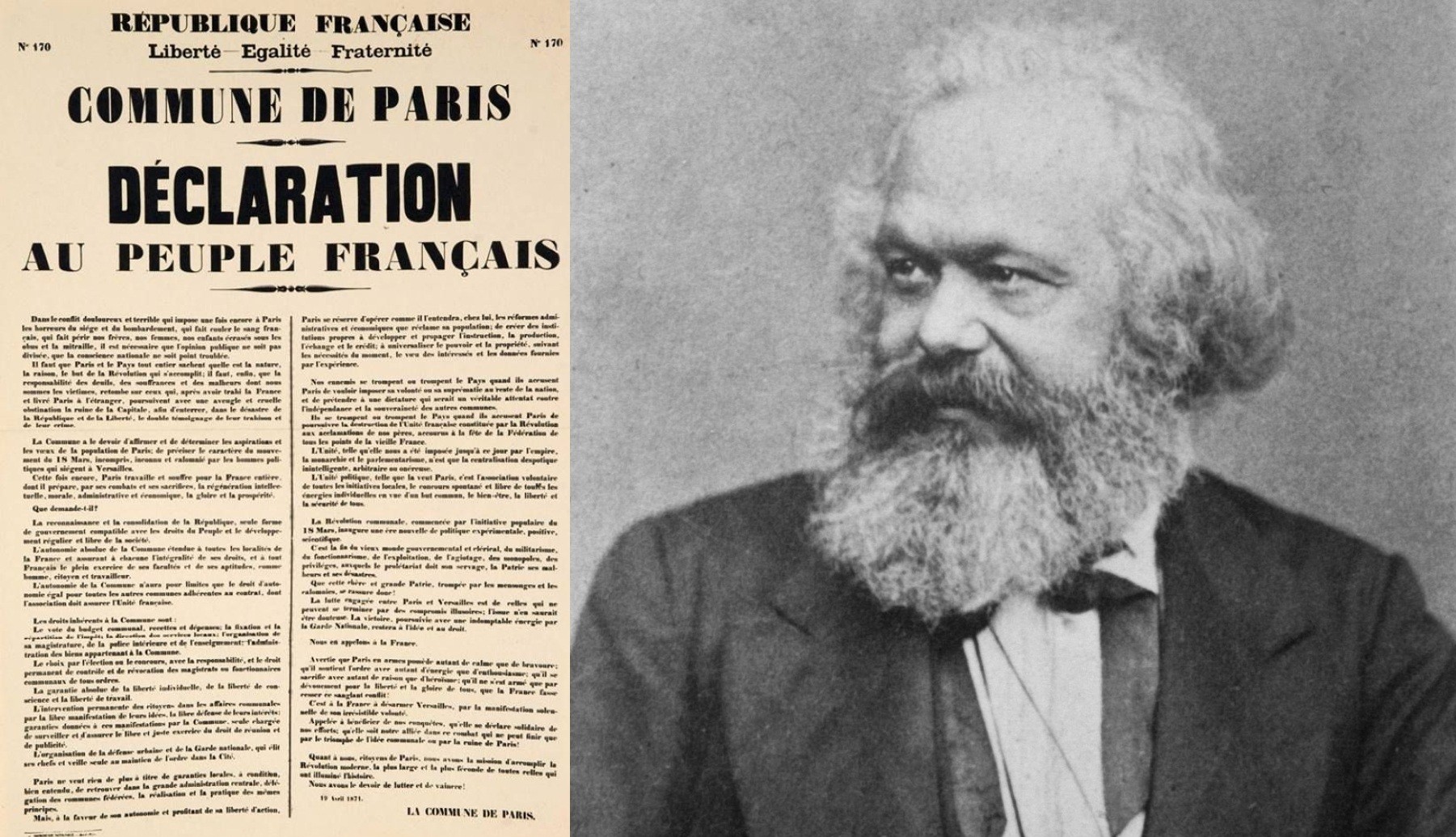
The International Labor Defense relates Marx’s work in support of the Communards on the fiftieth anniversary of his death.
‘Karl Marx, Defender of the Paris Commune’ by Frank Spector from Labor Defender. Vol. 9 No. 3. March, 1933.
On March 14th the world toilers will commemorate the 50th Anniversary of the death of Karl Marx, the founder of Scientific Socialism and the organizer of the 1st International, the first general staff of the revolutionary vanguard of the working-class.
A greater and greater part of the working. class is rapidly learning the full influence which Karl Marx’s teachings had upon the struggles of toilers by every land against their oppressors. Yet, still very little is known to the broad masses of the outstanding role Marx played in the defense and relief of the tens of thousands of French Communards who became victims of the bloody French boss-class, after the fall of the Paris Commune.
It is therefore befitting that the International Red Aid, the general staff of the world army battling boss-terror, should, with the coming 50th Anniversary of Karl Marx’s death, begin the widest spread of knowledge of the magnificent role Karl Marx, personally, played as the inspirer and organizer of the defense and relief of the French Communards.
Already in April, the month following the establishment of the Paris Commune, Marx expressed the gravest concern for the fate of the Paris Commune and its heroic supporters. This anxiety came with Marx’s ability to clearly see the fatal weaknesses of the Communards who realized only too late the need for drastic, resolute measures for crushing the counter-revolutionary forces of the French bosses. Though he foresaw the fall of the Paris Commune he maintained an unbounding faith in the masses. While predicting the Commune’s fall he said, “but the Communes are permanent and cannot be destroyed. They will assert themselves again and again till the working-class will be free,” a prophecy fully realized by the victorious Bolshevik revolution of October, 1917.
Marx’s anxiety for the fate of the Paris Commune shortly became a reality. After a brief existence of 72 days the Paris Commune fell, unable to withstand the savage blows of the combined forces of the treacherous French bourgeoisie and Bismarck, who rendered the full aid of his military hordes for the bloody extermination of the Communards. In the bloody “May Week,” from May 21st to 28th, nearly 30,000 defenders of the Commune were murdered, until “the river Seine has flown red,” as history records.
Marx and the General Council of the 1st International were faced with the tremendous problems of defense and relief for the victims of the bloodiest terror in Europe’s history. After the fall of the Commune the full weight of the savage hatred of the international bourgeoisie, led by the heads of the Versailles government, Thiers and Favre, was brought down upon the heads of the surviving Communards, threatening their complete extermination. A most vicious. campaign of lies and calumny exceeding even present unceasing campaign against the Bolshevik revolution, vilified the Paris Commune and hounded its heroic fighters.
In this campaign of boss-class hatred, the most reactionary government–Prussia, Spain and Italy and the most “liberal”–English, Belgian, Swiss, etc.–joined hands. The Pope of Rome played the same putrid role in the hounding of the French Communards as his present successor Pius XI now plays in the counter-revolutionary front of Imperialism against the Soviet toilers. In his report to the General Council Marx quoted the following excerpt from the Pope’s address before a delegation of Swiss Catholics: “Your country is a land of great liberty, yet it offers asylum to many bad people who wish to destroy every law and order and who wish to do to Europe as they have done to Paris.” Then, hinting at the desirability to turn the French Communards over to the bloody Versailles government, he termed the Communards “the devil’s incarnate,” hypocritically adding that “all we can do for them (the Communards) is to pray for them.”
This campaign was joined, in their special fashion, by the treacherous leaders of the English Trade Unions, who bitterly attacked Marx and the General Council for upholding all the acts of the Commune–then as now acting as bosses’ agents in workers’ ranks. In the “democratic” Belgian parliament the foreign minister denounced the French Communards–refugees in Belgium–as “people steeped in sins for which they must be punished,” denying their status as political emigrants. The “liberal” English government indicated its intentions to prosecute individual Communards on pretext that “they were guilty of criminal acts.” The reactionary Spanish and Italian governments promptly and completely closed their borders to the hounded Communards.
To counteract effectively the vicious campaign of lies about the Commune, through which the French bosses were rapidly poisoning and inciting the minds of the European people against the Communards, Marx and the General Council decided as their immediate main task the broadest circularization of the Manifesto of the 1st International on the “Civil War in France,” which brought to light the real aims and the role of the Communards exposed before the whole world the role of the treacherous murderers of the French people–the Thiers, Favres and their ilk. The Manifesto was met with a conspiracy of silence on the part of the kept press. However, through almost super-human efforts of Marx and his associates the manifesto on “Civil War in France” soon became the topic of world-wide discussion.
Despite the most vicious attacks directed against Marx personally for his authorship of the most devastating exposure of the crimes and treachery of the French ruling clique, and most brilliant defense of the Paris Commune, Marx and the General Council were able, thanks to the sensational discussion, to place volumes of material before the reading people in defense of the French Communards. Thus in a great measure they succeeded in turning the tide of hatred aroused by the French government against the Communards, against their enemies the Thiers and Favres, and tremendously aided the cause of the struggle against attempts of the various governments to turn the French emigrants over to their murderers. Even some newspapers began to speak more of the “crimes of Versailles” rather than “crimes of Paris Commune.”
Marx and the General Council fully realized the importance of proper legal presentation of legal defense for the Communards in Thier’s Courts. Thier’s line was to place on trial the entire 1st International whom the ruling class rightly considered as the real inspirer of the Commune. His intentions were to turn this trial into a mighty propaganda instrument through which he could appear as the savior of France and the rest of the civilized world from the “bandits”–the Communards and the 1st International. Through fabricated documents he intended to show the close connection of the Commune with the Prussians and reveal the 1st International as Bismarck’s secret agents. (Just as the boss-class in 1917 hounded Lenin as the Kaiser’s agent.) In this way he hoped to counteract Marx’s and the Communards’ merciless exposure of himself and his government of “National Defense” as Judas, who for a pottage sold France to the Prussian militarism.
The tremendous importance of the trial placed upon Marx’s shoulders, the additional burden of preparing and supplying the lawyers with reams of material necessary for the case. At the same time he and the General Council worked feverishly to arouse tremendous mass-pressure in support of the legal defense of the Communards.
News was also percolating through the rigid censorship of the frightful treatment of Communards in prisons. Through the aroused mass-pressure even some of the hostile press was compelled to publish descriptions of the brutalities against the imprisoned men, women and children. The Times was forced to print an article by Frederick Engels (Marx’s closest associate) exposing the murderous treatment of the Communards, ending with a passionate appeal to compel the Versailles government to cease the torture of its victims. Marx and Engels wrote, “While preparations for the trial are going on the prisoners of Satory die like flies. Death acts much swifter than Thier’s ‘justice.’”
The thousands of Communards who succeeded in escaping from the jaws of death flooded the neighboring countries presenting a tremendous problem for their defenders–Marx and the General Council. The emigrants’ plight was terrific, as they were forced as best they could to eke out a living in strange lands with no work, hence no food nor shelter.
Marx faced this problem with superhuman efforts towards collecting funds for relief of the emigrants. He wrote passionate appeals to all workers and intellectuals to come to their aid. On September 5th he addressed a special appeal to the American workers who responded with a collection of one hundred pounds and pledges of more.
Marx turned to the middle class and intellectuals, issuing special collection lists as well as “penny lists. While doing this Marx rejected appeals that tended to offend the dignity of the Communards. HE INSISTED UPON THE COLLECTION OF FUNDS BEING CONDUCTED UPON THE CLASS-ISSUES INVOLVED.
Marx gave himself to this colossal task not out of petty-bourgeois sentimentalism, not out of classless humanitarianism. To him the Communards were soldiers of the first unsuccessful proletarian revolution, forerunners of the coming victorious proletarian armies. To him, in the words of Lenin, “the cause of the Commune was the cause of social revolution.” He strained almost superhuman efforts towards rescuing the Communards from the jaws of death and towards relieving their terrific distress with a clear thought in mind to return them into the ranks of the revolutionary working-class.
The activities of Marx and the General Council of the 1st International in defense of the French Communists are tremendous lessons in building proletarian solidarity of all toilers in defense and relief of class war victims. They were also the forerunners to the present world-wide defense movement led by the International Red Aid.
The I.L.D. membership and its supporters will derive from this chapter of Karl Marx’s manifold revolutionary activities lessons to be ap plied in our daily efforts to strengthen our defense and relief activities. Of outstanding value are the lessons of International Solidarity as taught to us by Marx’s splendid example when he aroused tens of thousands of workers from many lands in support of the French Communists and the vital importance of giving relief to class war victims and their families.
Labor Defender was published monthly from 1926 until 1937 by the International Labor Defense (ILD), a Workers Party of America, and later Communist Party-led, non-partisan defense organization founded by James Cannon and William Haywood while in Moscow, 1925 to support prisoners of the class war, victims of racism and imperialism, and the struggle against fascism. It included, poetry, letters from prisoners, and was heavily illustrated with photos, images, and cartoons. Labor Defender was the central organ of the Scottsboro and Sacco and Vanzetti defense campaigns. Editors included T. J. O’ Flaherty, Max Shactman, Karl Reeve, J. Louis Engdahl, William L. Patterson, Sasha Small, and Sender Garlin.
PDF of full issue: https://www.marxists.org/history/usa/pubs/labordefender/1933/v09n03-mar-1933-lab-def.pdf
 Revolution's Newsstand