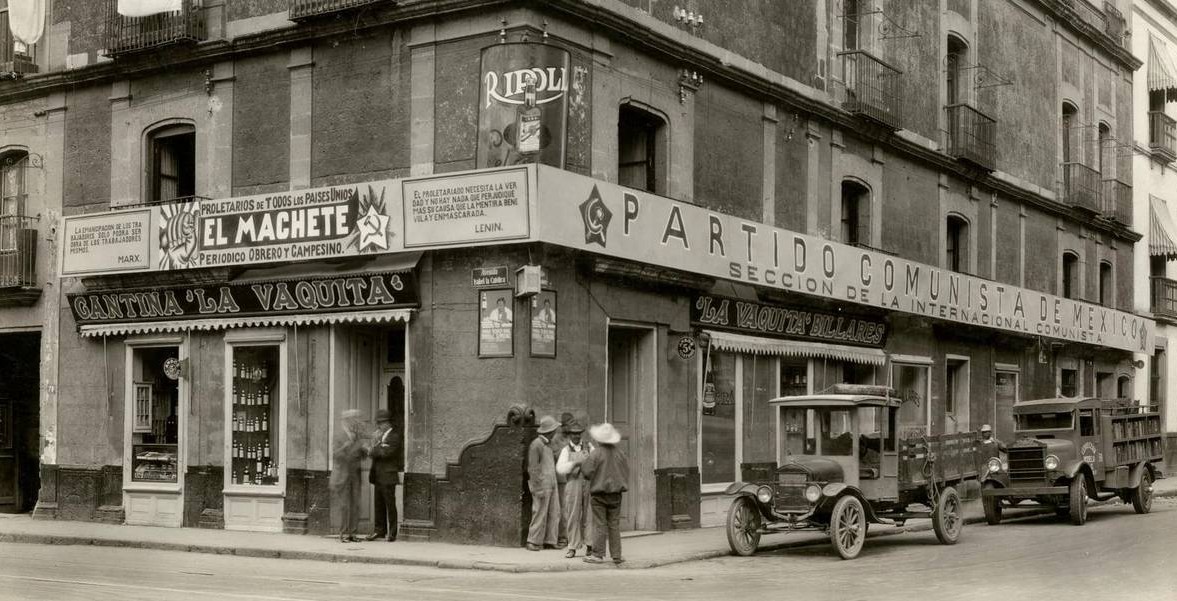
Though formally outlawed in 1925, the Communist Party remained active in Mexico growing to 1000 members in 1928 despite repression. The report on the previous four years’ activity for the Sixth Comintern Congress.
‘Report of the Mexican Communist Party’ from The Communist International Between the Fifth and the Sixth Congresses, 1924-28.
I.
THE social structure of Mexico is based on the following groupings: (1) National landownership connected with American and British oil capital; (2) the national capitalists and the petty bourgeoisie; (3) the worker and peasant masses. The main characteristic of the economic position of Mexico is that three-quarters of the raw material industry are in the hands of foreign capital. Apart from the textile industry, Mexico has at present no manufacturing industry worth mentioning. There are about 300,000 industrial workers in Mexico.
The present Calles Government made it its first and foremost task to undermine the economic supremacy of the United States through the creation of a national industry, and to carry through the agrarian revolution to a successful conclusion. It was quite obvious that this programme could not be carried out in the way proposed by the Calles Government, and that United States supremacy would again prevail in Mexico in the near future.
An analysis of the general situation in Mexico reveals a series of fundamental conflicts of interest, which can be summarised as follows:
1. The conflict between the petty bourgeoisie and the survivals of feudalism.
2. The conflict between the national capitalists and the economically-predominant foreign imperialism.
3. The conflict between national and foreign capital on the one hand, and the workers and peasants on the other.
4. The conflict between the various groups of foreign capitalists.
5. The conflict between the central government and the provincial governments, which is particularly accentuated by the fact that the Central Government lacks the necessary courage and determination to carry out the agrarian reform. This, in its turn, led to a continuous civil war, which has been going on intermittently waxing and waning for the last 15 years.
The attempts to solve these conflicts lead continually to new ones, which keep the country in a state of ferment and unrest. The main struggle is for the re-establishment of the power of the old feudal regime and for securing the unlimited dictatorship of foreign capital, whose position has been somewhat undermined in the last few years/
II.
It is a well-known fact that the Callies Government came into power in 1924, after the overthrow of the counter-revolutionary rebellion of the landowners and the reactionary soldiery led by De la Huerta, and supported by British and American imperialism. Calles drew the most important leaders of the reformist labour movement into his government. This petty bourgeois government immediately revealed the limitations of its revolutionary will which did not go further than the overcoming of feudalism. This was clearly shown in the class differences, which found their expression under the guise of religious struggles. These struggles, led by the Catholic Church, and supported by the old landowners and the American imperialists, broke out with renewed violence in the beginning of 1926. The attack of the counter-revolutionary forces was directed against the Mexican Constitution of 1917, which decreed the destruction of the power of the church and its closely connected allies, the big landowners. The moment of the attack was certainly well chosen, because the Mexican Government was at that time in difficulties with the United States in connection with the promulgation of the oil laws. The efforts of the Catholics were brought to a standstill for the time being through the accentuated struggle of the Calles Government against this counter-revolutionary attack. But the Catholics resumed the struggle in the middle of 1926, whereupon the Government decreed strict administration of the church laws and introduced even more drastic measures against the feudal-church reaction.
In complete contrast to this struggle against feudalism was the attitude taken up by the Calles Government towards the workers and peasants, with whose help it had assumed power. The efforts of the workers and peasants to continue the revolution and to carry through the agrarian programme to a successful conclusion were met by the Government with the suppression of the workers’ and peasants’ struggles for land and for better wages and labour conditions, which it called extremist and unlawful. One of the first blows directed against the working class was the establishment of a national arbitration court, without whose sanction no strike could be declared. If, however, strikes occurred in spite of it, the leaders of the reformist trade union organisations C.R.O.M. (Confederacione Regionale Obrera Mexicano) sent strike-breaking gangs to defeat the workers.
With regard to internal politics, another of the main tasks which the Government set itself was the abolition of the powers of the provincial governments and their concentration in the Central Government.
Thus the Government, split up through provincial separatism, is at present fighting for power which it can only maintain with the support of the workers and peasants. At the same time, it represents more and more the interests of agrarian capital, without relinquishing, however, the popularisation of its petty-bourgeois programme for demagogic reasons. (Development of a native industry, organisation of agricultural producers’ and consumers’ co-operatives, establishment of agricultural credit co-operatives, installation of irrigation works on a large scale, an improved transport service, etc.).
Although the Government has been victorious in the struggle against feudalism, which is closely connected with the church, it is continually on the defensive with regard to American imperialism. Continual backsliding to the Right is an illustration of the insecurity of the Government and of the political role of the bourgeoisie in general.
The whole plan of the Government is, on the whole, nothing but the industrialisation of the country under cover of a reformist, petty-bourgeois ideology, which will ultimately lead to the consolidation of the capitalist regime. This explains also the fact that the struggle of the workers against the employers and the struggle of the peasants for the accomplishment of the agrarian revolution has been going on with renewed vigour, even after the coming into power of the petty-bourgeoisie. Although the mass of the workers and peasants have been on the defensive since 1924—nearly all the movements of the workers in the towns came to nought—the struggles for economic demands are growing in number from year to year, and the peasant movements against the attitude of the Government to the agrarian question are also developing.
Thus, the entire fate of the Mexican Revolution depends on the extent to which the workers and peasants succeed in exercising a decisive influence on the political life of the country through the organisation of their resistance to the petty-bourgeois government.
III.
The activity of the bourgeois and Social Democratic parties is dominated by the coming presidential election, which has in fact been already decided through the removal of the most important opponent. The election campaign, which cannot to any extent influence the election result, is being carried on at present by the three biggest parties. First of all should be mentioned the National Revolutionary Party, which was, in fact, created in preparation for the presidential election. It is composed of a military clique and is partly under the influence of the Roman Catholic Church. Then comes the national anti-election party: it carries on its agitation under the slogan that a president can be elected only once. Politically, it is thoroughly reactionary, and wants to reinstate the Catholic Church with all its former powers. It represents mainly the interests of the big landowners and of the American magnates whose financial support it enjoys. Its candidate was General Gomez, who was shot.
The third group in the election is that of General Obregon. His programme is the creation of a strong native bourgeoisie, and in this he has the support of the petty-bourgeoisie. He has considerable influence over the army and will win a formal victory in the coming election. The party of the reformist trade union leaders is the Partito Laborista (Labour Party). It is so to speak the other face of the C.R.O.M.: the same leaders and the same policy. It has neither organisation nor a press.
The Partito Marionale Agrarista (Agrarian Party) is the real Government party with whose help Calles came into power, but with whom he has already severed connection. It is, above all, an election party, and has considerable influence in North Mexico; it is supporting Obregon. Most of its leaders are lawyers who use the party to secure governmental posts.
Formerly the agrarian party collaborated closely with the C.R.O.M., but in 1924 it severed connection with it and has been retrogressing ever since. It its place agrarian committees sprang up throughout the country; they consist of urban and rural representatives who obtained common land after the revolution. These agrarian committees are mostly economic associations with about 500,000 members, most of whom are under Communist influence, particularly in the States of Veracruz, Michocher, Halisco.
The best peasant organisations are in South Mexico, and the most important of them is that in the Veracruz State. It has about 30,000 members, controls nearly all the village communes in the State and is under Communist influence. It also adheres to the Peasant International. Apart from these peasant organisations there are the armed organisations of the peasants, the Guerillas, who frequently give armed support to the struggle for land.
IV.
The Situation in the Trade Unions.—The reformist trade unions give their membership as 800,000 in round figures, but this is probably an exaggeration. According to the statistics of the C.R.O.M., 75 trade union federations are affiliated to it, which comprise 195 trade unions in the capital, 1,000 trade unions in the provinces, and 1,500 agricultural labourers’ unions. They are most influential in the small industries, but embrace only a small section of the workers in the shipbuilding, textile and mining industries, and also a small number of employees and civil servants. The reformist trade unions are the main support of the Government. With regard to their policy they allow themselves to be guided by the political lines laid down in 1919, which advocate a cautious and moderate policy. Their programme states that by means of this policy satisfactory relations with the existing government are to be maintained. In their attitude towards the employers they advocate a class collaboration policy. Trade union organisation is confined almost exclusively to the labour aristocracy. It holds the opinion that the revolution in Mexico has come to a conclusion, that the construction period is setting in and that the trade unions too must be guided by this. The objective it pursues is some kind of co-operative republic based on the middle class, the peasantry and small industry.
Since 1926 the Amsterdamers have been trying to get the C.R.O.M. to affiliate to the Amsterdam International.
Independent Trade Unions.—The most important independent trade unions are those of the oilfield workers and railwaymen. They are violently opposed to the C.R.O.M. Apart from these two, there is the Trade Union Federation of Tampico with about 35 trade unions.
The action of the Government in restoring the railways to the private owners, which was followed by many dismissals among the railwaymen, resulted in recent years in a strong orientation to the Left. The oilfield workers constitute the best and most revolutionary section, and together with the textile workers they are a fruitful field for Communist propaganda and organisation.
Anarcho-Syndicalist Trade Unions.—This is the Mexican section of the I.W.W.; it embraces mainly the textile workers of the capital and has about 25-30,000 members.
V.
Communist influence is strongest among railwaymen in the capital, oilfield workers in Tampico and textile workers in Orizaba. Among the peasants the influence of the Communist Party is strongest in the peasant movement of the Veracruz State. While generally speaking the Party is doing satisfactory agitational work, particularly on special occasions, although not always with the necessary clarity, it has not yet been able to make proper organisational use of its activity. Neither can it boast of a uniform ideology.
A central organ is published fortnightly under the title “El Mechete.” In the period between the V and VI World Congresses, three Party Congresses took place, the third in April, 1925. This dealt mainly with the struggle against American imperialism, the measures for the Bolshevisation of the Party, the activity of the Party in the trade unions and among the peasants. Up to this period the Party manifested strong opportunist tendencies, the main reasons for which were: the peculiar trend of the Mexican revolution, the absence of a Social Democratic Party capable of absorbing the opportunist elements, the corruption policy of the government, as well as weak Party leadership. The Party Executive was relieved of its office (or resigned with one exception) at the Third Party Congress. Under the leadership of the former Central Committee the Party was divided into several sections, it failed to take up a decisive Communist attitude to the rebellion of De la Huerta; it had no press, no membership contributions and its influence among the workers had decreased considerably. Only its influence among the peasants in the Veracruz State was maintained.
In the theses on the political situation adopted by the III Party Congress, it was incorrectly stated that the Calles Government was the left hand of American imperialism. With regard to the peasant question, the demand for the formation of a federation of the already existing peasant associations was adopted; whilst it was emphasised that struggle against the expulsion and disruption tactics of the reformist leaders in the trade unions must be carried on by the application of the united front tactic. Other important items discussed at this Party Congress were: the reorganisation of the Party on the basis of factory and estate groups and of agrarian communities, the development of the press, the establishment of an education department and recruiting of new members.
The Fourth Party Congress was held at the end of May, 1926. In the period between the III and IV Party Congresses the membership of the Party, already small, suffered another decrease. On the other hand, the Party became more united during this period. The most important problems discussed at the IV Party Congress were the internal Party regime, Party tactics and organisation. Theses were adopted on the economic and political situation and the immediate tasks of the Party.
The errors made in the period intervening between the III and IV Party Congresses were remedied and also admitted by the responsible comrades. A resolution on the internal political situation and the Calles Government declared that the latter is not merely the obedient servant of American imperialism, but that it is also struggling for the formation of a national capitalism and of a national capitalist class. It was also pointed out that the development of national capitalism is slower than the development of North American imperialism. The latter could only be overcome through joint action by the united workers and peasants. These theses give a different estimation of the Calles Government than the estimation given before the III Party Congress.
On the question of the united front tactic it was stated that formerly this tactic was not always correctly applied. It was decided that the Party should do its utmost to counteract the Left tendencies, which advocated that workers should leave the reactionary trade unions. With regard to the peasant question, the main slogan was to be “land for the peasants.” In connection within with the political divergencies of opinion between workers and peasants, the Party issued the following slogan:—”Above all divergencies is the unity between workers and peasants which must be effected.”
It was also decided that the organisational plan for the reorganisation of the Party on a factory and street group basis must be carried out more energetically than before. The results of the IV Party Congress can be summed up as follows:
Alteration of united front tactics as proposed by the E.C.C.I.; organisation and systematic leadership of the trade union fraction; reorganisation of the already existing unity committee of the trade unions on a broader basis; organisation of agricultural labourers, workers and peasants. With regard to the land question: endorsement of the decision of the III Party Congress, struggle against the disarming of the peasantry. Other decisions were: Increased activity in the co-operative movement, reorganisation of the youth movement, work among women and in the Red Aid. The V Party Congress took place in April, 1927, during the offensive of the reaction and the foreign capitalists against the government. This Congress greatly contributed to the unification and clarification of the Party policy. The discussion on the role of the petty bourgeoisie, the importance of the agrarian movement, the tactic in the trade question, stirred up the whole Party and made the Central Committee adopt a new course.
The VI Party Congress took place at the beginning of April, 1928. The most important discussions were: the agrarian question, the war danger question (war against the Soviet Union, was between imperialist countries and war between the colonial countries and the various imperialist countries as well as struggle against imperialism).
The Present Tasks of the C.P.
The most important task of the C.P. of Mexico at the present juncture is the elaboration of a programme of its own. In this connection the revolutionary activity which was impeded by the present government must be renewed, until the demands brought forward in the earlier revolutionary period have been granted. In these struggles the Party must be the leader of the working and peasant classes. It must unite the masses into a workers’ and peasants’ bloc, whose aim shall be defence of the gains of the revolution and their further development. It is under this slogan also that the Party must carry on the coming election campaign. This workers’ and peasants’ bloc must struggle for the immediate introduction of the agrarian reforms, for the complete expropriation of big landowners, for the distribution of the land amongst the agricultural communes, for the abolition of the agrarian debt of the central and the provincial governments, for the full application of Article 123 of the Constitution concerning labour legislation, for the elimination of all counter-revolutionary elements from the administration of the State and of all reactionary officers from the army, for the legally-sanctioned formation of defence organisations of the workers and peasants.
To create the conditions necessary for this bloc, the Party must give first place to the economic demands of the workers and peasants. The programme as a whole must be linked up with the political every-day struggle and with systematic penetration of and work in municipalities, co-operatives and other organisations, in order to get into closer touch with the workers and peasants, and also in order to increase the influence of the Party. The latter most emphatically declare that only a genuine workers’ and peasants’ government will be able to overcome reaction in the country. In this manner Mexico can become the centre of an anti-imperialist revolutionary movement throughout all Latin America which will shake off the yoke of the imperialistic powers and particularly that of North American imperialism. If the Party is to carry on a proper struggle for these demands it must overcome the sectarian spirit within its ranks and must develop into a mass Party. It is only by becoming a mass Party that the C.P. of Mexico will be able to solve the tasks imposed on it by the country itself.
In 1927, the Party almost doubled its membership. On January 1, 1928, it had 1,000 members, including 600 manual workers, 50 peasants, the remainder being artisans, intellectuals, etc. In the big industrial centres, particularly in the oil, coal and other districts, the Party organisations consist almost entirely of manual workers. Agricultural labourers, who form a large part of the population in Mexico, are barely represented at all in the Party. In 1926 the C.P. of Mexico had not a single factory group; at the end of 1927 it had already 54. A beginning has been made with the organisation of trade union fractions. But up to quite recently Party influence in the trade unions was limited to the personal influence of individual officials. Generally speaking, the Communist Party of Mexico is still very weak organisationally.
 Revolution's Newsstand