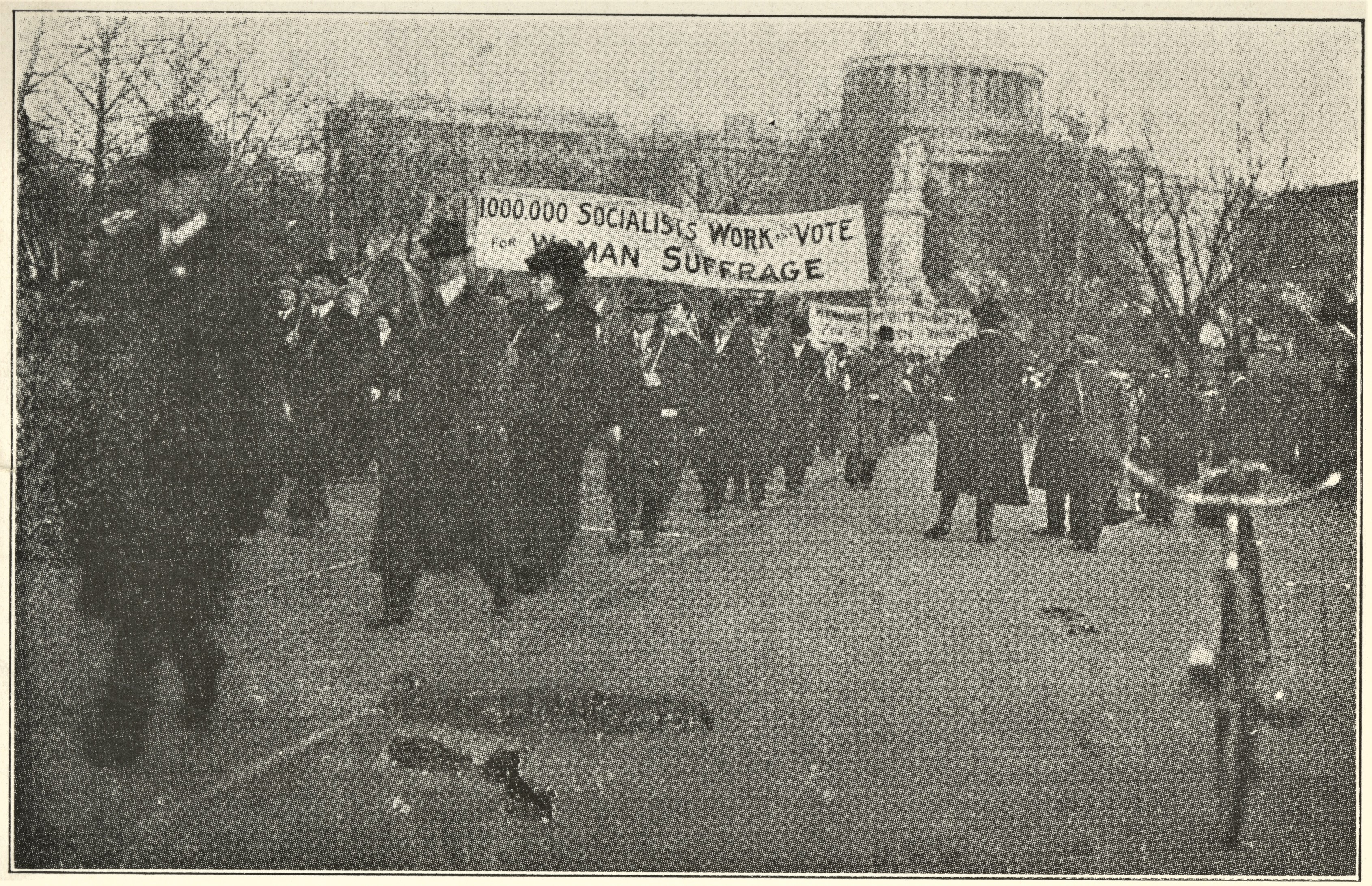
It is fair to say that women’s issues had a much more robust discussion in the Socialist Party than in the first decades of the Communist Party. A multi-sided debate within the Socialist women’s movement broadly over the relative weight of specific women’s demands, organization and relations to the suffrage campaign developed throughout the 1910s. Mary S. Oppenheimer was the part of the Socialist women’s movement that in general disfavored separate women’s organizations and platforms.
‘The Suffrage Movement and the Socialist Party’ by Mary S. Oppenheimer from New Review. 3 No. 19. December 15, 1915.
In this article it is meant by the Socialist Party the party in Greater New York, or those districts of the city where the Socialist Women’s movement has been particularly active in holding meetings and waging propaganda for Socialism and Votes for Women. The writer has never been more than a lukewarm supporter of the separate women’s movement within the party and may therefore fittingly praise the skill with which it has been managed of late and the energy and devotion of its workers.
Here in New York this movement has justified itself and proved its value as a political and moral factor. Certainly without it at least half the Socialist men who voted the other day would have left their ballots blank on the suffrage amendment. Plenty of us can remember only too well the stolid indifference of even the best party workers among the men when the question of Woman Suffrage first came up at Branch meetings. The opposition was active as well as silent. If women had the vote it would retard the coming of Socialism was a favorite argument. A good many of the older party members still feel the strength of that statement though they say less about it since the steady growth of the Votes for Women movement everywhere. Secondly, Woman Suffrage was a middle class and not a working class movement, a statement undoubtedly true and just as true now as it was several years ago. The men’s verdict was that, while theoretically the thing was all right, it was too middle class, not calculated to advance the interests of the workers, indeed, likely to divert attention from issues of great importance to the workers, and therefore best not made a live party issue. As for the women, they wanted the votes they regarded as their right and the instinct to fight for their rights drove them on with considerable aggressiveness.
The path of the Socialist Women’s movement has not been easy and rosestrewn; rather is has been a stony and thorny way, financially and otherwise. A frequent accusation made by party members against the Socialist women was that they were more Suffragists than Socialists. It must be admitted that there was sometimes ground for the accusation.
Once at least, the women openly defied the Central Committee and marched in a suffrage parade against official orders. A second time they would have done the same thing had the Central Committee taken the same stand. The fight that evening was one of the exhilarating events of a usually dull body. The opposition made fiery speeches against march ing, though some members who might have opposed the plan refrained from taking an active hand in the proceedings because their wives, all ardent Suffragists, were present as spectators. A few of the men were glad to act as tellers, thus diplomatically escaping committing themselves. Then the husband of one of the most enthusiastic workers appeared, coming late. Seeing, how matters were going, he threw himself into the oratorical fray with energy, advancing the argument that the women were bound to march anyway, with or without permission. The vote was close, but, thanks largely to him, it went in favor of the women.
In the last year the tide of Votes for Women, rising everywhere, has swept the party along with it. The present membership in this city includes a very large proportion of Russian Jews and these, to a man, are warmly in favor of Woman Suffrage. They voted solidly for it too. The three Assembly Districts, two in Manhattan, the Sixth and the Twenty-Sixth, and one in the Bronx, the Thirty-fourth, where the suffrage amendment won out by small majorities, 88, 70 and 153 respectively, are all strong Jewish districts and the Socialist vote is something of a factor. The vote for the amendment was undoubtedly the Socialist vote. The various suffrage associations may not like to face the fact that they owe such meagre majorities as they got in the city to the Socialists and the foreigners, but the truth is the truth. In this case the result is significant of the complexity, political and racial, of New York City to-day.
Really the women workers for suffrage in the Socialist Party were between the devil and the deep sea. Many of the Socialists thought their course unwise, and, on the other hand, it is the fact that, in the main, the different suffrage associations do not want the Socialists. It is true that many individual Suffragists do not share this feeling. The leaders recognize that Votes for Women is a movement big enough to sweep all sorts of women into it: that it does so in the course of its strength and of its growth. Yet lots of members in the rank and file shudder politely when they meet a woman who tells them she is a Socialist. Perhaps a minor reason why the Suffragists would rather we stayed away from their movement is the fact that we are, on the whole, bad marchers and paraders, not over willing to submit to discipline and undignified in exchanging greetings and bits of conversation with the sidewalk onlookers.
The backbone of the Suffrage movement is almost entirely middle class, being made up of the teachers, the nurses, the professional women of brains and liberal education, helped by a few women wealthy even as wealth goes here in New York, the financial centre of the whole country. A working class movement it is not—not yet. The average Socialist worker would not feel at home in it, even if she could bring herself to join and try to work actively in one of the suffrage bodies. Yet the Socialist, like every other woman of intelligence and advanced ideas feels a thrill of indignation when she sees a drunken man staggering along on his way to the polls and knows that in a sense that man holds her fate at the ballot box in his hands. That feeling she shares in common with Suffragists of all sorts.
We must not overrate the value of the final result of Votes for Women. If the foreign born working woman had the ballot to-morrow, very large numbers could not vote, either because they are not citizens of this country, or else, being compelled to move about from place to place in search of employment, they are deprived of their vote because they cannot fulfil the qualifications as to length of residence. The same thing is true of large numbers of foreign born working men. Naturalization has become too slow and too expensive a process, devouring time as well as money; it fails to meet the requirements of the case. All these working people, both men and women, are in the main amenable to our laws, but they lack the protection of the vote, even those who would now be entitled to it by right of sex. Our voting system lacks Democracy, and Votes for Women is in the long run but an inadequate means to mend that want. Yet it is immensely valuable for that disfranchised class whom it would reach. It may be remarked that the American women are putting up a far better fight for their rights as suffragists than are the horny handed sons of toil for the rights of their unorganized brothers.
The New Review: A Critical Survey of International Socialism was a New York-based, explicitly Marxist, sometimes weekly/sometimes monthly theoretical journal begun in 1913 and was an important vehicle for left discussion in the period before World War One. Bases in New York it declared in its aim the first issue: “The intellectual achievements of Marx and his successors have become the guiding star of the awakened, self-conscious proletariat on the toilsome road that leads to its emancipation. And it will be one of the principal tasks of The NEW REVIEW to make known these achievements,to the Socialists of America, so that we may attain to that fundamental unity of thought without which unity of action is impossible.” In the world of the East Coast Socialist Party, it included Max Eastman, Floyd Dell, Herman Simpson, Louis Boudin, William English Walling, Moses Oppenheimer, Robert Rives La Monte, Walter Lippmann, William Bohn, Frank Bohn, John Spargo, Austin Lewis, WEB DuBois, Arturo Giovannitti, Harry W. Laidler, Austin Lewis, and Isaac Hourwich as editors. Louis Fraina played an increasing role from 1914 and lead the journal in a leftward direction as New Review addressed many of the leading international questions facing Marxists. International writers in New Review included Rosa Luxemburg, James Connolly, Karl Kautsky, Anton Pannekoek, Lajpat Rai, Alexandra Kollontai, Tom Quelch, S.J. Rutgers, Edward Bernstein, and H.M. Hyndman, The journal folded in June, 1916 for financial reasons. Its issues are a formidable and invaluable archive of Marxist and Socialist discussion of the time.
PDF of full issue: https://www.marxists.org/history/usa/pubs/newreview/1915/v3n19-dec-15-1915.pdf
 Revolution's Newsstand