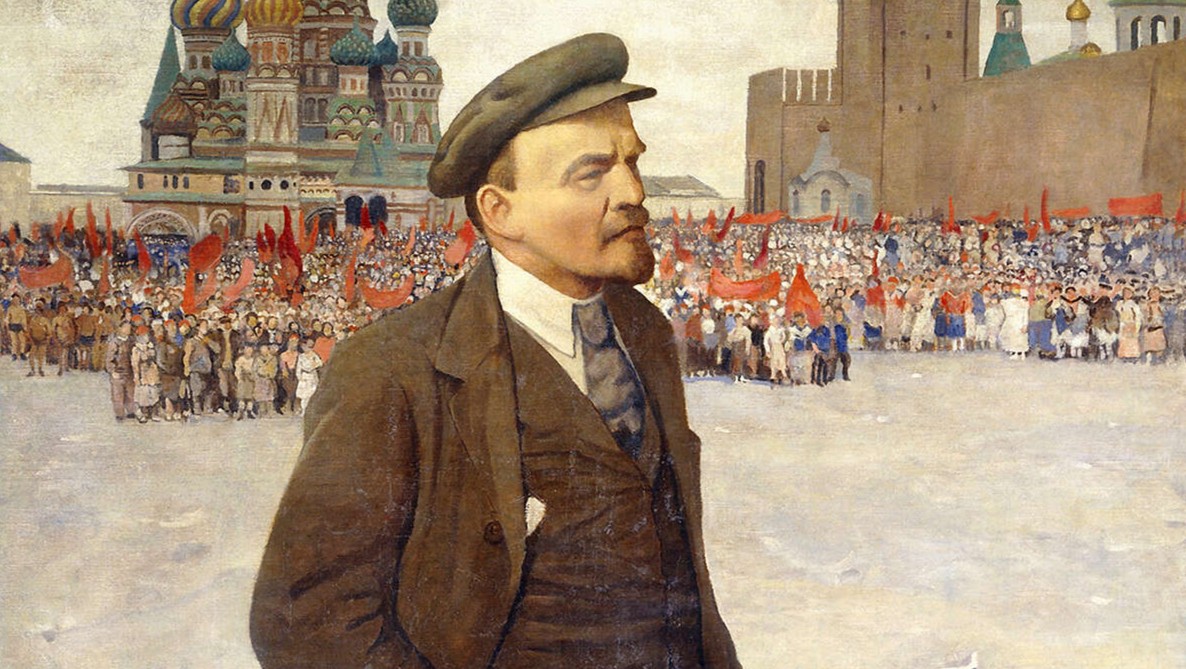
‘Economism’ in the historic Russian sense was a sort of Marxist-Fabian-Labourism wherein, broadly speaking, the working class would have its own class-based Labor Party party to lobby for its economic demands, but its political demands, the destruction of Tsarism and the establishment of ‘democracy,’ it would leave to the revolutionary intelligentsia. In this early article for Iskra, Lenin critiques the position of newspaper Rabochaya Mysl (Workers’ Thought) in what would be an important early debate in the Russian Social Democratic and Labor Party.
‘The Urgent Tasks of Our Movement’ (1900) by V.I. Lenin from Selected Works, Vol. 4. International Publishers, New York. 1929.
Russian Social-Democracy has more than once declared that the immediate political tasks of a Russian labour party should be to overthrow the autocracy and to secure political liberty. This was declared more than fifteen years ago by the representatives of Russian Social-Democracy—the members of the Emancipation of Labour group. It was declared two and a half years ago by the representatives of the Russian Social-Democratic organisations, which in the spring of 1898 founded the Russian Social-Democratic Labour Party.
In spite of repeated declarations, however, the question of the political tasks of Social-Democracy in Russia is now coming again to the fore. Many representatives of our movement express doubt as to the efficacy of the above-mentioned solution of the question. It is claimed that the economic struggle is of predominant importance; the political tasks of the proletariat are placed in the background, narrowed down, and restricted. It is even stated that the talk about forming an independent labour party in Russia is merely an imitation of others, that the workers ought to conduct only the economic struggle and leave politics to the intelligentsia and the liberals.
The latest confession of faith (the notorious Credo) recently published amounts practically to a declaration that the Russian proletariat is still an infant, and to a complete rejection of the Social Democratic programme. Rabochaya Mysl (more particularly in its Special Supplement) takes practically the same attitude. Russian Social-Democracy is passing through a period of vacillation and doubt which amounts to self-negation. On the one hand, the labour movement is being torn away from Socialism, the workers are being helped to carry on the economic struggle, but nothing is done to explain to them the Socialist aims and the political tasks of the movement as a whole. On the other hand, Socialism is being torn away from the labour movement; Russian Socialists once again are beginning to talk more and more about the fight against the government having to be carried on entirely by the intelligentsia, be cause the workers are confining themselves only to the economic struggle.
In our opinion, three circumstances have prepared the ground for this sad state of affairs. First, in the beginning of their activity, Russian Social-Democrats restricted themselves merely to work in propaganda circles. When we took up work of agitation among the masses we were not always able to restrain ourselves from going to the other extreme. Second, in the beginning of our activity we often had to fight for our right of existence against the Narodovoltsi, who by “politics” understood activity isolated from the labour movement and who reduced politics exclusively to the struggle through conspiracies. In rejecting this sort of politics, the Social-Democrats went to the extreme of shoving politics entirely into the background. Thirdly, in working isolatedly, in small, local, workers’ circles, the Social-Democrats did not devote sufficient attention to organising a revolutionary party which would combine all the activities of the local groups and make it possible to organise the revolutionary work on proper lines. The predominance of isolated work is naturally connected with the predominance of the economic struggle.
The above-mentioned circumstances caused all attention to be concentrated upon one side of the movement only. The Economist tendency (that is, if we can speak of it as a “tendency”) has attempted to elevate this one-sidedness to a theory, and has tried to utilise for this purpose the now fashionable revisionism, and “criticism of Marxism,” which is introducing old bourgeois ideas under a new flag. These attempts alone have given rise to the danger of weakening the connection between the Russian labour movement and Russian Social-Democracy, which is the vanguard in the struggle for political liberty. The immediate task of our movement is to strengthen this connection.
Social-Democracy is a combination of the labour movement with Socialism. Its task is not passively to serve the labour movement at each of its separate stages, but to represent the interests of the movement as a whole, to point out to this movement its ultimate aims and its political task, and to protect its political and ideological independence. Isolated from Social-Democracy, the labour movement becomes petty and inevitably becomes bourgeois: In conducting only the economic struggle, the working class loses its political independence; it becomes the tail of other parties and runs counter to the great slogan: “The emancipation of the workers must be the task of the workers themselves.”
In every country there has been a period in which the labour movement existed separately from the Socialist movement, each going its own road; and in every country this state of affairs weakened both the Socialist movement and the labour movement. Only the combination of Socialism with the labour movement in each country created a durable basis for both the one and the other. But in every country this combination of Socialism with the labour movement took place historically, was brought about in different ways, in accordance with the particular conditions prevailing at the time in each country. In Russia, the necessity for combining Socialism with the labour movement has been proclaimed in theory long ago but it is only now being carried into practice. The process of combining the two movements is an extremely difficult one, and there is therefore nothing surprising in the fact that it is accompanied by vacillations and doubts.
What lesson can be learned from the past?
The whole history of Russian Socialism has so brought it about that the most urgent task of the day is to fight against the autocratic government and for political liberty. Our Socialist movement became crystallised, so to speak, in the process of the struggle against the autocracy. On the other hand, history has shown that the isolation of Socialist thought from the vanguard of the working classes. is greater in Russia than in other countries, and that if this state of affairs continues, the revolutionary movement in Russia is doomed to impotence.
From this automatically emerges the task which the Russian Social-Democracy is destined to fulfil: To imbue the masses of the proletariat with the ideas of Socialism and political consciousness, and to organise a revolutionary party closely connected with the spontaneous labour movement. Russian Social-Democracy has already done much in this direction, but much more still remains to be done. With the growth of the movement, the field of activity for Social-Democrats will become much wider; the work will become more varied, an increasing number of party workers will concentrate their efforts upon the fulfilment of various special tasks which the daily needs of propaganda and agitation bring to the front. This fact is absolutely legitimate and inevitable, but efforts must be exerted to prevent these special activities and special methods in the struggle from becoming ends in themselves and to prevent preparatory work from being regarded as the main work, to the exclusion of all other activity.
To facilitate the political development and the political organisation of the working class is our principal and fundamental task. Those who push this task into the background, who refuse to subordinate to it all the special tasks and methods of the struggle, are straying on to the wrong path and cause serious harm to the movement. And it is precisely those who call revolutionaries to the struggle against the government through the medium of circles of conspirators isolated from the labour movement, those who restrict the content and scope of political propaganda, agitation and organisation, who think the workers ought to be treated to politics only in exceptional moments of their lives, only on festive occasions, those who so sedulously substitute for the political struggle against the autocracy, demands for partial concessions from the autocracy, and are little concerned with raising the demand for separate concessions into a systematic and determined struggle of the revolutionary party against the autocracy—it is those who push this fundamental task into the background.
“Organise!”, is the appeal to the workers by the Rabochaya Mysl, and this appeal is set to various tunes and taken up by all the adherents of the Economist tendency. We, of course, wholly endorse this appeal but we unconditionally add to it: Organise, not only in benefit societies, strike funds and workers’ circles, but organise also in a political party, organise for the determined struggle against the autocratic government and against the whole of capitalist society. Unless the proletariat organises in this way, it will never rise to the heights of the class-conscious struggle; unless the workers organise in this way, the labour movement is doomed to impotence. Merely with the aid of funds and circles and benefit societies, the working class will never be able to fulfil its great historic mission: To emancipate itself and the whole of the Russian people from political and economic slavery.
Not a single class in history achieved power without producing its political leaders, its prominent representatives able to organise a movement and lead it. And the Russian working class has already shown that it can produce such men. The struggle which has developed so widely during the past five or six years has revealed the great potential revolutionary power of the working class; it has shown that the most ruthless government persecution does not diminish, but on the contrary, increases the number of workers who strive towards Socialism, towards political consciousness and towards the political struggle.
The congress which our comrades held in 1898 quite correctly defined our tasks and did not merely repeat other people’s words, did not express merely the “enthusiasm” of the intelligentsia. We must set to work resolutely to fulfil these tasks, and discuss the question of defining the programme, organisation and tactics of the party. We have already explained our views on the fundamental postulates of our programme and, of course, this is not the place to develop them in detail. We propose to devote a series of articles in ensuing numbers to questions of organisation. This is one of the most serious questions that confront us. In this respect, we lag considerably behind the old workers in the Russian revolutionary movement. We must frankly admit this defect, and exert all our efforts to devise methods of greater secrecy in our work, to conduct systematic propaganda in favour of proper methods of conducting the work, proper methods of deceiving the gendarmes and of avoiding the snares of the police.
We must train people who shall devote to the revolution not only their spare evenings, but the whole of their lives; we must build up an organisation so large as to be able to introduce division of labour in the various forms of our work. Finally, with regard to the question of tactics we intend to confine ourselves here to the following: Social-Democracy does not tie its hands, it does not restrict its activities to some preconceived plan or method of political struggle: It recognises all methods of struggle, as long as they correspond to the forces at the disposal of the party and facilitate the achievement of the best results possible under the given conditions.
If we have a strongly organised party, a single strike may grow into a political demonstration, into a political victory over the government. If we have a strongly organised party, a rebellion in a single locality may flare up into a victorious revolution. We must bear in mind that the fight against the government for certain demands, the gain of certain concessions are merely slight skirmishes with the enemy, slight skirmishes of outposts, but that the decisive battle still lies ahead.
Before us, in all its strength, towers the fortress of the enemy from which a hail of shells and bullets pours down upon us, mowing down our best warriors. We must capture this fortress, and we shall capture it if we combine all the forces of the awakening proletariat with all the forces of the Russian revolutionaries into a single party embracing all that is virile and honest in Russia. Only then will be fulfilled the prophecy of the great Russian worker-revolutionary, Peter Alexeyev: “The muscular arms of millions of workers will be raised, and the yoke of despotism, that is now guarded by soldiers’ bayonets, will be smashed to atoms!”
Iskra, No. 1, December, 1900
International Publishers was formed in 1923 for the purpose of translating and disseminating international Marxist texts and headed by Alexander Trachtenberg. It quickly outgrew that mission to be the main book publisher, while Workers Library continued to be the pamphlet publisher of the Communist Party.
PDF of book: https://archive.org/download/collectedworksof0000vlad/collectedworksof0000vlad.pdf
 Revolution's Newsstand