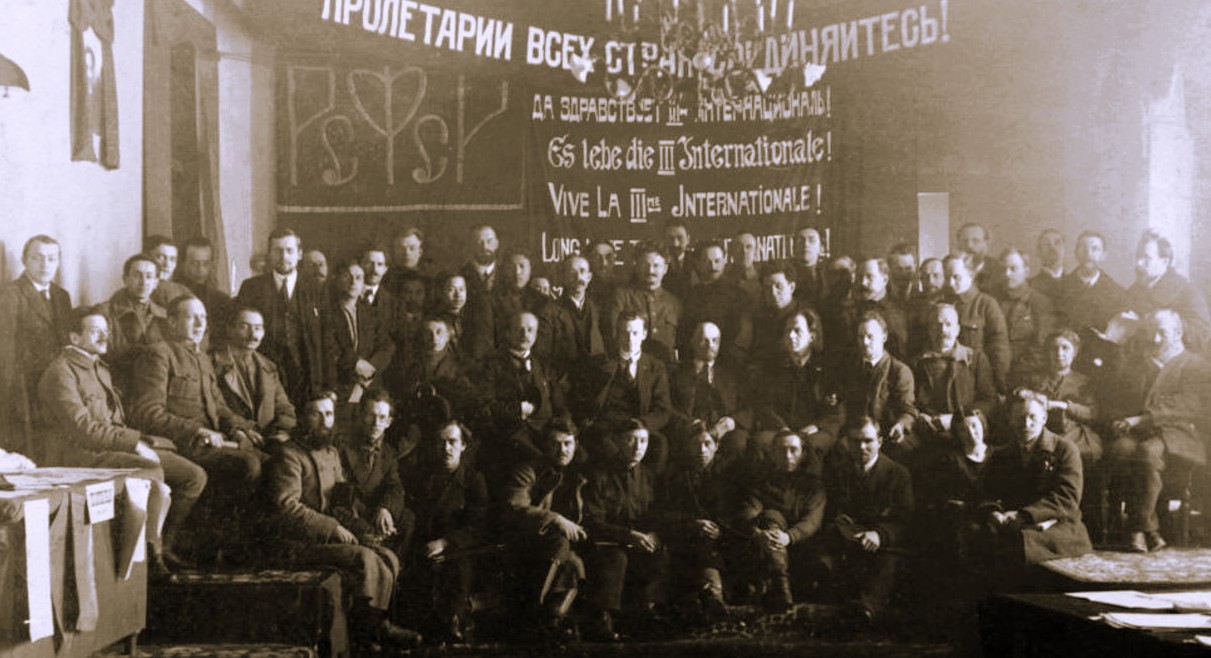
Our movement is, by definition and outlook, internationalist. Our movement’s history is one of internationalism, and its betrayal. The founding conference of the Third International was opened on March 2, 1919 at Moscow in the midst of Civil War, blockade, and intervention, with fifty-two delegates, also listed below, representing dozens of countries and nationalities. The Manifesto was adopted at the end of the gathering, this is its original English translation.
‘Manifesto of the Communist International’ from Communist International. Vol. 1 No. 1. May, 1919.
To the Proletariat of All Lands!
Seventy-two years have gone by since the Communist Party of the World proclaimed its program in form of the Manifesto written by the greatest teachers of the proletarian revolution, Karl Marx and Frederick Engels. Even at that early time, when Communism had scarcely come into the arena of conflict, it was hounded by the lies, hatred and calumny of the possessing classes, who rightly suspected in it their mortal enemy. During these seven decades Communism has traveled a hard road: storms of ascent followed by periods of sharp decline; successes, but also severe defeats. In spite of all, the development at bottom went the way forecast by the Manifesto of the Communist Party. The epoch of the last decisive battle came later than the apostles of the social revolution expected and wished. But it has come.
We Communists, representatives of the revolutionary proletariat of the different countries of Europe, America and Asia, assembled in Soviet Moscow, feel and consider ourselves followers and fulfillers of the program proclaimed seventy-two years ago. It is our task now to sum up the practical revolutionary expense of the working class, to cleanse the movement of its admixtures of opportunism and social patriotism, and to gather together the forces of all the true revolutionary proletarian parties in order to further and hasten the complete victory of the communist revolution.
I.
For a long span of years Socialism predicted the inevitableness of the imperialistic war; it perceived the essential cause of this war in the insatiable greed of the possessing classes in both camps of capitalist nations. Two years before the outbreak of the war, at the Congress of Basle, the responsible Socialist leaders of all countries branded Imperialism as the instigator of the coming war, and menaced the bourgeoisie with the threat of the Socialist revolution—the retaliation of the proletariat for the crimes of militarism. Now, after the experience of five years, after history has disclosed the predatory lust of Germany, and has unmasked the no less criminal deeds on the part of the Allies, the State Socialists of the Entente nations, together with their governments, again and again unmask the deposed German Kaiser. And the German social patriots, who in August, 1914, proclaimed the diplomatic White Book of the Hohenzollern as the holiest gospel of the people, today, in vulgar sycophancy, join themselves with the Socialists of the Entente lands to accuse as arch-criminal the deposed German monarchy which they formerly served as slaves. In this way they hope to erase the memory of their own guilt and the gain the good will of the victors. But alongside the dethroned dynasties of the Romanoffs, Hohenzollerns and Hapsburgs, and the capitalistic cliques of these lands, the rulers of France, England, Italy and the United States stand revealed in the light of unfolding events and diplomatic disclosures in their immeasurable vileness.
The contradictions of the capitalist system were converted by the war into beastly torments of hunger and cold, epidemics and moral savagery, for all mankind. Hereby also the academic quarrel in Socialism over the theory of increasing misery, and also of the undermining of Capitalism through Socialism, is now finally determined. Statistical and teachers of the theory of reconciliation of these contradictions have endeavored for decades to gather together from all corners of the earth real and apparent facts which evidence the increasing well-being of the working class. Today abysmal misery is before our eyes, social as well as physiological, in all its shocking reality.
Finance-capital, which threw mankind into the abyss of war, has itself suffered catastrophic changes during the course of the war. The dependence of paper money upon the material basis of production was completely destroyed. More and more losing its significance as medium and regulator of capitalistic commodity circulation, paper money becomes merely a means of exploitation, robbery, of military-economic oppression. The complete dumb, but everywhere enchains the proletariat, with the single aim of maintaining its own rule? Or will the working class take into its own hands the disorganized and shattered economic life and make certain its reconstruction on a Socialist basis?
Only the Proletarian Dictatorship, which recognizes neither inherited privileges nor rights of property but which arises from the needs of the hungering masses, can shorten the period of the present crisis; and for this purpose it mobilizes all materials and forces, introduces the universal duty of labor, establishes the regime of industrial discipline, this way to heal in the course of a few years the open wounds caused by the war and also to raise humanity to a new undreamed of height.
The national State, which was given a tremendous impulse by capitalistic evolution has become too narrow for the development of the productive forces. And even more untenable has become the position of the small States, distributed among the great powers of Europe and in other parts of the world. These small States came into existence at different times as fragments split off the bigger States, as petty currency in payment for services rendered, to serve as strategic buffer States. They, too, have their dynasties, their ruling gangs, their imperialistic pretensions, their diplomatic machinations. Their illusory independence had until the war precisely the same support as the European balance of power: namely, the continuous opposition between the two imperialistic camps. The war has destroyed this balance. The tremendous preponderance of power which the war gave to Germany in the beginning compelled these smaller nations to seek their welfare and safety under the wings of German militarism. After Germany was beaten the bourgeoisie of the small nations, together with their patriotic “Socialists,” turned to the victorious Imperialism of the Allies and began to seek assurance for their further independent existence in the hypocritical points of the Wilson program. At the same time the number of little States has increased; out of the unity of the Austrian-Hungarian monarchy, out of the different parts of the Czarist Empire, new sovereignties have formed themselves. And these, as soon as born, jump at each others throats on account of their frontier disputes. Meanwhile the Allied Imperialists brought about certain combinations of new and old small States through the cement of mutual hatreds and general weakness. Even while violating the small and weak peoples and delivering them to famine and degradation, the Entente Imperialists, exactly as the Imperialists of the Central powers before them, did not cease to talk of the right of deterioration of paper money now reflects the general deadly crisis of capitalist commodity exchange.
As free competition was replaced as regulator of production and distribution in the chief domains of economy, during the decades which preceded the war, by the system of trusts and monopolies, so the exigencies of the war took the regulating role out of the hands of the monopolies and gave it directly to the military power. Distribution of raw materials, utilization of petroleum from Baku or Roumania, of coal from Donetz, of cereals from the Ukraine; the fate of German locomotives, railroad cars and automobiles, the provisioning of famine-stricken Europe with bread and meat—all these basic Questions of the economic life of the world are no longer regulated by free competition, nor yet by combinations of national and international trusts, but through direct application of military force.
Just as complete subordination of the power of the State to the purposes of finance-capital led mankind to the imperialistic shambles, so finance-capital has, through this mass slaughter, completely militarized not alone the State but also itself. It is no longer able to fulfill its essential economic functions otherwise than by means of blood and iron.
The opportunists who before the war exhorted the workers, in the name of the gradual transition into Socialism, to be temperate; who, during the war asked for submission in the name of BURGFRIEDEN and defense of the Fatherland, now again demand of the workers self-abnegation to overcome the terrible consequences of the war. If this preaching were listened to by the workers Capitalism would build out of the bones of several generations a new and still more formidable structure, leading to a new and inevitable world war. Fortunately for humanity, this is no longer possible.
The absorption by the State of the economic life, so vigorously opposed by capitalist Liberalism, has now become a fact. There can be no return either to free competition nor to the rule of the trusts, syndicates and other economic monsters. The only question is who shall be the future mainstay of state production, the Imperialistic State or the State of the victorious proletariat. In other words, shall the entire working humanity become the feudal bond-servants of the victorious Entente bourgeoisie, which under name of a League of Nations aided by an “international” army and an “international” navy here plunders and murders, there throws a self-determination of all peoples, a right which is now entirely destroyed in Europe and in the rest of the world.
Only the proletarian revolution can secure the existence of the small nations, a revolution which frees the productive forces of all countries from the restrictions of the national States, which unites all peoples in the closest economic co-operation on the basis of a universal economic plan, and gives even to the smallest and weakest peoples the possibility freely and independently to carry on their national culture without detriment to the united and centralized economy of Europe and of the whole world.
The last war, after all a war against the colonies, was at the same time a war with the aid of the colonies. To an unprecedented extent the population of the colonies was drawn into the European war. Indians, Arabs, Madagascans battled on the European continent—what for?—for their right to remain slaves of England or France. Never did capitalist rule show itself more shameless, never was the truth of colonial slavery brought into such sharp relief. As a consequence we witnessed a series of open rebellions and revolutionary ferment in all colonies. In Europe itself it was Ireland which reminded us in bloody street battles that it is still an enslaved country and feels itself as such. In Madagascar, in Annam, and in other countries, the troops of the bourgeois Republic have had more than one insurrection of the colonial slaves to suppress during the war. In India the revolutionary movement has not been at a standstill for one day, and lately we have witnessed the greatest labor strike in Asia, to which the government of Great Britain answered with armored cars.
In this manner the colonial question in its entirety became the order of the day not alone on the green table of the diplomatic conferences at Paris, but also in the colonies themselves. The Wilson program, at the very best, calls only for a change in the firm name of colonial enslavement. Liberation of the colonies can only happen together with liberation of the working class of the capital cities. The workers and peasants not only of Annam, Algeria, Bengal, but also of Persia and Armenia, can gain independent existence only after the laborers of England and France have overthrown Lloyd George and Clemenceau and taken the power into their own hands. Even now in the more advanced colonies the battle goes on not only under the flag of national liberation, but it assumes also an open and outspoken social character. Capitalistic Europe has drawn the backward countries by force into the capitalistic whirlpool, and Socialistic Europe will come to the aid of the liberated colonies with its technique, its organization, its spiritual influence, in order to facilitate their transition into the orderly system of socialistic economy.
Colonial slaves of Africa and Asia! The hour of triumph of the Proletarian Dictatorship of Europe will also be the hour of your liberation!
II.
The entire bourgeois world accuses the Communists of destroying liberties and political democracy. That is not true. Having come into power the proletariat only asserts the absolute impossibility of applying the methods of bourgeois democracy and creates the conditions and forms of a higher working-class democracy. The whole course of capitalistic development undermined political democracy, not only by dividing the nation into two irreconcilable classes, but also by condemning the numerous petty bourgeois and half-proletarian elements, as well as the slum proletariat, to permanent economic stagnation and political impotence.
In those countries in which the historical development has furnished the opportunity, the working class has utilized the regime of political democracy for its organization against Capitalism. In all countries where the conditions for a worker’s revolution are not yet ripe, the same process will go on. But the great middle layers on the farm lands, as well as in the cities, are hindered by Capitalism in their historic development and remain stagnant for whole epochs. The peasant of Bavaria and Baden who does not look beyond his church spire, the small French winegrower who has been ruined by the adulterations practiced by the big capitalists, the small farmer of America plundered and betrayed by bankers and legislators—all these social ranks which have been shoved aside from the main road of development by Capitalism, are called on paper by the regime of political democracy to the administration of the State. In reality, however, the finance oligarchy decides all important questions which determine the destinies of nations behind the back of parliamentary democracy. Particularly was this true of the war question. The same applies to the question of peace.
If the finance-oligarchy considers it advantageous to veil its deeds of violence behind parliamentary vote, then the bourgeois State has at its command in order to gain its ends all the traditions and attainments of former centuries of upper-class rule multiplied by the wonders of capitalistic technique: lies, demagogism, persecution, slander, bribery, calumny and terror. To demand of the proletariat in the final life and death struggle with Capitalism that it should follow lamblike the demands of bourgeois democracy would be the same as to ask a man who is defending his life against robbers to follow the artificial rules of a French duel that have been set by his enemy but not followed by him.
In an empire of destruction, where not only the means of production and transportation but also the institutions of political democracy represent bloody ruins, the proletariat must create its own forms, to serve above all as a bond of unity for the working class and to enable it to accomplish a revolutionary intervention in the further development of mankind. Such apparatus is represented in the workmen’s councils. The old parties, the old unions, have proved incapable, in person of their leaders, to understand, much less to carry out the asks which the new epoch presents to them. The proletariat created a new institution which embraces the entire working class, without distinction of vocation or political maturity, an elastic form of organization capable of continually renewing itself, expanding, and of drawing into itself ever new elements, ready to open its doors to the working groups of city and village which are near to the proletariat. This indispensable autonomous organization of the working class in the present struggle and in the future conquests of different lands, tests the proletariat and represents the greatest inspiration and the mightiest weapon of the proletariat of our time.
Whenever the masses are awakened to consciousness, Workers, Soldiers and Peasants Councils will be formed. To fortify these Councils, to increase their authority, to oppose them to the State apparatus of the bourgeoisie, is now the chief task of the class-conscious and honest workers of all countries. By means of these Councils the working class can counteract that disorganization which has been brought into it by the infernal anguish of the war, by hunger, by the violent deeds of the possessing classes, and by the betrayal of their former leaders. By means of these Councils the working class will gain power in all countries most readily and most certainly when these Councils gain the support of the majority of the laboring population. By means of these Councils the working class, once attending power, will control all the fields of economic and cultural life, as in the case of Russia at the present time.
The collapse of the imperialistic State, czaristic to most democratic, goes on simultaneously with the collapse of the imperialistic military system. The armies of millions, mobilized by imperialism, could remain steadfast only so long as the proletariat remained obedient under the yoke of the bourgeoisie. The complete breakdown of national unity signifies also an inevitable disintegration of the army. Thus it happened, first in Russia, then in Austria-Hungary, then in Germany. The same also is to be expected in other imperialistic States. Insurrection of the peasants against the landowner, of laborer against capitalist, of both against the monarchies or “democratic” bureaucracy, must lead inevitably to the insurrection of soldier against commander and, furthermore, to a sharp division between the proletarian and bourgeois elements within the army. The imperialistic war which pitted nation against nation, has passed and is passing into the civil war which lines up class against class.
The outcry of the bourgeois world against the civil war and the red terror is the most colossal hypocrisy of which the history of political struggles can boast. There would be no civil war if the exploiters who have carried mankind to the very brink of ruin had not prevented every forward step of the laboring masses, if they had not instigated plots and murders and called to their aid armed help from outside to maintain or restore their predatory privileges. Civil war is forced upon the laboring classes by their arch-enemies. The working class must answer blow for blow, if it will not renounce its own object and its own future which is at the same time the future of all humanity.
The communist parties, far from conjuring up civil war artificially, rather strive to shorten its duration as much as possible—in case it has become an iron necessity—to minimize the number of its victims, and above all to secure victory for the proletariat. This makes necessary the disarming of the bourgeoisie at the proper time, the arming of the laborers, and the formation of a communist army as the protector of the rule of the proletariat and the inviolability of the social structure. Such is the Red Army of Soviet Russia which arose to protect the achievements of the working class against every assault from within or without. The Soviet Army is inseparable from the Soviet State.
Conscious of the world-historic character of their mission, the enlightened workers strove from the very beginning of the organized socialistic movement for an international union. The foundation-stone of this union was laid in the year 1864 in London, in the first International. The Franco-Prussian War, from which arose the Germany of the Hohenzollerns, undermined the First International, giving rise at the same time to the national labor parties. As early as 1889 these parties united at the Congress of Paris and organized the Second International. But during this period the center of gravity of the labor movement rested entirely on national ground, confining itself within the realm of national parliamentarism to the narrow compass of national states and national industries. Decades of organizing and labor reformism created a generation of leaders most of whom gave verbal recognition to the program of social revolution but denied it in substance. They were lost in the swamp of reformism and adaptation to the bourgeois state. The opportunistic character of the leading parties of the Second International was finally revealed—and led to the greatest collapse of the movement in all its history—when events required revolutionary methods of warfare from the labor parties. Just as the war of 1870 dealt a deathblow to the First International by revealing that there was not in fact behind the social-revolutionary program any compact power of the masses, so the war of 1914 killed the Second International by showing that above the consolidated labor masses there stood labor parties which converted themselves into servile organs of the bourgeois state.
This includes not only the social patriots who today are openly in the camp of the bourgeoisie as preferred confidential advisers and reliable hangmen of the working class, but also the hazy, fickle and irresolute socialist Centre which is today trying to revive the Second International, i.e., the narrowness, opportunism and revolutionary impotence of their predecessors. The Independents of Germany, the present Majority of the Socialist party in France, the Independent Labor Party in England, and similar groups, are actually trying to re-establish themselves in the position which the old official parties of the Second International held before the war. They appear as before with proposals of compromise and conciliation and hereby paralyze the energy of the proletariat, lengthening the period of crisis and consequently increasing the misery of Europe. War against the Socialist Centre is a necessary condition of successful war against Imperialism.
Spurning the half-heartedness, hypocrisy and corruption of the decadent official socialist parties, we, the Communists assembled in the Third International, feel ourselves to be the direct successors of the heroic efforts and martyrdom of a long series of revolutionary generations from Baboeuf to Karl Liebknecht and Rosa Luxembourg. As the First International foresaw the future development and pointed the way; as the Second International gathered together and organized millions of the proletariats, so the Third International is the International of open mass-action of the revolutionary realization, the International of deeds. Socialist criticism has sufficiently stigmatized the bourgeois world order. The task of the International Communist Party is now to overthrow this order and to erect in its place the structure of the socialist world order. We urge the working men and women of all countries to unite under the Communist banner, the emblem under which the first great victories have already been won.
Proletarians of all lands! In the war against imperialistic barbarity, against monarchy, against the privileged classes, against the bourgeois state and bourgeois property, against all forms and varieties of social and national oppression—UNITE!
Under the standard of the Workingmen’s Councils, under the banner of the Third International, in the revolutionary struggle for power and the Dictatorship of the Proletariat, proletarians of all countries UNITE!
Delegates
Delegates with Decisive Vote
Communist Party of Germany, Max Albert [Hugo Eberlein].
Russian Communist Party V.I. Lenin, L.D. Trotsky, G. Zinoviev, I.V Stalin, N.I. Bukharin, G.V. Chicherin, with consultative vote: V. V. Obolensky [N. Osinsky], V.V. Vorovsky.
Communist Party of German Austria I. Gruber [Karl Steinhardt], K. Petin.
Communist Party of Hungary Endre Rudnyanszky.
Swedish Left Social Democratic Party Otto Grimlund.
Norwegian Social Democratic Party Emil Stang.
Swiss Social Democratic Party (Opposition) Fritz Platten.
American Socialist Labor Party Boris Reinstein.
Balkan Revolutionary Social Democratic Federation (Bulgarian Tesnyaki and Romanian Communist Party) Christian Rakovsky.
Communist Party of Poland Jozef Unszlicht.
Communist Party of Finland Yrjo Sirola, Kullervo Manner, Otto Kuusinen, Jukka Rahja, Eino Rahja.
Communist Party of the Ukraine N.A. Skrypnik, S.I. Gopner.
Communist Party of Latvia Karl Gailis.
Communist Party of Lithuania and Belorussia Kazimir Gedris.
Communist Party of Estonia Hans Pogelman.
Communist Party of Armenia Gurgen Haikuni.
Communist Party of the German Colonists in Russia Gustav Klinger.
United Group of the Eastern Peoples of Russia Gaziz Yalymov, Hussein Bekentayev, Mahomet Altimirov, Burhan Mansurov, Kasim Kasimov.
Zimmerwald Left of France Henri Guilbeaux.
Delegates with Consultative Vote:
Czech Communist Group Jaroslav Handlir
Bulgarian Communist Group Stojan Dyorov
Yugoslav Communist Group lliya Milkic
British Communist Group Joseph Fineberg
French Communist Group Jacques Sadoul
Dutch Social Democratic Group S.J. Rutgers
American Socialist Propaganda League S.J. Rutgers
Swiss Communist Group Leonie Kascher
Sections of the Central Bureau of Eastern Peoples:
Turkestan Gaziz Yalymov
Turkish Mustafa Subhi
Georgian Tengiz Zhgenti
Azerbaijani Mir Djafar Baguirov
Persian Mirza Davud Bagir-Uglu Gusseinov
Chinese Socialist Workers Party Liu Shaozhou, Zhang Yongkui
Korean Workers League Kain
Zimmerwald committee Angelica Balabanoff
The ECCI published the magazine ‘Communist International’ edited by Zinoviev and Karl Radek from 1919 until 1926 irregularly in German, French, Russian, and English. Restarting in 1927 until 1934. Unlike, Inprecorr, CI contained long-form articles by the leading figures of the International as well as proceedings, statements, and notices of the Comintern. No complete run of Communist International is available in English. Both were largely published outside of Soviet territory, with Communist International printed in London, to facilitate distribution and both were major contributors to the Communist press in the U.S. Communist International and Inprecorr are an invaluable English-language source on the history of the Communist International and its sections.
PDF of full issue: https://www.marxists.org/history/international/comintern/ci/old_series/v01-n01-1919-CI-grn-goog-r2.pdf
 Revolution's Newsstand