
Weekly newsletter containing many nuggets of I.W.W. and social history of the National Industrial Union of Textile Workers, which at the time provided the wobblies their majority of women members nationally and their strongest concentrations in the East. This week has news from Boston, Lowell, Fall River, New Bedford, Fitchburg, Holyoke, in Massachusetts, Baltimore, Rochester, New York and Greenville, South Carolina, Woonsocket, Rhode Island and Norwalk, Connecticut.
‘News Of the Textile Locals’ from Solidarity. Vol. 5 No. 225. May 2, 1914.
Evidences of Renewed Activity All Along The Line Of The National Industrial Union
BOSTON, Mass., April 21. LAWRENCE, MASS., No. 20. Considerable activity is reported from this district in the way of organization work, strikes and agitation.
About ninety-five unorganized dye house workers with knowledge of I.W.W. tactics were able to close one of the largest plants in the city and at one time during the fight it appeared as if the Pacific mill, that is the name of the plant that was affected, would have to close its entire set of mills. It was a big surprise for the mill-owners and as a result they are not looking for trouble at this time. The local secretary reports that a monster parade will be held May 1st with thousands in line in celebration of the Labor Day of the working class.
From the New Bedford local comes the news that a big strike is liable to break out at any time owing to the low wages paid the majority of the weavers and the other textile workers of that city. Even the conservative craft unions are preparing for action.
BOSTON, Mass., No. 190. A bitterly contested strike was recently brought to a close by the above local with a complete victory for the strikers. During the fight twenty-five active members were placed under arrest and given jail sentences or made the victims of excessive fines. Many of the cases were appealed to the higher court, among others being Henry D. Cohen, who was given a sentence of six months by the judge in the lower court. At this writing the local not only has to meet the little shop bosses but also the reactionary. A.F. of L. business agents if victory is to be won. The strike mentioned above was in the St. Louis Raincoat factory.
ROCHESTER, N.Y., No. 191. The local at Rochester has had many difficulties to contend with during the last two months, owing to the tactics of certain business agents of the United Garment Workers. One of these fellows managed to lead some of the members away from the I.W.W. by making an appeal to religion and the flag, but those same members when they learned that they were being played for so many suckers, beat it back to the I.W.W. in a hurry with the resolve that if that business agent puts in an appearance he will learn something about the I.W.W.
BALTIMORE, No. 192. This local has had Fellow Worker Ettor on the job for the last three weeks, agitating and organizing among the garment workers of Baltimore. The members are preparing for their yearly celebration of May 1st and expect to have William D. Haywood as one of the speakers during the grand turnout.
From the Fitchburg, Mass., district comes the news that the John Golden outfit is endeavoring to disorganize the forces of the mill workers by planning with the reactionary wing of the Socialist party to herd the textile workers of Fitchburg and vicinity into small craft unions. So far they have not been very successful owing to the activity of the militants of the I.W.W. who are working in the mills of this district.
FALL RIVER, MASS., No. 204. A free speech fight will be conducted in this city during the summer months if the police continue their present tactics. Conditions are such that the members cannot even hire a hall in the city for an I.W.W. meeting, while all street meetings are out of the question at this stage of the fight. The patience of the active members is at breaking point and as a result plans are under way to have as many unemployed textile workers make Fall River during the summer, and make free speech possible and put the city on the free speech list.
Under this head it might be interesting, to the members to know that one of the bitterest enemies of the I.W.W., the Rt. Rev. James E. Cassidy, V.G., has stated that the average wage of the textile workers at Fall River is not higher than eight dollars a week and is forced to admit that it is not enough to support a family on in decency. It is evident that he is coming down off his high horse. This same man in an indirect manner admitted that the I.W.W. will lead the next revolt at Fall River. His statement is as follows: “Then we will have the I.W.W. wild eyed and wild mouthed in our midst, because honest labor has got to force dishonest capital to give what belongs to it.”
In reference to wages paid he has the following to say:
“The average of the unskilled labor of this city is not higher than $3.00 a week. Is that a sufficient wage for the head of any family? Is that a sufficient return for the labor he gives? Does that enable him to provide food and shelter and clothing of a proper kind for himself and family? No, I don’t think that there is a man or woman here who does not feel that the mill owners can pay more if they want to.”
HOLYOKE, MASS., No. 205. Report has been received from this district to the effect that the Farr Alpaca Company has inaugurated a profit sharing plan whereby the workers will receive a wage dividend on the actual year’s wages received, reckoned at the same rate per cent as the shareholders of the company receive in cash dividends on their stock.
The circular issued by the company, however, goes on to say:
“Any on the Profit Sharers’ List who may be discharged, or who may leave our employ, or shall be deemed unsatisfactory, during the twelve months period, will forfeit all claim to share in the division of profits that year.”
The active members are doing good work at the present time and a big local will soon be the result. The industries of Holyoke are as follows: Paper mills, cotton and woolen factories. An active bunch are always on the job and workers seeking employment there with the interest of the I.W.W. at heart are advised to assist in spreading the propaganda of the one big union.
LOWELL, MASS., No. 436. Active member sends in report that Greeks returning from the war have caused a glut on the labor market so far as the textile industry is concerned and advises all textile workers to avoid Lowell until further notice. In the meantime the local is beginning to hold meetings among the unorganized with good results.
GREENVILLE, S.C., No. 512. One of the members of this local has forwarded statement to this office that many of the weavers are operating 24 Draper Looms and on cloth known as 80 times 80 meaning 80 picks to the inch and 80 warp threads to the inch, that for weaving a cut 126 yards long the weaver receives 30c and it takes four days to weave a cut weavers can easily figure out the wages paid these men and women who weave cloth for the southern mill owners.
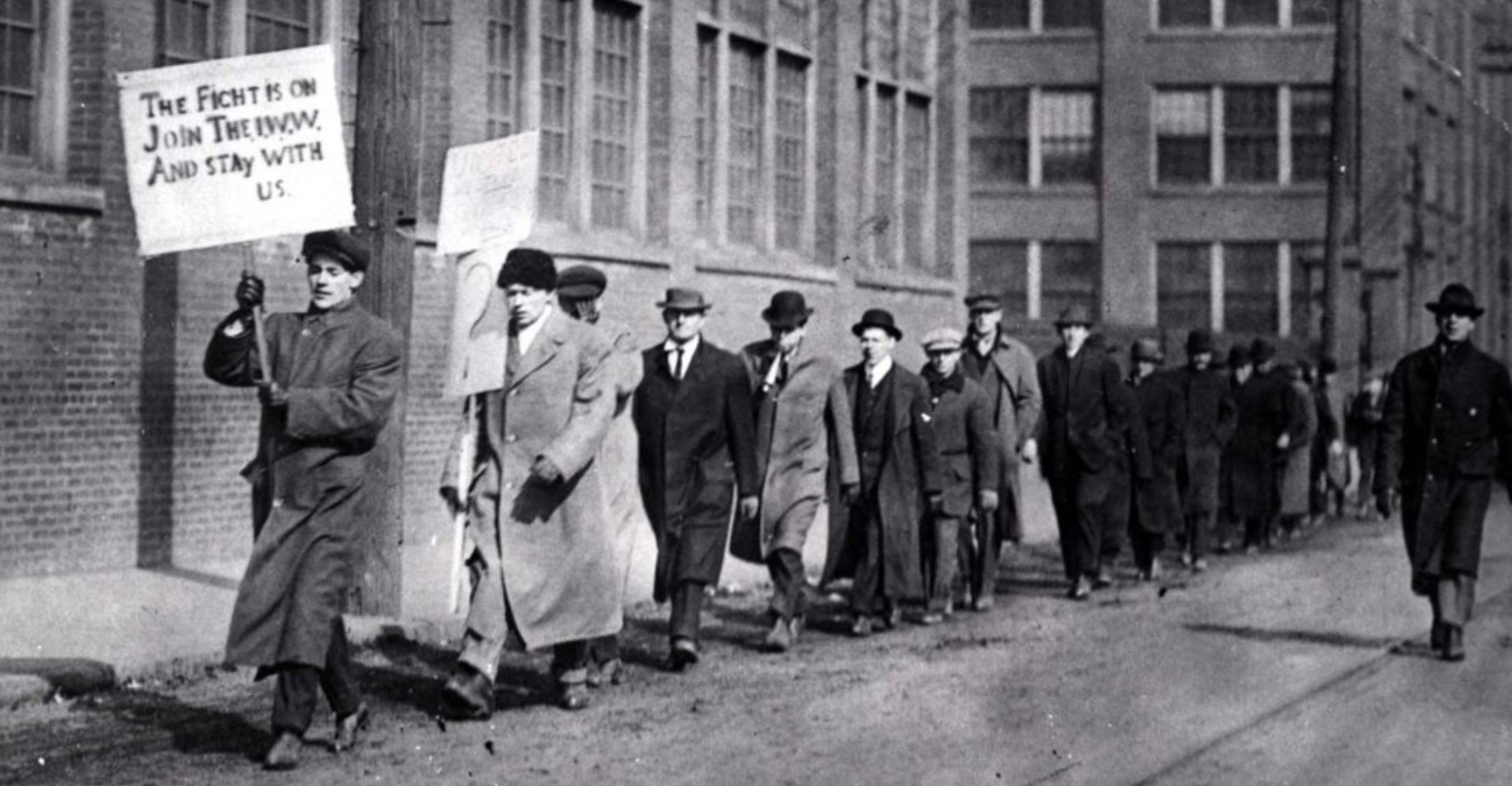
WOONSOCKET. R.I, No. 513. A strike has been on in this mill town since Mar. 19th. The strikers have issued the following appeal to all textile workers:
CALL TO ALL THE WEAVERS Dressers, Spinners, and Piecers of All the Factories Around.
Comrades and Workers:
Since a few weeks back a strike was declared at the Montrose Woolen Co. of Woonsocket. The exigencies of the company having pushed the help to the last limit the workers have been forced to take this last, supreme resolution.
Weaving fancys on two looms, with 5 and 6 shuttles, single filling, there is the conditions under which the weavers were obliged to earn their daily bread. Besides, in a little while the weavers will also be obliged to weave white goods on 6 looms, which will cut out two heads of families out of three.
This is the situation the weavers have answered to by a strike. By not making any filling for those working in the place of the strikers, the spinners and piecers of the Alsace Worsted Co., which is under the same management of the Montrose, refused to work, and are also on strike.
For a just cause, the weavers, spinners and workers of everywhere, must not present themselves to get work in either of the two mills.
Outside of the sympathy of the public, who is in favor of the strikers it is hoped that everyone should come in aid of those who suffer now, but the worst is still to come and they are ready to endure for a good cause.
We have decided to fight to the end, we are not asking for anything, only the right to work at the same conditions that they are working elsewhere. We sincerely believe that our call will be heard from everyone and that no one will come and take our places, before having full and entire satisfaction.
All the women and girls who worked at the Montrose Woolen Co., went out also, so as not to finish the work done by the strike breakers. Signed:
The Weavers of the Montrose Woolen Co. The Spinners and Piecers of the Alsace Worsted Co.
At this writing it appears as if a general strike will break out in Woonsocket in the very near future owing to the fact that the mill men are reducing the wages of the workers or else increasing the amount of work without an increase in wages. The workers have determined to resist to the bitter end and as a means to prevent the bosses’ imposition the workers are standing together, absolutely refusing to scab on one another as the circular well says, that the other workers in the mill will not handle scab material, with the result a solidarity strike is in progress. It has been reported that the Governor of the State is treasurer of the two mills mentioned in the circular issued by the strikers. These workers know how to conduct their own fight; and a local union connected with the Golden organization has served notice on him, by sending charter back with advice to keep away from the city. The strikers, many of them in no way connected with the I.W.W., are, however, adopting its tactics with good effect.
NORWALK, CONN., No. 535. This local has had another strike since the last issue of the News Letter. It appears that the boss discharged one of the weavers for cutting out a warp, and as a means of having him reinstated all the weavers left in a body. The mill bosses then had the discharged weaver arrested.
The lawyer’s report on the case reads as follows:
“Dear Sirs: I have been requested to give you the facts in the case of State of Connecticut vs. Anthony Markisz. The accused in this case is charged with willfully injuring and destroying certain silk threads owned by Richard Muller and used in the manufacture of silk.
“The State produced a number of witnesses to prove this accusation, among whom were Theodore Soderland, the assistant foreman; John Jones, superintendent of the Gloria Mills; Richard Muller, the owner of the Gloria Mills, and John Miller, loomfixer.
“These witnesses testified in substance that the accused cut the edges of his warp and also the warp body: that by so doing he violated the rules of the company and destroyed the silk in question. These witnesses testified that the value of the silk destroyed was about $1.00 and $2.00 additional expense for extra time lost in re-threading, etc.
“The accused in this case denies absolutely that he violated any rule of the company and states that he finished his warp and thought he would assist the twister by cutting the body warp; that he had not destroyed any silk; that the balance of the roller was left after he had finished his warp; that he had oftimes seen others, employes, cut and do the very same thing that he had in this case, and no one had ever been arrested in these cases.
“There were witnesses who went upon the witness stand and testified in substance that they themselves had cut the warp in the manner in which the accused had done in this case and that nothing was said to them.
“That after he had finished his warp he brought the same to the Office to be measured as is usually done, and the employers claimed that the warp was seven yards short. He denied the same then and there and he was allowed to continue to work the next day until 10 o’clock, when he was told to come to the office that they desired to see him there.
“He did so and was paid his weekly wages and discharged.
“Whereupon the other employees, learning of his discharge, and feeling that it was unwarranted, all left in a body.”
The next we hear is the arrest of this accused.
“The lower court who heard the facts of this case found him guilty and imposed a sentence of thirty days in jail, from which judgment the accused has taken an appeal to the next term of the Criminal Court of Common Pleas. which convenes on the first Tuesday of April 1914 at Bridgeport, Conn.
“I am of the opinion that if the state insists upon going to a trial in this case before a jury he will not be found guilty and on the contrary will be found not guilty.
“I do not believe that there is a jury in the wide world that would convict this man on this charge under) these circumstances.”
(Signature of Lawyer.) The fellow workers at Norwalk are asking your assistance in order that they may be able to fight this case in the courts. Textile workers should) come to the aid of this Fellow Worker with financial assistance thru this office.
THOMAS HOLLIDAY. Sec.
The most widely read of I.W.W. newspapers, Solidarity was published by the Industrial Workers of the World from 1909 until 1917. First produced in New Castle, Pennsylvania, and born during the McKees Rocks strike, Solidarity later moved to Cleveland, Ohio until 1917 then spent its last months in Chicago. With a circulation of around 12,000 and a readership many times that, Solidarity was instrumental in defining the Wobbly world-view at the height of their influence in the working class. It was edited over its life by A.M. Stirton, H.A. Goff, Ben H. Williams, Ralph Chaplin who also provided much of the paper’s color, and others. Like nearly all the left press it fell victim to federal repression in 1917.
PDF of full issue: https://www.marxists.org/history/usa/pubs/solidarity-iww/1914/v05-w225-may-02-1914-solidarity.pdf
 Revolution's Newsstand