
Before uniting into the Workers Alliance in 1936, there were three national unemployed organizations during the Great Depression: The Communist Party-led Unemployed Councils, the Socialist Party-led Worker’s Alliance, and the C.P.L.A.-led National Unemployed League. Louis Breier of A.J. Muste’s Workers Party tells the story of the National Unemployed League founded in 1933 in four parts below.
‘Building The National Unemployed League’ by Louis Breier from New Militant. Vol. 1 Nos. 3, 4, 6, 8. December 15, 1934-February 2, 1935.
(Ed. Note. This is the first of a series of articles on the history and methods of the National Unemployed Leagues, the strongest and most substantial organizations in the unemployment field.)
I. History and Methods.
A brief history of the National Unemployed League necessarily involves a history of the unemployed movement as a whole. As it stands today, the N.U.L. represents the highest point in a long process of development and transition from the first, uncertain attempts of the “technically” unemployed to organize on a “Self-Help” or “Chiselling” basis in 1929 to class-conscious and militant organizations with policies of cooperation in struggles of the employed workers (and leadership, as in the case of the famous Toledo Auto-parts strike) and a trend to political consciousness.
The earliest history of the unemployed movement must be classified according to the methods used. Roughly, therefore, we may divide it as follows: a) Self-Help, b) Mass-Pressure, c) United action with the employed workers and a growing political consciousness. None of these stages should be taken as utterly distinct. They are progressive stages and the political stage, of course, combines with the Mass-Pressure stage. There are, however, Mass-Pressure groups that have failed as yet to derive political clarity from their activities. And though Self-Help organizations have largely ceased to exist, the remaining examples manage to eke out a precarious life by virtue of adding a measure of Mass-Pressure tactics to their “Barter” or “Chiselling” policies.
Furthermore it should be noted that many of the thriving organizations never went through the first or “Chiselling” stage, but were organized directly as Mass-Pressure groups. Such, for example, was the case with many of the leagues affiliated with the National Unemployed League, which were organized by the Conference for Progressive Labor Action. But on the whole, the characteristic history of an unemployed organization is its formation on a Self-Help basis, its development into a Mass-Pressure organization through realization of the futility of self-help tactics and its transition to a stage combining militant tactics with a progressive political understanding.
“Self-Help” and Barter Schemes
Three years ago, then, the greater portion of the unemployed movement was comprised of Self-Help organizations. The philosophy that called these organizations into being (and received the full support of President Hoover, the Chamber of Commerce and all the local organizations of conspicuous mercy) can be condensed as “Planned Economy in Garbage-picking.” Unemployment was a temporary aberration on the part of capitalism, man’s noblest institution, and the one purpose of these groups was to tide the unemployed over from the Crash to the Prosperity that was just around the corner. To that end they were put to work chiselling scraps of meat, bread, odd clothing remnants etc. from the merchants; offering their services to farmers during harvest time in return for a share of the crop; clearing forest tracts for the privilege of burning brushwood and scrub. Later, when the patience of merchants began to wear thin and the federal government peeked at the unemployment problem and decided to handle it, as the Agricultural Department handles insect pests, by charts and advice, the Barter system began to supplement Self-Help.
At this stage it was no longer supposed that Prosperity was hiding behind a curtain like an old maid stretching out the anticipation of a kiss as long as possible. Instead it was thought that Capitalism was a trifle “tired” and needed only to be primed by an artificial resumption of services and the distribution of commodities (a nice homespun metaphysic since adopted by the NRA). The Barter system was guaranteed to do this, by what. devious economic law does not concern us here, and elaborate systems were set-up in various parts of the country, reaching its highest stage of development in Seattle, where the Unemployed Citizens League was able to put its members to work in abandoned factories, canneries, fisheries, etc. The strong family resemblance of this scheme! to Sinclair’s “Epic Plan” and the government’s “Ohio Plan” should be noted. Distribution of the products ranged from the simple “share and share alike” method to the use of scrip.
From “Self-Help” to Mass Pressure
The publicity given to the Self-Help and Barter movement was copious and generally friendly and called many such organizations into existence. A few of the localities and organizations involved were: Seattle, Tacoma and other parts of Washington; the California Cooperative Relief Association concentrated in the southern part of the state; the Natural Development Association of Utah which later spread into Idaho and Colorado. There were local Self-Help organizations in Philadelphia, Allentown, Dayton and a number of other) cities. The Mutual Exchange with headquarters in New York was an effort to coordinate the Self-Help movement on a national scale.
While most of these groups rapidly disintegrated under the impact of objective realities or were snapped up by enterprising old-line politicians (as was the case with the Seattle organization) others provided the base for the development of Mass-Pressure groups, going through the transition already described. Examples are Allentown and Belmont County, Ohio. In Allentown efforts were made from the very inception of the organization to substitute Mass-Pressure for Self-Help but the membership blithely continued to pick peaches on neighboring farms until by the sheer pressure of circumstance and peace juice these tactics were suddenly dropped and attention was turned to the business of stopping evictions by mass-demonstrations, buying sheriffed farms for a nickel. boosting relief schedules by invading relief offices, etc. Trucks, buildings and other paraphernalia cheerfully contributed to the Allentown league by the city government and the local civic leaders as a reward for chasing its own tail, are now used to transport pickets and demonstrators; the buildings harbor every manner of “dangerous doctrine”.
C.P.L.A. Enters Field
When the Conference for progressive Labor Action entered the unemployed field, it advocated pressure on the state and federal governments and public officials for direct and substantial relief and the unity of the unemployed and employed on the industrial front. At the same time the Communist Party, in the field since 1929, had demonstrated its inability to organize their Unemployed Councils outside of the large, industrial cities, especially in the smaller cities and towns and in rural areas. Unemployed Councils were success fully organized, they demonstrated a remarkably brief span of life, due undoubtedly to the familiar C.P. policies of mechanical control and wholesale indoctrination. The National Hunger Marches of 1930 and 1931 as well as several state marches and demonstrations in the larger cities afforded the general impression that the C.P. was leading an effective fight for the unemployed and achieving an inclusive organization.
The Socialist Party, after a long period during which it regarded the unemployed with mingled friendliness and indifference, made its bid for leadership by the organization of the Chicago Workers Committee and the publication of the “Unemployed”, a magazine which gave out the news that the unemployed could vote themselves out of the bread lines and which terminated publication after three issues. However, any analysis of the unemployed situation revealed the fact, that in spite of claims to the contrary, the vast majority of the unemployed remained unorganized and were not following either C.P. or S.P. leadership, or were dedicated to the various Self-Help and Self-Flagellation schemes. There was no effective national organization.
Moves for National Organization
The S.P. recognized the need for unifying national organization even as the C.P.L.A. did. But their solution to the problem was to set up a loose federation of unemployed groups through a conference of the top leadership–a device which the S.P. seems unable to abandon and which they are attempting to use at the present time. A preliminary conference to set up a National Federation to which unemployed leaders were invited was held in Chicago in November of 1932. The formal conference was not held until the May of 1933, following the Continental Congress white elephant in Washington.
In the meantime, the C.P.L.A. was placing most of its forces into the organization of the unemployed, especially concentrating on the building of the Ohio Unemployed League. A conference of local leagues was held in Niles, Ohio on October 9, 1932 which was followed by a convention on November 6, 1932 when a temporary state organization was established. This much accomplished, an intensive organization drive was instituted which culminated in the convention in Columbus on February 27-28, 1933 when the state league was finally instituted by delegates from leagues in most of the counties, cities, villages and hamlets in Ohio.
It was this convention that determined to call a National convention of the unemployed on July 3-5. To insure the widest possible rank and file representation and to avoid another still-born aggregation of scattered groupings, the call to the national convention stipulated that 5 delegates were to be sent from each local league. The distribution of this call stimulated organization of leagues in Pennsylvania, North Carolina, West Virginia and other states. It was also sent to every established organization of the unemployed which the Ohio league could contact.
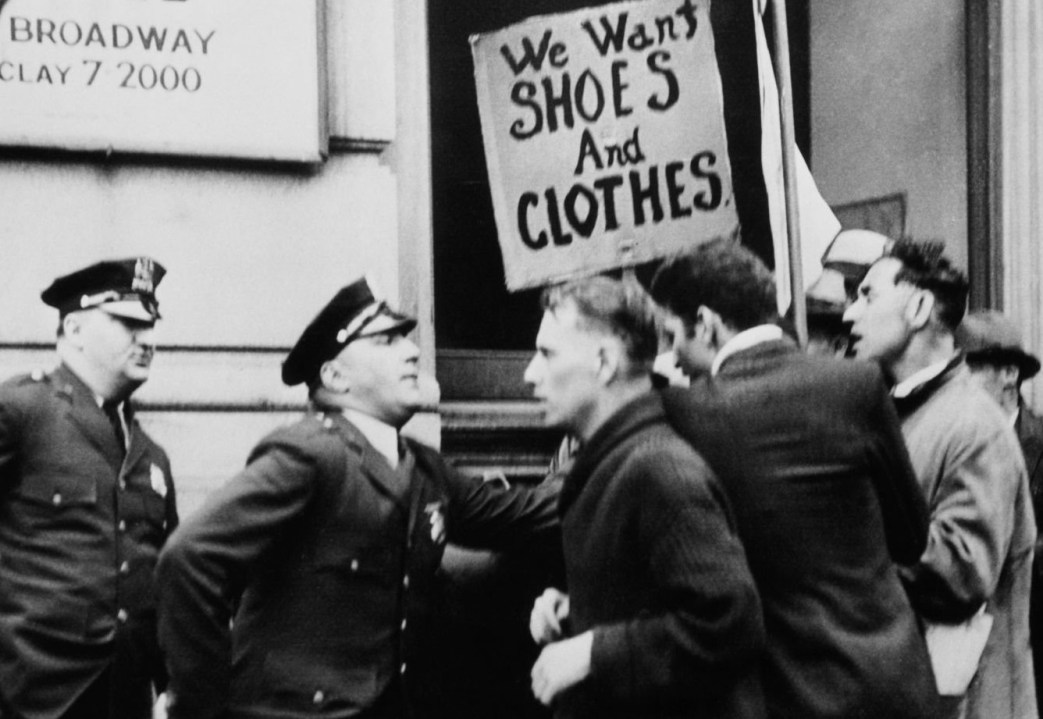
II. First National League Convention Stormy Test of “American Approach.”
The convention that founded the National Unemployed League is worth considering in some detail not only because its results were far-reaching and lasting, but also because its stormy and colorful sessions revealed the dangers threatening the movement then, as they do now. Fascism, partisan-inertia, jingoism and a horde of, crack-pot political schemes, any one of which was sufficient to wreck the convention and the movement itself, combined into a desperate onslaught against the building of a militant, nation-wide organization, of the unemployed.
Backgrounds
The beginnings of the widely discussed and much more widely slandered “American Approach” are probably to be found in the C.P.L.A. conception of unemployed activity. It represented a definite and realistic manner of directing and participating in the work of the leagues, of carrying on the day by day struggles, of raising the political level of the workers and of building a solid and progressive basis for the ultimate conflict–against unemployment and all other problems confronting the working masses. It was this which distinguished C.P.L.A. practice and insured the steady growth of the Leagues.
How Others Work
Some mention has already been made of the methods favored by the Communist and Socialist parties. In their direction of the Unemployed Councils the C.P. made few concessions to the regular “party line” Mechanical control of the organizations and wholesale indoctrination of the members while they “stick” is characteristic of their work in this field as among the trade unions.
The tactics of the Socialists differ from those of the Communist Party only by the addition of their usual smugness and the myth of their superior regard for “Democracy”. Because of this, mechanical control as practiced by the S.P. exceeds anything that even Amter or Benjamin ever hoped to get away with.
Appearing before the executive committee of the NUL last August to present the case for a “new national organization” David Lasser, president of the Socialist-controlled Workers Unemployed Union, stated frankly that he does not believe in rank and file conventions even for the purpose of resolving so important a problem as the formation of a new national unemployed organization, but prefers conferences of the top leadership because “they get more work done with less fuss”.
The “American Approach”
Although their tactics placed them in the position of an artist attempting to portray the moon with a mop, the C.P. conception of the purpose of work among the unemployed on the part of a revolutionary party was always sound. It is the business of the class-conscious, revolutionary elements in these organizations to make them militant, effective instruments for struggle against all forms of immediate repression, and to turn the faces of the unemployed toward the larger battle. This was always the philosophy underlying the work of the CPLA.
But philosophy as such never meant anything to the CPLA. Philosophy had to be confirmed in action and there had to be mass organizations before there could be any action.
In a series of articles written for Labor Age in 1931 Louis Budenz, who popularized the term “American Approach”, laid down the program for unemployed organization. Leagues, he said, must be mass organizations in the fullest sense of the term. CPLA elements in these organizations must not repeat the doctrinaire and factional mistakes of the C.P. and the S.P. They were to work to increase the effectiveness of the Leagues in their daily battles for immediate demands and, on the strength of their superior leadership and consistent realism, raise the political level of the masses, reveal the class-struggle, and lay a firm basis for their participation in the coming struggle for a workers’ world. During the first national convention of the Leagues, when Fascist elements seemed to have gained complete control and it was necessary to pronounce the name of Marx in very soft tones and with a great deal of head pivoting, several of the leaders of the Unemployed Councils who were present blamed the “American Approach” for it. The CPLA, they said, had substituted flag-waving for Marxism and those roaring patriots in the convention were only a natural consequence of social-fascism.
But these dervishes of the true faith were wide of the mark. It was not the “American Approach” that was at fault; it, was America. As we have shown, the unemployed leagues were all-inclusive.
The restrictions on membership were only against old party politicians and bosses of any category. These restrictions, however, could not exclude stool pigeons, provocateurs, spies, fascist agents, etc. They came in and did their work among the members until they were exposed or until the growing political consciousness of members themselves made them impervious to this poison.

It was the latter condition for which the CPLA worked. In the leagues, as in the general American scene, the effectiveness of a revolutionary organization is based on its ability to win the confidence and leadership of the masses as against the misleadership of the demagogues and fascists. The CPLA was not afraid to face this fact. It did not want another radical tea club. It wanted a mass organization. And it was willing to stake everything on the correctness of its tactics and its ability to lead the workers. The national convention was the test, not only of the courage and integrity of the CPLA but also on a minor scale of the ability and promise of the new party which has emerged from the combined experiences of the CPLA and the Communist League.
Next week we will see what happened at the first national convention of the Leagues.
III. How NUL Convention Nipped Fascist Attack.
The first session of the national convention in Columbus was called to order on July 3, 1933. Eight hundred delegates were present from thirteen states. The largest delegation to the convention was from the Ohio Unemployed League which had met in convention only a few days previously. This was an important factor in the events that followed. The O.U.L. was by far the largest league in the country and a good portion of its territory had been newly organized. There had been little time for that weeding-out process that follows the establishment of a new league eventually eliminates the shady elements and the wardheelers. They were present in force.
The session opened peacefully enough. Bill Truax, president of the Ohio league, made the initial speech in which he welcomed the delegates and pointed to the main task–building the N.U.L. During the course of his speech Truax made several characteristic statements on the condition of the country in which the government and the interests that control it were roundly and hilariously spanked. This was the cue for the spies and provocateurs. They scurried about the vast fairground show-ring that served as the meeting-hall–and the whispering began, This increased during succeeding speeches and when Arnold Johnson, secretary of the Ohio league and subsequently of the N.U.L., arose to outline the tasks facing the unemployed, the whispering had grown to a sort of subterranean roaring. The outburst came at the conclusion of Johnson’s speech. What he said has been lost to the theoreticians, but whatever it was a number of the delegates promptly construed it as an insult to the flag and a handful of picked men made a dash to the speakers’ stand–ostensibly to avenge the insult on Johnson’s person. A cordon of unemployed workers and C.P.L.A. members, however, swiftly formed around Johnson and the attack dissipated in a cloud of challenges and oratory. This continued for the greater part of the day–speaker after speaker coming forward to reiterate his abiding faith in the noble system that somehow, in spite of its nobility, made it necessary for them to join unemployed leagues in order to fight for a scrap of bread.
The Workers Guard
When a committee of the Ohio league attempted to procure the Columbus state fair-grounds for the convention they were told that they might have it only if a detachment of the National Guard could “guard” the place. The committee refused and made a counter-offer. They would create a guard of their own–workers from the leagues. This was accepted and the guard was chosen from among the members of the Franklin County unit. It was empowered to choose its own captains and leader. But before the election the fascists had been busy–and when the election came their men were chosen as captains and Joe Gershner, police-spy, professional strike-breaker and railroad detective was appointed the leader. He promptly armed the guard with clubs and was himself fitted out with a cartridge belt and a huge pistol. When the delegates poured into the convention, each one was carefully scrutinized by Gershner and his men, who took up posts at the entrances. When the hysteria broke out Gershner and his Lieutenant Bragg led their guard into the convention hall.
The July 3 session closed with the singing of the “Star-spangled banner” and a warning to all Reds to stay away from the fair-grounds on the next day, July 1. Nothing had been accomplished. There was not even a chairman, and the large presidium could find no one with temerity enough to accept the ungrateful task. There was good reason to believe that the July 4 session would see an increase in the jingoism.
At this point the C.P.L.A. began to take matters into its own hands. To begin with Anthony Ramuglia, a delegate from the California Co-operative Relief Association was chosen chairman. Wise in the handling of masses, deliberate and shrewd, it was felt that he could thread his way through all the shouting and disruption.
This he proceeded to do the next morning, exhibiting a wonderful capacity for not hearing the inconvenient questions fired at him from the fascists, and an ability for unravelling knotty problems in a few words. Within an hour, the convention had begun to settle down somewhat and the stage was being cleared for the counter-attack.
Role of the Socialists
There were a good number of Socialists present, mainly from Ohio and Pittsburgh. In the face of the fascist attack it might have been expected that these “Marxists” would immediately unite with all the left elements in the counter-attack. But they were too deeply concerned with destroying the influence of the C.P.L.A. within the leagues. Far from opposing the fascists, leading Socialists, such as Lieberman of Pittsburgh, joined in their attack and distributed a pamphlet vilifying the C.P.L.A. and charging it with “being sold out to Moscow,” etc. When the jingo tide was at its height several of these “working-class” leaders grew panic-stricken and approached the C.P.L.A. with a bid for unity. But by that time the C.P.L.A. had acted and the fascist attack was suddenly and decisively crushed.
The Counter-Attack
Bill Truax had started the trouble; now Bill Truax ended it. Shortly after the second session got under way, he took the platform and in short, electric phrases exposed the entire machinery of this “popular” defense of the fatherland, gave a complete and devastating genesis of Joe Gershner and his lieutenants and threw a sweeping challenge into the teeth of the fascists. They did not care to answer. Gershner disappeared from the scene as if he had fallen through a trap-door. The workers who had formed the guard now disbanded, shame-faced and enlightened. Before Johnson, who took the stage after Truax, had finished his attack, the spies and provocateurs bad begun their hurried exodus. The convention preserved an awe-inspiring quiet. You could hear those misled minds unfolding, matching facts, reaching realization and clarity.
It was the turn now of the “Reds” to send speaker after speaker to the platform. This the C.P.L.A. did and answered jingoism and fascism with unadorned Marxism and rebellion. Seldom are lines drawn more clearly in a situation short of revolutionary. And victory was complete. The convention settled down to business. Delegates came forward with reports on their local situations, reports full of defiance and determination. Committees were chosen for the drafting of the constitution, the program, resolutions, a Declaration of Workers and Farmers Rights. And before the convention closed on the next day, the victory of the “Reds” was doubly confirmed by the unanimous adoption of a program and a series of resolutions as militant and radical as any ever adopted “Build the N.U.L.” was the cry on every hand. The singing of “Solidarity” shook the walls.
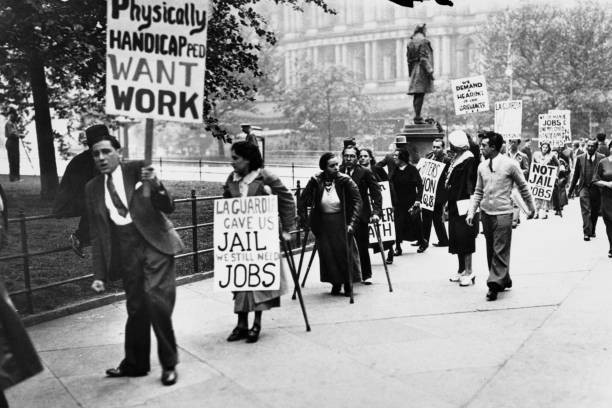
The N.U.L. was launched. The spies and fascists were decisively beaten–how decisively was apparent at the meetings following the convention and at the second national convention which showed clearly the tremendous progress in political understanding and class-consciousness that these workers, who only a year before waved the flag and dangled the club, had made under the tutelage and leadership of the C.P.L.A. Ramuglia and Johnson, elected president and secretary without opposition, could prepare their plan for extended organization.
IV. The League’s Fight for Unity.
The National Unemployed League has worked for unity in the unemployed movement. Worked and worked hard–not for a cooked-up or fake unity, but for unity in fact and not as a tactic,
Its history would not be complete without an account of the N.U.L.’s united front experiences with other unemployed organizations, particularly the Communist Party led Unemployment Councils and the Socialist Party led unemployed unions. These experiences lead one to ask–What is unity?
The NUL has taken a clear position on this question.
What Unity Is
Just as the struggle between classes cannot be compromised, but must be fought out to the very last element of opposition in spite of all temporary accommodations”, so the struggle within the working class for a lasting and genuine unity cannot be achieved by a mere “accommodation” but must be welded through understanding of the basic issues and elimination of all obstructing and incompatible elements.
If there is no united action among the organized workers today, it is not because the workers lack a common cause, but because they lack a common theory, a common tactic and a united leadership.
The real disunity is the disunity of working class leadership and the achievement of unity rests with these leaders or with the workers, if they fail.
This is the basic problem within the unemployed movement and in every other section of the labor movement. It cannot be solved by “accommodations”, “coalitions” or by federations” of unemployed organizations in the name of an abstract autonomy, but only by the most thoroughgoing and uncompromising elimination of all differences in theory and tactic.
Confusing the Problem
The problem has been confused by the very natural inclination of every leader or body of leaders to lay their own plans and aspirations on the doorstep of the plans and aspirations of the workers.
Thus, in the very worst days of the “United Front from Below” when every minute of that practice pushed unity back a year, the C.P. leadership shouted that “the workers were crying for unity”–meaning thereby that the workers were crying for the “United Front from Below” and the subsequent destruction of every organization but the Communist Party!
And thus, every pompous manifesto of the socialist old guard speaks in the name of the “workers” who are apparently not! afraid to defy the bayonet and the machine gun in a strike but fear to oppose imperialist war even on paper because it might annoy the police!
Even the Weisbordites, all 6 of them, weave their incredible phantasmagorias in the name of those same “workers”–who are prevented from embracing Weisbord only because they are handcuffed by Gitlow!
Workers Cannot Deviate
The workers need a clear revolutionary program and a consistent revolutionary leadership. They are not concerned with deviations. The workers themselves cannot deviate, however much they may be led to bark at tinsel moons temptingly dangled over them by the Roosevelts, the liberals and the fascists. In the end there is only one path that leads to the goal–the revolutionary path. When the workers realize this, they will set up the cry for unity.
But they will mean, not their own. unity (for it is by the recognition of their own unity that they find the revolutionary path) but the unity of their leadership. The leadership will either lead the way to revolution and the workers world by the shortest and most direct route, or fall by the wayside with the thousand Kerenskys et al. Nothing finally can destroy the essential unity of the proletariat. It is said that failure to unite against Fascism results in Fascist “unity” that is, the concentration camp. This is true, but not final. The unity of the concentration camp can be destroyed, but the workers are indissolubly united by a single interest and a single goal. Unity can be delayed, obstructed, led into the lunatic byways and the reformist highways–but it cannot be destroyed.
This is the conception of unity held by the National Unemployed League. It underlies the NUL program for achieving unity in the unemployed movement. But before we come to that program, we will review briefly the united front experiences of the NUL to date.
The Struggle for Unity
The experiences of the NUL io the struggle for unity may be classified for the sake of convenience as follows: a) the united front on specific issues, b) organizational and organic unity. In reality, however, this classification is not altogether valid.
The united front is, or should be. a transition measure towards organic unity within a particular field, i.e., the unemployed movement, the trade unions, etc. (The S.P. practice, which strictly limits the united front to “specific issues” is comparable to the lady of high virtue who limits her lover to a single kiss. Neither lovers nor workers will stand for this sort of teasing, finally.) Nor is there any “specific issue” confronting the workers on which they can unite as separated from any other issue on which they, presumably, cannot unite. There are issues that do not immediately involve organic unity, but organic unity is the goal of every genuine united front.
The united front on specific issues is the preliminary to and the testing ground of organic unity. That has always been the understanding of the NUL. Thus, at the first Columbus convention a united front was entered into with the Unemployed Councils WITH A VIEW TO CALLING A UNITY CONVENTION. Failure to carry out the united front successfully would result in failure to achieve the unity convention.
Testing the Councils
At this time the famous open letter of the C.P. to itself in which the united front from below was seemingly repudiated had hardly dried off the press. There was to be no double-dealing, no stabbing in the back. Issues were to be met squarely. The right of criticism was not abrogated, but confined to the work at hand.
The NUL accepted this agreement in good faith, recognizing then as now that dualism in the unemployed movement was one of the greatest impediments to progress. But almost at once evidences of bad faith on the part of the Councils began pouring into headquarters.
In Columbus itself, Council leadership blithely continued to damn the leaders of the NUL as if there had never been a united front.
In Toledo, where the Councils and the Leagues had united to carry out a relief-work strike, the Council leadership promptly forgot about the strike and concentrated on printing exposures of the social-fascists.
In Pennsylvania, a ‘red-herring’ was deliberately foisted on the Allentown League which might have destroyed that organization.
Patience, Another Letter
When the NUL complained of this sabotage, the leaders of the Councils explained that the new tactic, i.e., the abandonment of the United Front from Below had not yet trickled down to the rank and file. Only time and patience were required. But in the weeks following, the back-stabbing and sabotaging increased rather than diminished and the patience of the NUL came to an abrupt end when a letter from the N.Y. district of the Communist Party to the Toledo Unemployed Council fell into its hands.
The letter called on the Councils to make every use of the united front, not to win the relief strike, but to smash the Leagues!
When A.J. Muste read this letter to the Cleveland Trade Union Conference that same year in the presence of most of the top leadership of the C.P., the only answer was their complete silence. Only a rank and filer in the rear of the hall was heard to mutter: “How the hell did he get that letter?”
The New Militant was the weekly paper of the Workers Party of the United States and replaced The Militant in 1934, The Militant was a weekly newspaper begun by supporters of the International Left Opposition recently expelled from the Communist Party in 1928 and published in New York City. Led by James P Cannon, Max Schacthman, Martin Abern, and others, the new organization called itself the Communist League of America (Opposition) and saw itself as an outside faction of both the Communist Party and the Comintern. After 1933, the group dropped ‘Opposition’ and advocated a new party and International. When the CLA fused with AJ Muste’s American Workers Party in late 1934, the paper became the New Militant as the organ of the newly formed Workers Party of the United States.
 Revolution's Newsstand