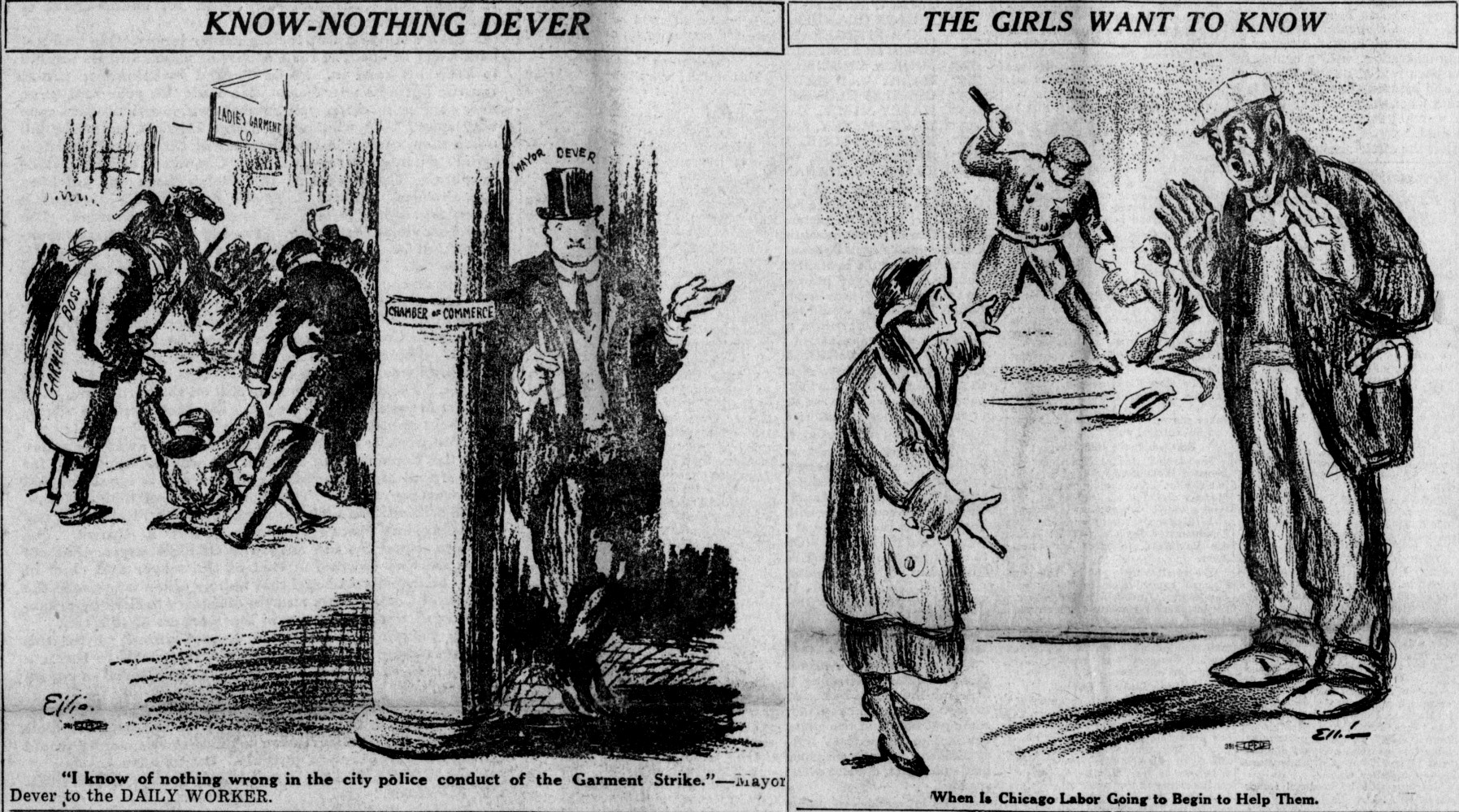
The Young Workers League takes arrests in their work for the massive Chicago dressmaker’s strike of 1924.
‘Chicago League Members Active in Dress Strike’ by john Williamson from Young Worker. Vol. 3 No. 7. April 1, 1924.
As we go to press, news comes that Comrades Abe Harris, John Harvey and Peter Herd, sports director, educational director and city organizer respectively of the Young Workers League of Chicago, have been arrested by the police for having been on the picket line in the strike of the dressmakers of the International Ladies’ Garment Workers’ Union. They volunteered their services to the union, which gladly accepted them, and steps are being taken immediately to bail them out. The Young Workers League and its members are very active in support of the strike, and no such arrests or any other kind of intimidation will stop them from continuing their support.
After many weeks of negotiations with the bosses in the ladies’ garment industry, the union called a strike on Wednesday, February 27th. Ten thousand workers responded, including three thousand cloak makers who went out for the first day to demonstrate their sympathy and insure the pickets protection.
The overwhelming majority of the strikers are young girls and women. It was admitted by the union that only 30 per cent of the industry being organized complicated matters, but they depended upon support from the unorganized shops. Their expectations were partially realized. union shops are practically at a standstill, only a few scabs having been recruited. The unorganized shops, which in most cases are the large shops, are running about 50 per cent normal. Many of the unorganized workers have joined the strike and have lined up in the union.
Y.W.L. Members Active.
The Young Workers League members, who are on strike, are among the most active and they are all to be found on the picket line from early morning till late at night. Two of our League girls have been arrested twice and are now out on $400 bail each. They are Ida Gaffin and Goldie Finkelstein.
Members of the Y.W.L. gained special mention when they successfully evaded the police and sluggers at the door of a shop composed entirely of young workers, urged them to strike, and marched them to the union headquarters. Many Y.W.L. members, who are employed in other industries are serving on the picket line 3 to 4 hours per day.
At a meeting called this week of all league strikers to check up on the league’s activities it was proved, after listening to all the reports, that our members were in the midst of the fight. Besides picketing and doing other detail union work, they are selling the Daily Workers every day among their fellow strikers.
Rotten Conditions Prevail in Industry.
The girls working in the dress industry are subjected to the worst conditions imaginable. They average about six months work during the year. Many days they only get two or three hours work and then must go home without getting a full day’s pay. If they don’t show up for these few hours work, they lose their jobs altogether. The wages have been cut and the bosses have been planning to abolish the union and establish the open shop.
The demands of the strikers are as follows: 5 day 40 hours week with 44 hour pav; increase of wares ranging from 5 to 14 per cent; closed shop; unemployment insurance; and a few other minor demands.
Sluggers Attack Defenseless Pickets.
Since the first day of the strike the city police force grew by hundreds of sluggers, furnished by State Attorney Crowe’s office and other private detective agencies and has been guilty of brutally beating and intimidating the girls on the picket line. An average of from 15 to 20 pickets are arrested. But arrest has no fear for these workers, who are used to suffering.
Injunctions are Ineffective.
The bosses have resorted as usual to their lickspittles called judges and the infamous “Injunction King” Sullivan, of railroad strike fame, has issued three injunctions against picketing. These, however, are useless against the militant garment workers. To date 43 of the smaller shops have signed up the new agreement with the union. This is an indication of weakness on the part of the bosses and victory looms near.
Expelled Militants Lend Aid.
An interesting feature of the strike is the fact that the 16 members of the Trade Union Educational League who were expelled by the reactionary bureaucracy of the International Ladies’ Garment Workers’ Union and charged with the falsehood of disrupting the union, have showed themselves to be worthy the name of union militants. They offered their service to the strike committee in any capacity desired and today they are among the most active. Dora Lipshitz has been appointed by Vice President Perlstein, her former persecutor, as secretary of the strike committee. This action of Perlstain, who previously had been the official leader in expelling unconstitutionally the militants, proves to any doubtful ones that the TUEL members are working at all times for the benefit of the union. The membership reiterates its unanimous demand that these members be reinstated.
Solidarity Displayed.
No color line is drawn in the strike. Many colored women are among the strikers and they are particularly active in combatting the efforts to obtain young negro girls to scab. This is a healthy sign of workers’ solidarity.
This strike has offered a wonderful opportunity to the league members to participate actively in the class struggle. Those ten Y.W.L. strikers! and the many more leaguers who are assisting are gaining an education many of our members need badly. The influence and prestige gained by activity should be cultivated and utilized to present to the other young garment workers the necessity of joining a militant youth organization. This is a practical example of the necessity of joining and taking an active part in the union. It should also demonstrate to those unions that still are blinded by the cobwebs of the last century, that it is necessary to organize the young workers, the militant fighting youth of the working class, to be secure of victory.
The Young Worker was produced by the Young Workers League of America beginning in 1922. The name of the Workers Party youth league followed the name of the adult party, changing to the Young Workers (Communist) League when the Workers Party became the Workers (Communist) Party in 1926. The journal was published monthly in Chicago and continued until 1927. Editors included Oliver Carlson, Martin Abern, Max Schachtman, Nat Kaplan, and Harry Gannes.
PDF of full issue: https://www.marxists.org/history/usa/pubs/youngworker/v03n07-apr-01-1924-yw.pdf
 Revolution's Newsstand