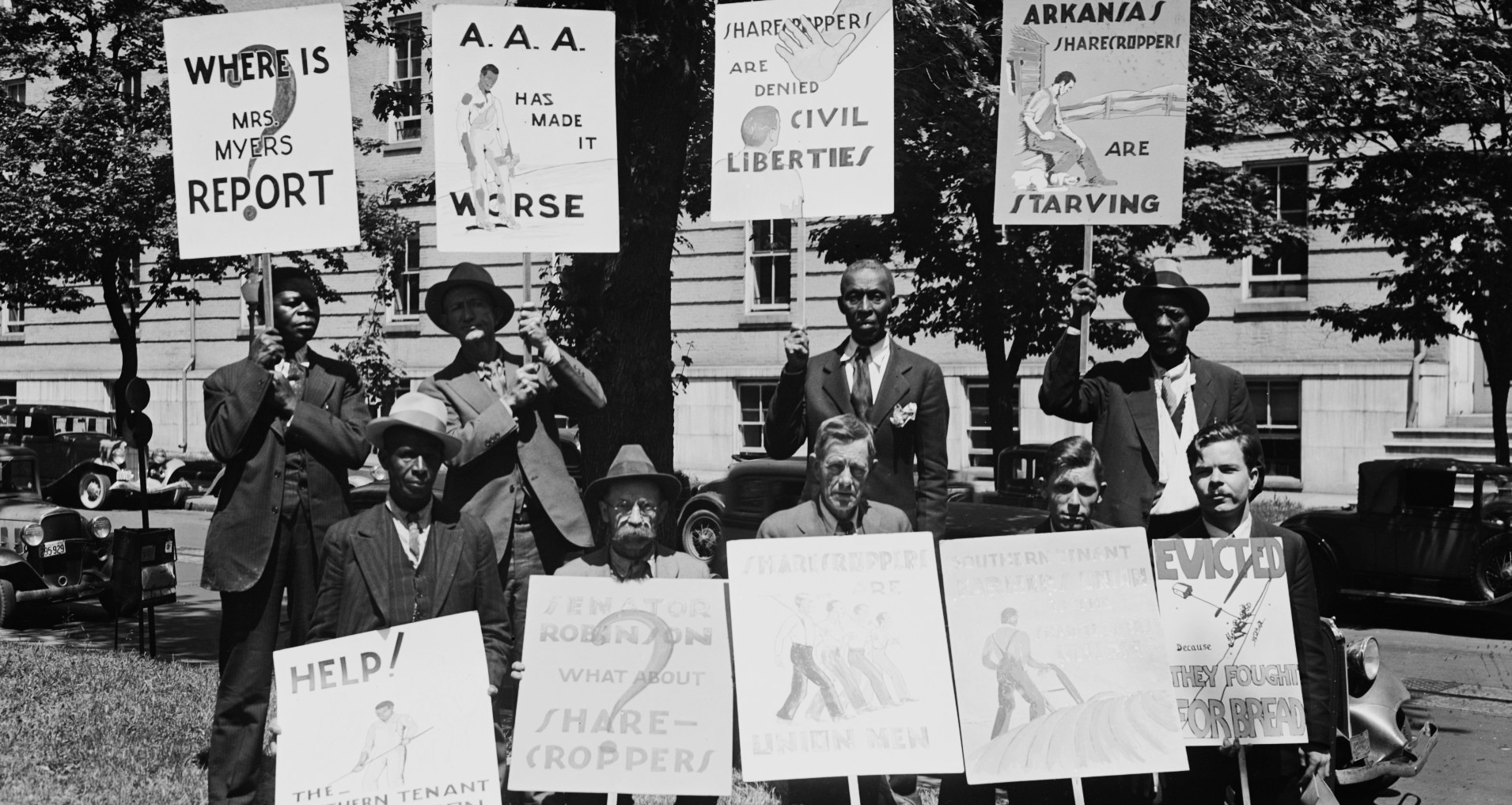
Some essential history of the inter-racial Southern Tenant Farmers’ Union from one of its lead organizers, Ward H. Rodgers, then a young radical Methodist minister and Socialist Party activist.
‘Sharecroppers Drop Color Line’ by Ward H. Rodgers from The Crisis. Vol. 42 No. 6. June, 1935.
Undoubtedly the most significant labor development in recent months is the organization of the mixed Southern Tenant Farmers’ Union in Arkansas. Ward H. Rodgers, one of its organizers, who was jailed for his activity, tells about it.
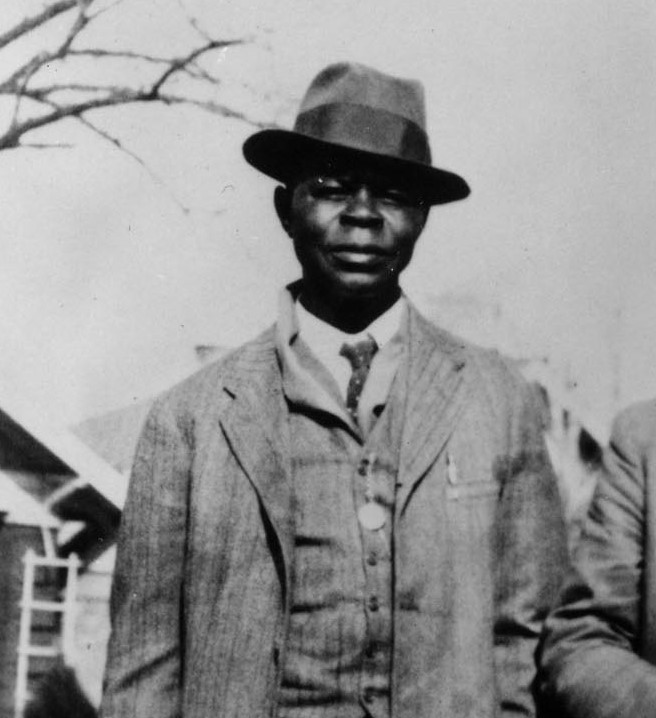
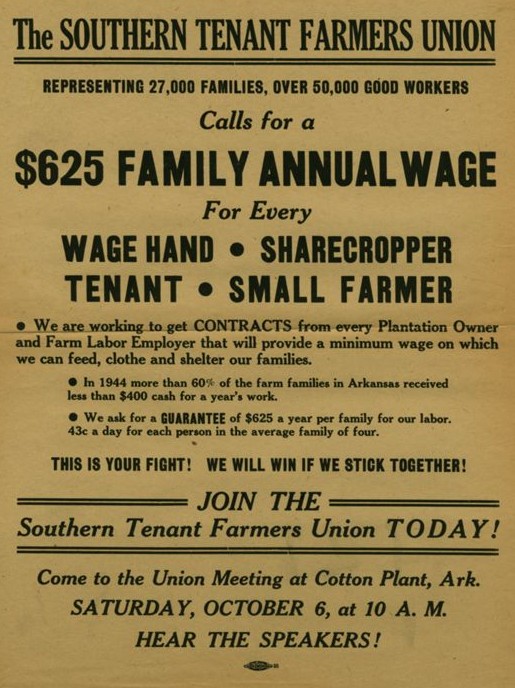
ALL too few have been the attempts in the South, or for that matter in the North, to organize labor unions which include both the Negro and the white workers. The Southern Tenant Farmers’ Union has from its beginning attempted to solve the difficulties of organizing across the race line. After eight months of work we now have 10,000 members, half of whom are Negro sharecroppers. During these months we have had practically no friction within the Union over the race question. Some of our best leaders are members of the Negro race. Metropolitan newspapers noted that our Negro leader, Mr. E.B. McKinney, could express himself better than the white members of the committee that came to New York City to raise funds for the Union. I mention this only to say that it has been my observation that the Negro sharecroppers ordinarily are as qualified for leadership as the white sharecroppers.
Because of his long experience in other organizations, such as churches, burial societies, fraternal organizations and the like, the Negro generally knows how to run meetings as they should be run. Practically the only organization that the white sharecroppers have had experience in outside of the churches is the Klu Klux Klan, therefore they have not had training in correct procedures at meetings. The only explanation that I have for sharecroppers joining our interracial organization who used to show their race prejudice by being members of the night riding K.K.K., is that they have learned that both white and Negro sharecroppers are the victims of the same system of exploitation, both Negro and white suffer from the same “belly hunger.” The sharecroppers, regardless of color, have been deprived of a living which certainly they work hard enough to earn. Both races have been driven down to a low economic level of bare existence. The white sharecropper also is discriminated against and insulted. The word sharecropper itself has come to be used as a term of contempt. In the minds of the ruling class of eastern Arkansas, he is a “lazy, shiftless fellow,” a social outcaste.
Race Bugaboo Fails
The planters and their agents, the sheriffs and riding bosses, have tried repeatedly to break the Union by the use of the “equality” red-herring. In this attempt they have been unsuccessful. Even the Governor of Arkansas in a hearing told Norman Thomas, “You can’t preach social equality in Arkansas, nor can you preach economic equality.” The Union leaders months before had known that pressure would be put on at this link in our chain, therefore, the sharecroppers of both races were warned that the race issue would be used in a campaign to divide the Union.
The argument against race prejudice which has been used by the organizers is: “If we organize only a Union of Negro sharecroppers then the Negroes will be evicted and white sharecroppers from the hill-country or the unemployed in Memphis will take their places. If on the other hand we organize only a Union of white sharecroppers then the white men will be evicted and Negro sharecroppers from Mississippi and the unemployed in Memphis will take their places.” The above statement was understood by the sharecroppers to mean that their only chance of winning would be for each race to forget prejudices and build an organization of all sharecroppers, day-laborers, managing share tenants, and small land owners who are “dirt farmers” without regard to race. Over and over again the sharecroppers in the STFU were warned not to let themselves be divided on the race issue. This they have been able to do in spite of ridicule, insults and slander from individual planters and deputy sheriffs, as well as the bombasts of the planter-controlled Commercial Appeal of Memphis.
A sharecropper is a “dirt farmer” who receives as his wages one-half of the cotton crop, minus “deducts.” He does not own anything. The planter furnishes the land, team, tools and seed and receives half of the cotton crop for his share. A sharecropper works from 10 to 25 acres of land. Most sharecroppers do not have an adequate supply of cows, hogs and chickens. He lives in a shack that leaks, the doors do not fit, the walls and floor let the wind come straight through and the windows do not have screens. The sharecropper is forced to buy from a commissary store, also is charged from ten cents to twenty-five cents on the dollar. The plantation owner often figures the accounts with a crooked pencil and the sharecropper has difficulty getting his share of the government acreage reduction money. When he does stand up for his rights and demands his share, he is evicted at the first opportunity.
Secretary Wallace admitted in his speech in Maine, April 17, the truth of our contention that, “The South had had its income cut down to the point where the average income of a cotton grower is $250.” It is this great injustice that has caused the sharecroppers, who are the “dirt farmers” of the South, to organize the STFU instead of the agitation of “communistic and socialistic gentlemen” which Wallace charges.
Wallace’s agriculture program has aggravated the situation rather than helped it. The most important grievances of the STFU grow out of Wallace’s program.
AAA Aggravates Condition
The complaints from the Cotton Acreage Reduction Contract have been the grievances that have built the STFU. They are briefly, disputes over the use of the government rented acres. (1) The sharecropper and the tenants are supposed to have the use of the government-rented acres, rent free for food and feed crops for home consumption. He pays for the use of the team and tools. Most planters have demanded that these food and feed crops be sharecropped as usual, which means that both the sharecropper and the government pay rent on the same land. (2) The sharecropper is supposed to have wood from the plantation wood lot. Many plantation owners have been selling the wood to the sharecroppers in violation of the cotton acreage reduction contract. (3) The planters attempted to force all sharecroppers to sign papers making the planter guardian over them, which makes it possible for the crooked planters to sell the cotton at a price above what he told the sharecropper. This caused much hard feeling, the sharecropper insists on selling his own crops and tending to his own business affairs. Many hundreds of sharecroppers in Eastern Arkansas were forced to sign these guardianship papers, the AAA has not fined these planters $1000 each for forcing sharecroppers to sign, as the government contract requires. (4) We have a list of 300 sharecroppers who have been evicted in our particular area. They are men who demanded fair settlements. There were this winter 40 families around Marked Tree, Ark., at one time, who were piled up in each other’s houses, two and three families to a house, as a result of vicious evictions. The Transient Bureau of Memphis has 531 families who have been forced off the plantations. (5) Government money from the processing tax was distributed $8 to the plantation owner for every $1 to the sharecropper. The latter insists that this is an unfair division. (6) Many sharecroppers did not even receive this dribble from the processing tax, because their part came through the hands of the plantation owners who have glue on their fingers. (7) Neither white nor Negro sharecroppers were allowed to be represented on the local agricultural board to enforce the AAA contract. (8) The status of sharecroppers has been changed to day-laborers in order for the planter to get the government money. (9) Managing share tenants were reported to the government as sharecroppers by planters, thus the planter received government benefits that should go to the managing share tenants.
Old Plantation Evils
Besides the complaints that have arisen as a result of the Triple A program of the Roosevelt government, the following evils of the plantation system have kept the “emancipated” sharecroppers in debt, poverty and peonage since the Civil War and are continuing to do so. (1) Sharecroppers obtain “furnish” or credit from the plantation owners and are charged from ten cents to twenty-five cents on the dollar for this service. (2) Many plantations use “doodlum books,” commissary coupons, instead of United States currency, thus forcing the sharecropper to trade at a particular store. (3) The commissary store charges from fifteen per cent to fifty per cent higher prices than the regular stores. (4) Settlements at the end of the year are often figured with a “crooked pencil” to keep the sharecropper in debt.
In 1919 Negro sharecroppers in Phillips County, Ark., organized the Progressive Farmers and Labor Household Union of America, incorporated under the laws of Arkansas, in order to obtain settlements. This resulted in the Elaine Massacre, five whites and fifty Negroes were killed. It was called at the time a “white massacre!” The N.A.A.C.P. defended and freed some 800 Negro victims, twelve of whom were sentenced to death and sixty-seven were sentenced to twenty-one years in prison. After legal battles extending over a period of four years, the N.A.A.C.P. won the above cases. The Arkansas Supreme Court reversed the death sentences on the ground that Negroes had been excluded from juries in Phillips County in contravention of the fourteenth Amendment and the Civil Rights Acts of 1875, a precedent for the Scottsboro case. Later the cases were taken to the U.S. Supreme Court and again the N.A.A.C.P. won. The decision (Moore v. Dempsey, 261 U.S. 86) was epoch making in deciding that a trial dominated by mob sentiment was not due process of law, and reversed the U.S. Supreme Court itself in its decision in the Leo Frank case. This struggle of Arkansas sharecroppers obtained for them the “settlements” that are now figured with a “crooked pencil.”
The STFU is struggling in this same region of planter terror. Fortunately our organization is inter-racial in character which is the best insurance against a race riot because the white sharecropper would be the first to be called by the planters to lynch leaders of a “Negro Union.” Now the planters have to do their own dirty work. (5) Day labor is paid only fifty cents to seventy-five cents per day. Each sharecropper usually does some day labor for the plantation besides putting in his crop. Several plantations switched entirely to day labor in order to receive all of the Crop Reduction Benefits. The day laborer works from sun to sun. (6) Plantation owners do not allow sharecroppers to plant enough garden and truck patches. Rarely do the sharecroppers have pastures for cows, instead they stake their cows up and down the highways. (7) Plantation owners control the local politics, and through it the FERA, thus they manage to keep relief work down in order to keep wages at the fifty cents level. (8) Negro sharecroppers are not allowed to vote even if they pay their poll taxes. This is done by the threat of lynching being held over the Negro’s head. Many Negroes in Memphis and Little Rock vote, but the rural Negro is not allowed to do so. (9) Planters maintain control of the local courts thus preventing the white and Negro sharecroppers from getting justice either in criminal or civil disputes.
Reign of Terror
One of the results of the policies of the AAA in the South is a virtual reign of terror carried on by the cotton planters against the sharecroppers who have sought to have the government contract enforced. The Administration’s policy of acreage reduction is being administered by Secretary Wallace, perhaps the most socially-minded member of the Roosevelt regime. But the fact is that the sharecroppers, who own practically nothing and need help more than any other section of the population, face eviction; and when they organized into a union, the present terror started.
The STFU was organized last July, 1934. We had a rapid growth to 6,000 members in January, 1935. Soon after we started a Negro organizer was horsewhipped by a deputy sheriff and a white organizer forced to leave that section of the state. In November four sharecroppers were arrested for “disturbing labor” and “collecting money under false pretenses.” We were unable to raise bond and three stayed in jail forty-five days and one twenty-three days before bail could be found. Mrs. Mills, the wife of one of the prisoners, became sick with pellagra while her husband was in jail which aided our ability to raise bail money. Later it was discovered that four members of the family of eight had pellagra. Mr. Mills, during his twenty-three days in jail, gained fifteen pounds. A school teacher who was used to having plenty of food lost five pounds while on jail fare only nine days. It is needless to say that many of the Mills’ meals often consisted of only “biscuits and white gravy.” In February we won the cases of “collecting money under false pretenses” and the “disturbing labor” charge was postponed. Early in January we sent a committee of five to Washington to carry out grievances directly to the secretary of agriculture. On January 15 they made their report to a mass meeting of 800 sharecroppers at Marked Tree.
He Called Negroes “Mr.”
I had been teaching in the FERA Workers Education program members of the STFU. I had two Negro classes and three white classes. I was teaching economics, current events, and English. On January 14 my Negro class near Tyronza was “investigated” by the school board, who had no authority to do so. They complained because I was a Socialist and because I was a white man teaching Negroes. The latter was the more “unpardonable” in their minds. The next morning I tried to straighten things out with the superintendent of schools, Mr. R.A. Lynch of Tyronza. He threatened me with the K.K.K. H.L. Mitchell, the executive secretary of the Union, took the threat seriously. Therefore Mitchell and I brought it up that afternoon at the mass meeting. I spoke on the relief situation, telling the actual conditions of suffering, the dis- crimination, etc.—facts that everyone knew. I quoted the Declaration of Independence, “All men are entitled to life, liberty and the pursuit of happiness. When any government becomes destructive of these ends, that government the people have the right to alter or abolish.” This prefaced my sentence asking for the United States government to abolish the plantation system which is keeping both the Negro and the white sharecroppers in peonage and near the starvation point. I spoke of the violence being used against the Union and told of our policy of non-violence. But stated that violence is a weapon that two can use. And that if the planters continued their violent acts, eventually sharecroppers would stop turning their other cheeks and start using lynch ropes. I, as chairman, had introduced two Negro organizers as “Mr.”, an unpardonable sin in my homeland in the South. I was arrested on the absurd charges of “anarchy,” “inciting a riot,” “using profane and abusive language,” and “conspiracy to usurp the government.” I was held nine days unable to raise a $3,000 bail, tried for anarchy, found guilty by a planter jury and sentenced to six months in jail and $500 fine. The deputy prosecuting attorney, Fred Stafford, in his charge to the jury referred to my introducing a “n***r” as Mister in a vile attempt to arouse racial hatred. This was turned into laughter as one of the sharecroppers, a white man yelled out “I’d ruther call a n***r Mister than you.” This man was hurried out of the room by officers. The atmosphere of the trial was tense, every person who entered the grocery store where the trial was held was searched for weapons—the planters on being searched showed permits to carry guns. No arms were found on Union men. I appealed and the other charges were dropped because of the publicity given the case.
Goal: A New South
Immediately we started pounding away with mass meetings and building the union. False arrests were numerous. Sheriffs and planters beat up speakers and organizers with whips and pistols. On two occasions visiting speakers were stopped by an armed planter mob. The speakers were Powers Hapgood and Norman Thomas. Several meetings have been shot into and homes also. The situation is very tense. Recently two Negro boys were shot in their legs when their home was shot into, and any day open conflict may start as it is difficult to keep men disciplined to nonviolence. Mr. C.T. Carpenter, a southern Democrat and the Union attorney, was shot at while in his home. A Negro woman’s ear was knocked off by a planter with his gun butt. A Negro, Reverend T.A. Allen of Marks, Miss., was killed. The sheriff said he was a Union organizer. We have no record of him. He wore an “Everyman a King” button in honor of the Kingfish who has failed to act on behalf of the sharecroppers. Many other acts of violence have been committed often by officers of the law.

In the meantime Washington does not act to enforce its contracts or stop planter violence. The governor of Arkansas says publicly that the officials of the eastern Arkansas counties might as well be in Alaska as far as any control he has over them.
In spite of increasing terror, the Union grows. Hundreds are joining, Negro and white sharecroppers. We now have 10,000 members, an increase of 35 per cent since January 15.
The Union is now calling on all its friends and friends of simple human justice to aid in the legal defense of eleven organizers who have charges pending in court and to the organizational fund to spread the Union. We have an excellent chance of building a mass movement of southern sharecroppers. We have three and one-half million sharecroppers to organize. Enthusiasm is running high, hundreds are joining weekly. Help us build a new South.
The Crisis A Record of the Darker Races was founded by W. E. B. Du Bois in 1910 as the magazine of the newly formed National Association for the Advancement of Colored People. By the end of the decade circulation had reached 100,000. The Crisis’s hosted writers such as William Stanley Braithwaite, Charles Chesnutt, Countee Cullen, Alice Dunbar-Nelson, Angelina W. Grimke, Langston Hughes, Georgia Douglas Johnson, James Weldon Johnson, Alain Locke, Arthur Schomburg, Jean Toomer, and Walter White.
PDF of full issue: https://archive.org/download/sim_crisis_1935-06_42_6/sim_crisis_1935-06_42_6.pdf
 Revolution's Newsstand