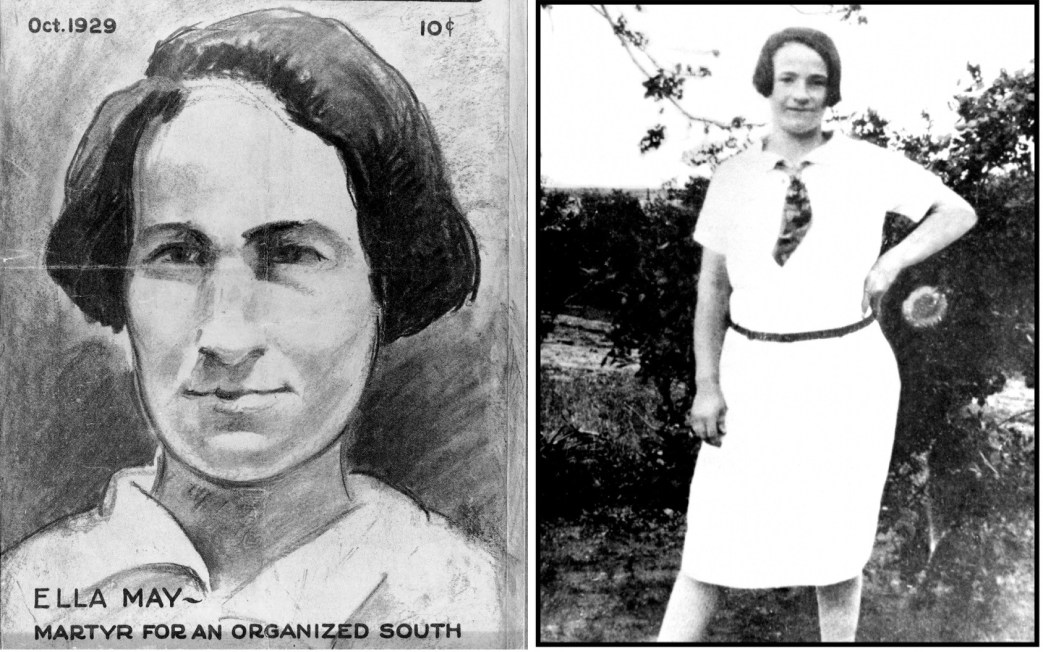
A note from striking mill worker, single-mother, and National Textile Workers organizer Ella May Wiggins, who was murdered when returning from a union meeting on September 14, 1929 in Gastonia, North Carolina. Wiggins came to life in the strike, by her own admission, writing songs for the workers and going to Washington to testify before Congress. She left five orphans.
‘Ella May Sent a Letter to the Working Woman’ from Working Woman. Vol. 1 No. 3. December, 1929.
That Ella May Wiggins followed an unfaltering course of sacrifice and struggle for the upbuilding up of the National Tex- tile Workers Union in the South and never lost an opportunity to use every available means to plead for support of the Southern strikers, was revealed in an unexpected way this week by the finding of a bit of workers correspondence, dated August 23, addressed to the “Editor of the Working Woman,” and signed “A STRIKER, RLLA MAY.”
To the deep regret of the editor, this is the first issue of the Working Woman to be printed since June. Since Ella May wrote the brief story of her life, first, as mother of a mountaineer’s family of five, and later as an impassioned pleader in action and in writings for the organization of the textile mill “hands” against the bosses’ exploitation her heroic part in the class struggle was cut short by a company gunman in the mob of mill hirelings who shot into a truckload of strikers going to a protest meeting in Gastonia, N.C., to demonstrate their allegiance to the imprisoned strikers.
Wen Ella May wrote her worker-correspondence, she didn’t know that seven of these strikers were to be sentenced to a living death in prison for defending the rights of workers to build a union–the same cause for which she herself was to lose her life. But she knew at least this: that it was a life-and-death battle between workers and mill-bosses, and that the burning need of the hour was, for labor solidarity. So she wrote her message, “And I hope whoever reads this story will lend us a helping hand in our struggle.”
Ella May’s Letter
Following is Ella May’s story, written from Bessemer City, N.C., August 23, with! no alterations whatsoever by the editor:
“I have been working in the mills eight years. I was raised in the mountains and in 1921 they come out to the mountains, getting hands to work in the Loray mill in Gastonia, and my husband give what we had away, and come there to live. They promised $7.70 a week to learn and a raise when we learned our jobs.
“THIS IS HOW THEY KEPT THEIR PROMISE: When I could run four slides of spinning, they cut me down to five dollars a week! Then when they had got all the new hands learned up, they had more help than they could work, so they would send us out to rest and that way we only got in two or three days a week. I had to buy furniture on time and they took it from me, and I had to go somewhere else.
“I am now left a widow with five children, and I have tried with all my might to make a living for them. The wages got in the mill at the most is from six dollars to-nine dollars a week. I can’t live on that. I have to keep my children out of school because I don’t make enough to keep them in bread and have no way in the world to clothe them at the wage I make.
“In January, my children was all down in bed with the influenza and I was working at night. I asked my boss to give me day. work so I could be with my children at night. His reply was for me to get some one to stay with them. I asked him how I could pay some one to take care of my children when was only making seven dollars a week and having to pay two dollars a week for my house rent.
“I hope whoever reads my story will understand I have always worked for my living and always will, but we must have pay for our work so we can feed and clothe our children.
“AND I HOPE WHOEVER READS THIS STORY WILL LEND US A HELPING HAND IN OUR STRUGGLE. THERE ARE MANY MORE IN JUST AS BAD CONDITION AS I AM IN. I AM ALWAYS IN HOPES CONDITIONS WILL NOT ALWAYS BE SO BAD IN THE SOUTH, ESPECIALLY AFTER WE BUILD UP OUR UNION, AND WE NEED THE HELP OF EVERYONE THAT CAN HELP US.”
The Working Woman, ‘A Paper for Working Women, Farm Women, and Working-Class Housewives,’ was first published monthly by the Communist Party USA Central Committee Women’s Department from 1929 to 1935, continuing until 1937. It was the first official English-language paper of a Socialist or Communist Party specifically for women (there had been many independent such papers). At first a newspaper and very much an exponent of ‘Third Period’ politics, it played particular attention to Black women, long invisible in the left press. In addition, the magazine covered home-life, women’s health and women’s history, trade union and unemployment struggles, Party activities, as well poems and short stories. The newspaper became a magazine in 1933, and in late 1935 it was folded into The Woman Today which sought to compete with bourgeois women’s magazines in the Popular Front era. The Woman today published until 1937. During its run editors included Isobel Walker Soule, Elinor Curtis, and Margaret Cowl among others.
PDF of full issue: https://www.marxists.org/history/usa/pubs/wt/v1n03-dec-1929-WW.pdf
 Revolution's Newsstand