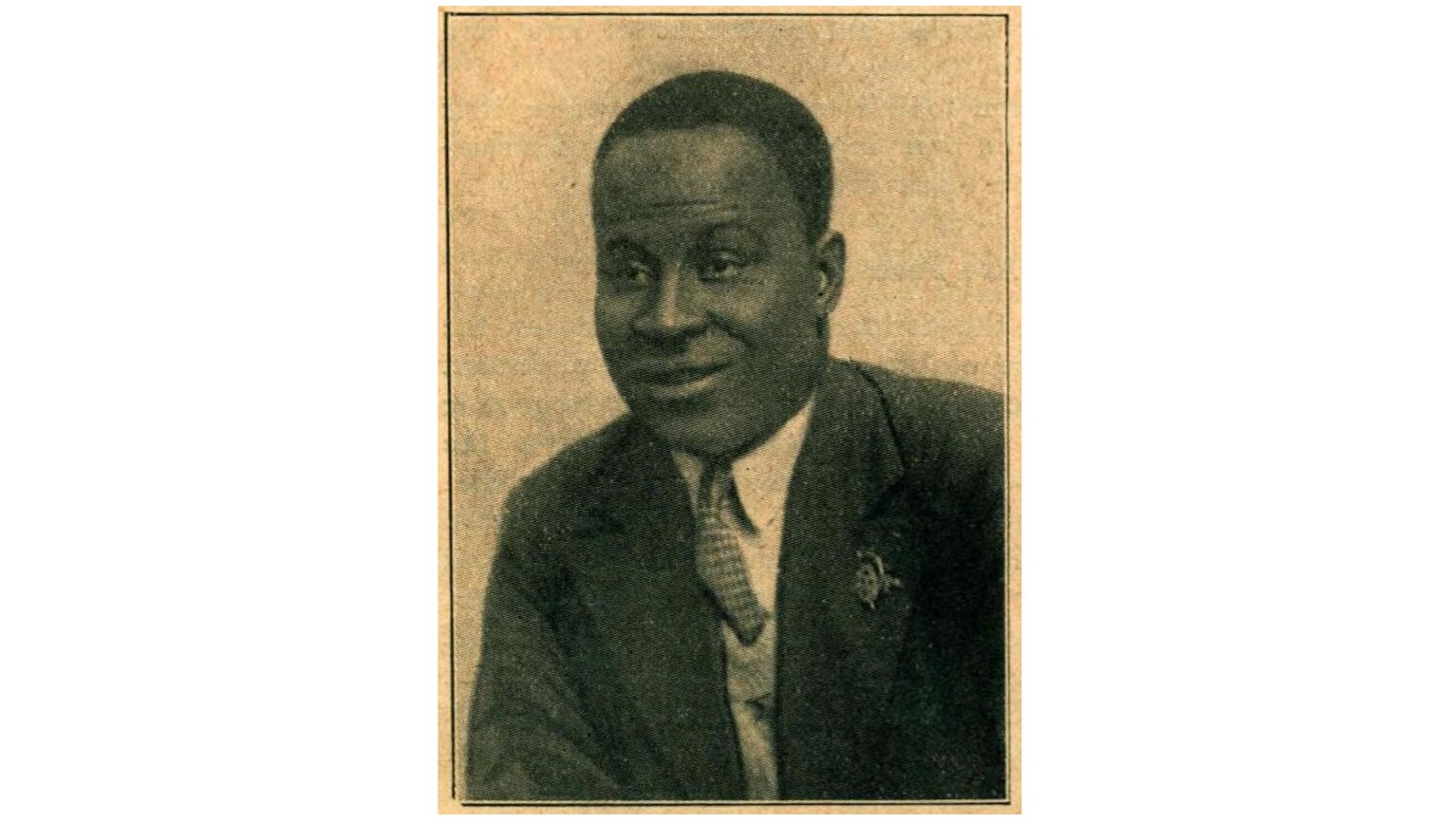
After its defeat in World War One, the German colony of Kamerun was divided between French and British imperialists. Here, the Secretary of the League For The Defence of the Cameroon Workers reports that exploitation has been accelerated under the new regimes. Born into the German Empire, Cameroon’s Joseph Ekwe Bilé studied in Berlin where he worked with the Communist Party and African emigre circles and was a leading figure in the International Trade Union Committee of Negro Workers.
‘How the Workers Live in Cameroon’ by Joseph Bilé from The Negro Worker. Vol. 2 No. 7. July 15, 1932.
I am writing this article on behalf of the natives of Cameroon, so that the readers of the “Negro Worker” may know that imperialist exploitation is the same now, when the French and British imperialists are sucking out the life blood of the natives of Cameroon by unprecedented exploitation methods sanctioned by the League of Nations, as they were before when Cameroon was groaning under the iron heel of German imperialism; we condemn imperialist exploitation of any kind. In writing about the conditions in Cameroon we only cite an additional example of the cruel way in which the imperialist powers oppress not only the Negro workers, but also the native workers in India, China, in the West Indies and other colonies.
In Cameroon our lands were “lawfully” occupied. “Scientists” have set up the theory that we were ignorant of any private property, and we are consequently refused even the right to our own land. The British Government has declared all areas coming under British administration to belong to the Crown; all the lands situated in French Cameroon were declared to belong to the State by the French Imperialists. The Negroes are, in the best of times, given only the use of their own lands which privilege may be immediately taken away from them, as was done in more than one case, whenever the European owners of the concessions wanted to use the land belonging to the natives for their own ends. A similar case that occurred under the regime of the present French administration proves that there is not any difference in the ways in which the imperialists treat the natives. The natives of Duala sent a delegate to Paris to file a protest with the French Government against the expropriation. We were sure that the delegate would fail in his mission if he stayed in Paris for even ten years.
As capitalist profiteering is the sole aim of the European imperialists the natives of Cameroon have been compelled to stop production and to work only in the interests of the European capitalists.
The result of the policy enforced by the French and British imperialists is that the natives of Cameroon are underfed; whenever the prices fall on cocoa and other commercial produce which they are compelled to plant they are brought to the brink of starvation.
The situation today is appalling. The majority of the peasants are ruined and thousands of workers are jobless. Since the unemployed do not get social insurance they are forced to starve. Added to this, the entire native population is forced to pay high taxes in order to enable the imperialists to maintain their oppressive governmental system.
For the purpose of recruiting workers for the plantations, for work in the African forests or for the construction of railways and roads, the usual methods of colonial exploitation come into force: the head and hut tax are fixed at so high a level that the natives are compelled to look for work in the capitalist enterprises so as to be able to pay the taxes imposed on them. Wherever this method of recruitment proves to be ineffective, compulsory labour is introduced, thus converting the natives into slaves; as a last resource the capitalists resort to the importation of foreign labour on a contract basis which renders them much more helpless in the face of ruthless exploitation. The Krus that are imported from Liberia and are hired on a five-year contract are compelled to slave for their bosses in Duala: they have to work from 6 a.m. till 8 p.m., sometimes even longer, for wages amounting not to more than a handful of rice and a piece of salted fish. After five years of work they receive 30 shillings and a yard or two cheap print cloth.
Whenever a worker falls ill he is told that “if the monkey dies another monkey will take his place”. The white capitalist looks upon his black workers as cattle that have to work until they drop.
Besides these workers, the “coolies” must be particularly mentioned. This kind of work is not classed as compulsory work by the Labour Office in Geneva though it is one of the most terrible kinds of labour enforced by capitalism. The natives are compelled to carry extremely heavy loads from the stores to the ships, and even to transport them on their bare backs from the interior to the coast; even women and children are made to do this kind of work. Whole villages are deserted when a capitalist merchant closes a good bargain in the interior of Cameroon and wants to have the goods brought to the coast.
The workers are terrorised to an unheard of extent. Whenever they endeavour to organize they are simply hanged as rebels. Whenever they complain against their bosses or against the foremen they are mercilessly whipped. The officials of the concession companies are, according to law, considered to be civil servants and, as such are entitled to mete out punishment: even if they kill a native they are not called to account as they acted in the interests of humanity and in defence of European culture. Among the 1,800,000 inhabitants of Cameroon only about 7,000 children attend school. Neither the foreign contracted workers nor the natives are given any housing accommodations on the plantations in the European sense of the word where they might take a rest after their inhuman labour! The workers from Liberia are forbidden to bring their families with them; whenever exceptions were granted, the married are compelled to live in the same room with the single. It is no wonder that diseases like typhus, swellings, etc. take a heavy toll among the workers.
The missionaries, the preachers of Christian “love” and “peace”, not only fully approve of this system but are, frequently partners in the business.
The time has come for us, in Cameroon, to do away with slavery and exploitation. Negro comrades of the world! White workers of Europe and America! Workers of the whole world! We call upon you to help the Negro workers in Cameroon in their struggle for emancipation; help us to win the rights and the independence that belongs to us and to all oppressed peoples in the colonies and to the working class throughout the world.
First called The International Negro Workers’ Review and published in 1928, it was renamed The Negro Worker in 1931. Sponsored by the International Trade Union Committee of Negro Workers (ITUCNW), a part of the Red International of Labor Unions and of the Communist International, its first editor was American Communist James W. Ford and included writers from Africa, the Caribbean, North America, Europe, and South America. Later, Trinidadian George Padmore was editor until his expulsion from the Party in 1934. The Negro Worker ceased publication in 1938. The journal is an important record of Black and Pan-African thought and debate from the 1930s. American writers Claude McKay, Harry Haywood, Langston Hughes, and others contributed.
PDF of full issue: https://www.marxists.org/history/international/comintern/negro-worker/files/1932-v2n7-jul.pdf
 Revolution's Newsstand