
Stumpy looks at the background to the struggle in which the ‘Everett Massacre’ of November 5, 1916 was the culmination. That day hundreds of armed thugs attempted to prevent the landing of of I.W.W. activists from Seattle onboard the Verona as it docked in Everett. The I.W.W. defended itself, with two gunthugs killed and two dozen wounded. At least five wobblies died, potentially a dozen more drowned, and another thirty were wounded.
‘Bloody Everett: Anti-Labor Crusade That Led Up to the Massacre of Union Men on the “Verona”’ by Stumpy from Solidarity. Vol. 8. No. 375. March 17, 1917.
BATTLE RAGING WITH RENEWED INTENSITY
Before this issue of Solidarity goes to press the trials of the men who failed to get killed on the Verona on November 5 last will be under way. The date for the trials to begin is set for March 5, just four months after the date of the tragedy when five men were killed and over thirty wounded.
The unlimited wealth and power of the Lumber Trust and the Pacific Shipping Interests are being used to railroad nearly a hundred of the members of the I.W.W. to the penitentiary for the remainder of their lives on charges ranging from murder in the first degree to unlawful assemblage. Of these men 74 have been held in the county jail continuously. Charges would have doubtless been placed against others had the jail been large enough to hold more.
Space will not permit of a full statement of all the causes that led up to the killing on the City Dock in November, but for a clear understanding of the issue it is necessary to refer to the past year to some extent.
The Shingle Weavers’ Strike.
Nearly two years ago the mill companies reduced the wages of the shingle weavers on the plea that the price of shingles was too low to warrant the old wage scale. The shingle weavers accepted the cat, together with the promise of the mill companies that the old scale would be restored as soon as the price of shingles advanced. Late in 1915 the price of shingles went up and the weavers asked to have the old scale restored. They negotiated with the mill owners till May 1, 1916, trying to have the wages adjusted, and then, as a last resort, went on strike.
As soon as the strike was called the shingle weavers went on the picket line to protect themselves, but the city authorities at once came to the help of the mill owners and began arresting and jailing the pickets on just any charge they happened to think of. This course had depleted the ranks of the shingle weavers so badly that by early July there were but eighteen men on the picket line.
On the morning that the picket line had been reduced to eighteen the police halted every man and searched him to make sure that there were no arms concealed on them, and then got out of the way to let the scabs and gun men do them up. This was done by waiting at the two gates of one of the mills, and when the pickets were on a bridge over an arm of the bay leading from one gate to the other over seventy scabs rushed out of the two gates at once and crushed the eighteen men between them. It was a case of the eighteen men taking a beating or jumping in the bay, so they took the beating, and several of them were forced to go to the hospital, and some of them have not yet fully recovered.
C.C. Murder-Lust.
That afternoon the weavers received the help of the Longshoremen’s Union, and there were no further beatings at the mill gates. But peace was not to the liking of the mill owners, unless it could be the peace of the slave system. At once the Commercial Club, the mill owners and the city and county authorities laid plans for a general clean-up of all strikers and their sympathizers. And the plan they laid plainly indicated that the circumstances of the 5th of November were planned in July, but the occasion to put it into effect did not arise till in November.
One evening some hundreds of scabs marched along the streets of Everett in a well-formed procession looking for strikers and their friends, and the Commercial Club had a swarm of autos on the streets to hurry any one who should be hurt out of the way. But the strikers had heard of what was coming, and were on the look out, with the result that the scabs came off second best.
The next move of the city authorities was to pretend to discharge several of the city policemen, but instead of that they were posted on a hill in some brush just above where the pickets were stationed, and were supplied with heavy rifles. It was the same sort of ambush that was arranged on November 5, and was done with the intention of killing as many of the strikers as possible should any pretext be found. Of course a few of the scabs might as well have been killed in the shooting, but that would have been all the better, for then all the strikers not murdered could be jailed and railroaded to the pen on charges of “murder,” just as the men in the jails here are now charged.
Street Speaking.
For several years there had been no attempt to enforce any street-speaking ordinance until the shingle weavers’ strike had been under way for some months, and the I.W.W. had used the privilege on the same terms as others. But the speakers for the I.W.W. would not refrain from talking the message of Industrial Solidarity to the strikers, and there was the rub. The city officials told many of the speakers and others connected with the I.W.W. that if they would just lay off till the strike was settled, they might then talk themselves black in the face.
Others than the I.W.W. were allowed to talk on the street, or were arrested and let go without being taken to the police station. The situation became constantly more tense during August, September and October. Many of the Secretaries of the I.W.W. were arrested in the hall without any warrant, and most of them were cruelly mistreated.
The First Outrages.
The worst outrage committed on any single one of them was the beating of James Rohn, whose head, back and shoulders were one mass of bloody bruises as a result. A short time later came an act of piracy on the high seas, when Sheriff McRae and a mob of the Commercial Club members met the launch Wanderer outside the harbor of Everett and fired several shots into the boat, overhauled her and abused all on board because some of the passengers happened to be members of the I.W.W. Among other acts of abuse, McRae struck Captain John Mitten on the head with a gun while the Captain was at the wheel.
Beverly Park.
Then on October 29 came the Beverly Park outrage, when forty-one men were arrested as they came into Everett to claim the same right that many others were exercising. These men were held jail for a few hours, then taken to Beverly Park in autos by over two hundred armed thugs, and there compelled to run the gauntlet between two lines of the thugs. The gauntlet was made to end at a cattle guard on a railroad track, and all the men were compelled to run over the sharp spikes in the guard before they could be rid of the mob.
Bloody Sunday.
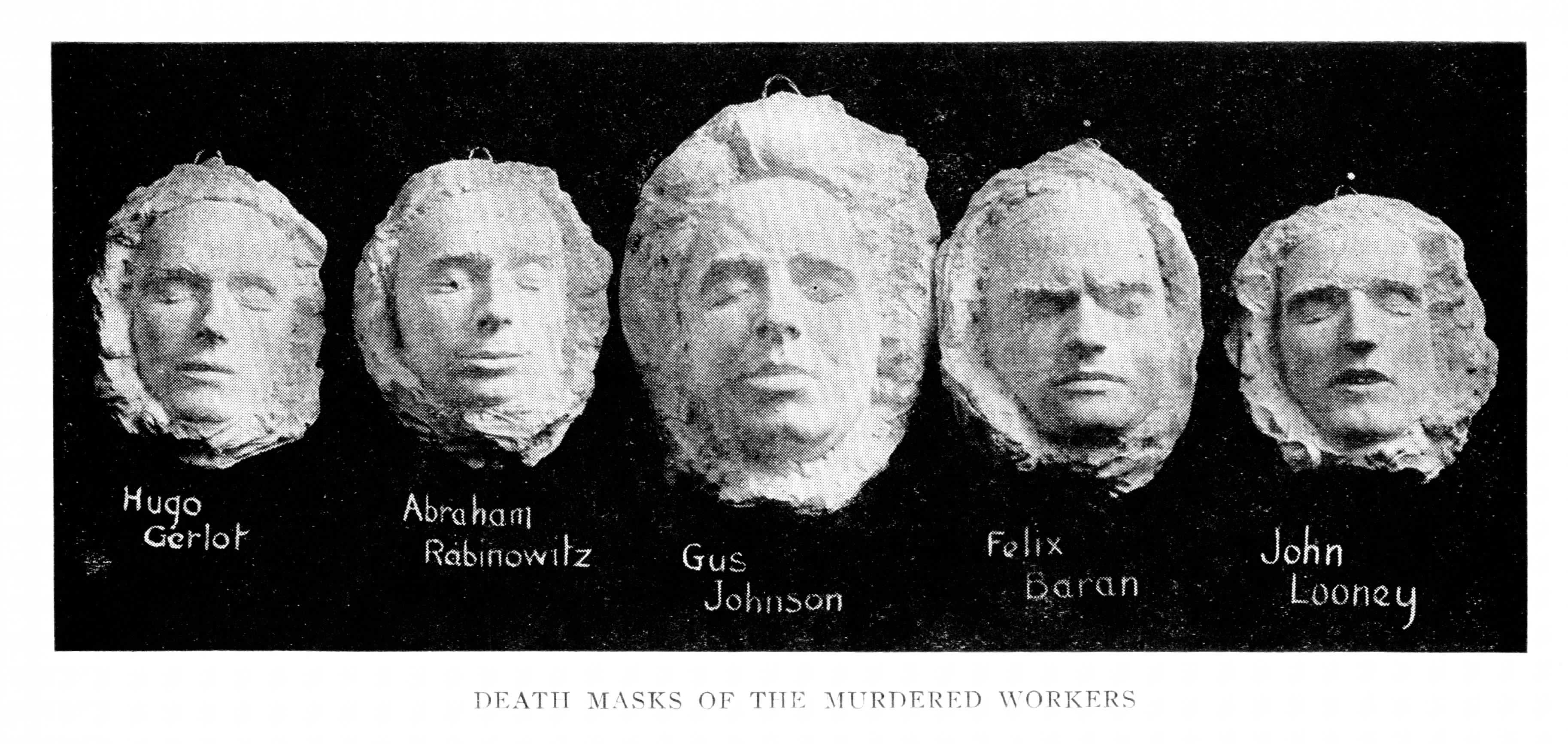
Then one week later occurred the murder of at least five members of the I.W.W. on the Verona, the wounding of over thirty others, making cripples of many of them for life, and the likelihood that some others were drowned and never found. The arrest of all who were on the boat was also a result of the plot of the Commercial Club, and all manner of charges were placed against them, from lawful assemblage to actual murder.
After the arrests were made in November Sheriff McRae had them under his charge for two months, and during that time all were treated to many petty persecutions; and seventy-four were held in a space that was too small for twenty-five. Since early January the conditions have been slightly improved, but the crowded condition was not relieved till a few days ago when twenty of the men were taken to Seattle to await the trials.
During the past four months there has been every means possible used to vilify the I.W.W. and make a fair trial impossible. The vicious lies of the capitalist press have been used here as elsewhere, but in addition the state legislature has been pressed into service to do the scavenger work of the Weyerhauser-Clough-Hartley-gang.
Class Legislation.
During the past month or six weeks there have been introduced in the state legislature the following bills:
The bill to restore capital punishment to the statute books; the bill to restrict the sale and manufacture of phosphorous; the bill to “define the crime of syndicalism.” and punish the advocacy of sabotage: the bill to have a thirteenth juror sworn in all cases where the judge considers it necessary, and have him sit with the regular jury to take the place of any one who becomes sick, but to have no part in the verdict otherwise: the bill to limit free speech and free press; the bill to make all high schools a part of the military training schools of the state, and several others that are frankly stated to be for the purpose of cutting down the rights of the people as a whole, and of the wage workers in particular. Most of these bills have passed one house or the other, and some of them have passed both.
There are small chances of these bills ever affecting the growth of the I.W.W., but all were introduced and exploited to their full extent for the purpose of influencing the opinion of any one who might be called to serve on the jury in the coming trials. That it will serve its purpose is a possibility, but it is also taking much work to fight such a campaign of slander.
Another sentiment that we are fighting here, and a very dangerous one at that, is the sentiment of over-confidence in what the result of the trials must be. The men here who know the situation know that the men charged with murder are absolutely innocent: and, knowing that fact, they feel that any jury must bring in a verdict of acquittal. But innocence will not save a worker in a master’s court. Money is all powerful, and what it will not do in the purchase of witnesses, judges and juries is not worth considering.
Money bought the guns and ammunition with which our fellow workers were killed, and it was the incentive that animated the men who used those guns. And it is money that is the incentive of Malcolm MacLaren and Arthur L.. Vietch, who sent the McNamaras to the penitentiary, and is how bringing those two scab-herding bloodhounds to Everett. The Lumber Trust and the Pacific Shipping interests have unlimited money, and any one who would murder for money can have all he asks for out of their hoards.
The Stand for Freedom.
Another point that we should take into consideration when we realize that we are fighting the men who dominate industry on the Pacific Coast is this very important fact: There has been no important labor case won on the Pacific Coast in the past ten years. Like a breath from hell, the wave of oppression has rolled up the coast from Lower California to Everett, and we are now making a stand to drive it back to gain for ourselves a measure of freedom.
Six years ago the peons of Lower California tried to throw the Otis yoke of slavery from their necks, and thousands of them were killed and the rest driven back to their tasks. Then came the McNamaras’ trials to a disastrous finish. Men in San Diego served time in the jails and penitentiaries for daring to say they had a right to free speech. Joe Hill was murdered in Utah. Ford and Suhr are in Folsom penitentiary for life. Billings and Mooney are convicted in San Francisco. The above are but a few of the more notable cases. The Socialist party has gone back, and the A.F. of L. has been hard hit at every turn. The I.W.W. is now the center of attack because it has been growing in the past year and has been a truly militant Jabor organization, and is getting the goods in some respects.
Against the I.W.W.
It is to keep the I.W.W. from gaining any more headway that it is hoped–and confidently expected–by the bosses that the coming trials will result in unlimited convictions. And such will certainly be the case if we do not put forth our utmost endeavors.
We here are doing our best to make one labor victory on the Pacific Coast, and we feel that we are justified in asking every worker in the world to help us by seeing to it that the bosses everywhere make constantly less and less profit until our fighters are freed. Are you with us?
The most widely read of I.W.W. newspapers, Solidarity was published by the Industrial Workers of the World from 1909 until 1917. First produced in New Castle, Pennsylvania, and born during the McKees Rocks strike, Solidarity later moved to Cleveland, Ohio until 1917 then spent its last months in Chicago. With a circulation of around 12,000 and a readership many times that, Solidarity was instrumental in defining the Wobbly world-view at the height of their influence in the working class. It was edited over its life by A.M. Stirton, H.A. Goff, Ben H. Williams, Ralph Chaplin who also provided much of the paper’s color, and others. Like nearly all the left press it fell victim to federal repression in 1917.
PDF of full issue: https://www.marxists.org/history/usa/pubs/solidarity-iww/1917/v8-w375-mar-17-1917-solidarity.pdf
 Revolution's Newsstand